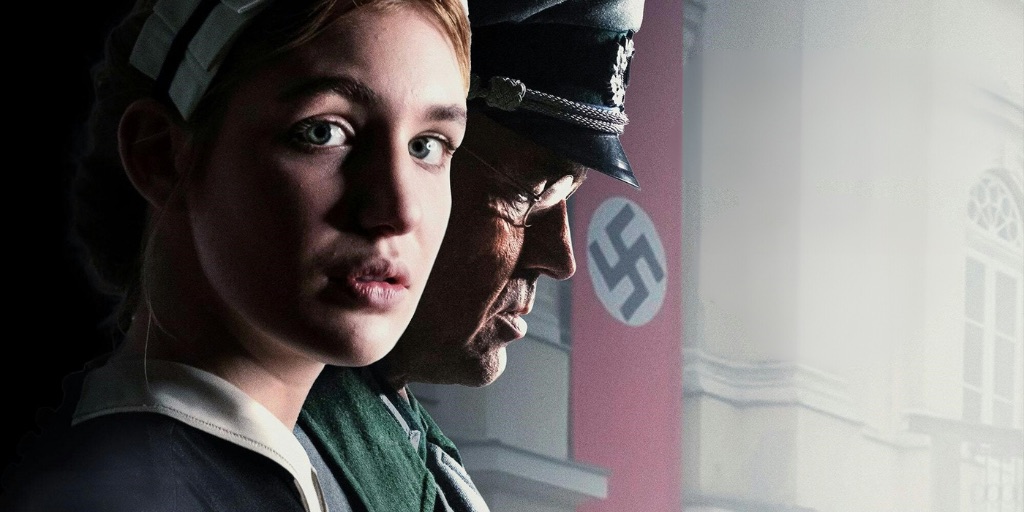
Sophie Nélisse gives what should be a breakout lead performance in “Irena’s Vow”, the new World War II drama from director Louise Archambault. The film is written by Dan Gordon who is adapting his own stage play of the same name. It tells the incredible true story of Irena Gut Opdyke, a young nurse whose heroism in the face of great danger ended up saving twelve Jews from extermination at the hands of the Nazis.
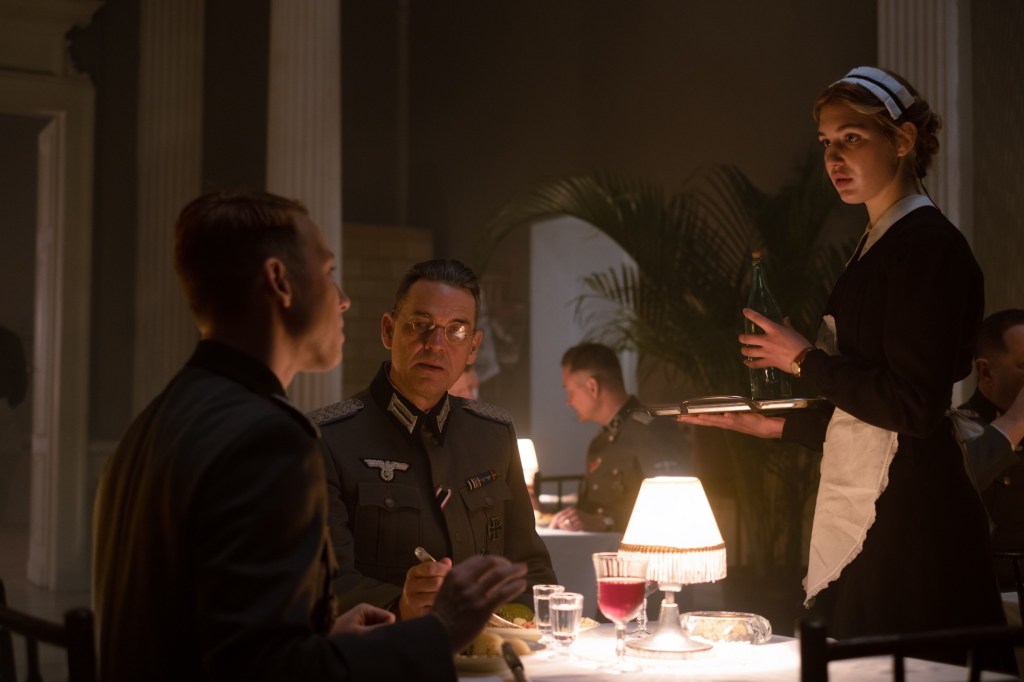
The film takes place in Poland during 1939 as the Nazi occupation of the country was intensifying. 19-year-old Irena Gut (Nélisse) was serving as a nurse in a Polish hospital when she and several others were rounded up by Nazi soldiers and sent to work in an ammunitions factory. Her hard work and distinctly German features earns the favor of an esteemed Nazi officer, Major Edward Rugmer (Dougray Scott). He assigns her to the kitchen staff at a Nazi officer’s headquarters.
Image Courtesy of Quiver Distribution
In the kitchen Irena works under a stately former innkeeper named Schultz (Andrzej Seweryn) who sees his daughter in his new worker. Schultz immediately gives Irena advice on how to survive in her new circumstances. He then informs her that her job will also include being in charge of twelve Jewish tailors who work in the laundry. The compassionate and sympathetic Irena quickly earns the trust of the workers and she develops a close affection for them.
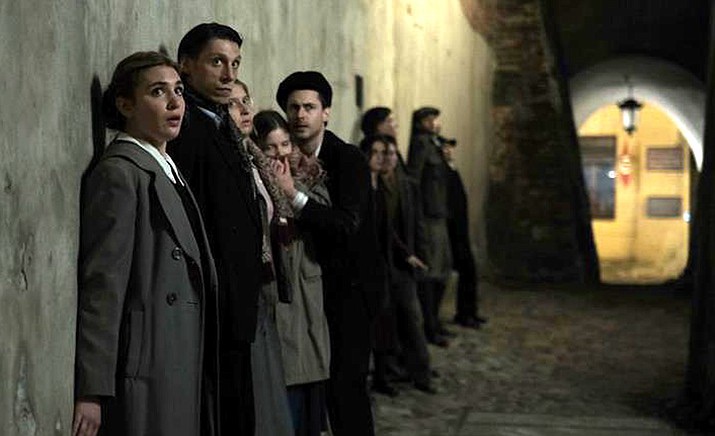
Irena’s perspective is forever changed after she witnesses an act of unspeakable savagery at the hands of an ambitious Nazi officer named Rakita (Maciej Nawrocki). Though helpless in that moment, Irena pledges to do everything she can to save as many lives as she can. And it starts with her twelve Jewish friends. After Major Rugmer promotes her to be his personal housekeeper, Irena devises a desperate plan to hide the twelve Jews from the intensifying Nazi aggression. And she picks a place where no one would think to look – in the rural villa of a high-ranking Nazi officer.
Image Courtesy of Quiver Distribution
It truly is a remarkable story and one that would almost defy believability if it hadn’t really happened. At the same time “Irena’s Vow” doesn’t feel especially unique when compared with other Holocaust movies of its kind. Still, Archambault creates some good tension and builds a suitable amount of suspense. And the performances are all-around terrific starting with Nélisse who is savvy beyond her years and really earns our emotional investment. Scott brings a surprising nuance to Rugmer while Nawrocki’s boyish good looks make Nawrocki’s cold brutality all the more sinister.
It’s hard not to moved by “Irena’s Vow” and the remarkable true story of courage and sacrifice it tells. Louise Archambault’s direction is assured and focused while Sophie Nélisse, though not a newcomer, is an actress to keep your eye on. Here she offers a compelling portrayal of Irena Gut Opdyke, showing her to be smart, resourceful, and a quick thinker with an ability to adapt on the fly. She’s the epitome of a hero, and it’s so good that filmmaker’s are still using their time and talents to share inspiring and illuminating true accounts like her’s.
Filmmaker Alex Garland has provoked a wide range of responses with his latest film “Civil War”. In partnership with A24, Garland’s dystopian war film has prompted some to say he goes too far while others say he doesn’t go far enough. Some have called him irresponsible for releasing such a film at such a precarious time while others have proclaimed this as exactly the kind of movie we need right now. Some believe it will open eyes yet others say it will only further divide.
As with most opinions colored (at least in part) by personal politics, it’s hard to gauge the truth in some of the reactions that are out there. So as is often the case, it’s best to go to the movie itself and make up your own mind. In doing so, I found that “Civil War” falls somewhere in the middle which is sure to frustrate the two unforgiving extremes. The movie’s politics are vague enough so that all sides might listen, pay attention, and perhaps consider the path our country is on.
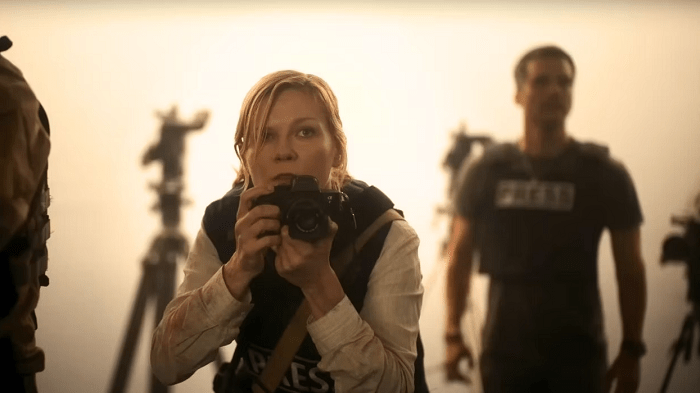
But at times even that feels deeper than writer-director Garland wants to go. Through much of “Civil War” he seems more interested in examining the heroism yet murky ethics of wartime journalists. And I’m guessing that has fueled many of the frustrations. After all, if you’re opening up such potent ideas during what many perceive to be a tinderbox era of American history, wouldn’t you take some kind of position? I’m sure Garland has his beliefs, but he’s more interested in ours. He trusts that we’ll use those beliefs to define things for ourselves. He’s merely showing us the potential consequences and issuing a warning that every side should heed.
Image Courtesy of A24
The story takes place in a dystopian near future where the United States isn’t so united. The current President (played by Nick Offerman) is a dictator who’s currently serving his third term. He has seen America fracture under his watch with a number of militant groups forming across the country. The most powerful of the rebel factions are the Western Forces – a coalition formed between California and Texas. The escalating tensions between the President’s regime and the WF eventually ignites a second Civil War.
An intensely captivating Kirsten Dunst stars as Lee Miller, a renowned war photographer who has grown cold and callous from the countless conflicts she has covered. This comes through clearly in the film’s opening scene where she and her colleague Joel (Wagner Moura) are shooting a riot in New York City. After a suicide bomber detonates herself in a huge crowd of people, Lee’s first impulse is to take pictures rather than check for survivors. She does manage to save the life of a young aspiring war photographer and fangirl named Jessie (a terrific Cailee Spaeny).
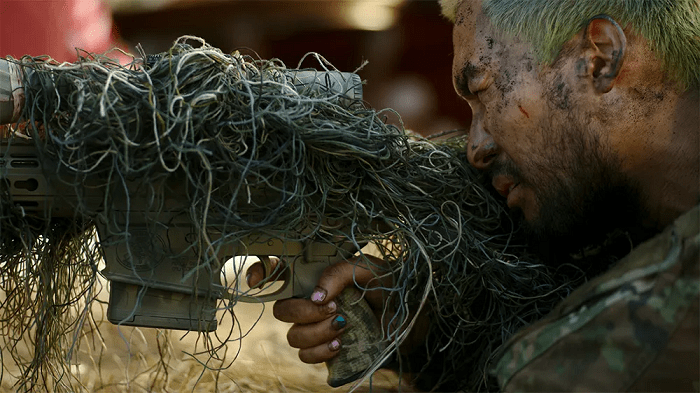
With Joel scheduled for an extremely rare one-on-one interview with the President, he and Lee prepare to set out to Washington DC. Lee agrees to let veteran journalist and mentor Sammy (Stephen McKinley Henderson) hitch a ride against Joel’s wishes and Joel agrees to let Jessie tag along against Lee’s. The four take off on a perilous road trip, avoiding the war-ravaged bigger cities for the unknowns of the lawless rural areas which prove to be far more dangerous than the group were prepared for.
Image Courtesy of A24
Along the way Garland hits us with some truly disquieting imagery. Teaming again with cinematographer Rob Hardy, Garland paints a disturbingly vivid portrait of a collapsed American society. The visuals are searing, brutal, and necessarily uncomfortable. At the same time, Garland’s simmering pacing maintains a steady feeling of unease. Regardless of where they stop, there’s never a sense that his four protagonists are out of danger.
It all culminates in a fierce and stunningly shot warfare sequence that brings everything we’ve seen to a violent and unsettling finish. It’s an ending that could be called grossly irresponsible IF there was ever a sense that Garland was conveying a sense of triumph. Instead the final shots leave you with the sickening feeling that things are only going to get worse. If it doesn’t, there’s a good chance you’ve missed the real genius behind Garland’s film.
Calling “Civil War” apolitical (as some have done) is a bit of a stretch. In fact it’s pretty obvious where Garland takes some of his cues. But he doesn’t get bogged down in the polarizing whys. He knows we will bring those to the table ourselves. Rather he wants us to think about the possible consequences of today’s contempt-driven division and consider our roles in it. And he examines it all through the lenses of war photographers, a sadly essential profession that can often miss the humanity for that one perfect shot. “Civil War” is in theaters now.
Robert Altman’s New Hollywood neo-noir “The Long Goodbye” has all the markings of old school film noir – a private eye, a femme fatale, a twisty crime-driven story, seedy characters, and so on. But Altman’s film is just as much a stiff jab at classic noir, a revisionist incarnation, and at times a borderline mockery. And what better way to poke fun at a “genre” (and annoy its fans) than by using one of its most renowned characters as your centerpiece.
As I’ve written before, I love film noir. And while they don’t come around very often these days, I’ll be first in line every time one does. But I also like Altman’s unique and fascinating spin. It’s entertaining from start to finish and it features many of the characteristics I look for and love in a film noir. But Altman and screenwriter Leigh Brackett (who was the co-writer of the 1946 Humphrey Bogart noir classic “The Big Sleep”) take several of those very same characteristics and turn them on their heads. The results are pretty great.
Image Courtesy of United Artists
It starts with the lead character, noir stalwart Philip Marlowe, this time played by Elliott Gould. What better way to prod the “genre” than through one of its most well known protagonists? Altman’s Marlowe isn’t nearly as sharp. He routinely seems one step behind. He’s even a bit of a sap. And he often comes across as a man out of time (a 1940s gumshoe in 1970s Hollywood). It seeps out in everything from his chain-smoking (no one else smokes) to the 1948 Lincoln Continental Cabriolet he drives around town.
Rather than the first-person narration that often accompanies film noirs, here the haggard Marlowe constantly mumbles to himself. It’s mostly early on (Altman seems to forget about it in the second half) and the bits we’re able to make out can be pretty funny. He lives in a top floor L.A. apartment where he keeps to himself outside of his occasional exchanges with the free-spirited hippie girls next door. And there is his picky-eating cat (there’s a great early scene where Marlowe goes to the supermarket at 3AM to get cat food – terrifically written, shot, and edited).
One evening Marlowe’s drab routine is shaken when he’s paid a visit by his good friend Terry Lennox (played by baseball player Jim Bouton). Terry needs help getting out of town so he asks Marlowe for a ride across the Southern border to Tijuana. It’s suspicious but Marlowe doesn’t ask any questions. When he gets back Marlowe is visited by LAPD detectives who take him in for questioning. We learn they’re looking for Terry and are prepared to charge him with the murder of his wife, Sylvia. Marlowe doesn’t cooperate and ends up spending three days in the county jail with little to no explanation.
After Marlowe is let out he pushes the cops for information. They tell him Terry was found dead in Mexico of an apparent suicide. Marlowe isn’t having any of it. “I don’t believe he killed her. I don’t believe he killed himself.” He wants answers, but first he’s approached by Eileen Wade (Nina van Pallandt) who happens to live in the same neighborhood as Terry and Sylvia. She wants Marlowe to find her alcoholic husband Roger (Sterling Hayden), a blustering giant who has been gone for a week. Marlowe agrees to help, but little does he know, his search for Roger ends up setting him on the path to find out the truth about Terry.
Image Courtesy of United Artists
As with any good noir – even one more focused on bucking trends than following them – we get an array of mysterious characters. In addition to Pallandt’s Eileen and Hayden’s Roger, we get a really good Mark Rydell playing a dangerous gangster named Marty Augustine. Henry Gibson pops up playing a bizarro Dr. Verringer. There’s even a young Arnold Schwarzenegger making a fun uncredited appearance.
The supporting work is good throughout, but it all comes down to the wisecracking Gould – messy and unkept, with a cigarette loosely dangling from the corner of his mouth. He’s the special sauce that makes the whole thing work and a perfect fit for the kind of movie Altman is shooting for. Throw in the jazzy score from none other than John Williams and Vilmos Zsigmondy’s well-calibrated cinematography and you have an immensely entertaining noir that gleefully goes against the grain.
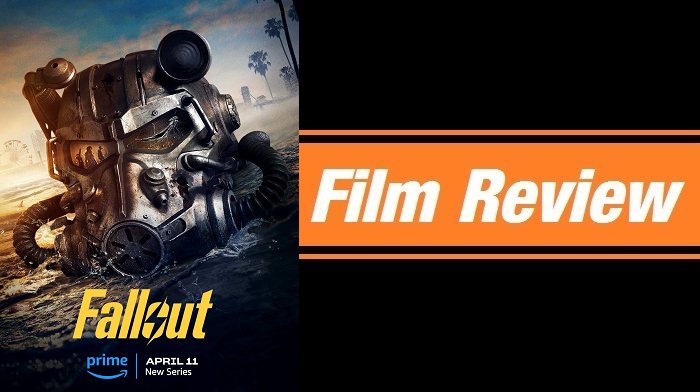
I’ve always felt that Fallout, the long-running and beloved video game franchise now helmed by Bethesda Game Studios, would make for great live-action entertainment. Its retrofuturistic style, dark underlying themes, sardonic humor, and gleefully gory action seemed custom-made for the big or small screen treatment. But knowing the history of video game adaptations all too well, and knowing the creative energy and studio backing needed to do it right, the notion of a live-action Fallout project didn’t seem realistic.
Boy it’s nice to be wrong. Not only have we gotten an actual Fallout series, we’ve been gifted one of the better (if not the best) video game adaptations to date. Yes I know that may be a low bar. But “Fallout”, from show creators Jonathan Nolan and Lisa Joy, is an absolute knockout – a brilliantly crafted cocktail of postapocalyptic mayhem laced with humor that ranges from cynical to outrageous. Better yet, the show nails that tricky balance of entertaining newcomers while satisfying the most passionate of fans.
“Fallout” plays out over eight one-hour-ish long episodes, all released together and available now on Prime Video. Through them we follow the interconnected stories of three (I would argue four) key characters as they navigate the complexity and chaos of the show’s wonderfully realized world. Fans will have a blast spotting the endless nods to the franchise and admiring the game-perfect detail in nearly every frame. And they (along with everyone else) will also enjoy the offbeat tone, the jolts of violence, and the exquisitely layered storytelling.
Image Courtesy of Amazon MGM Studios
The setting goes something like this. In the post-war 1950s a global nuclear war ravaged our planet. Those with the financial means were able to secure spots in underground structures known as vaults. There they stayed protected from the devastation with the intent of preserving the best of humanity until the irradiated surface was fit for repopulation. But while generations of vault dwellers naively lived in safety below, outside a dangerous, violent, and savage new ‘society’ was forming.
The first few episodes do a great job opening up the world while introducing us to three key characters – a vault dweller named Lucy (Ella Purnell), a bounty-hunting ghoul (Walton Goggins), and an ambitious young squire in a militarized organization known as the Brotherhood of Steel (Aaron Moten). We meet the three survivors 219 years after the first nukes dropped, each navigating their own unique storylines which inevitably intersect over time.
The sprightly Lucy and her neurotic brother Norm (Moisés Arias) reside inside Vault 33, a pseudo utopia sealed off from the perilous outside world. Her father Hank (Kyle MacLachlan) is the overseer of Vault 33 whose blue-suited denizens live in a sheltered state of bliss. Lucy is set for an arranged marriage with a dweller from the neighboring Vault 32. But her wedding and subsequent honeymoon turns into a nightmare after the visitors from Vault 32 turn out to be Raiders led by Lee Moldaver (Sarita Choudhury), a mysterious woman who kidnaps Lucy’s father. Defying Vault regulations, the determined yet unprepared Lucy ventures to the surface to find her father and bring him home.
Image Courtesy of Amazon MGM Studios
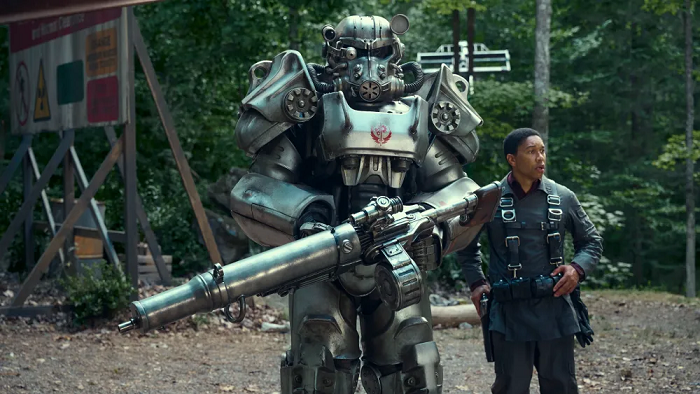
Elsewhere the quiet yet embittered Maximus (Moten) has joined the Brotherhood of Steel, a paramilitary organization devoted to the collection and preservation of technology across post-war America. Through some rather spurious circumstances Maximus is promoted to the rank of Squire and is tasked with accompanying a Knight named Titus (Michael Rapaport) as he tracks down a scientist in possession of some invaluable world-changing tech.
Meanwhile a once famous Hollywood movie star named Cooper Howard (Goggins) has been transformed into a cold-blooded gun-slinging ghoul after being exposed to intense amounts of surface radiation. Now he roams the lawless wasteland as a bounty hunter, complete with a well-worn Stetson, a tattered duster, and Goggins’ signature cowboy drawl. He too is after the scientist in hopes of collecting a big reward. But soon we discover that his manhunt is driven by more than a bounty.
While these three are clearly the main players in the series, there’s also a compelling mystery that uncoils inside Vault 33 as a suspicious Norm unearths secrets about Vault 32 and the even more mystifying Vault 31. It’s yet another piece in what is one big elaborate puzzle. The sheer ability to manage of all of these moving pieces is impressive in itself. But doing so with such artistry and control is astonishing. There are a couple of holes that I haven’t been able to fill, but for the most part the stellar team of writers and directors deliver an absorbing buildup and a satisfying payoff.
Image Courtesy of Amazon MGM Studios
Equally vital to the show’s success is the fantastic array of performances. A rich and talented supporting cast help bring the crazy and multifaceted world to life. Dale Dickey, Michael Cristofer, Michael Emerson, and Leslie Uggams are just some of that great faces to show up. But it’s Purnell who is the show’s heart and soul. She immerses us in Lucy’s journey from wide-eyed and gullible to plucky and hardened. And then there’s the beguiling Goggins who astonishes either as the disfigured wastelander or in flashbacks to his Hollywood days prior to the war. He’s an absolute scene-stealer.
The biggest challenge in adapting this particular franchise is in capturing its distinct tone. Thankfully “Fallout” nails it. What we get is twisted, brutal, and even terrifying on occasions. But it’s also outlandish, satirical, and often times laugh-out-loud hilarious. There’s an undeniable bleakness to it all yet it’s surprisingly hopeful in its own absurd way. What’s amazing is that none of these things feel at odds. They all fit firmly together in the world we watch unfold.
“Fallout” can be needlessly crude and a little gratuitous. But I loved watching textured characters grow as they maneuver through the moral haze of a collapsed society. I adored the razor-sharp wit and fabulous 1950s era soundtrack. I ate up the innumerable callbacks and references which is catnip for a franchise fan like me. This show was clearly made by people with a deep admiration for the Fallout video games. It was also made by people who clearly love imaginative worlds, immersive storytelling, and richly developed characters. Sign me up for Season 2.
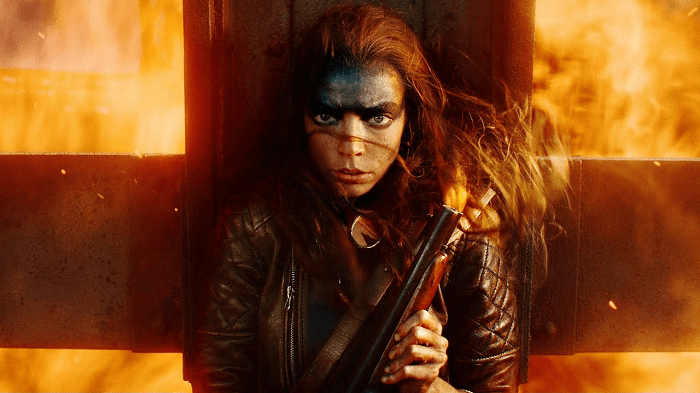
One of the most eagerly anticipated action movies of the year is only a few weeks away. George Miller returns to the post-apocalyptic wasteland with “Furiosa”, the fifth installment in his beloved Mad Max franchise. “Furiosa” serves both as a spin-off and prequel to Miller’s extraordinary “Mad Max: Fury Road” from 2015. The trailers have been brilliant and now Warner Brothers has dropped a killer new poster to entice us even more. Check it out and tell me what you think.
DIRECTOR – George Miller
WRITER – George Miller, Nico Lathouris
STARRING – Anya Taylor-Joy, Chris Hemsworth, Angus Sampson, Nathan Jones, Tom Burke, Lachy Hulme, John Howard, Charlee Fraser, Daniel Webber
Todd Phillips’ 2019 “Joker” turned out to be a blockbuster smash, making over $1 billion at the global box office and earning Joaquin Phoenix an Academy Award for Best Actor. Gritty, violent, and rooted in realism, “Joker” took the legendary DC Comics villain in some dark yet captivating directions. To no surprise a sequel was eventually announced. But rather than offer your run-of-the-mill follow-up, Phillips and Phoenix return with “Joker: Folie à Deux”, a movie that has been described as a super-villain movie musical.
Phoenix reprises his role as Arthur Fleck (aka Joker) who was last seen attempting to break out of Gotham’s Arkham Asylum. Where this second installment goes from there is anyone’s guess. What we do know is that Lady Gaga takes on the role of Harley Quinn. The first trailer shows the two meeting in Arkham and eventually breaking out together. But what really has me curious is the use of music. It’s been said the movie will include a total of 15 musical numbers which both piques my interest and causes concern. The trailer does hint at how the music will be used. It has the potential to be utterly spellbinding or a major miscalculation. Either way, I’ll be there on opening night.
“Joker: Folie à Deux” dances into theaters on October 4th. Check out the trailer below and let me know if you’ll be seeing it or taking a pass.










 Keith & the Movies