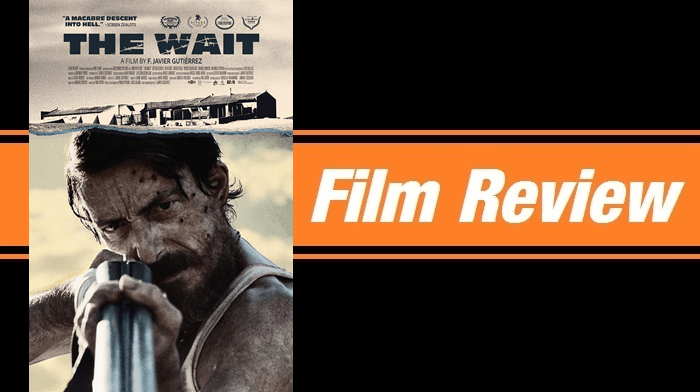
REVIEW: “The Wait” (2024)

Written and directed by F. Javier Gutierrez, “The Wait” (also known by its Spanish title (“La espera”) is a transfixing fusion of folk horror and Greek tragedy. It’s laced with elements from classic Westerns and dark fantasy. At times it resembles an absorbing morality tale and at other times a gritty revenge thriller. What’s impressive is how seamlessly its pieces fit together. And all because of Gutierrez’s meticulous craftsmanship and laser focus.

Set in 1970, the story follows a family man named Eladio (Victor Clavijo) who moves his wife Marcia (Ruth Diaz) and 10-year-old son Floren (Moisés Ruiz) to the parched Andalusian countryside after taking a job tending a hunting estate owned by the wealthy and powerful Don Francisco (Pedro Casablanc). Three years pass and Eladio begins preparing Floren to take on more responsibilities around the place. But things aren’t as agreeable with the disillusioned Marcia who misses her life in the city.

One day Eladio is approached by a local named Don Carlos (Manuel Morőn) who organizes area hunts for his wealthy clientele. Don Carlos is in a pickle. He has overbooked an upcoming hunt and wants Eladio to add three additional hunting stands to the property, raising the total to thirteen. But that would go against Don Francisco’s strict orders. So Eladio turns down a generous bribe and sticks to his principles. But Don Carlos secretly pays Marcia a visit and tells her of his offer. She immediately begins pressuring her husband, even calling him a coward for not taking the money.

Against his better judgment, Eladio gives in to Marcia and accepts Don Carlos’ offer. From the very moment he does we know he’s going to regret it. Almost immediately a sense of dread creeps in, and after a tragic chain of events, Eladio loses the two things he holds dearest – his wife and son. It leaves him all alone on the property, overcome with sorrow, haunted by visions, and tormented by guilt.

Gutierrez pushes Eladio to the brink of madness and the stoic Clavijo captures his descent with startling clarity. His searing performance conveys volumes, mostly through expression and physicality rather than dialogue. The pride and confidence that once filled his eyes is replaced by a cold emptiness. Grief fuels his anguish, but it’s a fit of drunken rage and its ensuing violence that sends him careening over a psychological edge.

The movie’s wicked second half takes a near primal turn as Gutierrez leans heavily on his film’s folk horror element. It ventures into the macabre and surrealistic to the point that we often question what’s on screen. Are the things we see real or are they grim manifestations from a troubled mind? Thankfully Gutierrez never allows Eladio to fully lose his grasp of reality. He’s kept grounded by clues that point to a mystery he’s determined to solve. It’s a mystery that drives the movie to its allegorically rich and painfully potent ending.

“The Wait” is a movie that truly earns its title. It’s a slow-burn in the best of ways, patiently plowing its themes and examining its main character’s psyche. The rugged rural landscapes form a fittingly harsh backdrop while intense close-ups makes even the everyday minutia a means to immerse us in this unforgiving world. It all works together in harmony to make this dark and twisted genre-bender worth every second of our investment. “The Wait” is out now on VOD.

VERDICT – 4 STARS

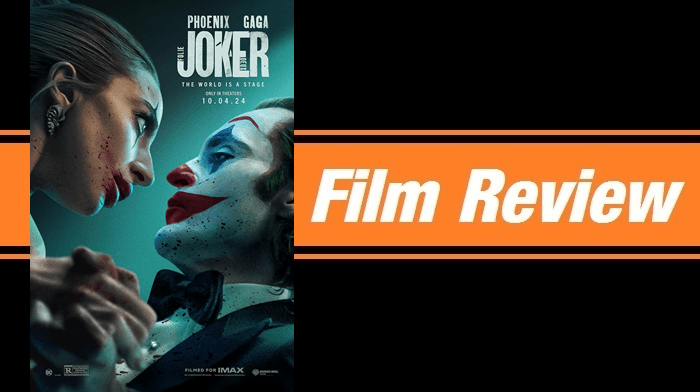
REVIEW: “Joker: Folie à Deux” (2024)

The road to the big screen has been interesting for “Joker: Folie à Deux”. The highly anticipated sequel to the 2019 box office juggernaut “Joker” puzzled many when it was first announced as a musical. Since then the studio has dialed back its emphasis on ‘Joker the Musical’ and has since promoted it in a more traditional manner. Yet fans of the first film (a group I’m happy to be a part of) remained a little hesitant and unsure of what to expect.

That kind of subversion of expectations can be a good thing, especially if your movie ultimately delivers. “Joker: Folie à Deux” delivers to a degree, but expect the reactions to be all over the map. Much like its predecessor, you can count on some being predisposed to disliking it. But it’s the diehard fans who will almost certainly end up split. That’s because “Folie à Deux” takes some wild creative risks, some of which pay off and others that frankly drag the movie down.

Todd Phillips returns to direct, produce, and co-write, this time with a budget that ballooned to nearly $200 million. Phillips reteams with several collaborators from the first film including his co-writer Scott Silver, his cinematographer Lawrence Sher, his editor Jeff Groth, and his Oscar-winning composer Hildur Guðnadóttir. But the most essential returning piece is Joaquin Phoenix, reprising the title role which earned him a Best Actor Oscar.

“Folie à Deux” (translated shared madness or madness for two) doesn’t play like a fully realized sequel. It’s more akin to an extended epilogue that follows the events from “Joker”. But the differences between the two films are significant and somewhat confounding. “Folie à Deux” splits its time between being a courtroom drama and a prison drama with Phillips injecting the dark edginess of the first film into both. But the movie eventually gets caught in a frustrating cycle that keeps bouncing us back-and-forth between the two without much happening in-between.

Image Courtesy of Warner Bros. Pictures

Phoenix is once again spellbinding as he follows the continued dark descent of Arthur Fleck, a part-time party clown and aspiring stand-up comedian who killed six people in the first film including a popular talk show host on live television. Arthur’s unhinged antics and vigilante Joker persona inspired a mob of disillusioned and (in some cases) equally deranged citizens to unleash a wave of violence and chaos across Gotham.

As he awaits his trial, Arthur remains locked up in Arkham State Hospital where he’s kept heavily medicated while swapping bad jokes for cigarettes with a semi-sympathetic guard named Jackie (Brendan Gleeson). Nothing much happens in these scenes other than a miserable Arthur trudging down cold drab hallways, escorted to and from to his cell, and occasionally let out in the prison yard. But he does find a spark of life after he meets and falls for a fellow inmate, Harleen “Lee” Quinzel (Lady Gaga).

With Arthur deemed competent to stand trial, his lawyer, Maryanne Stewart (Catherine Keener) gets busy preparing their case. She intends to argue that the Joker persona doesn’t represent the real Arthur. She contends that Joker is another personality – a manifestation brought on by years of abuse and neglect. Her claims that Arthur was an unwilling participant and a victim angers his many fans who see Joker as the catalyst for their twisted cause. It also frustrates Lee who encourages Arthur to embrace his true Joker self and take charge.

As with the Arkham drama, the courtroom scenes have a tough time gaining traction. In several ways they seem inspired by the trial of serial killer Ted Bundy. It’s a full-blown media circus. It’s being televised live. And like Bundy, Arthur gives into his Joker persona and decides to represent himself in court. It’s a scenario so full of potential but much of it is never fully realized. That’s because any dramatic momentum is routinely interrupted by trips back to Arkham or by an untimely musical number.

Image Courtesy of Warner Bros. Pictures

As for the musical numbers, they do play a big part in “Folie à Deux”. They represent an inspired and even bold approach to telling Arthur’s story. But their quality and execution are very much a mixed bag. On the positive side, they are designed as expressions of Arthur’s emotional turmoil and inner fantasies. The songs are a collection of covers, many rooted in Arthur’s past while others convey whatever feeling is overwhelming him in that moment.

Unfortunately the numbers grow burdensome over time. They become more intrusive than enlightening – taking screen time that could’ve been better spent developing a more involving story. The songs themselves aren’t likely to stick with you due to the calculated choice to sing them badly (as Phoenix confirmed to People magazine). Narratively it makes perfect sense. Neither Arthur or Lee are talented singers so why make them sound like Sinatra and Fitzgerald? But that doesn’t necessarily make for enjoyable listening, especially by the fifth of sixth tune.

Yet despite its frustrations and flaws, there’s something incredibly admirable about the movie’s audacity. In an era where we’ve been trained to expect very specific things from comic book movies, I love that Phillips and company have dared to make one that doesn’t abide by any established rules. Phoenix is once again intensely committed and hauntingly grim. And Gaga makes the most of her sparse screen time, taking an underdeveloped character and making her somewhat interesting.

At one point in the 2019’s “Joker”, Arthur says “I used to think my life was a tragedy, but now I realize it’s a comedy.” Those words are given a powerful new meaning in “Folie à Deux”, as are several other things from the first film. If only the two movies had more in common. Phillips puts aside the raw and incisive storytelling of “Joker” for something that’s more experimental but with less to say. And he tops it all off with a sour ending that may be fitting in some regards, but that feels like Phillips and Phoenix wiping their hands clean. I’m afraid that’s what “Joker” fans will want to do after seeing this ambitious but disappointing gamble. “Joker: Folie à Deux” is in theaters now.

VERDICT – 2.5 STARS

REVIEW: “White Bird” (2024)

The 2017 coming-of-age family film “Wonder” was a surprise hit both with critics and at the box office. It was based on a 2012 children’s novel of the same name by R. J. Palacio which spawned several other books including a 2019 graphic novel titled “White Bird: A Wonder Story”. Now it too has received the big screen treatment in a tender yet powerful new film directed by Marc Forster (“Monster’s Ball”, “Finding Neverland”, “A Man Called Otto”).

“White Bird” serves as a spin-off sequel that follows the character Julian Albans (Bryce Gheisar), the repentant bully from “Wonder”. The story (adapted by screenwriter Mark Bomback) sees 15-year-old Julian attending a new private school, Yates Academy following the events of the previous film. In an effort to fit in, he has adopted a passive approach, “Don’t be mean, don’t be nice. Be normal.”

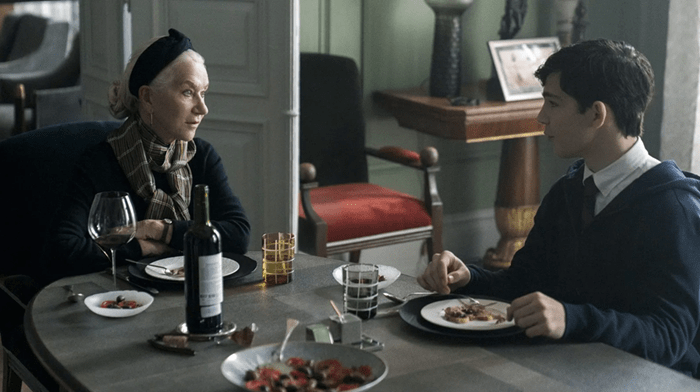
One day after school Julian arrives home to find his grandmother, Sara (Helen Mirren) visiting from Paris. She’s a renowned artist who is in town to be featured in a local museum’s retrospective highlighting her work. With Julian’s parents out for the evening, Sara sits down with her grandson to catch up. As she listens to him talk about his passivity, Sara is reminded of her own childhood which she has long chosen not to talk about. She makes the decision to tell Julian about her past in hopes of steering him away from a potentially regretful path.

Image Courtesy of Lionsgate

From there we are taken to a flashback which makes up the majority of the movie. It’s where we’re introduced to a young Sara, earnestly and sensitively played by Ariella Glaser. It’s August, 1942 and Sara seems to have a wonderful life. Her father (Ishai Golan) is a surgeon and her mother (Olivia Ross) is a mathematics professor. They’re a loving and close-knit Jewish family living in a cozy French village.

The starry-eyed Sara sees the world through a comfortable and naive lens. Her days are mostly spent indulging her love for clothes, drawing, and hanging out with her equally oblivious friends. She stays out of anything that man invade her comfort zone including turning a blind eye to a bullied classmate with polio named Julien (Orlando Schwerdt). In reality, Sara and her family live under the shadow of Nazi occupation. The Germans had already marched into Paris, but their presence in the villages has been minimal.

But that changes seemingly overnight. Her mother is promptly fired from the university and local stores begin denying service to Jews. But reality truly sets in when Sara’s school day is interrupted by Nazi soldiers sent to roundup Jewish students. After a harrowing escape attempt goes terribly wrong, Sara finds help from the most unexpected source.

Image Courtesy of Lionsgate

Julien discovers Sara hiding and sneaks her out of town to his family’s farmhouse. His parents, Vivienne (Gillian Anderson) and Jean Paul (Jo Stone-Fewings) hide her in their barn, out of sight of their nosey Nazi sympathizing neighbors. As days turn to weeks and weeks turn to months, Sara and Julien grow closer. Their budding relationship helps form the heart of the movie. But the threat of being discovered is always looming, adding a steady tension that is palpable yet never overplayed.

Throughout the film’s swift two hours, Forster maintains a good grip on his premise and subject matter. It’s a tricky task, but he finds the right balance between a poignant coming-of-age story and a serious-minded Holocaust drama. Much of his world is shown through the eyes of children yet he never trivializes or downplays the gravity of what’s happening. Nor does he use the heaviness of history to manipulate his audience. Instead, the emotions he brings out are authentic and earned.

“White Bird” navigates its solemn subjects with an open-hearted optimism, incisively exploring its themes of kindness, cruelty, forgiveness, and sacrifice. The film doesn’t say anything especially new, but it head-on confronts the cycles of hatred that have long plagued humanity. It leads to a powerful and forever relevant message that is enriched by top-to-bottom terrific performances and a director who never takes his finger off the human pulse. “White Bird” opens in theaters on October 4th.

VERDICT – 4 STARS
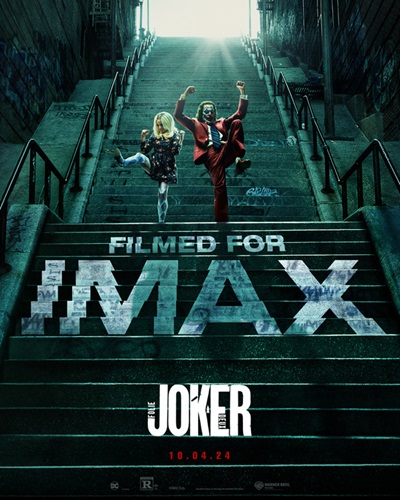
Movie Poster Spotlight – “Joker: Folie à Deux”

“Joker: Folie à Deux” is only a couple days away and it looks to be at least as polarizing as the first film. Director Todd Phillips reunites with star Joaquin Phoenix in this direct follow-up to the wildly successful first film. Lots of questions have been asked from people wondering what to expect. Wherever you are with the movie, the film’s promotion has been pretty great, especially the series of posters released over the past year.

Below are some of the best posters from Warner Bros. Pictures. Check them out and let me know what you think.

“Joker: Folie à Deux” premiered last month at the Venice International Film Festival. It opens everywhere Friday, October 4th exclusively in theaters.

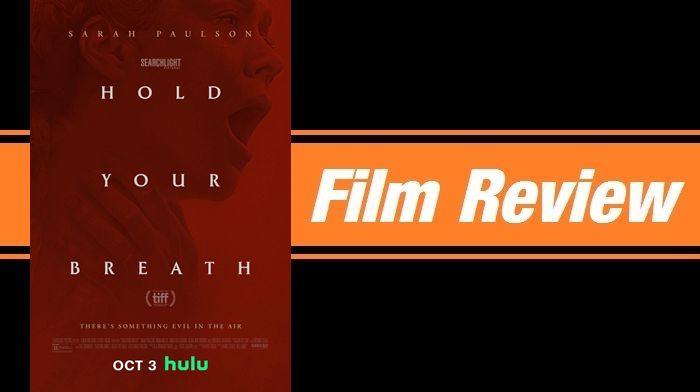
REVIEW: “Hold Your Breath” (2024)

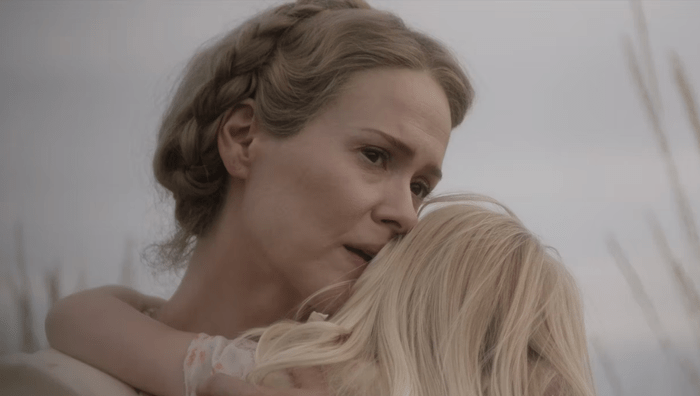
The directing duo of Karrie Crouse and Will Joines make impressive feature film debuts with “Hold Your Breath”, a psychological horror-thriller set during the devastating Dust Bowl of the 1930s. Anchored by a wrenching Sarah Paulson lead performance, “Hold Your Breath” combines devastating elements from American history with familiar genre tropes to form a well-made and thematically rich movie. It’s a little too ambitious, but I appreciate its big swings.

Set in 1933, Paulson plays Margaret, a mother with two daughters struggling to get by in the dust-ravaged Oklahoma panhandle. With their farmland decimated, Margaret’s husband Henry has been forced to take a far-away job in hopes of earning money to send back home. That leaves Margaret, her oldest daughter Rose (Amiah Miller), and her hearing-impaired youngest, Ollie (Alona Jane Robbins) to scrape by with one old cow, no crops, and no way to leave their situation.

Image Courtesy of Searchlight Pictures

Margaret loves her daughters and does everything in her power to protect and provide for them. She’s also seen as a stabilizing presence in their small rural community. But deep down she has issues of her own that torment her. She’s been haunted by the same reoccurring dream since losing their first child to Scarlet Fever. And as their circumstances get worse, Margaret begins to lose her grip on reality. Or is there something else at work – something malevolent and sinister.

That burning question drives much of “Hold Your Breath”. There’s a lot going on in the story (written by Crouse) narratively, thematically, and psychologically. There are constant threats – some real and others imagined. There are the howling dust storms, children getting sick, potential starvation, and even the sudden appearance of a mysterious preacher named Wallace (Ebon Moss-Bachrach) who claims to be a friend of Henry’s. It all leads to an intensifying sense paranoia that culminates in a harrowing and heart-rending final act.

A key strength of the film is found in its recreation of the Dust Bowl era. Crouse and Joines shot in several locations around New Mexico in order to capture the stark barren landscapes of 1933 Oklahoma. They’re just as attentive when it comes to conveying the punishing conditions. The dust storms are ferocious and you can almost taste the grit in your mouth and feel the wind-blown sand stinging your eyes.

Image Courtesy of Searchlight Pictures

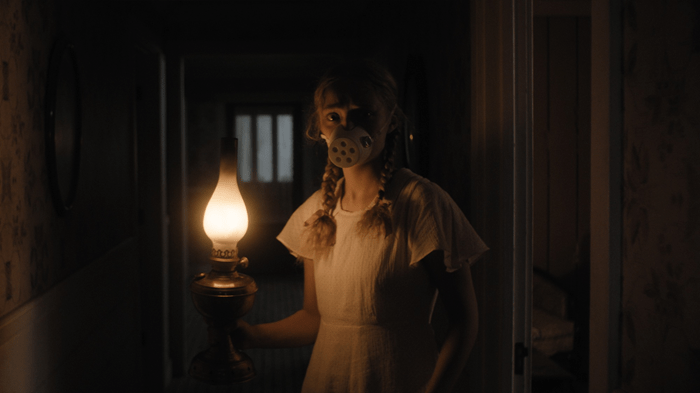
Then you have the film’s meticulous attention to details. It’s seen most in the terrific costume and production designs. But also in seemingly small things, such as Margaret using strips of fabric to seal their house from the sand. Or the masks they sometimes wear outside that are plucked directly from old archived photos. It all adds a heavy layer of realism to a movie than (especially in the second half) leans heavy on the psychological.

Thematically, “Hold Your Breath” has a lot it’s trying to say. Motherhood, grief, societal pressure, and isolation are just some of the topics that Crouse and Joines touch on. Some of them are more present than others but none are deeply explored – a side-effect of having too much on their minds. But the movie has some notably tense and unsettling moments, most seasoned by the eerie tones of composer Colin Stetson. And the committed performances from Paulson and Miller add a resonance that gives the movie its emotional kick. “Hold Your Breath” premieres October 3rd on Hulu.

VERDICT – 3.5 STARS

First Glance: “Juror #2”

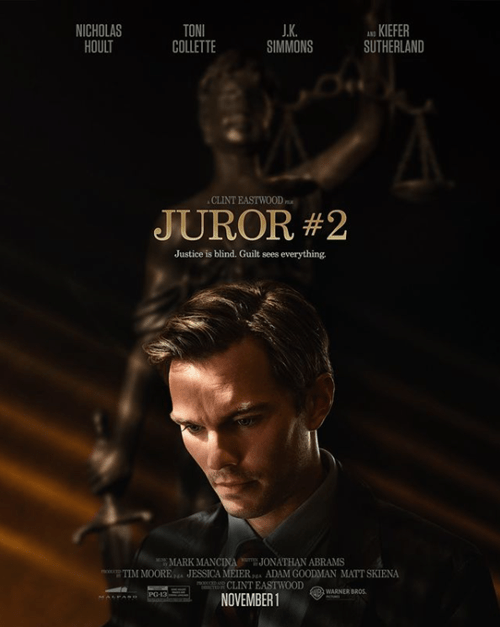
Motion picture icon Clint Eastwood returns with his highly anticipated thriller “Juror #2”. His incredible career has seen him star in countless big screen classics. But he’s also flourished behind the camera. “Juror #2” marks the 40th film directed by the 94-year-old legend. Written by Jonathan Abrams and featuring a terrific cast, Eastwood’s latest has the look of a potential awards season contender. It would be a fitting result for what is rumored to be the final film of his storied career.

The new trailer offers us a tantalizing taste of what we’re in for. The film stars Nicholas Hoult playing a family man caught in a fascinating moral dilemma. He’s been chosen as a juror for a high-profile murder trial but quickly discovers that he may have more of a connection to the case than he imagined. Toni Collette, J.K. Simmons, Zoey Deutch, Chris Messina, Kiefer Sutherland, Cedric Yarbrough, and Leslie Bibb round out the sterling cast in what has quickly turned into one of my most anticipated movies of the year.

“Juror #2” premieres at AFI Fest on October 27th and will open in select theaters on November 1st. Check out the trailer below and let me know if you’ll be seeing it or taking a pass.