REVIEW: “Affection” (2025)

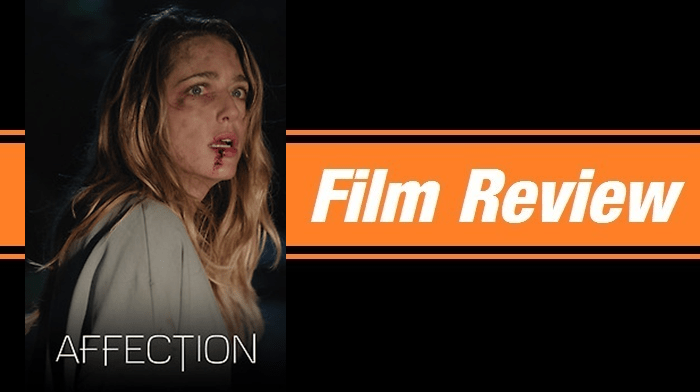
“Affection” opens with a startling shot of a car in the center of a rural road, its headlights illuminating the dark. The camera then cuts to a severely injured woman lying motionless on the pavement, bloodied and bruised, her eyes blankly staring as a small tear leaks across the bridge of her nose. Suddenly she gasps, has a violent convulsion, manages to stand, and then frantically walks away, only to be plowed over by a speeding car.

Writer-director BT Meza’s well-conceived and well-shot opening sequence does a good job piquing our interest. The woman is played by Jessica Rothe, a seriously underrated actress whose impressive range has shown from “La La Land” to “Happy Death Day”. The mysterious table-setting and a talented lead gets things started on the right foot. But over time, “Affection” loses its intrigue, not because of premise or performance. But due to its convoluted storytelling which leaves us with too many questions.

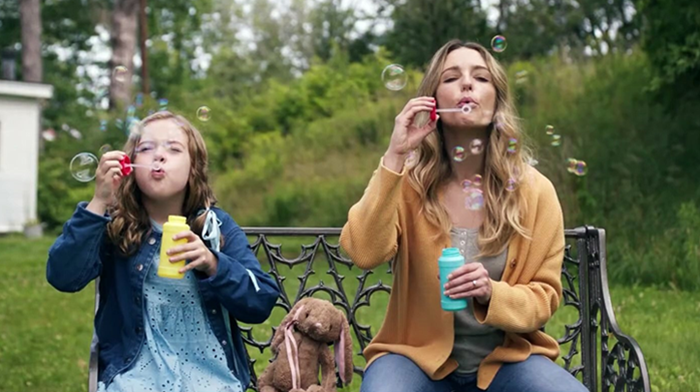
Rothe plays Ellie Carter…or does she? That’s a question at the center of “Affection”. Ellie wakes up after a terrible dream. She’s in bed next to a man she doesn’t know, in a house she doesn’t recognize, and with a young daughter she doesn’t remember. In what she believes is self-defense, Ellie attacks the man but stops when she sees the terrified expression from the little girl who calls her “Mommy”. A confused and distraught Ellie crumbles to the ground where she’s embraced by her family(?).

After things calm down, the unctuous man tells Ellie he is her husband, Bruce (Joseph Cross) and the little girl is their daughter, Alice (Julianna Layne). Bruce goes on to describe a horrible accident that left her severely injured. As a side-effect of her trauma, Ellie is suffering from petrifying memory resets – a condition where her mind takes pieces of information from her life and twists them into false memories. Their neuro specialists have prescribed isolation as a part of her recovery leading Bruce to buy a remote farmhouse with no phone, no internet, and no neighbors. There they hope to rebuild the connections to her real memories.

Rothe superbly navigates Ellie’s inner turmoil which alternates between perplexity, frustration, and despondency. Adding to her emotional conflict are vividly detailed memories of a much different past. A past where her name was Sarah Thompson and she had a different husband and a son. She had other parents, other friends, and another childhood. These invasive memories clash with the old pictures, home videos, and passionate testimonies of Bruce and Alice.

But around the 40 minute mark the story takes a sharp turn, revealing what we already know – that things are not as they seem. Unexplainable tremors, nightmarish visions, a strange wound near the base of her neck, and so on. It all points to a mid-movie twist that I don’t dare spoil even though it’s fairly simple to figure out. The problems are with the details. The general idea is easy enough to grasp. But the convolution comes in understanding how it all fits together. Again, I’m keeping it vague, but I found myself left with too many significant questions.

That’s not to say “Affection” doesn’t have its strengths. The three-person cast is more than proficient with Rothe carrying the bulk of the load on her capable shoulders. The movie takes some admirable big swings which opens the door for some delightfully grisly makeup and effects. And to the film’s credit, it makes a poignant and personal statement on grief and isolation – both themes pulled directly from Meza’s own life experience. Sadly, the movie’s second-half incoherence ends up seriously impacting the payoff. It’s unfortunate considering the many things the movie gets right.

VERDICT – 2.5 STARS

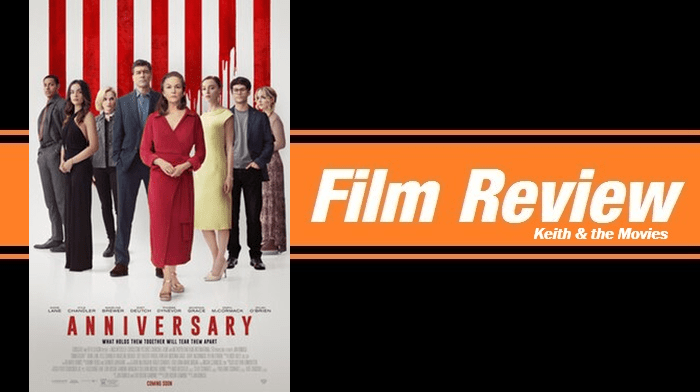
REVIEW: “Anniversary” (2025)

“Anniversary” travels a pretty crazy path. It begins as a domestic thriller before flirting with becoming a psychological thriller and ultimately ending as something resembling a dystopian thriller. It’s a movie filled to the brim with clever ideas, some of which sizzle with intrigue and tension while others have a hard time connecting to everything else we see. Ultimately, I love that “Anniversary” takes some wild swings, even if it doesn’t hit everything it swings at.

“Anniversary” comes from director Jan Komasa who’s working from a screenplay written by Lori Rosene-Gambino. The film sports a terrific ensemble that features Diane Lane, Kyle Chandler, Zoey Deutch, Phoebe Dynevor, Dylan O’Brien, McKenna Grace, Madeline Brewer, and Daryl McCormack. All play characters caught up in a whirlwind of family dysfunction. Some stems from buried issues from their pasts. But most come with the introduction of a new person into their lives.

Image Courtesy of Lionsgate

The movie opens with the Taylor family gathering to celebrate the 25th wedding anniversary of Ellen (Lane), a Georgetown University professor, and Paul (Chandler), a restaurant owner. Joining the honored couple are their children, Cynthia (Deutch), a stuffy environmental lawyer who brought her disillusioned husband Rob (McCormack), Anna (Brewer), a provocative stand-up comedian, Josh (O’Brien), a smarmy and angsty struggling writer, and their geeky science-loving youngest, Birdie (Grace).

But it’s an outsider brought into their fold who swiftly turns things upside down. Accompanying Josh is his new girlfriend Liz (Dynevor). Josh is smitten with Liz and from all indications she feels the same way about him. But Liz is nervous about meeting his family. We see why once Josh introduces her to his mother. It turns out Ellen and Liz have some bad history dating back to an incident at the University. The sheepish yet cryptic Liz says it’s all behind them while a skeptical and cautious Ellen believes it’s no coincidence that Liz has attached herself to her son.

This first segment sees Komasa planting several narrative seeds as he sets up this complicated family dynamic. From there he jumps ahead eight years, and then two years, and so on. At each stop on the timeline we revisit the Taylors and witness another phase of their deterioration. Ellen’s frustrations with Liz festers, Cynthia battles depression as her relationship with Rob sours. Anna has a violent encounter at one of her shows. And the observant Birdie quietly soaks it all in.

But what about Josh and Liz? The couple marry and soon have twins. Later, Liz writes a controversial book called “The Change” which becomes a cultural phenomenon. The radically political manifesto sells over 10 million copies, making Liz and Josh a wealthy and powerful couple. The success of Liz’s book not only tightens the tension within the Taylor household. It lays the groundwork for an authoritarian dystopia which ends up affecting the story in ways we never see coming.

Image Courtesy of Lionsgate

From the very start there’s no denying the movie’s mammoth ambition. It’s melding of domestic and sociopolitical chaos is bold, but it’s a bit too much for it to handle. Still, the steady screw-tightening creates the kind of ever-intensifying, anxiety-riddled drama that keeps you glued to every harsh word and hateful stare. Meanwhile Komasa opens up a wealth of themes which he examines with the subtlety of a sledgehammer. He doesn’t hide his provocative prodding or his blunt-force messaging which overall works for and against his film.

As the film zips from point to point, certain family troubles escalate too quickly and without much explanation. Others feel oddly disconnected from the bigger story. But Komasa steadily propels his story forward, leaving us with little time to dwell on the negatives. He also lets his cast go for the jugular leading to some savory performances. Lane gets one of her meatiest roles in years. Chandler is a stabilizing force. O’Brien exudes detestability. Dynevor is a mystery who never tips her hand. They are all crucial ingredients that make this enthralling, swing-for-the-fences effort work.

VERDICT – 3 STARS

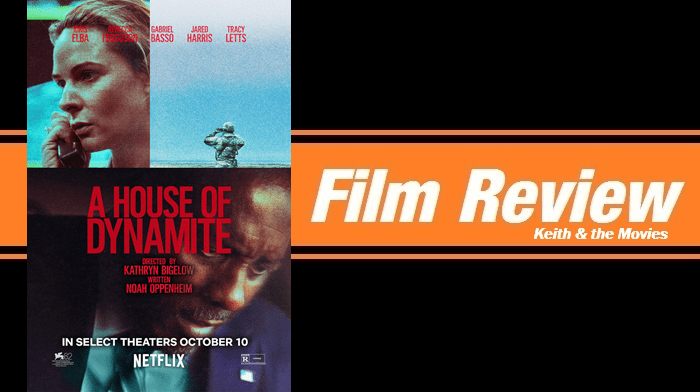
REVIEW: “A House of Dynamite” (2025)

Kathryn Bigelow’s highly anticipated and long awaited next movie has finally arrived via Netflix. It’s “A House of Dynamite” and it’s Bigelow’s first feature film since her 2017 historical crime drama “Detroit”. This is another audacious swing from the Oscar-winning director who delivers a harrowing ‘what-if’ nail-biter that’s infused with a sobering sense of urgency. It’s one of the best films of the year.

“A House of Dynamite” is a riveting thriller that can also serve as a pressing wake-up call to the ever-present danger of living in this new nuclear age. Written for the screen by Noah Oppenheim, the story plays like a hardcore military/political procedural laced with 1990s thriller vibes. But it’s Bigelow’s striking efficiency and razor-sharp precision that makes the movie’s engine hum. She maintains such control of the story’s many moving parts while keeping her audience firmly in her grip for the duration.

Bigelow is helped by a star-studded ensemble who fill out this three-pronged story. The narrative structure follows one significant event but tells it from three distinct yet interconnected perspectives. It begins at the 49th Missile Defense Battalion at Fort Greely, Alaska. Major Daniel Gonzalez (Anthony Ramos) and his unit pickup an unidentified ballistic missile in the air. At first they believe it’s a test. But by failing to detect the launch’s point of origin, they don’t know for sure.

Image Courtesy of Netflix

Fort Greely informs the White House situation room in Washington DC where Captain Olivia Walker (Rebecca Ferguson) and her team monitor potential threats to the country. Experts soon inform Walker that the missile is not a test and is only 19 minutes away from striking the continental United States. Multiple agencies spring into action, making efforts to intercept the missile while narrowing down its impact zone. As the clock counts down, fear and anxiety sets in.

We then hop back in time to when the missile was first detected but shift our focus to Offutt Air Force Base in Nebraska where General Anthony Brady (Tracy Letts) leads the US Strategic Command and Control. Brady’s team is able to determine the missile’s target to be Chicago and its 9.2 million people. With a nuclear attack seeming imminent, Brady pushes for the President to immediately consider a counter attack. But Deputy National Security Advisor Jake Baerington (Gabriel Basso) disagrees, insisting they get more information before thrusting the world into a nuclear war.

The movie transports us back once more, this time focusing on the President of the United States (played by an impressively grounded Idris Elba). We follow him as he gets word about the inbound missile and works under immense pressure to decide the best course of action. Does he follow Brady’s recommendation and counterattack before their window closes? Or does he listen to Baerington and wait, despite the dangers of doing so?

Image Courtesy of Netflix

The cast is full of other supporting players who have their own roles in the story. Jason Clarke plays the senior Situation Room officer and Walker’s boss. Greta Lee plays an intelligence agent with the NSA. Moses Ingram plays a FEMA official. Jared Harris plays the Secretary of Defense. Renée Elise Goldsberry plays the First Lady. Jonah Hauer-King plays the President’s retaliatory adviser. These are just some of the characters serving as key pieces in the story, who either provide vital information that moves the plot forward or add needed humanity to the chaos.

“A House of Dynamite” wastes no time lighting its fuse and it steadily burns right up to the film’s gutsy finish. It’s a near certainty that some viewers will be upset with where Bigelow pulls the plug. But I can’t imagine a more effective ending for the kind of impression she wants to leave. The palpable fear, the unnerving uncertainty, the sobering real-world relevance – it all hits like a hammer in the film’s final shots which Bigelow lands just as intended.

With “A House of Dynamite” Bigelow reminds us of how close we are to annihilation and how helpless we would be once those dominoes started to fall. At the same time, her film maintains its human pulse, never losing sight of the personal stakes for many of the people involved. The changes in viewpoints work surprisingly well within the ticking clock formula in large part thanks to Bigelow’s laser-focused execution. The urgency is emphasized in Barry Ackroyd’s documentary-style cinematography while the tone resonates through the ominous groan of Volker Bertelmann’s score. It all creates a tension-fueled movie that offers a prescient warning for our current day. “A House of Dynamite” premieres October 24th on Netflix.

VERDICT – 4.5 STARS

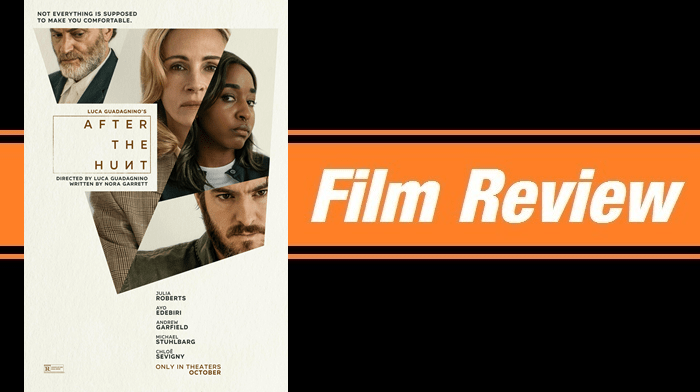
REVIEW: “After the Hunt” (2025)

Luca Guadagnino puts aside some of his usual preoccupations in his latest feature “After the Hunt”. Known for his provocative fixations on sensuality, desire, and obsession, the enigmatic filmmaker can often get hung up on his own interests to the detriment of his characters and storytelling. There are remnants of that in “After the Hunt”. But it mostly feels like an interesting departure for Guadagnino, although one not without its own self-induced problems.

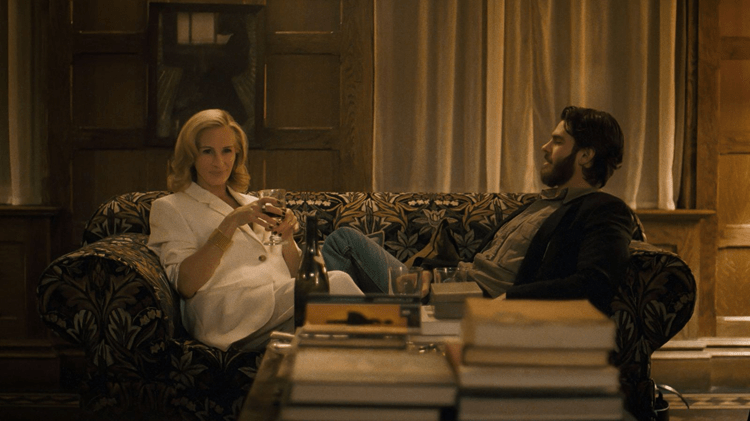
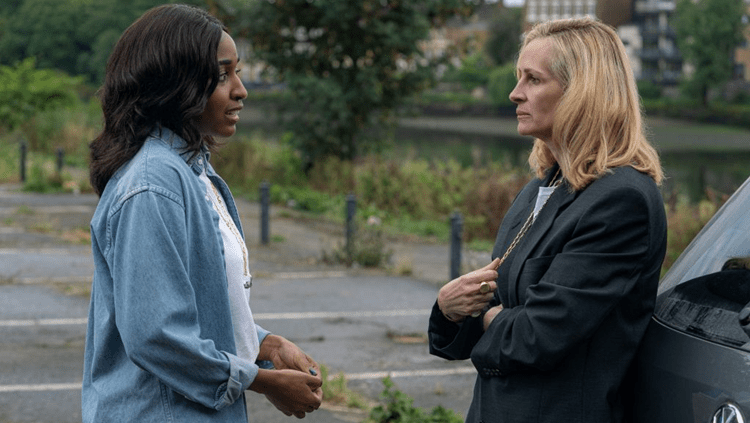
Guadagnino amasses a compelling ensemble led by Julia Roberts who’s given her most savory role in years. She plays Alma Imhoff, a highly regarded philosophy professor at Yale University. Alma is a complex woman of stature in the world of male-dominated academia. From one angle she’s an intimidating and impenetrable intellectual who relishes being the center of attention. From another angle she’s a troubled woman concealing her personal pain and bottling up anything resembling emotions.

Image Courtesy of Amazon MGM Studios

Alma’s tightly self-controlled world is shaken after her student and protégé Maggie Resnick (Ayo Edebiri) accuses Alma’s colleague and close friend Hank Gibson (Andrew Garfield) of sexual assault. The alleged transgression happened after a dinner party at Alma’s home. Hank admits to Alma that he walked Maggie home and even went up to her apartment for a nightcap. But he fiercely denies he assaulted Maggie.

There are dubious layers to Alma and Hank’s relationship that raises a number of questions. Professionally, both are pillars in the university’s philosophy department and they are the two finalists for the school’s lone tenure spot. Away from work they are uncomfortably close, to the point of kindling suspicions in Alma’s passive yet internally frustrated husband Frederik (played by a perfectly tuned Michael Stuhlbarg).

Alma’s relationship with Maggie proves to be equally complex but for much different reasons. She enjoys Maggie’s adoration and takes pride in being considered a mentor. But the two immediately clash over how to handle her accusations. Alma’s view is shaped by her own history, especially within the patriarchal construct. It causes her to be cold and unsympathetic, often thinking more about self-preservation and consequences than condemnation. Maggie shamelessly hides her real self behind various marginalized identities. In reality she’s dishonest, opportunistic and manipulative which quickly calls her credibility into question.

Guadagnino and screenwriter Nora Garrett make Alma their focus, following the character as she navigates the #MeToo minefield between the untrustworthy Maggie and the boozy flirt Hank. As they do, the filmmakers sling us into a thematic whirlwind of power dynamics, victimization, privilege, academia, support systems, culture shifts, and generational divides. Their storytelling strikes a peculiar balance between empathizing with Ivy League elites and excoriating them. But make no mistake, the film’s overall tenor ranges from morally murky to downright dastardly, with only a few measures of grace sprinkled in.

Image Courtesy of Amazon MGM Studios

Guadagnino and Garrett forsake ‘nice and tidy’ for something that challenges audiences willing to engage with the film on its own terms. There is an intentional ambiguity woven throughout the story that forces us to reckon with our own perceptions. Yet a later scene nearly undercuts that aim as Guadagnino seems to tip the scales in one direction. It’s a frustrating inclusion that obstructs the filmmaker’s intentions without fully derailing them.

“After the Hunt” is a technically savvy and narratively enthralling drama, anchored by awards-worthy performances from Roberts, Garfield, and Stuhlbarg, while offering a bold take on a sensitive subject that sparked a cultural flashpoint. The movie isn’t without flaws, such as a key plot point hinging on an absurd moment of pure happenstance. And an ending that leaves us questioning some things more than wrestling with them. Still Guadagnino impresses with his latest – an intelligent and guileful feature that’s both riveting and challenging.

VERDICT – 3.5 STARS

REVIEW: “Anemone” (2025)

Danial Day-Lewis makes his triumphal return to acting after an eight year retirement in “Anemone”, delivering what should be one of the most talked about performances of the year. It’s yet another richly complex character for Day-Lewis to dissect and explore, and he does so with the kind of intensity and precision that has marked the three-time Oscar winner’s career.

This isn’t just a case of Day-Lewis simply returning to a craft he loves. “Anemone” is a true passion project which he co-wrote with his son, Ronan Day-Lewis. Also, the younger Day-Lewis directs his father in what is the 27-year-old’s feature film debut. Their intimate connection beyond the camera finds its way onto the screen, adding a compelling perspective on fathers and sons and the ties that bind them.

“Anemone” is a dark family drama with a piercing psychological edge that delves into some heavy and uncomfortable subject matter including childhood trauma, PTSD, strained family bonds, isolation, and self-condemnation versus self-forgiveness. It’s a visually captivating film where the camera is as essential as the pen when it comes to storytelling. Narratively it’s a methodical slow-burn, patiently and quite brilliantly unwinding its characters and the conflicts that have defined them.

Image Courtesy of Focus Features

The elder Day-Lewis plays Ray Stoker, a damaged soul who has condemned himself to a life of isolation for reasons that painfully become clear as the story unfolds. Ray lives in a secluded one-room stone cabin, deep in the forest on a tiny patch of land that’s unreachable by vehicle. Ronan Day-Lewis and his DP, Ben Fordesman use the haunting beauty of nature to set the tone and to ground us in the setting. The churning clouds in the overcast skies. The thick forest canopy swaying in the heavy winds. The steady patter of rain on Ray’s tin roof. It’s a stunning bit of visual table-setting.

One afternoon Ray’s self-imposed disconnection from society is interrupted by an unannounced visit from his brother, Jem (Sean Bean). The tension between the two is obvious from first glance and the root of it is patiently revealed over the course of Jem’s stay. We watch as the two brothers spend the next few days together, revisiting ghosts of their pasts, picking at scabs from old wounds, and slowly piecing together their family history, ultimately arriving at the real reason for Jem’s visit.

The differences between Ray and Jem are striking, yet the bond of brotherhood is still real and present. We learn that they’re both men of violence, with pasts that have shaped who they have become. The key difference is one was able to find a measure of peace through faith while the other has built a wall around himself and his demons. Shades of bitterness, resentment, and contempt boil to the surface during their time together. But we also see moments of authentic connection.

Their time together is broken up with swings back to civilization where Jem’s wife Nessa (Samantha Morton) is having a hard time with her son Brian (Samuel Bottomley). He has found himself in trouble after nearly beating someone to death during military training. He’s been sent home where he struggles to understand his actions while Nessa worries that he’s following in some troubling footsteps. The connections between these scenes and Jem’s visit to Ray are better left unspoiled, but they add significant layers to the story that pay off in a powerful way.

Image Courtesy of Focus Features

The film’s script is an impressive display of audacity, peculiarity, and incisiveness. It tells a mostly contained and character-centric story with an equal reliance on dialogue, performance, and visual language. While the dialogue is rich and Day-Lewis delivers some mesmerizing monologues, the moments of silence are just as captivating, especially between the brothers who sometimes seem as if they’re communicating telepathically.

As for the performances, Daniel Day-Lewis once again disappears within another enigmatic and complicated character. He burrows deep into Ray’s psychology, relaying his inner turmoil with a simmering rage and even slivers of sharp-edged humor that cut right to the bone. Yet Day-Lewis never loses sight of Ray’s humanity. Bean makes for a brilliant foil. He’s quiet but possesses a strong presence while remaining sharply focused and ever observant. He’s a crucial part of the film and a fixture in its very best scenes.

“Anemone” won’t be for everyone. Its dark themes and brooding tone can be a challenge. And it isn’t a movie driven by spoon-fed, by the book plotting. Its storytelling bucks nearly every convention, shrewdly oscillating between expressionistic and raw gritty realism. Yet it’s a movie bursting with artistic vision from a daring first-time director and anchored by a sublime return performance from a generation’s best actor. When you consider it altogether, “Anemone” is one of the year’s best films.

VERDICT – 4.5 STARS

REVIEW: “Americana” (2025)

It has been over two years since writer-director Tony Tost’s “Americana” had its world premiere at the 2023 South By Southwest film festival. Now this rural genre smorgasbord is finally set for its official release on August 15th. But before it does, “Americana” recently kicked off Filmland 2025, an Arkansas based celebration of cinema presented by the Jeff Nichols led Arkansas Cinema Society.

“Americana” is a movie that can’t be summarized by a single label. Tost throws a little bit of everything at the screen. His film could rightly be called many things including a crime thriller, a heist comedy, a Western deconstruction, a stylish neo-noir, a trashy (although relatively tame) exploitation flick, and more. It unquestionably borrows (perhaps too heavily) from its obvious inspirations, most notably Quentin Tarantino and the Coen brothers. Yet it’s a surprisingly assured first feature from a filmmaker drawing from several of his own life experiences.

Image Courtesy of Lionsgate

Set along the border of South Dakota and Wyoming but mostly shot in New Mexico, “Americana” leans into its unique setting both visually and narratively. The sparse, sunbaked territory adds a certain character that richly benefits the story. As for that story, it’s a non-linear yarn that Tost unfolds through a series of chapters. It features a wide array of colorful characters who function like puzzle pieces, each connecting together in unexpected ways.

Much of the story revolves around an ancient ghost shirt traced to the indigenous Lakota people. The movie begins with it in the possession of a wealthy collector played briefly but comically by Toby Huss. With a worth of around half a million dollars, the ghost shirt attracts the attention of a lot of people. Among them is a sleazy antiquities dealer named Roy Lee Dean (Simon Rex). Dean hires a local thug, Dillon MacIntosh (Eric Dane) to steal the shirt. But once Dillon discovers its worth, he considers selling it himself.

Elsewhere, Sydney Sweeney plays Penny Jo Poplin, bashful waitress with strawberry blonde hair, a noticeable stammer, and big dreams of moving to Nashville and becoming a country music singer. Paul Walter Hauser plays Lefty Ledbetter, a lonely lovelorn cowboy who frequents her diner. Over time the two development a amusingly sweet relationship. And after Penny Jo overhears Roy Lee making the deal with Dillon, they decide that getting the shirt first could be the answer to their dreams.

And elsewhere (again), a battered single mother named Mandy (played by pop star Halsey) flees an abusive relationship with Dillon, seeing the shirt as her ticket to a better life. In the process, she leaves behind her stubborn 11-year-old son Cal (Gavin Maddox Bergman) who is obsessed with Native American culture (the television version), so much so that he believes himself to be the reincarnation of Sitting Bull. Young Cal eventually crosses paths with Ghost Eye (Zahn McClarnon), the leader of an area Native American resistance group who soon find themselves hot on the shirt’s trail.

Image Courtesy of Lionsgate

As you can tell, “Americana” has numerous parts moving in the same general direction. Yet to Tost’s credit, he maintains mostly unpredictable character arcs. Despite how familiar the movie sometimes feels, the characters take enough surprising turns to keep us guessing. As for the offbeat cast, Sweeney and Hauser are highlights with each giving solid low-key performances in a movie that cranks so much up to 10. Halsey also shines despite having the hardest to read character in the movie.

As Tost maneuvers his way towards the story’s inevitably violent finish, he lightly explores several themes. The most glaring features yet another patriarchy takedown that gets more obvious with every white male Tost kills off. But frankly no one should watch “Americana” in search of some deep sociopolitical insight. It’s best viewed as a routinely funny, fittingly violent, and stylishly made caper that’s cinematically seasoned with 70s, 80s, and even a touch of early 90s flavor. It’s a well-acted romp and an accomplished first feature from a filmmaker to keep your eye on.

VERDICT – 3.5 STARS