REVIEW: “A Man Called Ove”

ove-poster

While not exactly a genre in itself, movies about grumpy old men were once pretty common and came in all forms. Think about this variety for a second – Scrooge from “A Christmas Carol”, Clint Eastwood’s “Grand Torino”, the Pixar gem “Up”, and of course the two “Grumpy Old Men” movies. This is just a handful of examples yet none of these films are quite like the Swedish dramedy “A Man Called Ove”.

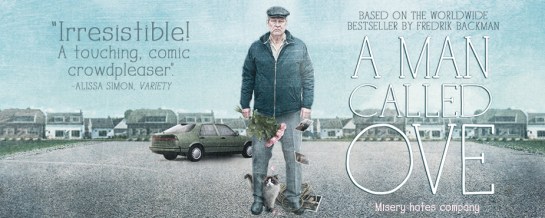
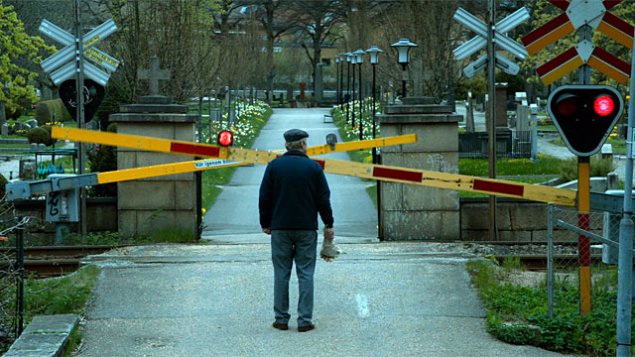
Rolf Lassgård stars and plays the title character Ove. He’s a crusty old curmudgeon who runs his neighborhood association with an iron fist even though he was deposed as its president a few years earlier. His zero-tolerance policies puts him at odds with some residents while others laugh him off as Ove being Ove. Things get even worse after he is squeezed into early retirement by his young supervisors.
ove2

The cantankerous Ove meets his match when a young family moves in across the street. Things get off to a rocky start with Ove letting them have it for every little infraction. But the young mother Parvaneh (Bahar Pars) is impervious to Ove’s belligerence. In fact, she kind of gets a kick out of it. What follows is an unexpected friendship with potential life-changing effects for Parvaneh but especially Ove.

This odd relationship helps to crack open the Ove character and reveal the reasons for his misery. He slowly makes more sense to us. The frequent visits to his wife’s grave and a series of flashbacks paint a picture of a man stricken by heartbreak, sorrow, and loneliness. But don’t let that fool you. This is a black comedy at its core. There are some really good laughs some from unexpected places. Writer-director Hannes Holm juggles the wacky range of emotions and the periodic time hops fairly seamlessly which is no small task.

ove1

Lassgård deserves a lot of credit as well. His stone-faced persona is helped by some really good makeup (for which it earned an Oscar nomination) but is mostly carried by the actor’s charisma. There’s also Lassgård’s snarling snark which is so finely in sync with Holm’s wickedly funny dialogue. And when he’s asked to tone down the crabbiness (ever so slightly) the actor pulls it off without coming across as manipulative.

“A Man Called Ove” was a huge hit in its native Sweden becoming the third highest-grossing domestic movie in the nation’s history. It’s easy to see why. Despite his prickly nature the film’s protagonist is easy to enjoy and eventually sympathize with. That’s mainly due to the surprising amount of tenderness packed into the story and a fabulous lead performance. And now two well-deserved Oscar nominations are icing on this surprise hit’s cake.

VERDICT – 4.5 STARS

4-5-stars

REVIEW: “Assassin’s Creed”

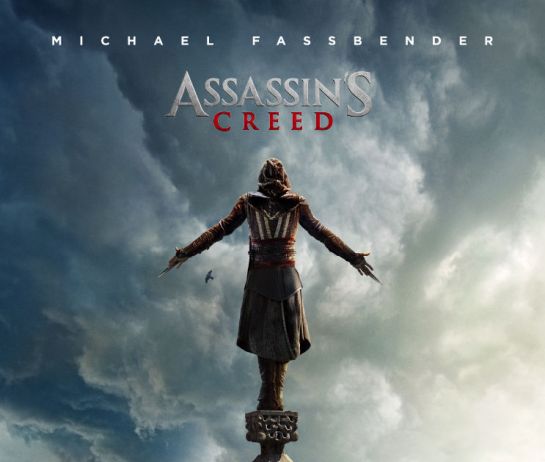
creed-poster

I just knew they existed even before the first screenings of “Assassin’s Creed” – the haughty dismissive jabs at yet another ‘video game movie’. Nevermind that video games have evolved from simple pixels and sprites into vast interactive experiences often times anchored by deep, thoughtful stories. Forget that video games have surpassed both Hollywood and the music industry in the entertainment market. Many people simply won’t treat video games or their movie adaptations seriously, so in that regard “Assassin’s Creed” was already behind the proverbial eight ball.

But there is another unavoidable truth. Filmmakers aren’t doing much to quell these attitudes. In fact, video games have a history of spawning some truly terrible film adaptations. Look no further than “Super Mario Bros.”, “Street Fighter”, “Mortal Kombat: Annihilation” just to name a few. But isn’t “Assassin’s Creed” different? I mean it stars Michael Fassbender, Marion Cotillard, Jeremy Irons, Brendan Gleeson, Charlotte Rampling. With that amount of talent it can’t be as bad as many are saying, right? The short answer – no it isn’t, but it’s complicated.

creed-3

The immensely popular Assassin’s Creed video game franchise from developer Ubisoft is ripe with big screen potential. This film clearly intends to be a launching point for a film series. The games have never been restricted to certain characters which enables to movie to create entirely new ones and tell a new story within the same universe. Fassbender latched on early in the process not only starring but also co-producing.

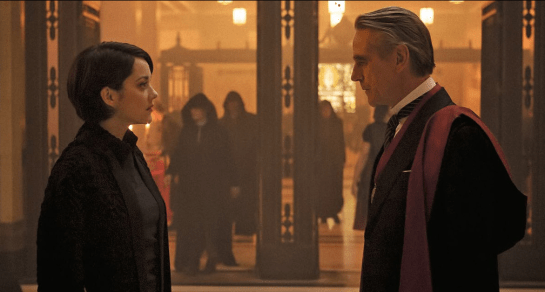
The story takes place during two time periods – 2016 and 15th century Spain during the Spanish Inquisition. An age-old war between the Knights Templar and the Assassins has bled over into modern day driving the mysterious Abstergo Foundation to create the Animus. The machine allows Abstergo to connect people with their descendants in order to glean information from the past. The foundation is ran by Alan Rikkin (Irons) but the Animus creator Sophia Rikkin (Cotillard) oversees the project. Both father and daughter have very different ideas for its use.

Enter Callum Lynch (Fassbender), a death row inmate who wakes up to find himself in an Abstergo facility. Lynch is the descendent of a 15th century Assassin named Aguilar de Nerha who may hold the key to locating a powerful relic called the Apple of Eden. Sophia sees the relic as a tool for global peace while others at Abstergo have much more nefarious intentions.

creed2

Let’s get this out of the way. “Assassin’s Creed” isn’t the wretched, soulless dreck its Rotten Tomatoes score would have you believe. In fact, a solid two-thirds of its running time is a ton of fun especially for those familiar with the franchise. The film nicely juggles Creed’s signature crazy mix of action, historical drama, and science fiction while tossing out several nods to fans. But you don’t need to be an aficionado to understand what’s going on, at least until the last act. At that point things get a bit muddled and messy as the film tries to tie up its many layers of plot.

Director Justin Kurzel (who had previously worked with Fassbender and Cotillard in “Macbeth”) offers several interesting touches as he works in two very different time periods and locations. The 15th century sequences are exhilarating particularly one street chase that may be my favorite action sequence of the year. Kurzel and regular cinematographer Adam Arkapaw shoot the scenes with gusto and great detail. When it moves back to modern day it leaves the dusty, dirty shades of brown for cold, dreary blues and greys. This is where most of the story plays out.

creed1

But now I get back to that third act. Overall I disagree with the criticisms calling the plot convoluted and overblown, at least for the majority of the film. But as it wraps things up it does get a little confusing. The story moves into full franchise setup mode, putting characters and tensions in places that clearly points to follow-up movies. There are some good elements to the finale, but some messiness as well. Even the action takes a step down in last 15 minutes.

Still, I had fun with “Assassin’s Creed” particularly with its wildly unique (and admittedly wacky) story. It also doesn’t hurt to have this level of acting talent in front of the camera. It does fall victim to some of the usual franchise-building frustrations, but at the same time it sets itself up for limitless possibilities. Where does it go next – the Civil War, the French Revolution, the Cold War? I don’t know. First it will depend on the box office and so far that hasn’t looked too promising.

VERDICT 3 STARS

REVIEW: “Arrival”

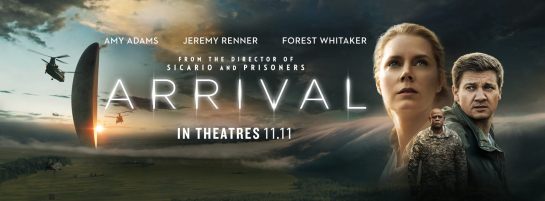
arrival-poster

The cryptic and ambiguous ad campaign for Denis Villeneuve’s “Arrival” made the movie impossible to define. Some things are obvious. “Arrival ” is clearly science fiction and it looks to be playing around in the ‘alien invasion’ sub-genre. Past that it’s hard to tell what this movie is. There isn’t a glimpse of alien warfare or mass destruction. Actually there is no big action highlight to speak of. Since Hollywood has influenced our leanings towards that type of movie, I’m certain some people will leave “Arrival” having expected something far different than what they were given.

Denis Villeneuve is a filmmaker as difficult to pin down as his new movie. But there is one thing we can learn from his small but impressive filmography. Villeneuve loves tension and his ability to ratchet it up through a wild assortment of means is showcased in each of his movies. “Arrival” is a much different project but it doesn’t take long to recognize that common thread of tension.

arrival1

The film is based on Ted Chiang’s award-winning short story “Story of Your Life” which played with linguistics and communication inside of an alien encounter. Villeneuve and screenwriter Eric Heisserer stick close to that idea. Their adaptation isn’t about flying saucers, alien abductions, or the CGI devastation of Earth’s metropolises. It’s much more cerebral and metaphysical. I guess you could say this is the thinking man’s alien abduction movie.

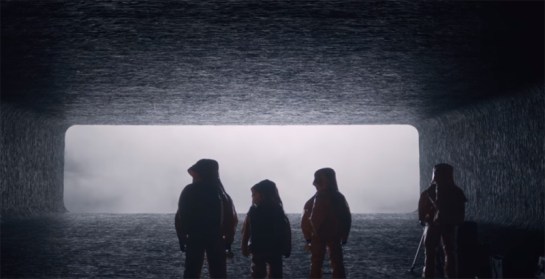
Amy Adams plays Louise, a language professor who, along with everyone else on the planet, is shocked when twelve mysterious spacecraft land at different points around the globe. After one ship lands in Montana, Louise is approached by Army Colonel Weber (Forest Whitaker) to lead a team sent in to communicate with the aliens. She is to work alongside theoretical physicist Ian Donnelly (Jeremy Renner) to find the answer to the biggest question – what is their purpose here?

arrival2

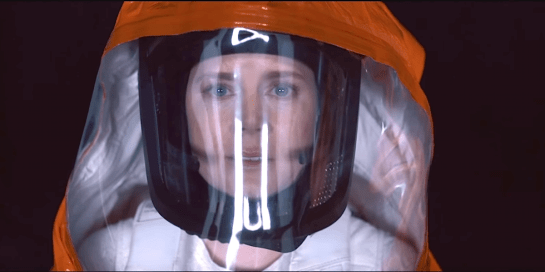
To answer that question Louise and Ian must first learn the alien’s highly advanced language which comes in the form of symbols resembling inkblots or coffee mug stains. For Louise it’s imperative that her superiors be patient, but as world governments begin to cave to paranoia it could be us who ushers in a global catastrophe.

There is another reoccurring layer to the story that feeds into the overall mystery. From the opening shot we get flashbacks to a tragedy from Louise’s past. The more she learns of the alien language the more vivid her flashbacks become. In addition to developing suspense, these sequences provide a human pulse to the film mainly because of Adams’ measured performance. She is sophisticated enough as an actress to remain genuine and understated which keeps her character emotionally grounded.

arrival3

Villeneuve’s storytelling is both patient and methodical which is sure to frustrate some and blow the minds of others. Yet while deliberate, the aforementioned tension never fully leaves even in the quieter scenes. That’s in big part thanks to an ever-present sense of dread and an eerie ominous mood which is clearly a focal point. Villeneuve has shown himself to be a stylish, visual filmmaker and he combined his flair for tantalizing imagery with cinematographer Bradford Young’s love for deep shadows and natural lighting. Also adding to the mood is the ethereal, off-kilter score from Villeneuve favorite Jóhann Jóhannsson. It’s both beautiful and foreboding – some of the best use of movie music this year. Plus there is the use of Max Richter’s exquisitely haunting “On the Nature of Daylight” which is such a perfect fit.

The film’s final act becomes a real mindbender as we start fitting together all of the pieces including some things we didn’t even know were pieces. This too is sure to split audiences between those who go for its mental gymnastics and those who see it as too much. Me, I loved it from the start. I appreciated the intelligent science fiction, but also how the film steps beyond genre. It turned out to be far more intimate and thought-provoking than I ever expected. And all of that on top of the superb visuals, art direction, and score. “Arrival” is an absolute gem from Denis Villeneuve and hopefully a precursor to his next movie, 2017’s Blade Runner sequel.

VERDICT – 5 STARS

5 STARSs

5STAR K&M

RETRO REVIEW: “Assault on Precinct 13”

ASSAULT POSTER

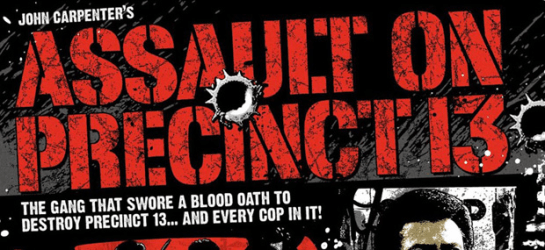
Before John Carpenter became a horror movie icon for his 1978 classic “Halloween” he made a low budget crime thriller that wasn’t well received at first but eventually blossomed into a cult classic. Since then “Assault on Precinct 13” has gained wider appreciation from critics and huge respect for its impressive accomplishments with a shoestring budget.

Producer J. Stein Kaplan approached Carpenter about making a crime exploitation thriller with only $100,000 to work with. Carpenter would be given full creative control including handling the script. It only took him eight days to finish the story which he stated was heavily influenced by Howard Hawks’ “Rio Bravo” and George Romero’s “Night of the Living Dead”. You see those influences in a number of places. Casting an African-American in the lead role was significant. The plot itself features several callbacks to those classics.

ASSAULT2

It takes place in a Anderson, California, a crime-riddled suburb of Los Angeles. After six members of a street gang are killed by cops their leaders form a blood pack to avenge their deaths. A series of events brings groups of people together in Anderson’s closing police precinct building. As night falls this group of policeman, prisoners, secretaries, and civilians must survive waves of attacks from heavily armed gang members until help can finally arrive.

Carpenter shot “Assault” in 20 days, meticulously planning his scenes to best utilize his limited funds. When watching the film there is no denying its minuscule budget. You see it in numerous places. But the sheer quality of the suspense trumps nearly every budget limitation. Carpenter demonstrates some of same bubbling tension that would later make “Halloween” so effective.

ASAULT2

Carpenter also handled the score, writing the music in only three days. While performing the music he relied heavily on synthesizers and drum machines. The score hops back and forth between surprisingly catchy hooks and tense minimalist chords. While it is absolutely a product of its time, Carpenter’s score does the most important thing – it serves the story well.

“Assault on Precinct 13” made its mark as a griping crime thriller that was never hampered by its low budget. John Carpenter’s violent tale taps into themes of racism, gender roles, personal responsibility, and inner-city violence while also being a groundbreaking action picture. Perhaps it hasn’t aged well in certain areas, but in terms of what I care about the most – high quality storytelling – it hits nearly every right note.

VERDICT – 4 STARS

4 Stars

REVIEW: “Anthropoid”

anthropoidposter

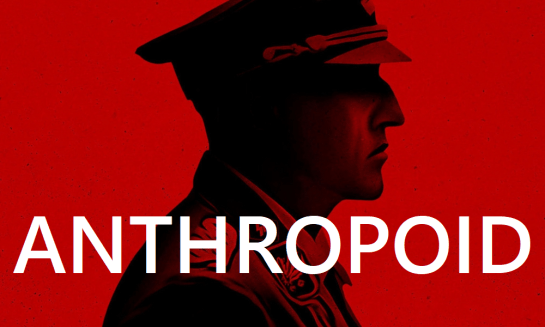
Operation Anthropoid was the code name given to the 1942 attempted assassination of Reinhard Heydrich, Hitler’s third in command and one of the chief architects of the Holocaust. The secret mission took place in Prague and was carried out by agents of the exiled Czechoslovakian government. It’s also the subject of Sean Ellis’ new film “Anthropoid”.

“Anthropoid” isn’t the first movie to share this remarkable true story, but it is the first since 1975’s “Operation Daybreak”. Ellis directs, shoots, co-writes, and co-produces this taut wartime thriller that moves from methodical and restrained to intense and explosive in the snap of a finger. This unique shift in pace seems to have been a problem for some people. For me it represented two very different sides of a story that are intrinsically tied together, so much so that their eventual clash was inevitable.

anthropoid1

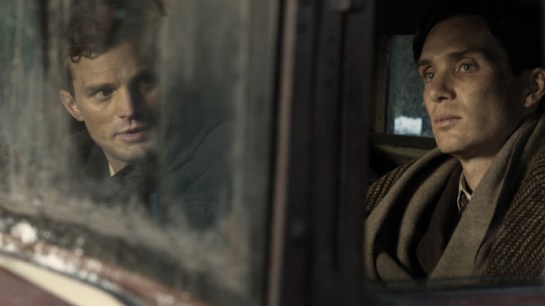
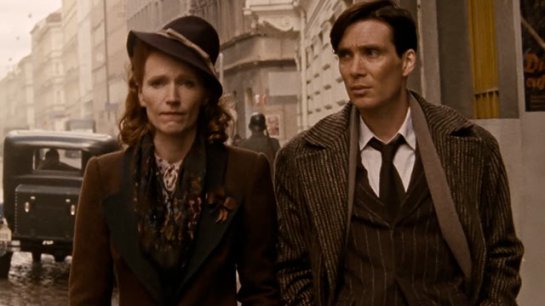
Jozef Gabčík (Cillian Murphy) and Jan Kubiš (Jamie Dornan) are Czech secret agents tasked with carrying out Operation Anthropoid. The two covertly slip into the Nazi-occupied city of Prague where they meet up with the dwindled Czech resistence led by Jan Zelenka-Hajský (Toby Jones). The early part of the film focuses on preparation and reconnaissance. They meet up with the rest of their team and begin planning their mission.

Ellis adds several layers to these early scenes. First is the layer of fear that blankets everyone Jozef and Jan encounter. Heydrich’s brutal presence in Prague has left the resistence in shambles and sympathizers terrorized. So many moments, even quiet ones, are soaked with anxiety and stress. This everpresent tension leads to bouts of distrust, uncertainty, and debates over the consequences of their potential actions.

ANTHROPOID2

Jozef and Jan do get vague refuges of normalcy through their relationships with two women sympathetic to the resistance, Lenka (Anna Geislerová) and Marie (Charlotte Le Bon). Both are intriguing characters particularly Lenka who hints at a deeper disdain for the Nazis. Romances spring up which don’t feel forced or out of place, but that are underserviced and I wish they were given more time.

Ellis’ pace shifts and the intensity only gets thicker as the assassination attempt gets closer. The final act is edge-of-your-seat thrilling while also being perfectly (and violently) harmonious with the earlier slow-burning buildup. Ellis’ camerawork in the final act offers up some of the most visually gripping sequences of the year.

ANthropoid3

One of my favorite things about “Anthropoid” is that it feels grounded and authentic. There is no stilted dialogue or grandiose verbiage. There is no sign of Hollywood formula, overwrought melodrama, or heavy sentimentality. It feels genuine and true to the story it’s telling. And while some may struggle with Jozef and Jan’s lack of backstory, I was drawn to their humanity and invigorated by their valor and conviction. And it is all conveyed without a flashy coat of studio gloss.

“Anthropoid” is refreshingly earnest and subtle. It has confidence in the compelling strength of its story and feels no need to embellish it or the characters. That same confidence allows Ellis to put more of his focus on an accurate historical portrayal. Sure, it may not be a common crowd-pleasing approach, but when it comes together this potently I can’t help but love it.

VERDICT – 4.5 STARS

4.5 STARS

2016 Blindspot Series: “A Man Escaped”

BLINDSPOT LINEUP

1956’s “A Man Escaped” was the fourth feature from French cinema pioneer Robert Bresson and a showcase for his focused minimalist filmmaking. Considered by many to be Bresson’s masterpiece, the film brims with his signature stripped down presentation, free of any visual or narrative embellishment. In fact the film opens with a message from Bresson that reads “The following is a true story. I present it as it happened, without adornment”.

Bresson’s low-key style is also seen in his aversion to using movie stars in his films. He believed professional actors, much like special effects, drew attention to themselves and away from the story. He also believed professional actors conveyed too much emotion in their performances instead of letting the audience deduce it on their own. Therefore Bresson preferred to cast people to be models instead of performers.

man2

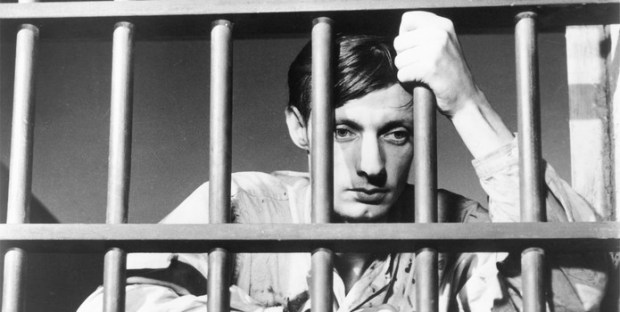
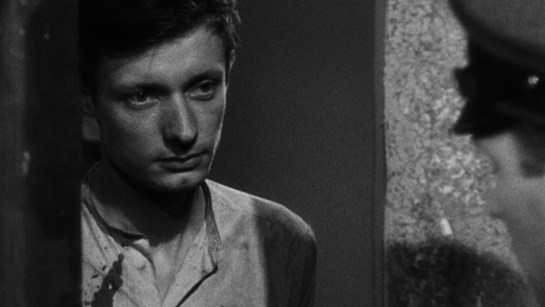
His chosen model for “A Man Escaped” was François Leterrier. He plays a French Resistance soldier named Fontaine. It’s 1943 and the film begins with a captured Fontaine being transported by Nazis to Montluc military prison in German occupied Lyon. The film is based on the true story of André Devigny and his attempt to escape Montluc prison before he is to be executed.

The story is as simple as they come yet so enthralling. With the exception of two brief scenes the entire film takes place within the walls of the prison. Fontaine is our eyes and ears. When he is in the cell so are we. When he is allowed out to wash we are with him. Then back in the cell we go. Everything we learn is from his perspective – from his brief interactions with other prisoners in the washroom, from what he sees from his cell window, or from the sounds he hears.

MAN1

The sound element is crucial to Bresson’s film. As mentioned it often provides information. A good example is the disturbing sounds of echoing machine gun fire each time the Nazis perform an execution. There are no common cutaway shots to visualize it for us. Instead it is spoken to us through the sounds. Bresson also focuses on every sound Fontaine makes as he prepares for his escape attempt. He secretly uses the few things in his room as tools and every sound he makes could tip off the guards.

Fontaine’s narration may be the most vital component in Bresson’s feeding of information. In some films narration can be a crutch. Here it cleverly unveils Fontaine’s feelings and thought processes while adding a surprising amount of depth to his character. It also serves as an important source of time. As we hear Fontaine’s reflections he often alludes to the passing of time – days, sometimes months. Every bit of narration is succinct and has purpose. It doesn’t romanticize the story or character in any way.

MAN3

Bresson frequently channeled much from his personal experiences into his movies. In the case of “A Man Escaped” it’s the cruelty he experienced from Nazis as a prisoner of war during World War 2. Certainly the bulk of his inspiration came from Devigny’s true account, but you clearly sense a personal connection between director and his cinematic canvas.

Robert Bresson was one of the most original and influential filmmakers in cinema history. “A Man Escaped” is an exhibition of his unique style and approach. Spiritual undertones, personal influences, and a minimalist focus are just some of his characteristics highlighted in this brilliant 1956 classic.

VERDICT – 4.5 STARS

4.5 STARS