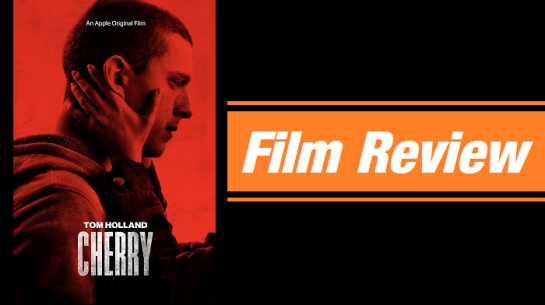
Tom Holland once again separates himself from his friendly neighborhood superhero persona in the new Apple Original “Cherry”. Last year he did it with “The Devil All the Time”, a dark and violent Southern Gothic drama. Next to “Cherry” that flick plays like an afternoon special on the Disney Channel. This time Holland throws aside any hint of his boyish humor and Peter Park charm to wade into the heavy topics of drug abuse, dependency, PTSD, and more.
“Cherry” is directed by Marvel Studios favorites Anthony and Joe Russo. But make no mistake, there is nothing here that remotely resembles their rousing work in the MCU. Instead “Cherry” soaks its audience in unpleasantness from its dour and (mostly) hopeless point-of-view to the grating f-bomb laden dialogue from writers Angela Russo-Otstot and Jessica Goldberg. The Russos do try to inject a little dark humor here and there, but next to the story’s dark and depressing subject matter those brief moments are smothered out and forgotten. That’s all fine, but when the movie struggles to relay its bigger message or any real meaning those things become a liability and are harder to endure.

Image Courtesy of Apple
“Cherry” is based on Nico Walker’s semi-autobiographical 2018 novel of the same name. It’s a very real story for Walker who actually wrote his book from prison where he was serving 11 years for robbing banks to support his heroin habit. The movie breaks itself up into chapters that cover a young Ohio man’s troubled odyssey through college, army basic training, deployment, then back home where he gets hooked on drugs and begins robbing banks to support his addiction. And let me just say, in “Cherry” robbing banks is easier than shoplifting a piece of gum from a convenient store. No mask required, no police chase afterwards. Just be cordial, tell them you have a gun and they’ll hand over stacks of cash. Easy-peasy. It’s one of several things the movie serves up that strains any sense of believability.
Holland immerses himself in this character who starts down his tragic path by swapping Xanax for Ecstasy at college parties. But his life turns around when he meets the girl of his dreams Emily (Ciara Bravo), that is until she breaks his heart which leads to a spur-of-the-moment decision to enlist in the army. Then in the worst stroke of movie luck, Emily comes back to him but not before he’s set for basic training and then shipped to the Middle East in the latter days of the Iraq War. A large chunk of the movie (too large) follows his time as a barely trained medic and the horrors of the battlefield which lead to his PTSD.
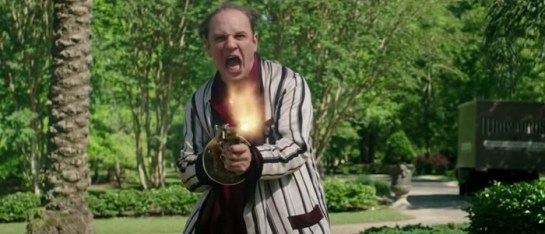
From there it’s back home to Cleveland where Emily awaits and yet another lengthy chapter of the young man’s life begins. It’s here that the Russos vividly capture PTSD and the psychological damage it brings as well as the crushing effects of drug addiction. But no matter how hard he tries, or how much pale makeup they put on him, or how many f-bombs he screams, Holland never feels right for the part. It’s not for lack of commitment and it’s not that his performance is empty or feels untrue. He simple struggles to sell the grit and numbness the role demands. Same with Bravo. As with Holland, her performance isn’t “bad”. But (through no fault of her own) she looks 10 years too young and Bravo is handcuffed to Emily’s woefully shallow and hard-to-buy descent into addiction.

Image Courtesy of Apple
“Cherry” is also hampered by some weird creative choices such as its tone-jarring breaking of the fourth wall. In these scenes characters yank the movie out of the reality-based setting it so desperately wants to depict. It’s a style and storytelling choice that offers nothing and even the movie itself seems unconvinced of its effectiveness. Maybe that’s why it all but disappears in the film’s second half. And the decision to go with a chapter-based structure only highlights one of the movie’s bigger issues – its overwrought and overstuffed story. And speaking of style choices, did I mention there’s a shot from inside Holland’s rectum looking out? Cutting edge stuff, right?
There’s something undeniably disturbing about watching two young people who look like kids (even though both stars are in their twenties) losing themselves in a drug-addled mire of misery and self-destruction. But those aren’t the optics “Cherry” is going for. The Russos have bigger ambitions and shoot for the stars in what amounts to their attempt at a prestige movie. It’s them saying “See, we can make more than big-budget, crowd-pleasing, superhero extravaganzas“. The problem is “Cherry” is a mess. It’s story is overcooked, its storytelling hampered by bad decisions. Even worse, after watching it for 140 long minutes, I was completely indifferent to the characters, their story, and the film as a whole. That’s pretty damning, especially for a movie so sure of itself yet so emotionally hollow. “Cherry” opens February 26th in select theaters before streaming March 12th on Apple TV+.
VERDICT – 2 STARS




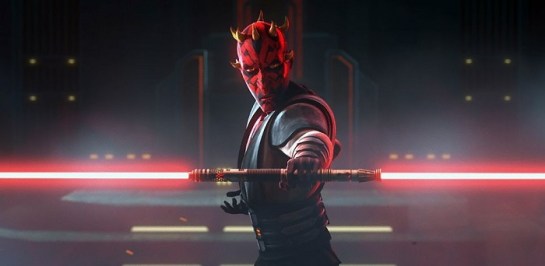
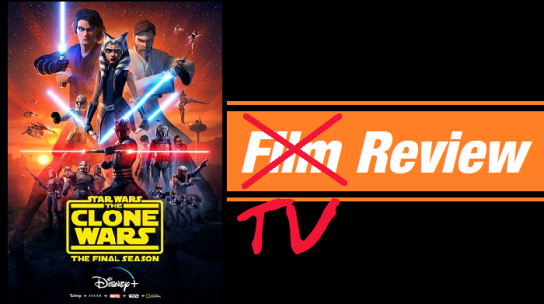 It goes without saying that K&M is predominately a movie site. But on rare occasions a television series or season resonates so profoundly with a particular fanbase or the culture in general that I feel compelled to write about it. The long-awaited final season of “Star Wars: The Clone Wars” recently wrapped up on Disney Plus, and a Star Wars die-hard like me couldn’t help but spend some time on it.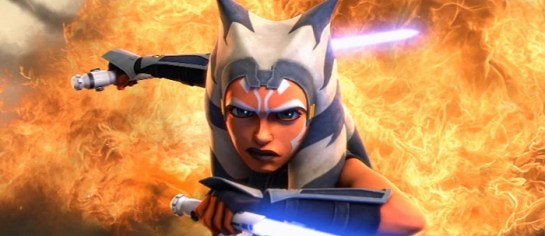





 Keith & the Movies