REVIEW: “Cinderella” (2021)

Sometimes you go into a movie with a sinking feeling in your stomach. You aren’t at all excited for what you’re about to see. Or at best you’re completely indifferent. Maybe the trailer left a bad impression. Maybe you just know the movie isn’t for you. Yet you see it anyway, clinging to a thin thread of hope that you’ll be surprised. Taking the chance that you may have misjudged it. Saying with all the optimism you can muster, “Maybe this isn’t the movie I thought it would be.”

“Cinderella” is exactly the movie I thought it would be.

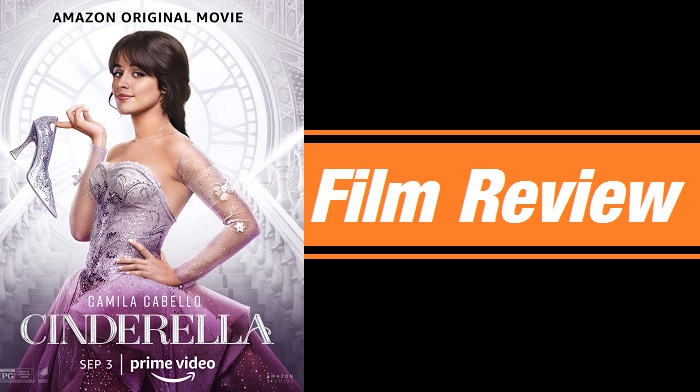
“Pitch Perfect” scribe Kay Cannon writes and directs yet another version of the Charles Perrault classic, this one originally under the Sony umbrella but sold to Amazon to be released this weekend on Prime streaming. While they share the same name, “Cinderella” 2021 has little in common with the other versions outside of the basic details. Instead what we get here is an aggressively modernized reimagining with what seems like a poorly veiled distaste for the fairytale that inspired it.

While I’m not sure anyone was clamoring for a new “Cinderella” movie, Cannon’s musical version had some promise. But it’s too preoccupied with highlighting its own forward-thinking and wedging in every policy from the progressive playbook. There’s no nuance, subtlety or cleverness to be found anywhere in this laughably heavy-handed reinvention. We see the politics everywhere, but where’s the magic?

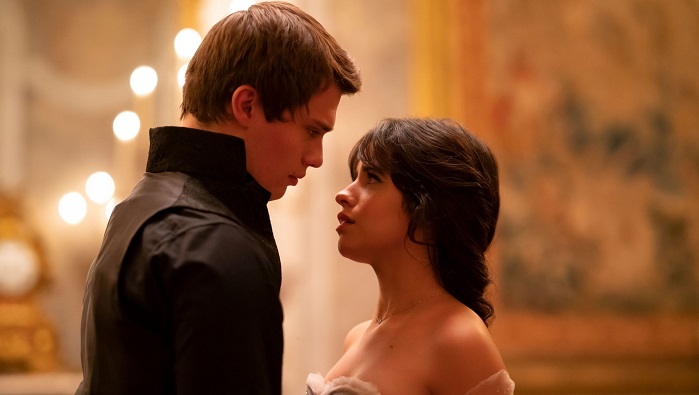
Image Courtesy of Amazon Studios

To clarify, Cannon has a tale that’s ready-made for a fun and enlightened update. The story of female empowerment and following one’s dreams should inspire any young girl. And its critique of a backwards male-dominated society speaks to issues that still have relevance today. But do we really go to a “Cinderella” movie for what it has to say about the coal industry or military spending?

Some of this would be easier to digest if the story itself wasn’t so flat. We get a few flashes of originality, but the movie ends up backing itself into a corner and routinely falls into traps that it itself set. Meanwhile characters are nothing but a swirl of bland caricatures. In fairness, some of this is due to classic story which most of us know by heart. But it’s still reasonable to expect the characters to be interesting, especially in a movie that makes such a big deal out of distancing itself from the other adaptations. They aren’t.

And the music isn’t much better. Weird covers of songs by Janet Jackson, Queen, Madonna, Salt-N-Pepa, Ed Sheeran and others too often sounds like group karaoke rather than movie musical numbers. And even the songs by pop-star Camil Cabello (the film’s lone burst of genuine energy) quickly begin sounding exactly the same.

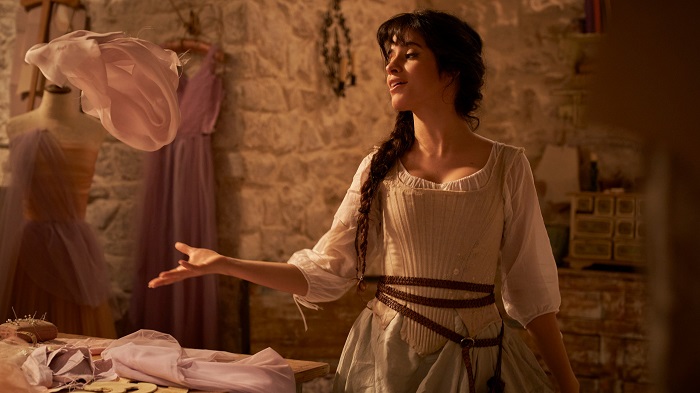
The film’s on-the-nose introduction gives you a good sense of where its head is at – “Once upon a time there was an old-fashioned kingdom bound by tradition.” From there we’re introduced to Ella (Cabello), an aspiring fashion designer who’s far more interested in owning her own dress shop than finding her Prince Charming. Unfortunately she’s stuck under the same roof as her wicked stepmother Vivian (Idina Menzel in a thankless role). While Ella is full of her own dreams, Vivian submits whole-heartedly to the kingdom’s patriarchy. And she’s determined to make sure her girls do too.

Image Courtesy of Amazon Studios

Meanwhile in the lavish castle on the hill lives the cartoonishly thickheaded King Rowan (Pierce Brosnan), his remarkably dull wife Queen Beatrice (Minnie Driver), his hyper-leftist daughter Gwen (Tallulah Greive) and of course his son Prince Robert (Nicholas Galitzine), who is (reluctantly) next in line for the crown. The King, who’s more worried about his power and perception than his son’s wishes, insists that Robert find him a wife. So what does any good house of royalty do? You throw a ball!

You know where it goes from there. With the help of a little magic (and I mean very little) Ella goes to the ball where the nobleman and the commoner fall for each other. But Ella is no stay-at-castle kind of girl. She has her own aspirations and enough girl-power to see them come true. It’s the only real twist to the classic story that’s remotely interesting. Unfortunately it too is glaringly predictable and ends with a rather underwhelming thud.

The film takes several big swings at comedy and pretty much misses every time. The biggest whiff comes with Billy Porter’s loud and garish performance as the Fabulous Fairy Godmother. It’s essentially Billy Porter playing Billy Porter and mercifully it’s only one (albeit long) scene. Speaking of distractions, producer James Corden sticks himself into the movie playing a talking mouse turned human footman. If you thought the viral video of him dancing in a mouse costume was bad, wait till you see this.

“Cinderella” ends up being a movie that’s so enamored with giving the classic fairytale a makeover that it forgets everything else. It’s a musical without good songs. It’s a comedy that isn’t funny. It’s a romance that lacks spark. The biggest casualty is Cabello who has some noticeable charm and even a little swagger which I liked. But material like this doesn’t highlight any of her acting or musical strengths. In fact it doesn’t highlight much of anything other than the fact that we really didn’t need another Cinderella movie. “Cinderella” premieres tomorrow (September 3rd) in theaters and on Amazon Prime streaming.

VERDICT – 1 STAR

REVIEW: “Candyman” (2021)

The original 1992 “Candyman” came out as the VHS era was booming. DVDs were still four years away so VHS cassettes were the way millions of people consumed their movies. When “Candyman” came out it wasn’t some genre-changing masterpiece, yet critics recognized not only its gory violence but its surprisingly rich social commentary. But for many, “Candyman” was just another VHS tape stuck in the horror section at their local video store.

As prep for my review of the new “Candyman” sequel, I rewatched Bernard Rose’s ‘92 original for the first time in decades. It turns out the critics’ favorable appraisal still holds up. I only wish I felt as strong about Nia DaCosta’s fascinating yet frustrating 2021 follow-up.

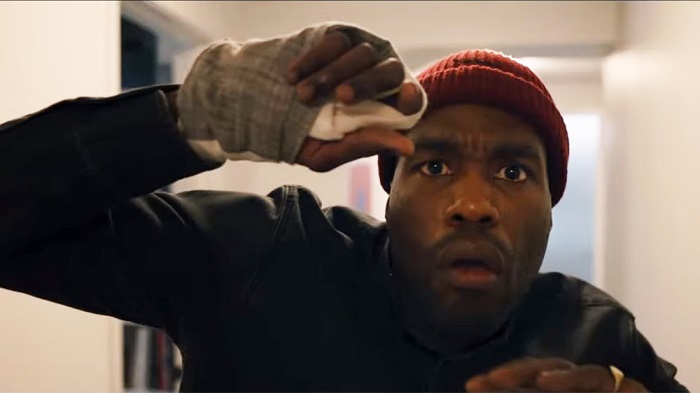
Image Courtesy of Universal Pictures

“Candyman” the 2021 edition is an entertaining mess; a film that grabs your attention and keeps it till the very end. At the same it’s a movie that teases far more than it delivers. It’s one that alludes to thought-provoking issues rather than exploring them in a challenging way. Even worse, its shaky storytelling skips over too many details leaving us with too many questions. Oh, and it wraps up with a hilariously on-the-nose ending that undercuts any suspense the film had mustered so far.

Written by DaCosta, Jordan Peele and Win Rosenfeld, the film follows Anthony McCoy (Yahya Abdul-Mateen II), a hot-shot visual artist who’s struggling to find inspiration. He lives rent-free with his girlfriend Brianna (Teyonah Parris) in her swanky new Chicago apartment. She’s a well-connected art gallery director who has always encouraged Anthony. But he’s in a funk and needs something to spark his creativity.

Anthony finds that elusive inspiration while researching the local urban legend of Candyman. See the 1992 movie for more details, but Candyman is said to be a supernatural killer in a trench-coat and with a meat-hook for a hand. Legend has it if you say his name five times in the mirror Candyman will appear in the reflection and kill whoever summoned him. (I’ve never fully understood those rules, but that’s fine).

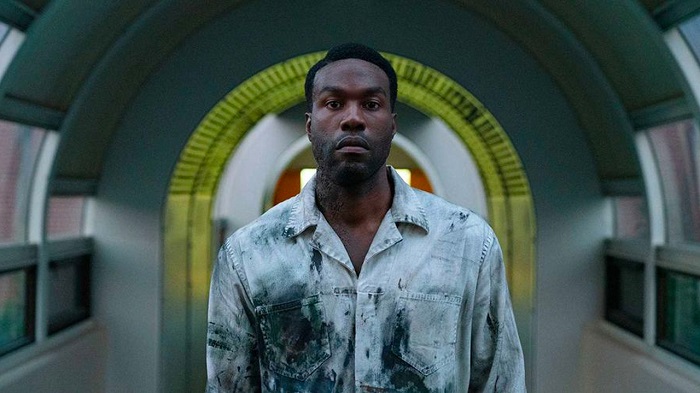
Anthony visits the abandoned Cabrini Green projects which was terrorized by Candyman decades earlier. He runs into a neighborhood old-timer named William (the always good Colman Domingo) who shares his first-hand account with Candyman. Before you know it an obsessed Anthony is chanting Candyman’s name in the mirror, a fresh bee sting on his hand is festering, and gruesome deaths start popping up across the city.

Image Courtesy of Universal Pictures

From the film’s earliest scenes DaCosta shows off her knack for framing shots. She does some unique and clever things with the camera that does more to add tension than anything written into the story itself. At the same time, she seems to have an aversion to blood and gore. I mean we do get a chopped hand, there’s a particularly gnarly slit throat, and Anthony’s infected hand gets pretty nasty. But far too often DaCosta cuts away or zooms out from the action, even relying solely on sound in a couple of scenes. It will be a welcomed choice for weak stomachs and a disappointment for some genre fans.

Meanwhile the mostly fright-free story zips along, infusing the lore of first film with its own current-day perspective. It’s a great idea on the surface, but the story ends up needlessly convoluted and with gaping holes in its logic. And while it seems interested in meaningful topics such as race and gentrification, just referencing them isn’t the same as dealing with them. It’s one of several areas where “Candyman” shows promise but fails to deliver. “Candyman” opens in theaters Friday, August 27th.

VERDICT – 2 STARS

REVIEW: “CODA” (2021)

One of the most talked about movies from this year’s Sundance Film Festival was Sian Heder’s “CODA”. The heartwarming coming-of-age story follows 17-year-old Ruby, the lone hearing member of her culturally deaf family. Both written and directed by Heder, “CODA” is an English-language remake of a 2014 French dramedy “La Famille Bélier”. It had its premiere at Sundance and was quickly gobbled up by Apple for a record setting $25 million.

While “La Famille Bélier” was set on a dairy farm in rural France, “CODA” (short for ‘child of deaf adults’) is about a family of fishermen in Gloucester, Massachusetts. Emilia Jones plays Ruby who we first meet on her family’s boat reeling in nets and separating flounder, crab, and the occasional leather boot. She works the tub with her salty and grizzled father Frank (Troy Kotsur) and her ambitious old brother Leo (Daniel Durant), both deaf. Back home the fourth member of the Rossi clan is Ruby’s mom Jackie (Marlee Matlin), also deaf. Together they make for a feisty but loving group.

Image Courtesy of Apple Studios

One of the great accomplishments of “CODA” is its ability to enlighten while also expelling myths about the deaf community. Heder puts a ton of effort into portraying the Rossi clan as a normal everyday family who in many ways aren’t too different than anyone else. They laugh, they squabble, they get on each others nerves. And like so many other families working the North Shore, they feel the financial strain of the struggling fishing market. Most importantly, Heder gives plenty of attention to each individual family member, fully fleshing out their unique personalities and trusting the cast to bring them to life.

At the same time Heder doesn’t shy away from the real-life day-to-day challenges that comes with being deaf. In many ways Ruby is our conduit to a better understanding of the struggles at home and out in the community. Sometimes it’s small things like the inability to gauge volume – the loud rattling of dishes, the noisy lovemaking coming from her parents’ bedroom, or the blaring music (Frank likes hip-hop, not for the music itself but for the vibration he feels from the speakers). Other hurdles have more serious implications especially when a local commission starts putting the squeeze on area fisherman. Frank fights to keep their business afloat, but without Ruby present, communicating with the all-hearing public is next to impossible.

This makes it especially tough for Ruby who is counted on to be her family’s interpreter and general go-between. Ruby loves her family deeply, but she’s carried this obligation since she was a child and it’s wearing her down. “I’ve been interpreting my whole life,” an exasperated Ruby laments. “It’s exhausting.” To make it worse, it doesn’t allow Ruby to pursue her real passion – singing. She has the voice but doesn’t have the nerves to sing in front of people nor does she have a family she can share it with.

Enter quirky choir director Bernardo Villalobos (a delightful Eugenio Derbez). He sees something in Ruby and pushes her to trust her voice and believe in herself. It’s a trope we’ve seen countless times – the inspirational teacher breaking through to the insecure pupil. But as with many things in “CODA”, underneath the familiar exterior is a warmth and authenticity that’s hard to resist. And as Mr. V. predictably encourages Ruby to pursue her passion, even pushing her to audition for Boston’s Berklee College of Music, we’re with her every step of the way.

Image Courtesy of Apple Studios

That aforementioned authenticity can be found all through “CODA”, from the rich blue-collar setting (filmed on location in Gloucester) to the way it normalizes the deaf community’s experience (I would guess 50% of the film is in American Sign Language). Mostly it’s in the characters who feel rooted in the world we see and driven by organic emotions. This is partly due to how well they’re written, but also because of the performances. Casting three incredibly talented deaf actors (including one Oscar winner) made all the difference and together with Jones the four share a remarkable chemistry.

And I also have to say that “CODA” is legitimately funny. The laughs come natural and frequently while also being honest and reverent. The humor makes for a great compliment to the coming-of-age drama which follows a pretty conventional blueprint but enhances it with a uniquely fresh perspective. And even though you get a good sense for where the movie is heading, the story is so joyously earnest and deeply affecting that you won’t care. There’s a magic to that and the folks behind “CODA” have it. “CODA” opens August 13th on Apple TV+.

VERDICT – 4 STARS

REVIEW: “The Conjuring: The Devil Made Me Do It” (2021)

Two of my very favorite horror movies of the last decade were James Wan’s “The Conjuring” (2013) and “The Conjuring 2” (2016). Based on the supposed real-life case files of paranormal investigators and Vatican certified demonologists Ed and Lorraine Warren, the Conjuring films were breaths of fresh air in a genre that had become pretty bland and stale. Both films were big box office successes which Warner Brothers used to launch several spin-off movies. None of them came close to the quality of Wan’s centerpieces, but they made money and ensured franchise fans of future movies.

The third film sees Wan producing and conceiving the story but stepping away from the director’s chair. It also sees the series dropping the number in its title and going with a case-referencing subtitle. Even more, unlike its predecessors, this isn’t a haunted house movie. Instead it’s based on the 1981 trial of Arne Cheyenne Johnson which became known as the “Devil Made Me Do It” case (hence the film’s funny sounding yet appropriate title). This one very much plays like a supernatural mystery; one that isn’t confined to a single location. Its differences from the previous two movies are obvious, but that’s part of what makes it such a nice addition to the series.

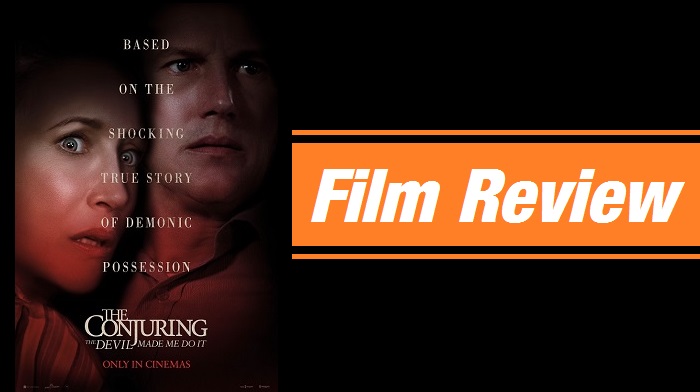
Image Courtesy of Warner Bros.

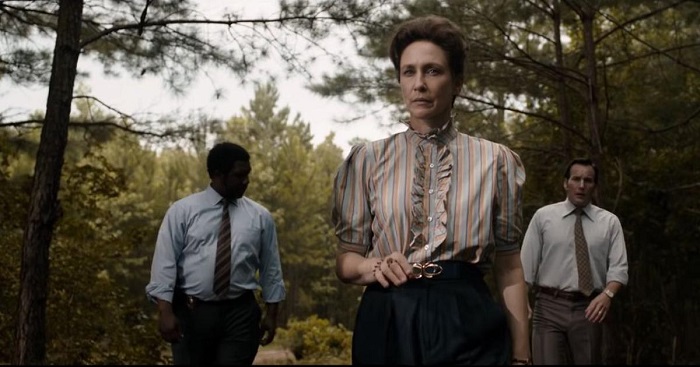
Though helmed by a new director (Michael Chaves), “The Devil Made Me Do It” does see the return of its most essential ingredients. The reliable Vera Farmiga and Patrick Wilson reprise their roles as Loraine and Ed, possessing that same stellar chemistry that has made the Warrens the heart of the “Conjuring” films. Their loving, devoted relationship has always played a crucial part to these stories, but never more than in the third film. In fact you could call this a thoughtful love story, albeit one wrapped from top to bottom in eerie supernatural terror.

The film opens with a chilling prologue that would feel right at home in first films. The Warrens have been summoned to Brookfield, Connecticut where they’re documenting the exorcism of 8-year-old David Glatzel (Julian Hilliard). In an obvious but satisfying toast to “The Exorcist”, the priest (Steve Coulter) arrives at the family home, standing in the soft glow of a street lamp with his bag by his side. Inside a malevolent demon fully takes hold of young David and a spiritual battle ensues. During the encounter Ed is attacked by the sinister spirit and suffers a heart attack. Then, unbeknownst by everyone other than the now unconscious Ed, the demon jumps from David to Arne Johnson (Ruairi O’Connor), the amiable boyfriend of David’s older sister Debbie (Sarah Catherine Hook).

By the time Ed wakes up in the hospital it’s too late to stop the demon from resurfacing in Arne. One gruesome murder later and Arne is in court pleading guilty by reason of demonic possession. Loraine and a recovering Ed get back on the case, setting out to prove Arne was possessed by uncovering the evil at the heart of it all. Screenwriter David Leslie Johnson-McGoldrick pulls the Warrens out of the confines of a single-setting and sends them on a paranormal whodunnit that sees them tracking down a hermit ex-priest with knowledge of the occult, helping police with a cold case in a nearby town, and revisiting the home where the demon first possessed young David. And of course there is plenty of demonic pushback along the way.

Image Courtesy of Warner Bros.

By venturing outside of the haunted house box the third movie loses some of the nail-biting tension that kept fans perpetually on the edges of their seats. The first two films did a masterful job immersing their audiences in the suffocating terror of their settings – confining them within the walls of a creepy house with a devilish entity. There are tastes of that throughout part three, but this one leans more into a sustained level of dread. It’s not always cranked up to 10 nor does it need to be. But there is an ominous cloud that hangs over practically every scene. There are parts of the story that I wish were given more attention (such as the courtroom stuff), but the filmmakers know people aren’t coming to a “Conjuring” movie to see witness testimonies and cross-examinations.

“The Conjuring: The Devil Made Me Do It” finds itself in an tough spot. It makes an effort to actually do something different within the series rather than follow the blueprint of the two earlier movies. It seeks to show that the “Conjuring” films don’t have to be the same thing over and over again. Some people will appreciate that ambition while others wishing for ‘more of the same’ could get lost in comparing it to its predecessors. That would be a shame because this is a solid entry that may lack some of the chills but yet maintains the spirit of the two earlier installments. And it does so by avoiding the copy-and-paste approach where the names have changed but not much else has. “The Conjuring: The Devil Made Me Do It” is now showing in theaters and streaming on HBO Max.

VERDICT – 4 STARS

REVIEW: “Cruella” (2021)

Since seeing its first trailer three months ago, Disney’s new film “Cruella” has had me in a shared state of fascination and bewilderment. On one hand I couldn’t wait to see Emma Stone dive headfirst into a demented character like Cruella de Vil. On the other hand how would Disney treat the backstory of one of the company’s most devious and notorious villains? Would they soften the edges of her story and go a more sympathetic route?

To no surprise Disney teases but ultimately steers clear of classic Cruella’s more diabolical character traits. Instead, any real evil is channeled through an entirely new character played by Emma Thompson. This Cruella is painted as a tragic figure whose pain turns her into a peculiar anti-hero of sorts. I’m not sure how this will sit with the devoted Cruella purists (if those people even exist), but I absolutely loved this deliciously unruly romp and the movie exceeded what expectations I had in every way imaginable.

Image Courtesy of Walt Disney Studios

“Cruella” comes from director Craig Gillespie and is a surprising step up from the many Disney live-action remakes. Okay, so this isn’t a ‘remake’ per se, but it does add a stylish new spin to an iconic character. Clocking in at two hours and fourteen minutes I was a little nervous. But at no time was I checking my watch or feeling the length. That’s because Gillespie, co-writers Dana Fox and Tony McNamara, and one of the best acting ensembles of the year pour every bit of themselves into this wickedly (and unexpectedly) fun origin story.

Emma Stone absolutely crackles in the titular role, adding heaps of seasoning to both sides of her character. Through Stone’s narration and a really well done prologue we meet Estella, played in flashbacks by a delightful Tipper Seifert-Cleveland. She’s a spirited young girl and aspiring fashion designer who has stood out from the crowd from the day she popped out of the womb. As Stone wryly explains “From the very beginning I’ve always made a statement,” and not just by her natural half-black, half-white mane. It’s her mischievous and assertive personality that makes her a handful for her mother (Emily Beecham) and gets her into the most trouble.

I won’t spoil the entire prologue but a young and alone Estella ends up in London after her mother’s tragic death. There she falls in with two pickpocketing orphans Jasper and Horace who live in the attic of an old abandoned church. Jump ahead several years and the three of them have made a decent living bopping around 1970s London swiping wallets and pulling small heists. Estella (now played by Stone) uses her fashion design genius to make their disguises while Jasper (the always great Joel Frey) and Horace (the scene-stealing Paul Walter Hauser) do a lot of the legwork.

Image Courtesy of Walt Disney Studios

Things slowly begin to change after Jasper gets Estella an entry-level position at a renowned fashion house ran by the devilishly chic and grossly narcissistic Baroness von Hellman (Thompson). It offers Estella a chance to get her foot in the door and finally realize her dream. But she quickly learns what all the other employees know but are too afraid to say – working for the relentlessly cruel Baroness isn’t easy.

Soon the Baroness’ nastiness and vainglory (mixed with a big reveal or two) gives birth to Estella’s flamboyant alter ego Cruella, a rather twisted amalgam of her pain and personality. It leads to a bitter rivalry between a haute and haughty industry legend and a ferocious new fashion provocateur. And as the mysterious Cruella captures more and more headlines, Estella starts to slowly fade into the background, becoming more of a disguise than a true identity.

From its earliest moments “Cruella” zips along with tenacious energy and a rich visual style. The stellar production design, the exquisite fashion, and DP Nicolas Karakatsanis’ lively camera ensure that there is always something to catch your eye. Oscar nominations for Hair and Makeup and Costume Design are all but assured. And I’m guessing a big chunk of the budget must have went towards the soundtrack. It seems every other scene features another great song. Blondie, ELO, Deep Purple, Queen, and so many more. I was bouncing my head through the entire movie. Sometimes that can feel like a crutch, but here it fits with the film’s carefree anarchic attitude.

Image Courtesy of Walt Disney Studios

And then you get back to the performances. Stone really sinks her teeth into the role, brilliantly capturing Cruella’s razor-sharp cunning and devilish charm. There’s even a subtle glint of vulnerability in the rare quiet scenes, namely her visits to the fountain in Region’s Park where she has heartfelt conversations with her late mother. And then you have Emma Thompson matching Stone step-for-step. Who knew vanity could be so hilarious? Thompson is given so many good lines that she delivers with the perfect mix of venom and spot-on comic timing. Her black-hearted Baroness is as funny as she is detestable. Both Stone and Thompson are helped by ace supporting performances across the board. Frey, Hauser, Beecham, Mark Strong, Kirby Howell-Baptiste, Ed Birch – just some of the film’s many essential pieces.

I can’t believe I’m saying this, but “Cruella” could end up being the biggest surprise of 2021. It’s brash, rowdy, and wickedly entertaining from start to finish. It fills its running time with great faces, a fabulous 1970’s London aesthetic, and killer music drops at every turn. It’s not an overstatement to say both Stone and Thompson deserve Oscar nominations for giving us two of the most warped yet entertaining characters we are likely to get all year. A part of me wishes they hadn’t played it so safe and let Cruella off her leash to truly become a villain. But in fairness Disney isn’t much for venturing into darker places these days, and the fact they went this far was a real treat. “Cruella” releases in theaters and on Disney+ Premier Access this Friday, May 28th.

VERDICT – 4.5 STARS

REVIEW: “Concrete Cowboy” (2021)

CCposter

Idris Elba is an actor I’ve always admired. Whether he’s speaking with power and passion as Nelson Mandela or declaring himself Black Superman in “Hobbs & Shaw”. He has always possessed both leading man charisma and supporting role restraint. He uses a little of both in the new Netflix drama “Concrete Cowboy”, directed by Ricky Staub from a screenplay by Staub and Dan Walser. The film is based on the 2011 young adult novel “Ghetto Cowboy” by Greg Neri. Elba plays the estranged father of a troubled teen and brings just the right amount of gravitas and sincerity.

“Concrete Cowboy” tells a story set within the free-spirited horseriding subculture of Philadelphia’s inner-city. These modern-day urban cowboys from predominantly African-American communities (such as the Fletcher Street Riding Club) mentor youth and offer them an alternative to the dangerous street life. Staub’s film shines eye-opening light on this compelling pocket of humanity and the performances fill his film with character and heart. Yet this is a very by-the-numbers coming-of-age story and within 10 minutes you’ll have a good idea of where it’s going and how it will end.

CC1

Image Courtesy of Netflix

Elba is a key player but the film’s lead is Caleb McLaughlin (“Stranger Things”). He plays 15-year-old Cole, a wayward teen living in Detroit with his working single mother Amahle (Liz Priestley). After Cole is expelled from school following yet another fight, a helpless and heartbroken Amahle picks him up from school and drives him straight to Philadelphia. There she drops him off with two garbage bags full of clothes at his father’s place downtown and then drives away in tears. Staub wastes no time introducing us to this low-income yet richly cultured neighborhood where the rest of the movie is set. In fact, one of the real strengths is the film’s ability to capture a strong sense of place and community.

Cole and his father Harp (Elba) don’t exactly hit it off. Harp is a no-nonsense guy with strict take-it-or-leave-it house rules. Cole pushes back and ends up reconnecting with a shady childhood friend named Smush (a very good Jharrel Jerome). But Cole is also introduced to his father’s passion – horses and the small group of neighborhood riders who make up their club. And this forms the dichotomy Cole will wrestle with for most of the movie – two vastly different lifestyles with significantly different outlooks pulling him in opposite directions.

CC2

Image Courtesy of Netflix

The movie is at its best when it’s sitting us down with the riders and letting us listen to their playful banter and personal stories. Or when it allows us to tag along and watch Cole’s challenging initiation into Harp’s group. We get to meet some interesting characters in these scenes, none better than Lorraine Toussaint’s Nessie, a wise and tough-loving mother figure with her finger on the neighborhood’s pulse. Her stables are a safe haven from the allure of street-life and the balm that help heal the film’s central father/son relationship. Staub also casts some real-life Fletcher Street riders who add a noticeable layer of authenticity to the stable scenes.

The film’s predictability turns out to be its biggest weakness. Not a single plot point, story beat, or character angle will surprise you. Instead it’s the vibrant community setting that feels fresh and unexplored. There’s something to watching Idris Elba and his fellow urban cowboys stoically riding their horses, not across an open rolling plain, but through cramped inner-city streets. And you never doubt it for a second. This is just one of many segments of Black America with stories waiting to be told. And as surreal as it sometimes looks and sounds, this horseback riding culture has for decades fought for its very existence. Staub captures that unique essence even though the particulars of the story he’s telling are nothing new. “Concrete Cowboy” is now streaming on Netflix.

VERDICT – 3 STARS

3-stars