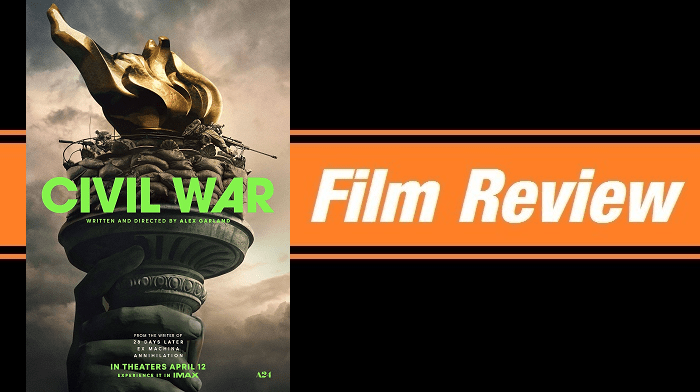
REVIEW: “Civil War” (2024)

Filmmaker Alex Garland has provoked a wide range of responses with his latest film “Civil War”. In partnership with A24, Garland’s dystopian war film has prompted some to say he goes too far while others say he doesn’t go far enough. Some have called him irresponsible for releasing such a film at such a precarious time while others have proclaimed this as exactly the kind of movie we need right now. Some believe it will open eyes yet others say it will only further divide.

As with most opinions colored (at least in part) by personal politics, it’s hard to gauge the truth in some of the reactions that are out there. So as is often the case, it’s best to go to the movie itself and make up your own mind. In doing so, I found that “Civil War” falls somewhere in the middle which is sure to frustrate the two unforgiving extremes. The movie’s politics are vague enough so that all sides might listen, pay attention, and perhaps consider the path our country is on.

But at times even that feels deeper than writer-director Garland wants to go. Through much of “Civil War” he seems more interested in examining the heroism yet murky ethics of wartime journalists. And I’m guessing that has fueled many of the frustrations. After all, if you’re opening up such potent ideas during what many perceive to be a tinderbox era of American history, wouldn’t you take some kind of position? I’m sure Garland has his beliefs, but he’s more interested in ours. He trusts that we’ll use those beliefs to define things for ourselves. He’s merely showing us the potential consequences and issuing a warning that every side should heed.

Image Courtesy of A24

The story takes place in a dystopian near future where the United States isn’t so united. The current President (played by Nick Offerman) is a dictator who’s currently serving his third term. He has seen America fracture under his watch with a number of militant groups forming across the country. The most powerful of the rebel factions are the Western Forces – a coalition formed between California and Texas. The escalating tensions between the President’s regime and the WF eventually ignites a second Civil War.

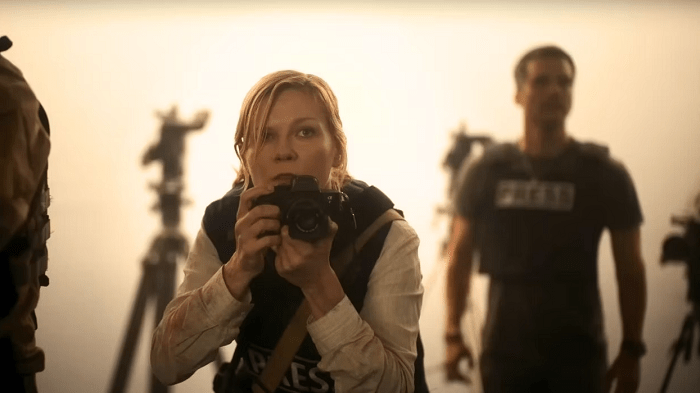
An intensely captivating Kirsten Dunst stars as Lee Miller, a renowned war photographer who has grown cold and callous from the countless conflicts she has covered. This comes through clearly in the film’s opening scene where she and her colleague Joel (Wagner Moura) are shooting a riot in New York City. After a suicide bomber detonates herself in a huge crowd of people, Lee’s first impulse is to take pictures rather than check for survivors. She does manage to save the life of a young aspiring war photographer and fangirl named Jessie (a terrific Cailee Spaeny).

With Joel scheduled for an extremely rare one-on-one interview with the President, he and Lee prepare to set out to Washington DC. Lee agrees to let veteran journalist and mentor Sammy (Stephen McKinley Henderson) hitch a ride against Joel’s wishes and Joel agrees to let Jessie tag along against Lee’s. The four take off on a perilous road trip, avoiding the war-ravaged bigger cities for the unknowns of the lawless rural areas which prove to be far more dangerous than the group were prepared for.

Image Courtesy of A24

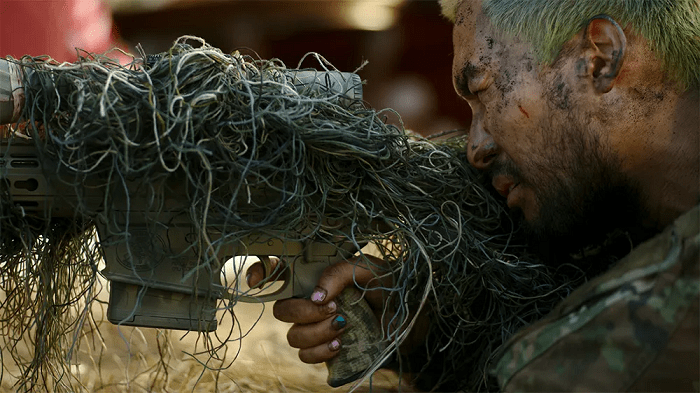
Along the way Garland hits us with some truly disquieting imagery. Teaming again with cinematographer Rob Hardy, Garland paints a disturbingly vivid portrait of a collapsed American society. The visuals are searing, brutal, and necessarily uncomfortable. At the same time, Garland’s simmering pacing maintains a steady feeling of unease. Regardless of where they stop, there’s never a sense that his four protagonists are out of danger.

It all culminates in a fierce and stunningly shot warfare sequence that brings everything we’ve seen to a violent and unsettling finish. It’s an ending that could be called grossly irresponsible IF there was ever a sense that Garland was conveying a sense of triumph. Instead the final shots leave you with the sickening feeling that things are only going to get worse. If it doesn’t, there’s a good chance you’ve missed the real genius behind Garland’s film.

Calling “Civil War” apolitical (as some have done) is a bit of a stretch. In fact it’s pretty obvious where Garland takes some of his cues. But he doesn’t get bogged down in the polarizing whys. He knows we will bring those to the table ourselves. Rather he wants us to think about the possible consequences of today’s contempt-driven division and consider our roles in it. And he examines it all through the lenses of war photographers, a sadly essential profession that can often miss the humanity for that one perfect shot. “Civil War” is in theaters now.

VERDICT – 4 STARS

REVIEW: “Cabrini” (2024)

Director Alejandro Monteverde follows up last year’s surprise box office hit “Sound of Freedom” with “Cabrini”, a gripping period epic that shares the profoundly moving story of famed Catholic missionary and future saint Francesca Cabrini. This biographical drama (penned by Rod Barr) follows Cabrini’s charity efforts on behalf of immigrant children in Five Points, New York City, while facing rampant bigotry, misogyny, and corruption from the local government as well as the church.

Born in 1850 near Milan, Francesca was the youngest of thirteen children and one of only four who lived past adolescence. She was born premature and remained in questionable health for the majority of her life. Yet she overcame countless obstacles beyond her health to help marginalized communities on her way to becoming the first American canonized by the Catholic Church. “Cabrini” powerfully portrays a slice of this remarkable life through Monteverde’s impressive direction, an array of technical savvy, and a stirring lead performance from Cristiana Dell’Anna.

Image Courtesy of Angel Studios

Dell’Anna’s dauntless yet empathetic portrayal of Mother Cabrini begins with her leading a small group of fellow nuns in Codogno, Italy. From there she travels to the Vatican after the latest of her many petitions to start a network of orphanages in China has been denied. After being brushed off yet again, she takes her case straight to Pope Leo XIII (a terrific Giancarlo Giannini).

It takes some lengthy persuading, but Mother Cabrini finally convinces Pope Leo to make her the first woman to lead an overseas mission for the church. But he has one condition. Rather than China, he wants her to go to New York City where waves of Italians have been immigrating. Poor, often illiterate, and rarely speaking English, the immigrants immediately face an uphill battle in their unwelcoming new country. Adding to the pressure of her mission, the Pope is quick to remind her that the entire church will be looking to her for proof of what women in her position can or cannot accomplish.

The frail but driven Mother Cabrini along with a small group of loyal nuns arrive in New York in 1889, ready to take over an orphanage in Five Points from a disillusioned Father Morelli (Giampiero Judica). What they find is an impoverished neighborhood riddled with disease, crime, and debauchery. The sisters immediately begin renovating the rundown orphanage before setting out to find homeless children and bringing them into their fold.

Image Courtesy of Angel Studios

It’s hard to see Mother Cabrini’s actions as anything but virtuous and noble. Yet she quickly finds herself running into all kinds of barriers. Some are placed by the local Archbishop Michael Corrigan (David Morse) who is terrified of ruffling the feathers of the area bigwigs. Others are placed by the racist, anti-immigrant Mayor Gould (John Lithgow) whose chief concern is maintaining his elitist vision of New York City.

Despite her failing health, Mother Cabrini fights for her mission, persistently seeking help from government officials, church leaders, press members, and even entertainers. Every hint of progress is met with resistance. Yet she pushes onward, determined to realize her “Empire of Hope”. Along the way she makes some valuable allies such as a former prostitute named Vittoria (Romana Maggiora Vergano) and a benevolent Irish doctor named Murphy (Patch Darragh).

The story of Mother Cabrini’s courage and commitment is inherently inspirational and affecting. Similarly the depictions of the countless roadblocks meant to deter her are unfathomable and infuriating. Monteverde artfully conveys it all while avoiding cliches, overwrought sentiment, and lazy histrionics. He’s aided by DP Gorka Gómez Andreu’s elegant yet uncompromising cinematography as well as the period-rich production and costume design. Then there’s the transporting score of Gene Back. His music walks us through a range of emotional highs and lows without ever feeling manipulative. And there are moments where his swells hearken back to classic big screen epics of old.

Image Courtesy of Angel Studios

Just as vital is Dell’Anna and her ability to relay so much through what remains a powerful yet subdued performance. Rather than a fiery tempest, Dell’Anna focuses on Mother Cabrini’s quiet determination and resolve to great effect. And it helps that she is surrounded a superb supporting cast most notably Judica, Morse, Lithgow, and Vergano. All fit incredibly well with their characters and are given good material to work with.

Obviously “Cabrini” is a movie about a religious figure. But it’s not what some would qualify as a “religious movie” – a label full of connotations that people like to project. It’s an enlightening historical biography. It’s a story of a fearless woman overcoming multiple patriarchal systems. It’s an uplifting testimony to the resilience of the human spirit. Despite the film’s lengthy 140-minute runtime, the ending feels a bit rushed. But other than that, there’s little fault to be found in this emotionally stirring and skillfully made feature. “Cabrini” hits theaters March 8th.

VERDICT – 4.5 STARS

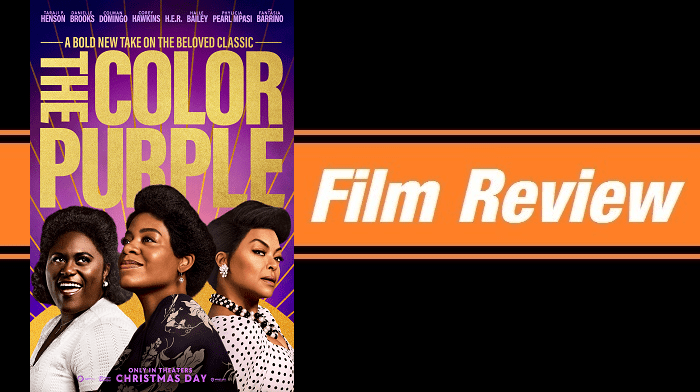
REVIEW: “The Color Purple” (2023)

Director Blitz Bazawule and screenwriter Marcus Gardley team up to give us the second big screen adaption of Alice Walker’s 1982 novel “The Color Purple”. The first movie released in 1985 and was directed by Steven Spielberg. He returns alongside Quincy Jones, Oprah Winfrey, and Scott Sanders to produce this enchanting but flawed update that is heavily inspired by the long-running, Tony award-winning musical.

At its heart “The Color Purple” is a moving coming-of-age period drama and Bazawule captures that essence most impressively in the film’s first half. From its sweeping opening to the story’s midway point, the movie simmers with powerful storytelling and spectacular musical numbers. Sadly it stumbles in the second half. The rousing and heartfelt tunes are still there, but the storytelling feels rushed, even patched together in spots. Certain character arcs get shortchanged and there is one particular redemption angle that doesn’t feel earned at all.

Image Courtesy of Warner Bros. Pictures

The story of “The Color Purple” begins in the early 1900s and spans over several decades. In a small African-American community near the Georgia coast lives 14-year-old Celie (Phylicia Pearl Mpasi) and her sister Nettie (Halle Bailey). The two are inseparable and have a joyous relationship. But the sisters live with a dark secret. Their vile and abusive father (Deon Cole) rapes Celie and has impregnated her twice. He then took her two babies and traded them off for the best deal.

A couple of years pass and Celie’s father sells her to the cruel and ruthless Albert “Mister” Johnson (a chilling Colman Domingo). He’s a banjo plucking farmer who immediately puts her to work cleaning his house and raising his kids. Mister is as violent as her father, and the physical abuse is only outdone by the psychological torment. Nettie moves in for a bit which offers Celie a welcomed respite. But when she’s forced to fight off Mister’s sexual advances, he throws her out leading Nettie to go far away.

As years go by Celie (now played by former American Idol winner Fantasia Barrino in her feature film debut) remains trapped under Mister’s rule with no real means of escape. Several more characters are thrown into the mix including Mister’s weak-minded son Harpo (Corey Hawkins), the great Louis Gossett Jr. as Mister’s crusty father, the scene-steaming firecracker Sofia (Danielle Brooks), and even David Allen Grier as a singing preacher.

And then Shug Avery (Taraji P. Henson) comes to town, a rowdy and popular blues singer who happens to be Mister’s former mistress. He’s still smitten with her despite claiming Celie as his wife. Yet rather than become rivals, Celie and Shug form a bond than only intensifies after Celie reveals the years of abuse she has endured from Mister. Shug is a striking presence but she sucks out most of the air from every scene she’s in. It’s not Henson’s fault, she’s quite good in the role. It’s more the writing and direction that at times can make her such an overpowering force.

Image Courtesy of Warner Bros. Pictures

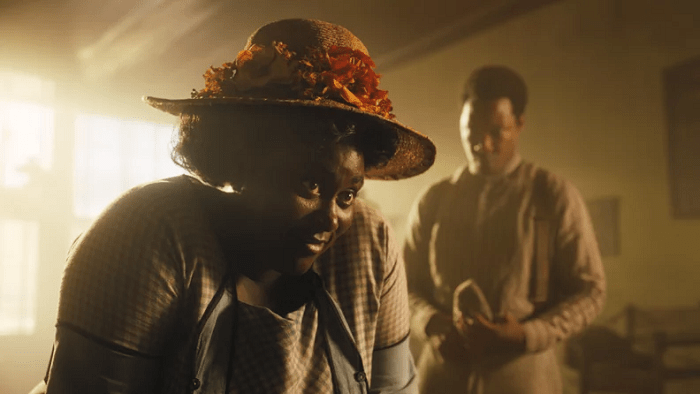
Over time I found myself less interested in Shug’s role and much more compelled by several other characters. Take Danielle Brooks’ Sofia, a veritable powder keg of righteous energy. It’s a big character and Brooks gives an equally big performance. But she steals so many scenes and belts out some of the film’s very best songs. I also wanted more of Squeak (played by R&B singer H.E.R.), Harpo’s second wife who has her own compelling story although most of it is left offscreen.

That leads (again) to the films’s biggest problem – it leaves too much off the screen specifically in the second half. That’s where Bazawule and Gardley seem to lose focus before rushing everything to a conclusion. Things like the above mentioned redemption angle that’s too thinly sketched and hurried to believe. Or Shug’s tense relationship with her father that’s mentioned several times but is barely explored. Perhaps 30 more minutes would have allowed time to fill in its holes. As it is “The Color Purple” is a frustrating tale of two halves – one half that’s among the very best cinema I’ve seen all year and the other half that can’t see it through to the end. “The Color Purple” hits theaters December 25th.

VERDICT – 3 STARS

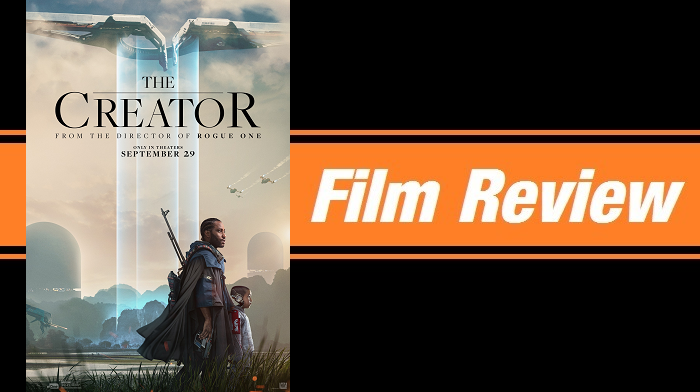
REVIEW: “The Creator” (2023)

If there ever was a 2023 movie that seems to have flown under many radars it would have to be “The Creator”. This ambitious science-fiction action thriller crept up with little fanfare yet left a significant impression with its eye-popping trailers. Now it’s in theaters and what we‘ve been given borders on extraordinary. This is a movie built around a bold original vision that begs to be experienced on the biggest screen available. Hopefully it finds a well-deserved audience.

“The Creator” is the brainchild of director and co-writer Gareth Edwards, the mind behind 2014’s “Godzilla” and 2016’s “Rogue One: A Star Wars Story”. This time he has stepped away from franchise movies and created something entirely his own – a thoughtfully conceived and incredibly well-crafted sci-fi epic brought to screen through a true visionary’s lens. Not everything clicks into place (more on that later), but as a whole it’s pretty remarkable.

Image Courtesy of 20th Century Studios

Storywise “The Creator” does what some of the best science-fiction movies do – it opens up and examines real-life current-day issues. In this case it’s several things including the growing AI debate. Visually it’s a breathtaking spectacle – an $80 million movie that looks ten-times better than most of the $200 million features we have gotten this year. Together they combine for some spectacular world building, immersing us in an enthralling war-torn dystopia that shrewdly combines the influences of “Blade Runner”, “District 9”, and even “Platoon” among many others.

Set in 2065, Earth has found itself on the brink. Robots created with hi-tech artificial intelligence gained independent thought and over time grew more advanced, even donning the faces of humans who have donated their likenesses. They’ve sought to assimilate into human society. But after a robot allegedly detonated a nuclear warhead in Los Angeles, incinerating nearly one million people, AI were banned in the West. As robots were being rounded up and destroyed, many fled to New Asia where AI manufacturing remained legal. There they built an army and soon they were at war with the West.

John David Washington plays Sgt. Joshua Taylor, an American special forces operative who we first meet on an undercover mission behind enemy lines in New Asia. He’s tasked with discovering the identity and whereabouts of Nirmata, the mysterious and inspiring leader of the AI. During his mission he fell in love and married Maya (Gemma Chan), a human ally to the robots who is pregnant with his child. But after a premature assault by American forces, Maya and their unborn child are presumed killed.

Image Courtesy of 20th Century Studios

Five years pass and a hardened Joshua is approached with information that Maya is alive and working alongside the AI in New Asia. He agrees to lead an assault on a lab where the AI are creating a super weapon. Backed by the truly ominous USS Nomad, an orbital station looming overhead, the Americans seek to destroy the weapon, level the lab, and end the war. Joshua’s goal is the find Maya and get her to safety before the assault commences. But things change when Joshua discovers the weapon is actually a 6-year-old AI girl who he dubs Alphie (Madeleine Yuna Voyles).

Believing the child can help him find Maya, Joshua disobeys orders and escapes with Alphie. This sets in motion the bulk of the film which follows their growing relationship while on the run. Joshua’s eyes inevitably begin to open while the American military’s violent fervor to destroy Alphie only intensifies. Edwards uses their journey to introduce a number of thoughts related to conspiracy theories, fearmongering, militarization, and justifying violence in the name of peace. Then of course you have the whole AI issue.

It goes without saying that Edwards has a lot on his mind. The themes he’s dealing with are rich although his positions can be overly simplistic and even sketchy in places. He often ignores more probing concerns and goes for surface level treatments instead. And his metaphors can be so glaringly on the nose that they sometimes lose their power.

Image Courtesy of 20th Century Studios

Elsewhere his story leans too heavily on some well-worn tropes without doing much new with them. Clichés pop up in the plotting and in some of the characters, especially the one-note American military. This issue is epitomized in an overly brawny Allison Janney who plays a prototypical cold-blooded Colonel without a hint of nuance. She barks out orders with a callousness that borders on comical. There’s never a doubt of whose side Edwards is on.

Yet despite the occasional sloppy messaging, “The Creator” remains a striking original work. The world Gareth Edwards has created is captivating and imaginative, full of evocative imagery and jaw-dropping spectacle. But equally important is the film’s human pulse. It never loses its heart. And when combined with its stunning visual palette, it makes it a lot easier to look past the movie’s rather noticeable issues. “The Creator” is in theaters now.

VERDICT – 4 STARS

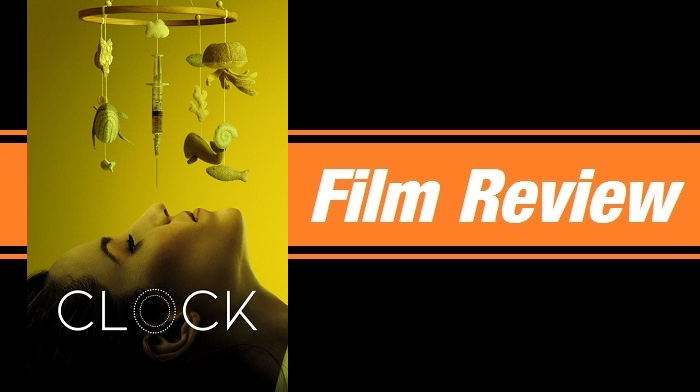
REVIEW: “Clock” (2023)

Hardly your run of the mill horror movie crowdpleaser, the Hulu Original “Clock” from writer-director Alexis Jacknow takes the genre to some unexpectedly interesting places. Adapting her own 2020 short film of the same name, Jacknow speaks to a number of compelling issues, exploring them through a horror framework in a way that can be genuinely disturbing.

“Clock” (which is Jacknow’s feature film debut) has a surprising thematic range. It takes on such topics as motherhood, childbirth, religion, peer pressure, and mental health in some cool yet weighty ways. Jacknow takes an interesting approach, starting her film with a satirical (and almost comical) bite. But the movie makes a pretty dramatic shift and the darker aspects of her story take over.

Image Courtesy of Hulu

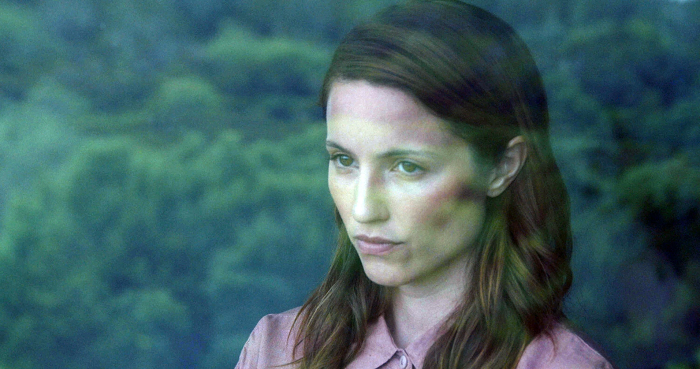
“The Clock” is anchored by a wonderfully committed lead performance by Dianna Agron who plays Ella Patel. She’s a smart and confident 37-year-old who has a successful career as an interior designer and a hunky husband named Aiden (Jay Ali) who adores her. Ella feels she has a wonderful life but there’s something missing (at least according to her gaggle of suburban mom friends and her hyper-opinionated Jewish father (Saul Rubinek).

You see, unlike her friends Ella hasn’t had a baby. In fact, she has never wanted to have children which blows the minds of her child-rearing peers. All they offer is unhelpful encouragement like “Don’t worry, your clock will kick in.” Meanwhile her father, who lost much of his family during the Holocaust, sees Ella’s position as an affront to their very history and heritage.

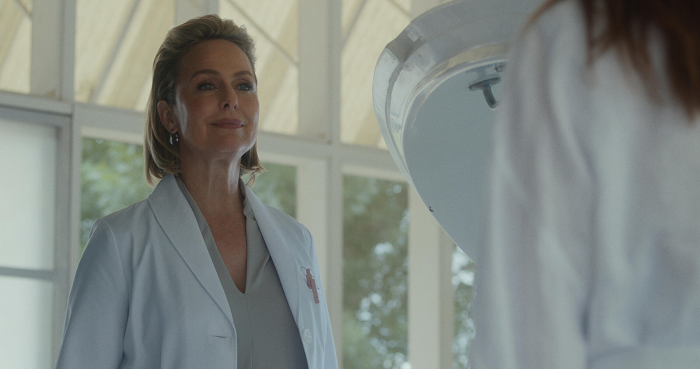
Caving to the notion that her biological clock is broken, Ella secretly pulls out of her dream job and enrolls in a clinical trial being conducted by a mysterious biotech firm at their remote facility. It’s led by Dr. Elizabeth Simmons (Melora Harden) who’s overseeing an intense and targeted 10-day study on “the cognitive side of fertility”. Rorschach tests, synthetic hormones, behavioral therapy – all meant to get Ella “realigned with her natural state”. What could possibly go wrong?

Image Courtesy of Hulu

Well as it turns out everything. As mentioned the story takes some dark turns as the “study” takes Ella to some unsettling places within herself. There is some twisted imagery and a handful of gnarly scenes that I guarantee will make you squirm. Through it all Agron gives us a compelling lead character to latch onto. Her performance remains strikingly authentic even as things steadily get more surreal and unnerving.

As it slowly unfolds the film’s deeper thematic interests come more and more into focus. Jacknow uses her strange but engaging premise to pose a number of compelling questions. Storywise it does have a few holes and parts are simply too far-fetched to look past. Yet it never loses its emotional punch in large part thanks Agron’s performance and Jacknow’s ability to keep us engaged till the very end. “Clock” is now streaming on Hulu.

VERDICT – 3 STARS

REVIEW: “Champions” (2023)

(CLICK HERE to read my full review in the Arkansas Democrat Gazette)

Despite their predictability and penchant for re-plowing old ground, many of us still love sports movies. We love feel-good moments. We love rooting for the underdogs. We love redemption stories. We love the competition. We love the camaraderie. We love seeing individuals or teams overcome insurmountable odds. Borrowing the words of the late great Jim McKay, we love “the thrill of victory and the agony of defeat”.

This latest sports movie to come down the pike epitomizes what you get when the above two contrasting elements come together. “Champions” is every bit as predictable and formulaic as any sports movie that came before it. There’s hardly a story beat that you haven’t seen before, and you’ll know the outcome within the first 15 minutes. Yet it also checks some of the boxes that fans of sports movies are looking for. And as an added bonus it stars Woody Harrelson, a genuinely funny actor who can play snarky wisecracking characters in his sleep.

Harrelson plays plays Marcus Marakovich, an assistant coach for the Iowa Stallions of the G League (the NBA’s minor league basketball organization). Marcus has a brilliant mind for basketball, but is terrible at building relationships which has led to him being fired as the head coach for Ohio State and kicked out of several international leagues. So now he’s stuck in Des Moines, working under his friend and the Stallions’ head coach Phil Perretti (Ernie Hudson). But his eyes are set on making it to the NBA, no matter what it takes.

Image Courtesy of Focus Features

But things go sideways after an ugly on-court incident with Phil. To make matters worse, Marcus gets behind the wheel after knocking back a few too many drinks at a local bar. He rear-ends a police car and is arrested and booked for driving under the influence. The judge gives Marcus a choice – 90 days of community service at a local recreation center coaching adults with intellectual disabilities or 18 months in prison. The choice he makes turns out to be life-changing.

Marcus meets the rec center’s manager Julio (Cheech Marin) who introduces him to his new team, The Friends. They’re a fun and charismatic collection of characters with disabilities. Among them is the animal-loving but shower-hating Johnny (Kevin Iannucci), a brainy fact-dropping chatterbox named Marlon (Casey Metcalfe), the hard-working and easy-going Benny (James Day Keith), the straight-shooting Consentino (Madison Tevlin), and the cryptic Darius (Joshua Felder), the team’s best player who refuses to play for their new coach.

At first, all Marcus sees in his players are their disabilities. But over time his eyes are opened and he begins to see them for who they are underneath. He begins to see them as people with their own personalities, their own feelings, their own backgrounds. He even strikes up a no-strings-attached relationship with Johnny’s sister, Alex (Kaitlin Olson). The closer he gets with the team, the better they begin to play. And before long The Friends find themselves in the hunt for a spot in the upcoming Special Olympics.

Image Courtesy of Focus Features

“Champions” is the solo directorial debut for Bobby Farrelly, one half of the mischievous (or notorious, depending on how you look at them) Farrelly brothers duo. Written for the screen by Mark Rizzo, the film is an adaptation of a 2018 Spanish film of the same name. Rizzo reinvents some of the characters and changes some of the details, but the core story remains the same. Unfortunately the movie has its issues, some of which can best be described as the Farrelly effect.

By all accounts this could easily have been a funny feel-good movie for the whole family. But in very Farrelly fashion, the filmmaker can’t resist the urge to be bawdy and crude. It makes me wonder exactly what audience he’s targeting. Even worse, some of the gags seem to be taking advantage of the characters’ disabilities and exploiting them for laughs. That’s not me being overly sensitive as some of the humor from those same characters works extremely well. But you can tell when jokes seem written solely for affect. That happens too often in “Champions”

Yet despite its predictability and few instances of poor judgment, “Champions” has enough crowd-pleasing mojo to make it worth sitting through. And it also has Woody Harrelson who carries much of the movie on his back. It’s hard not to love the young cast of intellectually disabled actors who give their all and are clearly having a great time. But Harrelson is the anchor. He’s funny, even a little charming, and without him “Champions” would have a tough time staying together.

VERDICT – 3 STARS