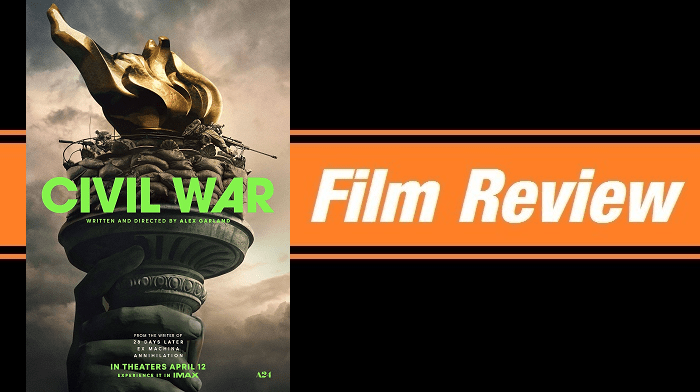
Filmmaker Alex Garland has provoked a wide range of responses with his latest film “Civil War”. In partnership with A24, Garland’s dystopian war film has prompted some to say he goes too far while others say he doesn’t go far enough. Some have called him irresponsible for releasing such a film at such a precarious time while others have proclaimed this as exactly the kind of movie we need right now. Some believe it will open eyes yet others say it will only further divide.
As with most opinions colored (at least in part) by personal politics, it’s hard to gauge the truth in some of the reactions that are out there. So as is often the case, it’s best to go to the movie itself and make up your own mind. In doing so, I found that “Civil War” falls somewhere in the middle which is sure to frustrate the two unforgiving extremes. The movie’s politics are vague enough so that all sides might listen, pay attention, and perhaps consider the path our country is on.
But at times even that feels deeper than writer-director Garland wants to go. Through much of “Civil War” he seems more interested in examining the heroism yet murky ethics of wartime journalists. And I’m guessing that has fueled many of the frustrations. After all, if you’re opening up such potent ideas during what many perceive to be a tinderbox era of American history, wouldn’t you take some kind of position? I’m sure Garland has his beliefs, but he’s more interested in ours. He trusts that we’ll use those beliefs to define things for ourselves. He’s merely showing us the potential consequences and issuing a warning that every side should heed.
The story takes place in a dystopian near future where the United States isn’t so united. The current President (played by Nick Offerman) is a dictator who’s currently serving his third term. He has seen America fracture under his watch with a number of militant groups forming across the country. The most powerful of the rebel factions are the Western Forces – a coalition formed between California and Texas. The escalating tensions between the President’s regime and the WF eventually ignites a second Civil War.
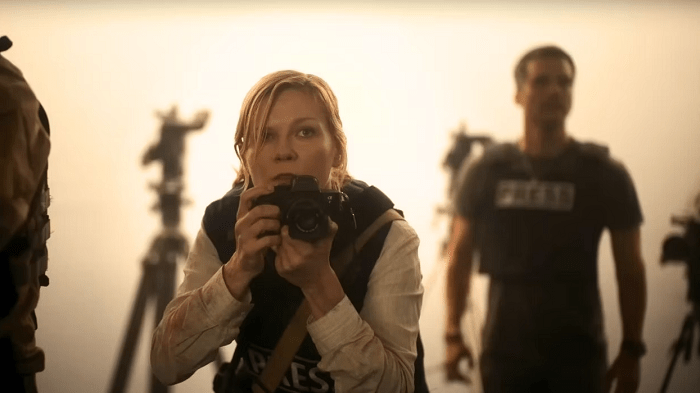
An intensely captivating Kirsten Dunst stars as Lee Miller, a renowned war photographer who has grown cold and callous from the countless conflicts she has covered. This comes through clearly in the film’s opening scene where she and her colleague Joel (Wagner Moura) are shooting a riot in New York City. After a suicide bomber detonates herself in a huge crowd of people, Lee’s first impulse is to take pictures rather than check for survivors. She does manage to save the life of a young aspiring war photographer and fangirl named Jessie (a terrific Cailee Spaeny).
With Joel scheduled for an extremely rare one-on-one interview with the President, he and Lee prepare to set out to Washington DC. Lee agrees to let veteran journalist and mentor Sammy (Stephen McKinley Henderson) hitch a ride against Joel’s wishes and Joel agrees to let Jessie tag along against Lee’s. The four take off on a perilous road trip, avoiding the war-ravaged bigger cities for the unknowns of the lawless rural areas which prove to be far more dangerous than the group were prepared for.
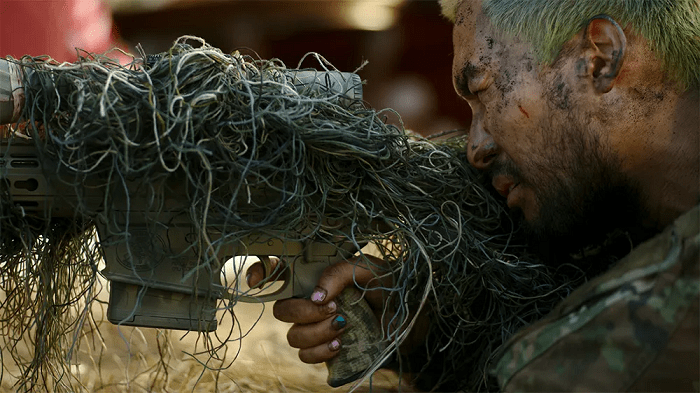
Along the way Garland hits us with some truly disquieting imagery. Teaming again with cinematographer Rob Hardy, Garland paints a disturbingly vivid portrait of a collapsed American society. The visuals are searing, brutal, and necessarily uncomfortable. At the same time, Garland’s simmering pacing maintains a steady feeling of unease. Regardless of where they stop, there’s never a sense that his four protagonists are out of danger.
It all culminates in a fierce and stunningly shot warfare sequence that brings everything we’ve seen to a violent and unsettling finish. It’s an ending that could be called grossly irresponsible IF there was ever a sense that Garland was conveying a sense of triumph. Instead the final shots leave you with the sickening feeling that things are only going to get worse. If it doesn’t, there’s a good chance you’ve missed the real genius behind Garland’s film.
Calling “Civil War” apolitical (as some have done) is a bit of a stretch. In fact it’s pretty obvious where Garland takes some of his cues. But he doesn’t get bogged down in the polarizing whys. He knows we will bring those to the table ourselves. Rather he wants us to think about the possible consequences of today’s contempt-driven division and consider our roles in it. And he examines it all through the lenses of war photographers, a sadly essential profession that can often miss the humanity for that one perfect shot. “Civil War” is in theaters now.
VERDICT – 4 STARS