REVIEW: “Die My Love” (2025)

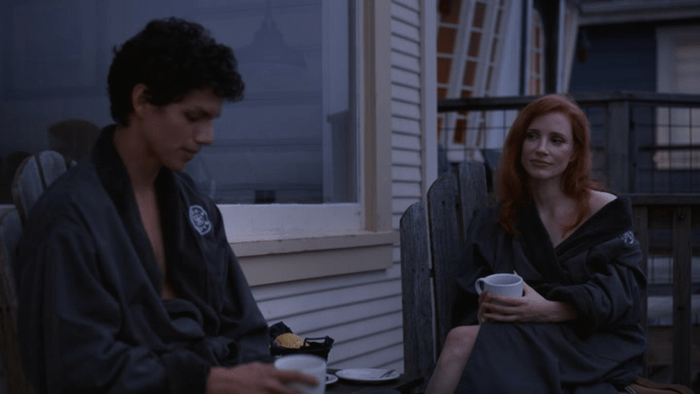
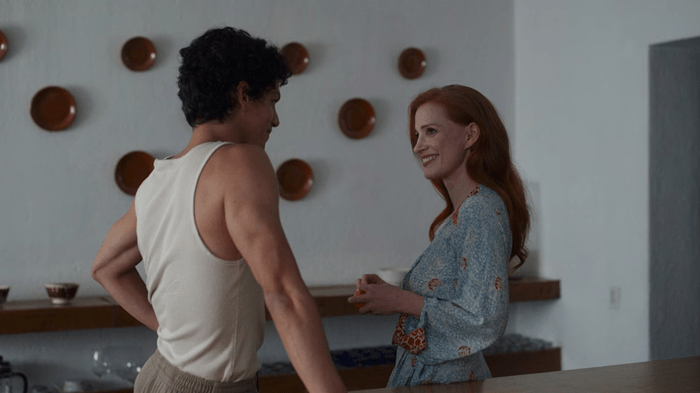
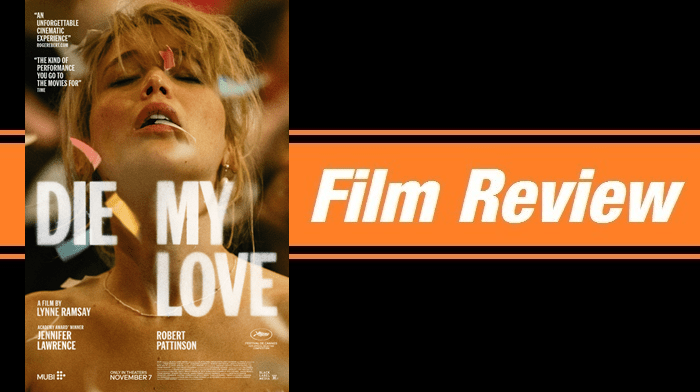
Jennifer Lawrence and Robert Pattinson are a couple trapped in a doomed relationship in director Lynne Ramsay’s grueling new feature, “Die My Love”. This is her first film since 2017’s much different but equally grim “You Were Never Really Here”. Though based on a 2012 Ariana Harwicz novel, Ramsay’s adaptation says nearly everything it has to say within the first half-hour. The remaining 90 minutes plays like misery porn as we watch a woefully unhappy woman barreling towards destruction.

“Die My Love” is written by the trio of Ramsay, Enda Walsh, and Alice Birch. Their story pitilessly blends motherhood and madness in a way that is surprisingly cold and unforgiving towards the lead characters, the lead cast, and the audience. It toys with such themes as postnatal depression and isolation. But Ramsay’s smothering approach spends more time breaking down and laying bare Lawrence’s character (as much physically as psychologically) than doing much meaningful with the themes that are introduced.

Image Courtesy of Mubi

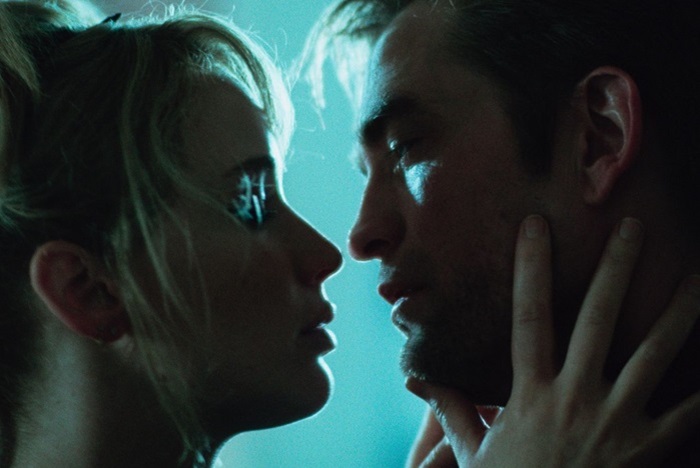
The film opens by introducing us to an unstable young couple, Grace (Lawrence) and Jackson (Pattinson). The two have moved away from the hustle and bustle of the big city to an old house in rural Montana that Jackson inherited from his late uncle. The couple settles into their new home, and following a rather ludicrous sex montage, they have a baby boy. From there to the final frame, the movie follows the slow disintegration of their ill-fated relationship.

Both Grace and Jackson are dissolute and self-destructive, to such a degree that we know things aren’t going to end well. But while Jackson has his own set of issues, it’s Grace who finds herself in the center of Ramsay’s sights. She’s a stalled writer who loses all inspiration and motivation after becoming a stay-at-home mother. She gets little support from Jackson who is off working for days at a time. And when he is home, his insensitivity (which seems to spring from nowhere) only pushes her closer to the edge.

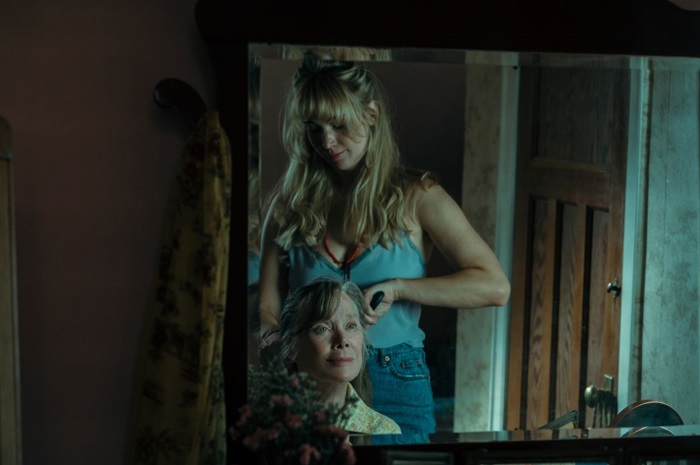
But none of this is especially surprising considering Grace and Jackson never really feel like a true-to-life couple. They never have real-world conversations and so many of their interactions appear staged for the camera. Brief supporting work from Sissy Spacek and Nick Nolte does more to ground Grace and Jackson than anything they do together. It’s a critical issue that leaves us with two shallow and intemperate hipsters rather than an organic couple with actual depth and complexities.

It ends up being all about Grace and her downward spiral. Her behavior gets increasingly bizarre, soon resembling full-on psychosis more than postpartum depression. Lawrence fully commits, crawling around on all fours, rabidly barking at Jackson’s annoying dog, furiously clawing away at wallpaper until her fingers bleed, throwing herself through a glass door, and randomly taking off her clothes whenever Ramsay asks. It’s the kind of performance awards voters often fall for, yet here it feels so hollow.

Image Courtesy of Mubi

Unlike Ramsay’s previous films, “Die My Love” is full of empty provocations that are more interested in shocking the audience than challenging us with substance. When not assaulting us with weird needle-drops and stylistic flourishes, Ramsay is sprinkling gasoline on the fire that is Grace’s sanity. And for what purpose? The movie has already played its hand by the 20-minute mark. Even later, when we’re led to believe Grace is “better”, we can easily see through her sudden turn towards domesticity.

“Die My Love” ends up being a maddening experience. It’s essentially the equivalent of lighting a fuse and waiting two hours for your main character to finally blow. It’s just pointless misery with rarely a reprieve. Ramsay is a talented filmmaker who is no stranger to working with dark and unsettling material. But with “Die My Love”, she seems too focused on her own abrasive formalism and with pushing her acclaimed lead actress to ridiculous lengths.

VERDICT – 2 STARS

REVIEW: “Deathstalker” (2025)

At the risk of once again dating myself, I miss the glory days of 1980s Sword and Sorcery movies. I grew up losing myself in the fantastical worlds created in movie like “Conan the Barbarian” (1982), “Clash of the Titans” (1981), “Beastmaster” (1982), “Krull” (1983), “Red Sonja” (1985), and “Dragonslayer” (1981). While fantasy adventures have continued in things like “The Lord of the Rings” and “Dungeons & Dragons: Honor Among Thieves”, the 80s Sword and Sorcery films had a spirit all their own.

Enter “Deathstalker”, a 2025 release that is an 80s styled Sword and Sorcery movie through and through. It’s passionately written and directed by Steven Kostanski, the man behind 2020’s genre explosion “PG: Psycho Goreman”. Now if you’re at all familiar with “PG” you’ll have a feel for the style of filmmaking you’ll see in “Deathstalker”. It’s almost playfully violent and unashamedly gory. But better than that, it’s a practical effects-driven feature that never lets its modest budget lessen its huge ambition.

Image Courtesy of Shout! Studios

“Deathstalker” is technically a remake of the 1983 Roger Corman produced movie of the same name. Kostanski is faithful to the original film in presentation, narrative style, and tone, but he tells a much different story. While scavenging a fresh, corpse-littered battlefield in the war-torn kingdom of Abraxion, a former soldier in the Queen’s army known as Deathstalker (actor, stuntman, and martial artist Daniel Bernhardt) recovers a gold amulet. His plans are to sell it for a tidy profit. But those plans quickly fall apart.

Deathstalker learns the amulet is cursed and magically bound to whoever possesses it. Unable to rid himself of the cursed relic, he sets out on a journey to find someone who can. Along the way he’s joined by a quirky sorcerer named Doodad (physically captured by Laurie Field and voiced by Patton Oswalt) and later an impulsive thief named Brisbayne (Christina Orjalo).

But there are others who want the amulet for their own nefarious purposes, namely a powerful necromancer named Nekromemnon (Nicholas Rice). He intends to unleash the amulet’s power to destroy the world and then rebuild it as he sees fit. So Nekromemnon sends out a host of assassins to kill Deathstalker and bring the amulet to him. And that sets up the bulk of the movie as Kostanski straightforwardly steers us from one action-packed and blood-drenched sequence to another.

Overall the story is fun, routinely silly, and proudly in-tune with the movies that inspired it. Admittedly the mythology is a little muddled and there is a tad too much exposition. But the cheeky sense of humor ensures it’s never taken too seriously. And the world-building is fittingly fantastical and full of imagination. It features many interesting locations that are populated by such creatures as two-headed trolls, witches, pig soldiers, swamp monsters, the reanimated dead, and so on.

Image Courtesy of Shout Studios

But the most fun is found in the movie’s special effects. You could almost consider “Deathstalker” to be a celebration of the practical effects era. Kostanski and his team put aside the prominent digital approach of today. Instead they go a more handcrafted route, using an amazing combination of stop-motion animation, richly detailed makeup and costumes, latex masks, prosthetics, bodysuits, and an assortment of sets and props. As with the movies from the genre’s heyday, the effects are sometimes obvious. But artistry can shine brightest in the imperfections. And there’s something refreshing about seeing a creative vision without the slick polish of CGI.

“Deathstalker” turns back the clock to an era when bringing your imagination to life required more than computer programs and green screens. It takes us back to a bygone era of Sword and Sorcery adventures, telling a ridiculously entertaining story and creating an inspired world of wonder despite its budget limitations. It does it all with a sincere passion but also an ever-present sense of self-awareness. Those two ingredients are essential in making “Deathstalker” a glorious throwback experience.

VERDICT – 4 STARS

REVIEW: “Dolly” (2025)

Rod Blackhurst makes his feature directorial debut with a film that hearkens back to the pulpy horror movies from 1970s which found new life on video store shelves in the 1980s. “Dolly” transports us back to the grindhouse with its noticeably low budget, gritty aesthetic, and unflinching graphic violence. At the same time we see flashes of the same artistic merit that made Tobe Hooper’s “The Texas Chain Saw Massacre” stand out from its contemporaries.

Now I don’t want to get too carried away. “Dolly” isn’t up there with Hooper’s seminal horror classic and I don’t think it’s trying to be. Instead Blackhurst (who also co-wrote the script with Brandon Weavil) embraces his clear inspiration and deep affection for genre films by both paying homage and adding his own deranged flavor. The result is an effectively chilling and delightfully twisted horror throwback that has just the kind of kick genre fans will relish.

Blackhurst and Weavil break their story into seven or so chapters with such titles as Mother, Daughter, Home, Reunion, etc. While it’s hardly significant or even necessary, the chapter structure strangely fits well and adds to the story’s macabre tone. As for the small cast of characters, we meet Macy (Fabianne Therese) and her boyfriend Chase (Seann William Scott) as they’re dropping off his daughter before heading out for a hike in the mountains. But it’s no normal couple’s getaway. Chase plans to ask Macy to marry him. Little does he know, Macy isn’t sure she’s ready to be a wife or a step-mother.

After taking a nature trail through the forest, Chase and Macy arrive at his favorite overlook. But before he can pop the question, Chase breaks his own rule and leaves the trail to investigate the eerie sound of music from a toy radio. When Chase doesn’t return, Macy goes looking for him. But instead she encounters a hulking non-verbal mother figure named Dolly (played by American pro wrestler Max the Impaler) who knocks Macy unconscious and carries her to an old house deep in the woods.

Macy eventually wakes up to find herself in a disturbing situation. She’s in an upstairs nursery, wearing baby girl clothes and awkwardly lying in an oversized bassinet. Just as Macy comes to her senses and begins looking for a way out, Dolly bursts in. She’s an imposing figure, wearing a tattered dress and a crude Porcelain doll head, who wants to raise Macy as her child. It’s a twisted scenario made even more unsettling with the revelation that Macy is the latest of many who have brutally suffered and died by the bloodstained hands of this unhinged ‘mother’.

Much like Hooper’s classic, things only get more depraved and bizarre the longer we stay in the house. Dolly’s delusion starts with pacifiers and baby bottles before devolving into something dramatically more shocking. And her warped motherly instincts are routinely interrupted by unstable fits of self-loathing rage. It makes the unstable Dolly even more terrifying. Meanwhile Therese, channeling her very best Marilyn Burns, shows Macy’s indomitable will to live which fuels her fight for survival, setting up several killer throwdowns with her captor.

“Dolly” was filmed over the course of 19 days on location in Chattanooga, Tennessee. Lovingly shot on Super 16mm, the lo-fi visual style alone has a transportive effect. It shrewdly calls back to the many similar films that paved its way. But it also plays a big part in capturing and sustaining the mood and atmosphere Blackhurst is going for. Equally essential is the assortment of crafty camera techniques he and DP Justin Derry employ including tilt shots, tracking shots, high angles, wide angles, intense close-ups, even a classic iris shot.

“Dolly” flaunts a premise that is as outrageous as it is creepy. It’s not for the squeamish, especially as the horror progressively turns more grisly. Yet there is a darkly comical undercurrent that Blackhurst knowingly embraces. Even with the hints of pitch-black humor, it’s easy to be unnerved by Dolly’s merciless psychosis, her grimy blood-splattered home, and some gnarly practical effects that have no shortage of blood and gore. These things alone meld into something wildly satisfying. But it’s the distinct throwback style that makes this catnip for genre junkies like me.

VERDICT – 4 STARS

REVIEW: “Die’ced: Reloaded” (2025)

In 2023, filmmaker Jeremy Rudd directed, wrote, and produced a 50-minute slasher horror short film called “Die’ced”. Almost immediately ideas sprang up for a feature length version. Rudd brought back many of his original cast members and crew, added about 25 minutes to the runtime, and with the help of horror distributor Dread, has made and released what he is calling Die’ced: Reloaded”.

“Die’ced: Reloadedshares some obvious similarities with the first Terrifier movie. It was made on a limited budget. Most of that budget went toward the gloriously gory makeup and effects. And for much of the film the story can feel like an afterthought. But for the most part it knows what it wants to be – an exceptionally brutal slasher set in the 1980s and made in a style reminiscent of the 1980s. In that way it succeeds. “Die’ced: Reloaded would feel right at home on VHS in the horror section of a video rental store.

Image Courtesy of Dread

Rudd kicks things off with a fitting introduction to his big baddie, Benjamin Newman (played by Jason Brooks). When we meet him, Benjamin has spent the last 17 years in an insane asylum after brutally butchering his family. Diagnosed with dissociative identity disorder, Benjamin believes he is a kid and finds childlike joy in killing. And for reasons never explained (but to make him a little creepier), he wears a ghastly mask made out of a paper plate.

A few miles away in a Seattle suburb, a high school teen named Cassandra (Eden Campbell) lives with her brother Tommy (Collin Fischer) and their father (Nigel Vons). The siblings have had a rough go since their mom up and left them. The mystery around their mom’s exit is something the movie could have built up better, and it’s begging to be explored further. As it is, it’s a plot point that doesn’t get much attention until it’s too late.

On October 31st (because what better time to have a killing spree), Benjamin gruesomely slaughters his doctor and nurses before venturing off to the above mentioned Seattle suburb. Once there he breaks into a house, murders its owner, and then steals their scarecrow costume. Not far away, Cassandra heads out for a Halloween party where she and her disposable best friend character drink some beer and chat meaninglessly about boys. But the high school tedium is short-lived and the inevitable slaying quickly begins.

Image Courtesy of Dread

While there’s barely enough story to fill its lean 75 minutes, it ends with a wild spray of information that could have added more meat to the rest of the movie. Instead it feels tacked on and underdeveloped. As for the 1980s setting, there’s so much more they could have done with that wildly distinct decade. But there’s not much that stands out, aside from the cool synth-pop score by composer Night Wolf.

But those things aside, Die’ced: Reloaded maintains a certain B-movie charm that’s hard to deny. And despite its obvious budget constraints, Rudd, along with his special effects coordinators Jason Brooks and Joe Castro, know what slasher fans want. They make sure there is enough fun to be had and more than enough gore splattered around to make overlooking the film’s other issues a little bit easier. Die’ced: Reloaded a available now on VOD.

VERDICT – 2.5 STARS

REVIEW: “Dangerous Animals” (2025)

Shark movies are a dime-a-dozen these days and it seems like we get several new ones each year. We’ve reached a point to where it’s rare to find a shark movie that offers something original. “Dangerous Animals” certainly does, although reducing it to a simple shark movie is patently unfair. It’s more of a high-stakes blend of deepwater horror and serial killer tension. And it’s driven by a brilliantly menacing Jai Courtney.

Directed by Sean Byrne, “Dangerous Animals” tells a taut tale that is unquestionably outrageous yet never feels outrageous in the moment. That’s because Byrne has a good grip on screenwriter Nick Lepard’s material and he knows how to immerse his audience in the kind of movie he’s making. There’s a nastiness to it that approaches exploitation yet Byrne (smartly) doesn’t take things too seriously. It results in a visceral and at times darkly funny genre cocktail that stands as one of the bigger surprises of the year.

Image Courtesy of IFC Films

Hassie Harrison plays Zephyr, a free-spirited American surfer living out of her van on Australia’s Gold Coast. Old baggage from her past led her to become a loner. But we see a small crack in her self-established walls when Zephyr meets Moses (Josh Heuston), a sweet and smitten real estate agent who also enjoys surfing. After spending the night together, Zephyr takes off to wrestle with these newfound feelings she has.

But before their potentially cheesy love story can get off the ground, things take a terrifying turn. While parking her van near the beach for the evening, Zephyr is attacked, sedated, and kidnapped. She wakes up in a metal room with another young woman named Heather (Ella Newton). We quickly learn they’re in the belly of a ship belonging to the burly Tucker (Courtney).

Tucker takes vacationers out to sea for private underwater shark encounters. But that’s just a facade. In reality he’s a maniacal serial killer who gets his kicks chumming the water and then feeding his victims to the sharks. To make it more unsettling, he films their gruesome deaths with an old VHS camcorder. And let’s just say he has a pretty large home movie collection. But the determined and resourceful Zephyr proves to be Tucker’s biggest challenge and she’s not willing to go down (literally) without a fight.

Image Courtesy of IFC Films

Within the first ten minutes it becomes obvious the title “Dangerous Animals” is referring to more than the well-known ocean predators. The much bigger threat is Tucker who is as mesmerizing as he is sadistic. Courtney is a psychotic force of nature, delivering a brawny, unnerving performance that’s laced with a disarming charm. Byre gives Courtney room to create a truly memorable villain, leaning into his star rather than over-explaining his character’s psychopathy.

“Dangerous Animals” hits its mark thanks to its straightforward storytelling approach and a truly sinister undercurrent. The film is a nail-biting thriller at heart but with a chilling horror movie edge. Add in a dash of sharksploitation and a career best performance from Jai Courtney and you’ve got a wildly entertaining feature with a gnarly B-movie bite. See it on the big screen; see it with a crowd. “Dangerous Animals” opens June 6th exclusively in theaters.

VERDICT – 4 STARS

REVIEW: “Death of a Unicorn” (2025)

Alex Scharfman writes and directs “Death of a Unicorn”, a bonkers horror comedy that is another in a long line of ‘eat the rich’ satires. The movie’s title serves as a good nuts-and-bolts overview of the story. But the film’s ultimate interest is in skewering the uber-wealthy through an outlandish scenario that may be a bit uneven in spots, but that ultimately finds a good rhythm amid the slew of gags and gore.

The movie opens up with Elliot Kintner (Paul Rudd) and his daughter Ridley (Jenna Ortega) on their way to a weekend retreat hosted by his boss, Odell Leopold (Richard E. Grant). As they drive through the forest-covered mountains (filmed in beautiful Hungary) we learn quite a bit about them. First, they seem to have very little in common – she is a committed young leftist; he’s a corporate stooge. Making matters worse, their relationship has been strained following the recent death of his wife and her mother.

Image Courtesy of A24

For Elliot, this weekend gives him a chance to reconnect with his daughter. But it’s mostly about impressing the sickly Odell who is dying of cancer and considering promoting Elliot to the top spot in his pharmaceutical firm. That becomes a running conflict for most of the movie – Elliot’s obsessive ambition for a new position versus his responsibilities to his hurting daughter.

But everything turns upside-down after their car collides with and appears to kill (of all things) a unicorn. As Elliot scrambles to compose himself, Ridley checks on the animal, having some out of body experience in the process. The two make the bizarre decision to load the unicorn carcass in the back of their SUV and drive on to the Leopold’s lavish enclave where they pretend like nothing happened.

But let’s be honest, how does one keep a dead unicorn in the trunk a secret? Through ways I won’t reveal, the Leopolds find out about the unicorn and are just as shocked as Elliot and Ridley. But when it’s discovered the unicorn possesses unexplainable curative attributes, a cured Odell immediately sees dollar signs. So he puts his on-site science team to work replicating the unicorn’s magical properties. Ridley is against what they’re doing but has no allies, not even her father who’s still looking out for his promotion.

But little do they know, the unicorn’s parents are looking for their foal. And when the one-horned creatures find their baby dead, “Death of a Unicorn” quickly evolves into a graphically violent revenge movie that manages to get funnier with every hyper-gory kill. Admittedly it gets incredibly silly. But Scharfman knows what he’s going for, and the movie’s obvious self-awareness is a key reason it works so well.

Image Courtesy of A24

Another reason it works is the fully committed cast. Rudd and Ortega have a natural father-daughter chemistry that their relationship needs. Meanwhile it’s the Leopolds who provide the laughs. Grant is so good in these roles and it’s no different here. But even funnier is Téa Leoni as Odell’s glaringly phony wife Belinda and Will Poulter as their spoiled and pampered nitwit son Shepard. The latter two delivery one funny line after another, exposing their characters’ insensitivity and entitlement in laugh-out-loud fashion.

Despite how “Death of a Unicorn” may sound, it’s effortlessly easy to get onboard with the wackiness. Scharfman knows how to lure us in. And his keen management of tone and steady flow of humor keeps our expectations in check. Admittedly it would have been nice to see a little more serious attention given to the daughter-daughter relationship at the story’s core. And the movie’s message is far from profound. But it’s hard to complain too much when you’re steadily laughing at the many gags and playfully gasping at the gory retribution.

VERDICT – 3.5 STARS