REVIEW: “Dark Passage”

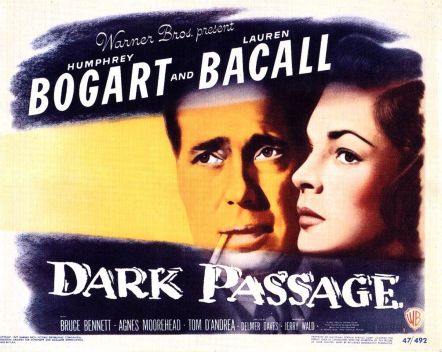
Dark Passage poster

Bogart and Bacall. Those three words always bring a smile to my face. They point to an enchanting onscreen chemistry than spanned four movies and eventually into their offscreen lives. Bacall’s beauty and saucy smarts was always the perfect match for Bogie’s cool tough guy. “Dark Passage” was the third movie that the headline-grabbing couple made together and at the time Bogart was the highest paid actor in Hollywood. The great Delmer Daves directed and wrote the screenplay for this clever film noir that had several unique tricks up its sleeve.

This film opens with a tense and brilliantly crafted jailbreak. Actually we never see the inside of San Quentin but we spot a man hiding in a barrel being driven off in a truck. Just down the road from the prison the barrel rolls off and the man is loose. Through a number of cool bits of camera trickery we never see the face of the escaped convict although we do hear his voice. Instead everything in this opening sequence is shown to us in first person. This treats the audience to a number of tricky perspectives that Daves pulls off beautifully. We learn from a radio alert than the convict’s name is Vincent Parry (Bogart) and he’s wanted for the murder of his wife.

PASSAGE1

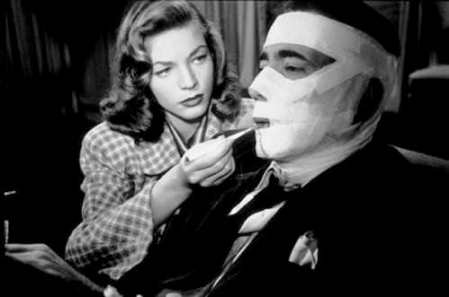
Parry is picked up by a mysterious young woman named Irene Jansen (Bacall). We learn that Irene is sympathetic towards Parry after believing he didn’t get a fair shake during his trial. She sneaks him past roadblocks and into San Francisco where he sets out to find his one and only friend George (Rory Mallinson). He also connects with a back-alley plastic surgeon who attempts to alter his appearance. Now keep in mind, up to this point we still haven’t seen Vincent’s face. Bogart works in the shadows or strictly through voice work from the first person perspective. After the surgery we finally see him only in full facial bandages. It’s not until about an hour in that the bandages are removed and we see Bogie’s mug for the first time.

We see the few central players during the first half of the film but it isn’t until Parry’s new face is revealed (in the image of Bogart) that the story changes direction. It becomes Parry’s quest to clear his name and to find out who really killed his wife. While the unfolding mystery is an interesting shift it is also a weakness. For such a dramatic setup, the revelation itself is pretty lightweight and how things unfold seems a little too on the nose. It’s not that it’s awful, but there was clearly room for a stronger and better conceived mystery.

Despite that, “Dark Passage” is still a wonderful movie because of the cool and stylish camera work, the great San Francisco locations, and the sizzling chemistry between Bogart and Bacall. There are also some really nice supporting performances from Bruce Bennett, Tom D’Andrea, Agnes Moorehead, and Rory Mallinson. “Dark Passage” sometimes gets lost in the conversations about Bogart and Bacall’s collaborations, but it’s a clever noir that does several things to set itself apart. It may soften up a tad in the third act but it is still a ton of fun.

VERDICT – 4 STARS

REVIEW: “Dawn of the Planet of the Apes”

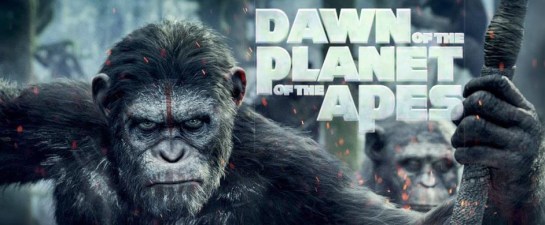
DAWN POSTER

While it may have one of the clunkiest movie titles of 2014, that hasn’t stopped “Dawn of the Planet of the Apes” from raking in loads of praise from critics and even more cash at the box office. I have to admit I’m surprised at how this franchise has found life again. I love the original 1968 classic, but frankly this doesn’t seem like the type of series that would appeal to the modern movie sensibilities of many of today’s moviegoers. The 2011 franchise reboot along with its $480 million box office grab proved me wrong. And of course when you make that kind of money you know there is going to be sequel.

I liked the first installment of this reboot but I didn’t see it as the gem that many did. This time around we have a new director and an overhauled cast but the writing team stays intact which you can sense from the first act. In what has become a very familiar way to setup these types of films, the movie opens with snippets from newscasts explaining the state of the world since the events of the first film. Human civilization has collapsed, ravaged by the effects of a deadly simian flu which decimated the population and triggered near apocalyptic after-effects. In other words things on earth are pretty bad, that is unless you are an ape.

DAWN1

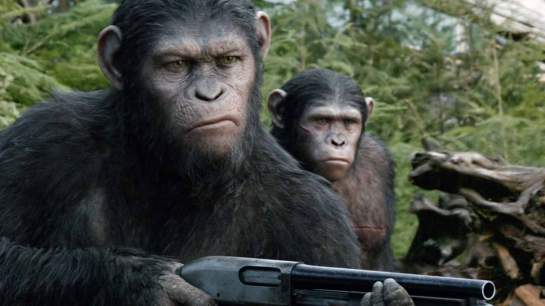
Caesar (Andy Serkis) now leads a large colony of apes who live in the forests outside of what was San Francisco. These apes share the intelligence of Caesar which we see exhibited in a variety of ways. Many of the apes believe that humans are now extinct, that is until they encounter a small group of them in the forest. The group turns out to be part of a pocket of survivors living in the city. Their energy supply is almost gone and a hydroelectric dam in the forest could supply them for years. But as they learn, the dam is smack dab in the middle of ape territory which presents a very big problem.

One of the most fascinating aspects of this film are the political wranglings that take place both between humans and between the apes. Internal debates, distrust, and dissensions plague both camps as each try to figure out how to handle the other. Malcolm (Jason Clarke), the head of the small group, recognizes something special about Caesar and tries to form a bond with him. Dreyfus (Gary Oldman) is more skeptical and he prepares the humans for war in case Malcolm fails. Similarly Cesar believes peace is the best option but his second in command Koba (Toby Kebbell) has personal animosity towards all humans and he wants to be proactive.

All of that is constructed in a way that shows the similarities between the humans and apes. In fact, that’s a central theme that runs throughout the picture. Whether it be tender family relationships or fear-driven warmongering, we see it all in both the humans and the apes. But what may be the most amazing feat accomplished by this film is its incredible way of translating emotion from the apes. Every display of love, hate, disappointment, frustration, anger, or sympathy that we get from them is incredibly…well…human. Much of it is due to the brilliant makeup and special-effects. But the true credit goes to the stunning motion caption mastery. I love hearing from people who are finally recognizing the genius of Andy Serkis. But folks let me just go ahead and say it – this is Oscar-worthy work. And Kebbell isn’t too far behind him.

XXX DAWN-PLANET-APES-MOV-JY-3806-.JPG A ENT

Now while the story is entertaining and never boring, it still has a few things that keep it from being truly phenomenal. There are so many familiar plot angles that we get throughout the entire movie. Honestly, I was amazed at how many things I saw that I had seen in other films. I don’t want to spoil anything , but it really stood out and it made many plot lines predictable. I also thought several of the emotional tugs were a bit obvious and gimmicky. What’s amazing about it is that they still worked for me. I knew I was having my heart-strings yanked during these instances yet I still went with them. Effective but still obvious.

Despite those gripes “Dawn of the Planet of the Apes” is still a highly entertaining picture. Regardless of its familiar directions the story still kept me engaged. It easily kept me attached to these characters and the film moved at an almost perfect pace. There is some great action, awesome effects, and the performances are strong (none better than the stunning work of Andy Serkis). This is yet another big budget 2014 blockbuster that delivers. I just wish the story itself went out a little more on its own.

VERDICT – 3.5 STARS

REVIEW: “Django Unchained”

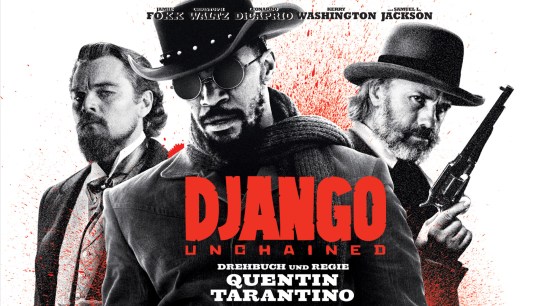
DJANGO poster

My initial reaction after first viewing Quentin Tarantino’s “Django Unchained” was incredibly mixed. So many critics and movie viewers loved the film while I struggled to get a true sense of my feelings towards it. In fact, my confliction was such that I never wrote a review for it. Now I have wrestled with this critical darling and I ask myself if my reservations still feel justified and is the film worthy of the massive amounts of accolades and praise heaped upon it?

One thing you have to give Tarantino is that he is a filmmaker with a definite style. But personally speaking it’s often his style that is both a strength and weakness of his films. I think that’s the case here as well. “Django Unchained” has a smart and instantly engaging blueprint. But there are stylistic choices, all signatures of Tarantino’s filmmaking, that are distracting and do more to promote his brand than actually strengthen the narrative. Many people love that about his pictures. I think it sometimes works against him and takes away his focus.

Django1

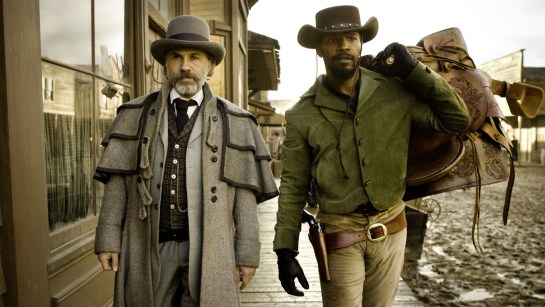
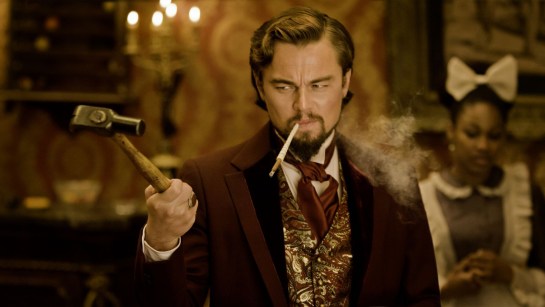
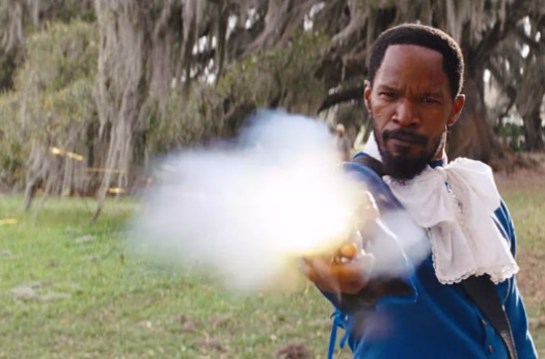
The story begins two years prior to the Civil War. A man named Django (Jamie Foxx) along with four male slaves is being driven like cattle by two slave handlers. They run into a German dentist named Dr. King Schultz (Christoph Waltz) who ‘acquires’ Django and hires him to help find a group of outlaws known as the Brittle brothers. Django reveals to Schultz that he was married but was separated from his wife by a wicked slave owner. Schultz offers to help him find his wife in exchange for Django working for him through the winter. While together they run into a wild assortment of people, none more heterogeneous that a plantation owner named Calvin Candie (Leonardo DiCaprio).

“Django Unchained” has been called Tarantino’s spaghetti western but we only occasionally see the similarities between his film and those Italian westerns that became popular in the late 1960s. This is really just a revenge tale with plenty of fancy dressing. The story starts up nicely and the opening 30 minutes or so sets a very interesting table. But then the film slows down a bit which begins drawing attention to its 165 minute running time. It picks back up once Candie appears and then falls into a stew of truly great scenes, uncomfortable but hilarious humor, goofy and outlandish graphic violence, and jarring injections of that Tarantino “style”. It makes the last third of the film range from fascinating and intense to messy and indulgent.

Django2

When Tarantino’s focus is on the right thing he can create some of the most mesmerizing scenes ever put to film. The opening sequence in “Inglourious Basterds” is a prime example. We get several instances of that in “Django Unchained”. There are moments when the dialogue is sharp and flowing which in turn creates scenes that turn out amazing. A long dinner table sequence at Candie’s plantation is one of my favorites. It’s crisp and fluid while also soaked in perfectly developed tension. There are a few other scenes where the humor hits with perfect timing and I found myself laughing out loud. QT is also always impressive with his camera. He can get a tad carried away at times but this film, like many of his others, looks great and there are several unforgettable shots.

But there are flipsides to almost all of these positives. While some scenes are brilliant and the dialogue strong, others drag out too long and feel false.  Then there are the aforementioned style choices. Take the music. QT has always liked to incorporate unique music into his films which I appreciate. But here he goes from a musical homage to the theme from “Two Mules for Sister Sara” to bass-pounding hip-hop. Stylish? Sure. Jarring? Absolutely. And then there is the much talked about graphic violence. Tarantino definitely soaks the audience in copious amounts of blood, but it’s hard to take it serious. In one sense it strips away any emotional power. In another sense (which is what QT is after), it’s a really fun exercise in genre indulgence.

Django3

I do have to give props to the cast. I’ve never been a big fan of Jaime Foxx but he does a nice job here. He does stumble over the occasional bits of poorly written dialogue but as a whole this was an impressive performance. Christoph Waltz is just a tremendous actor and he always seems to fit nicely into Tarantino’s weird worlds. Leo DiCaprio has an absolute blast playing this twisted francophile wannabe slaver with bad teeth and a deceptive charm. He steals several scenes by going all in and you can’t take your eyes off of him. Samuel L. Jackson is a hoot playing possibly the most despicable character in the movie. He’s also undeniable funny at times and more than once I caught myself in uncomfortable laughter. And Kerry Washington is very convincing in one of the film’s few emotionally steady roles.

So what to make of “Django Unchained”? I understand that many absolutely adore the movie. The good moments are really good but each of them are bookended by one questionable narrative choice or a blast of QT style that doesn’t always help the film as a whole. To call “Django Unchained” uneven would be an understatement. It has its share of problems. But it also features fabulous performances, a wonderful visual flare, and a handful of purely brilliant sequences. Those things save it from completely drowning in Tarantino’s indulgence.

VERDICT – 3.5 STARS

REVIEW: “Draft Day”

Draft Day Poster

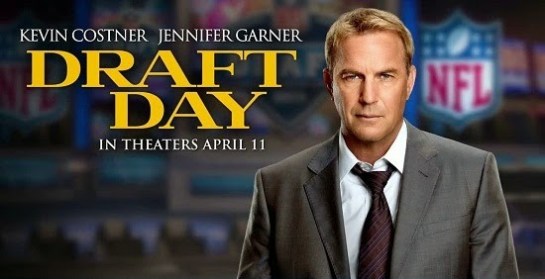
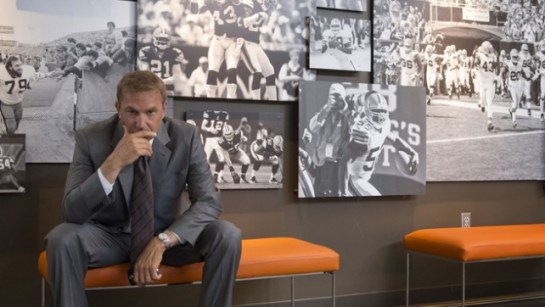
Kevin Costner’s 2014 movie trifecta continues with “Draft Day”, a football film about the back room wranglings leading up to and during the NFL draft. This certainly isn’t the first sports movie focused on the front office instead of on the field. Think “Moneyball” with helmets and shoulder pads. The two films actually have a lot in common. Both feature two strong central lead performances and both give cool cinematic insights into a little known side of their sports.

Interestingly its similarities to “Moneyball” could be perceived as a bigger weakness. Both movies revolve around an audacious and headstrong team leader who bucks the system and conventional sports wisdom to build “his team”. They face constant resistance from ownership, scouts, and everyone in between yet stake their job on their faith in their system. It’s impossible not to see the resemblance.

Draft Day 1

But despite the similarities “Draft Day” still manages to feel like its own movie. In reality football has become America’s #1 sport so much so that even the NFL Draft has become must watch television for fans. That hectic and intense timeframe is the setting for director Ivan Reitman’s movie. Costner plays Sonny Weaver, Jr., the general manager for a Cleveland Browns team mired in an extensive losing stretch. With only hours remaining until the start of the draft Sonny is facing immense pressure from the owner (Frank Langella) to make a big splash. He’s also butting heads with a newly hired coach (Denis Leary) and a fan-base desperate to win.

Sonny’s personal life is equally stressful. His secretive romantic relationship with a front office coworker named Ali (Jennifer Garner) has taken an unforeseen turn. He wrestles with the shadow of his recently deceased father – a well-respected former coach for the Browns. He also struggles under the weight of everyone’s expectations in light of his own inadequacies. The movie never dives deep into any of these personal issues, but we get just enough of them to flesh out Sonny and make him more than a stereotypical sports character.

The meat and potatoes of the movie is football but you don’t have to be well versed in the sport to understand what’s going on. That said, understanding the landscape and the relationship between college football and the NFL gave me a deeper appreciation for the story. I loved the manipulative and sometimes vulturous back-and-forths between GMs, each hungry to get the best deal. Then there is the turbulent draft preparation which is itself fascinating even without this stories added drama. All of this clicks and even when you know the movie is stretching it is still a ton of fun.

DRAFT DAY

But the biggest strength of the film is Kevin Costner. Talk about a strong performance. Costner reminds us why he became such a huge star. It’s a completely seamless and effortless performance that reveals so many of the characteristics and contradictions of this character. I also really love Jennifer Garner here. In the past she has been an actress I have never given much attention. Here she is razor sharp and she is a welcomed strong and confident female character. Even Denis Leary, an actor I normally dislike, is really good and I never get tired of watching Frank Langella. And then of course there is the assortment of mandatory football related cameos sprinkled throughout the film. Some are really cool while others are really obvious.

“Draft Day” could be accused of being too safe and by-the-book. It also follows several familiar sports movie tropes that you will immediately recognize. But the movie never chokes itself on them and it remains compelling throughout. The story is crisp and exciting even in its unique setting and overall it is loads of fun. But Costner is the shining light and watching him work here makes me so happy that he is back on the big screen. Simply put it’s one of my favorite performances of the year so far and it made “Draft Day” all the more interesting.

VERDICT – 4 STARS

REVIEW: “The Defiant Ones”

Classic Movie Spotlight

DEFIANTStanley Kramer’s “The Defiant Ones” opens with a prison transport truck on a dark and rainy night. The guards in the cab are distracted by two fighting prisoners which causes them to lose control and roll into the ditch. With a heavy rain falling two men stumble out of the prison truck. They take off running, shackled together arm to arm, a white man and a black man. Each have their own prejudices and each have a hatred towards the other. The question becomes will they escape the law or will they kill themselves first?

Kramer was known for making what some call “message movies”. Throughout his acclaimed career he addressed a number of social and political issues. “The Defiant Ones” takes a candid look at racism through two fascinating characters and a story that allows for a pointed but entertaining approach to the subject. Tony Curtis and Sidney Poitier handle the two lead roles and it doesn’t take long to see that these two men hate each other. Constant insults and unflattering nicknames such as “Colored” and “Joker” make up the bulk their early conversations.

DEFIANT1

The shackles that bind them together serves as an interesting metaphor. I won’t spoil it by going into detail but it was clearly the intent of Kramer and writers Harold Jacob Smith and Nedrick Young (Young had been blacklisted at the time. In fact both writers won Oscars for the film and Young’s award went to his pseudonym Nathan E. Douglas). On one hand the movie is a thriller about two escaped convicts and the manhunt to find them. But the social aspect can’t be ignored and unlike some of the more heavy-handed approaches that we see, “The Defiant Ones” looks at this subject through a smart and effective lens.

Tony Curtis wasn’t the first choice to star in the picture. Kramer insisted that Poitier be his man but conflicts involving Robert Mitchum and Marlon Brando, both in the running to star in the film, made that a problem. Mitchum eventually turned down the role and Kramer maneuvered his filming so that Brando had to drop out due to prior obligations. This opened the door for the casting of Curtis. I’ve always been mixed when it comes to Tony Curtis but he delivers a fantastic performance. His character’s arrogance and unbridled racism is the catalyst for the animosity between the two. Curtis slides into the role and sells it nicely.

DEFIANT2

But Kramer’s main choice Sidney Poitier was the real standout for me. Poitier is often looked at as a pioneer for African-Americans in the film industry. He certainly is that. But he was also a brilliant actor and we see it in this film. Poitier portrays a tough and rugged guy who has clearly been hardened by his experiences. There isn’t an ounce of insincerity from Poitier and I found his character compelling from the start. Both he and Curtis received Best Actor Oscar nominations (both would lose to David Niven for “Separate Tables), but for me Poitier is the highlight of the picture.

“The Defiant Ones” is also a visually stunning film thanks to Sam Leavitt’s Oscar-winning cinematography and Kramer’s sharp direction. A strong supporting cast featuring Theodore Bstraight ikel and Cara Williams (both of whom also received Oscar nominations) add even more quality. This is a smart and crafty movie that manages to be reflective and insightful. But it’s also highly entertaining as a thriller and it rarely takes its foot off the pedal. It hooked me from the opening scene.

VERDICT – 4.5 STARS

REVIEW: “The Darjeeling Limited”

DARJEELING POSTER

I’m a huge Wes Anderson fan so whenever he makes a film I take notice. But oddly enough his 2007 comedy/drama “The Darjeeling Limited” is one I still needed to see. In true Anderson style “The Darjeeling Limited” has a quirky sense of humor and it dabbles in several of the filmmaker’s familiar themes. It also features some of Anderson’s acting staples including his old college buddy Owen Wilson, Jason Schwartzman, Adrien Brody, and Bill Murray. And while some people consider this some of Anderson’s lesser work, I think it’s a movie that captures what I like about his films while carving out its own unique path.

In this offbeat concoction the opening scene is important. In India a businessman (Murray) tries unsuccessfully to catch his train as it departs the station. While he fails another man, encumbered by heavy luggage, just manages to board the train as it heads down the tracks. This short sequence is a microcosm of the entire film. It’s strange, funny, well shot, and filled with meaning.

DAJEELING1

The man who made the train is Peter (Brody). He is onboard the Darjeeling Limited passenger train to meet his two brothers, the controlling and downright anal Francis (Wilson) and the brokenhearted and obsessive Jack (Schwartzman). The three haven’t seen each other since their father’s funeral and Francis sets up the reunion in hopes of bringing them closer together. The train trip across India is framed as being a spiritual awakening of sorts but Francis may have something else as his motivation.

The movie pulls many laughs from these odd personalities, but that shouldn’t come as any surprise. Wes Anderson’s wacky cinematic worlds routinely feature idiosyncratic people with an assortment of troubles and in various states of despair and melancholy. His humor can be a bit prickly. By that I mean it isn’t easy for some viewers to cozy up to. Personally I love his unique brand and we get plenty of it in this film. But there is also a strong dramatic thread that runs throughout the film and really shows itself in the last act. This mix of well executed comedy and heartfelt, meaningful drama is what drives the picture.

Considering the amounts of dry kooky humor, it may surprise some people to find this much heart. But Anderson has always had a knack for that. He’s always dealing with family troubles as well as feelings of isolation and despondency. We certainly get that in this film. There is symbolism scattered throughout the film that deals on more emotional levels once they are realized. For example, take the aforementioned luggage. Anderson takes something simple like luggage, weaves it throughout the narrative, and uses it to make one of the movie’s more effective points. These treats are clever and satisfying.

Darjeeling2

I also must give credit to Wilson, Brody, and Shwartzman. These guys work so well within Anderson’s narrative style which probably explains why he keeps going back to them. The three offer great subtlety in their humor and watching them play off each other is a lot of fun. But they also dial it back when the story calls for it which is vital. Theres some good supporting work from Amara Karan as a train stewardess, Wallace Wolodarsky as Francis’ “assistant, and Waris Ahluwalia as the Darjeeling’s chief steward. Bill Murray has a brief but fun role and Anjelica Huston has a small yet important appearance. There are also some nice cameos from Natalie Portman (remember Hotel Chevalier?) and Irrfan Khan.

“The Darjeeling Limited” is soaked with Wes Anderson’s style. Whether it’s the humor and storytelling or his visual methods which include panning cameras, use of colors, or his particular use of music. There are a few lulls that the film experiences particularly in the second half. They never last long but they are noticeable and maybe they do keep this from being some of Anderson’s best work. Regardless I’m still a big fan of this film. I laughed a lot and I really responded to the emotional tugs we get later on. In the end it’s yet another example of why I love Wes Anderson movies.

VERDICT – 4 STARS