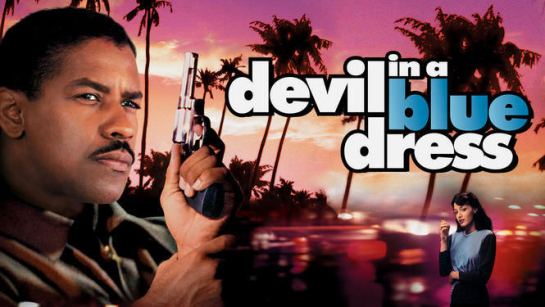
Over a span of two months each Wednesday will be Denzel Day at Keith & the Movies. This silly little bit of ceremony offers me a chance to celebrate the movies of a truly great modern day actor – Denzel Washington.
In his near forty years of big screen acting Denzel Washington has amassed a broad and diverse filmography. Out of his forty-seven movies (so far) I finally caught up with one that I’ve rarely heard talked about. As it turns out “Devil in a Blue Dress” is a saucy bit of pulpy noir that took no time getting its hooks in me.
Carl Franklin wrote and directed the film which was based on Walter Mosley’s mystery novel of the same name. The book was the first in a series that focused on the character Ezekiel “Easy” Rawlins, a post-war era laborer turned unwitting private detective. Franklin’s adaptation burrows deep into the book’s noir setting and brings out the genre’s richness of atmosphere and tone. Unfortunately the movie bombed at the box office which killed any chance of a possible followup.

A superbly cast and well-rounded Denzel Washington takes on the role of Easy Rawlins, Texas born but now living in 1948 Los Angeles. He moved to Southern California after the war when work on the coast was plentiful. But times have gotten tougher and he loses his job at an aviation factory. Already behind on his mortgage, Easy listens to an offer from a shady tough guy named DeWitt Albright (Tom Sizemore). It should be an easy $100. All he has to do is track down a white woman named Daphne Monet (Jennifer Beals) and tell Albright where she is. Sounds easy enough but remember, this is noir so it’s never that simple.
Easy begins his search down Central Avenue since Daphne was known to frequent the jazz clubs in the predominantly black neighborhood. But in no time he finds himself caught up in layers upon layers of deception, blackmail and of course murder. What started up as a quick $100 ends up being far more than Easy bargained for. As things heat up he recruits his trigger-happy Texas sidekick Mouse (a scene-stealing Don Cheadle) to help him with the tangled sordid mess he’s gotten into.
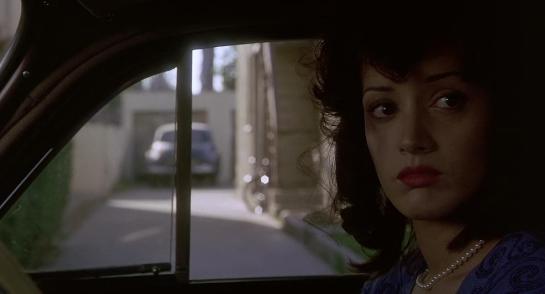
So much of Franklin’s film screams classic 50’s noir. We get the anti-hero private detective who serves as our window into the seedy and violent cinematic world. There is the beautiful yet mysterious femme fatale who clearly knows more than she’s letting on. And of course plenty of twists, double-crosses, and corruption. I could go on, but there is a unique flavor Franklin also brings that makes his film stand out. Through his more urban setting he is allowed to come at his story from a socially conscious perspective. He brings out themes of big city segregation, economic disparity, and more.
As “Devil in a Blue Dress” maneuvers its way through its taut and savvy mystery I found myself glued to its every twist and turn. I was just as captivated by Washington who already possessed that certain charisma and gravitas he would become known for. Here he takes a rich and compelling character and gives us a lived in and fully-realized portrayal. And in a career full of unforgettable performances, this may be one of his best.
VERDICT – 4.5 STARS