REVIEW: “Ella McCay” (2025)

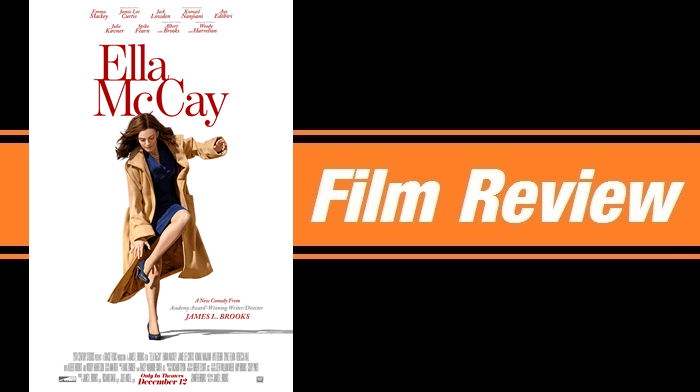
“Ella McCay” is the first film in fifteen years from writer-director James L. Brooks. Sadly, it’s hard to say it has been worth the wait. In fact, it’s hard to believe it comes from the same acclaimed filmmaker who made “Terms of Endearment”, “Broadcast News”, and “As Good as It Gets”. That’s because “Ella McCay” is a dull, frustrating mess that never feels rooted in the real world despite trying really hard to be.

It’s a shame because there is so much talent attached to the movie. Brooks has proven himself to be a great filmmaker and storyteller. But he miscalculates so much here, leading to him overstuffing his story, undercooking key moments, and diluting his characters. Even worse, the authenticity and sophistication he’s known for is nowhere to be found. It leaves us desperately looking for the humanity and struggling to find it.

Emma Mackey gives her all in the title role, doing her very best to deliver a character worth latching onto. Unfortunately, Ella’s story plays out through a cluttered narrative structure that’s littered with clunky flashbacks and annoying plot devices. It’s surprisingly unfunny as a comedy, noticeably lazy as a movie about empowerment, and completely ineffective as either a political or family drama.

Ella’s life is filled with enough drama to fill a primetime series on The CW. As a teenager, she and her kid brother were forced to navigate a difficult childhood, in large part due to their contemptible father, Eddie (Woody Harrelson). He was a habitual cheater who lost his job as a hospital administrator because of various sexual relationships with staff. When he and their mother Claire (Rebecca Hall) decide to move to California for “a fresh start”, Ella stays behind to finish school, moving in with her beloved Aunt Helen (Jamie Lee Curtis).

Now in 2008, the 34-year-old Ella is a lawyer working as her home state’s lieutenant governor. She has a close but hard to read relationship with her boss, Governor Bill Moore (Albert Brooks) who seems more interested in a potential position in the sitting President’s cabinet. Bill finally gets his big promotion, leading him to step down and leaving Ella to serve as interim governor for the next fourteen months. Ella is excited and ready to get to work for her state. But the political establishment sees her as nothing more than a lame duck.

As for her family, we learn Ella’s mother died sixteen years earlier and she hasn’t seen her loser father in thirteen years. That is until he suddenly shows up hoping to fix things with his estranged daughter. Meanwhile Ella’s dopey husband Ryan (Jack Lowden) is ate up with his wife’s newfound status and is encouraged by his comically overbearing mother (Becky Ann Baker) to milk it for all it’s worth. And if that wasn’t enough, Ella is trying to help her brother Casey (Spike Fearn) who has spent the last year isolated in his apartment after an issue with his girlfriend (Ayo Edebiri).

Sadly none of the above drama connects on any meaningful level, mainly because the story is too bloated and woefully overwritten. Yet it’s a movie full of thankless roles from actors trying to add weight to underwritten characters. Harrelson is collecting a check, popping up at the most peculiar times and then vanishing. Kumail Nanjiani is wasted as Ella’s loyal driver and head of security. Hall is essentially a cameo. Edebiri’s character could be erased and the movie wouldn’t be impacted at all. And Lowden is given an embarrassingly bad role to try and make interesting.

“Ella McCay” ends up disappointing on so many levels. It’s far from what you would expect from an accomplished filmmaker like Brooks. It squanders the perfectly capable but poorly equipped Emma Mackey who (like the rest of the film’s talented cast) finds herself stuck trying to find purpose in this empty and often confounding slog. As well-meaning as it may be, “Ella McCay” is a glaring misfire and a far cry from the significantly better films that have defined James L. Brooks’ career.

VERDICT – 1.5 STARS

REVIEW: “Eternity” (2025)

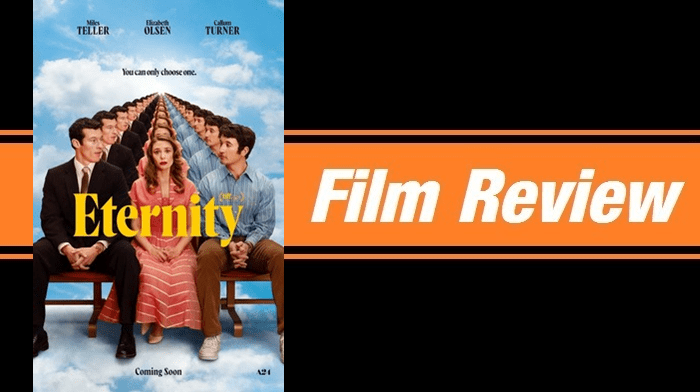
With his ambitious new film “Eternity”, director David Freyne combines classic screwball comedy with an old-fashioned romance, seasoning it all with a dash of wacky fantasy. He tells a story (co-written by Freyne and Pat Cunnane) that’s so strange on paper it never should work on-screen. Yet the surprisingly sincere and impressively imaginative “Eternity” is considerably more entertaining than you would ever expect it to be.

“Eternity” begins with an elderly husband and wife on their way to a family gender reveal gathering. As they drive, the crusty Larry (Barry Primus) and the needling Joan (Betty Buckley) have all the qualities of a couple who has been married for 65 years. Larry is a bit of a curmudgeon but a very caring one. Meanwhile the opinionated Joan has been diagnosed with terminal cancer – heartbreaking news which they’ve yet to reveal to the kids and grandkids.

Image Courtesy of A24

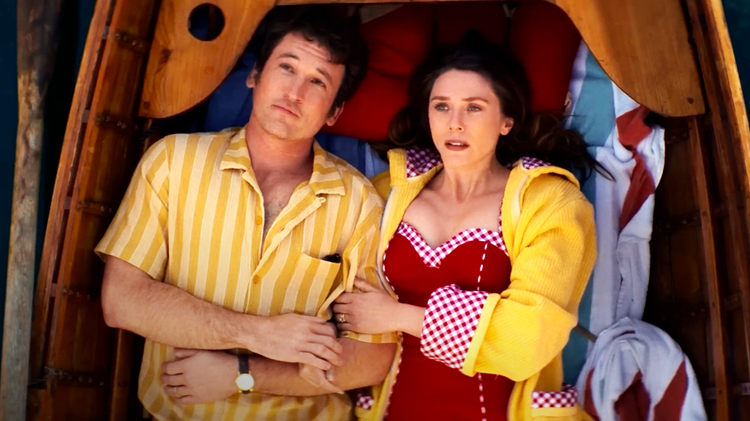
But their life together screeches to a halt when Larry chokes to death while at the party. In a snap, he suddenly awakes on a train, now as a much younger get version of himself (played by Miles Teller). When the train stops, Larry and a mass of other people are ushered into a waiting area called “the junction”. There he is instructed to wait for his Afterlife Coordinator. After a lengthy wait he’s finally greeted by his personal AO, Anna (Oscar winner Da’Vine Joy Randolph).

Anna immediately begins explaining things to the understandably confused Larry (and us). We learn Larry is in something resembling Limbo. It’s a depot of sorts where the recently deceased are given seven days to choose their eternal destination out of the many themed eternities offered. There’s an eternity for every taste imaginable – Beach World, Vampire World, Library World, Catholic World, Smoker’s World, Men Free World, and even a world dedicated to Paris in the 1960s. Once a person enters their chosen world they must stay their for eternity. Any attempt at escaping will see them cast into an ominous space called The Void.

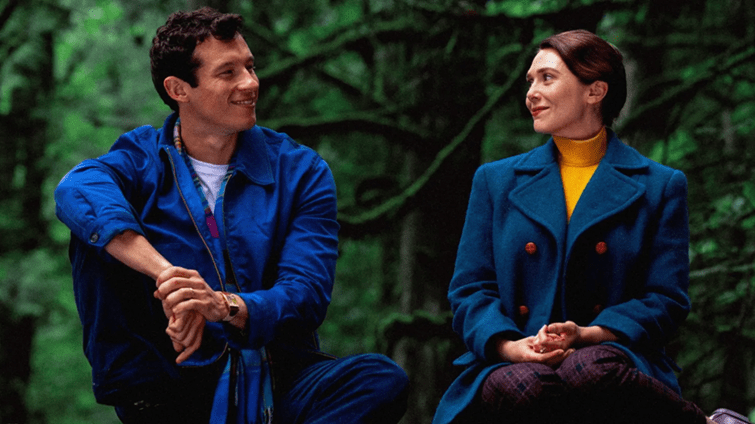
As for his younger appearance, Larry is told that after death people revert to the form of their happiest self in life. That’s why days later he is stunned to see a younger Joan (now played by Elizabeth Olsen) fresh off the train and just as confused as Larry was. But their sweet reunion is interrupted by the dashing Luke (Callum Turner), Joan’s first husband and the love of her life before he was killed in the Korean War. Luke reveals he has waited 67 years for Joan to arrive, biding his time as a bartender in the junction.

Image Courtesy of A24

So Joan is left with an impossible choice. Does she spend eternity with the man she had already built a life with or with the man who died before she was able to? That dilemma forms the crux of “Eternity”. For the most part Freyne keeps things sweet and endearing while also including some nice splashes of humor, mostly during his film’s first half. Yet there is an running undercurrent of heartache that grounds the many emotions surrounding this classic love triangle. And it doesn’t hurt to have such a capable trio as Olsen, Teller, and Turner anchoring things.

When it comes to world-building, “Eternity” plucks ideas from agnosticism, universalism, and Christian eschatology to create an equally interesting and imaginative fantasy setting. As for the story, you’ll find it easy to spot the cracks if you give it too much thought. But if you let the movie operate on its own terms, you’ll have a hard time denying its beguiling charm, admirable sincerity, well-struck comic beats, and welcomed originality. What can I say, I certainly found myself under its spell.

VERDICT – 3.5 STARS

REVIEW: “Eleanor the Great” (2025)

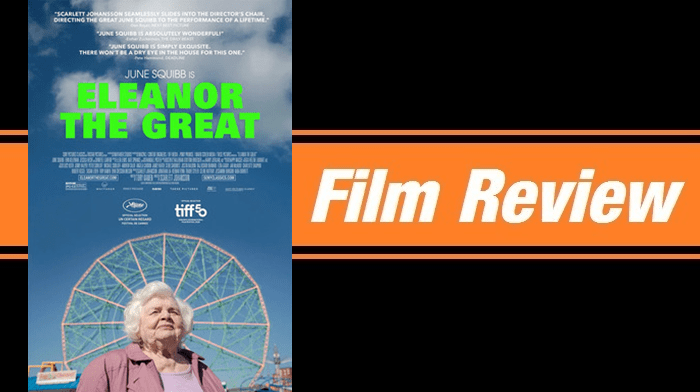
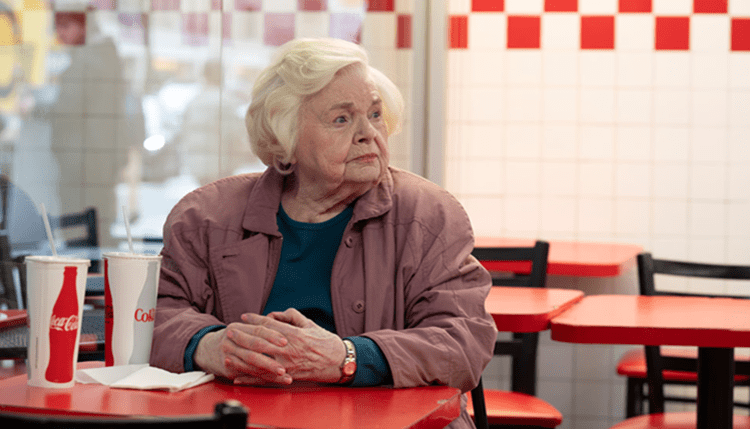
The indomitable and irresistible June Squibb once again shines in “Eleanor the Great”, the directorial debut for Scarlett Johansson. Written by Tory Kamen, this unusual little drama sees the 95-year-old Squibb once against putting her playfulness and charm on full display, Yet while she certainly gets in a few good zingers, the movie is more of a heartfelt drama that offers a thoughtful meditation on grief through very different life experiences.

The 95-year-old Squibb plays 94-year-old Eleanor Morgenstein, a feisty and straight-shooting New Yorker living in Florida with her best friend and roommate Bessie (a sublime Rita Zohar). Since their husbands died, the two longtime friends have done everything together from taking walks down by the beach to shopping. But their closeness is seen most in the times at home when Bessie, a Holocaust survivor still haunted by traumatic memories, pours her heart out to Eleanor.

Eleanor’s life is shaken to its core when Bessie dies. Unable to stay alone, Eleanor moves back to New York to stay with her daughter Lisa (Jessica Hecht) and her grandson Max (Will Price). The move proves to be a challenge for all three. Eleanor hasn’t been close to her daughter for years. Lisa is a career woman who’s worried about leaving her mother alone during the day. Lisa would rather she be in a senior care home which Eleanor resists.

Image Courtesy of Sony Pictures Classics

Johansson and Kamen take time to consider this complex mother/daughter dynamic – showing yet not overplaying the tension between them while empathizing with both sides and their set points of view. Some of the film’s best laughs come in Eleanor’s moments with her daughter (a well-timed Guantanamo reference had me laughing out loud). But it’s the more serious aspect of their relationship that is the most compelling, and I wish it was given more attention.

While visiting the Manhattan Jewish Community Center, Eleanor stumbles into a Holocaust survivors support group meeting where she ends up sharing Bessie’s survival story as her own. It’s a lie for sure, but one born out of her own grief. The story he shares grabs the attention of Nina (Erin Kellyman), a 19-year-old NYU journalism student siting in on the group’s session. Eventually an unlikely friendship forms as both Eleanor and Nina find someone they can connect with.

Nina is the daughter of a workaholic television news anchor named Roger Davis (the always reliable Chiwetel Ejiofor). At home, Roger has been distant and closed-off ever since his wife and Nina’s mother died six months earlier. As a result, Nina has been emotionally stranded and left to deal with her grief on her own. It’s a heart-wrenching storyline that adds new layers to the movie’s treatment of loss. Especially once Eleanor enters their lives.

Image Courtesy of Sony Pictures Classics

Johansson knows the treasure she has in Squibb and she allows the actress the space to both cut loose and dial it back. Squibb offers up a brilliant balance of feistiness and vulnerability. But the nicest surprise is Kellyman who matches her cast mate step for step. Kellyman gives an emotionally nuanced performance marked by some wonderfully subtle touches while at times being profoundly affecting. She’s a revelation.

Some may take issue with the movie’s conceit – more specifically, a story of someone falsifying their connection to the Holocaust. But neither Johansson nor Kamen make light of Eleanor’s offense or paint it as acceptable. Eleanor herself is uncomfortable with where her lie takes her, and there are significant consequences despite the film’s somewhat tidy ending. But Johansson is all about the humanity behind the actions, and her film examines it all maturely and with reverence.

“Eleanor the Great” tells an emotionally rich and morally complex story built around well-defined characters and their own personal bouts with grief. It’s an impressive directorial debut for Johansson who proves to be keenly in touch with her characters and the material. Her style is fittingly straightforward and shines most in her willingness to let her actors work. It may sound like a small detail, but Johansson conveys volumes by simply setting her camera on Squibb, Kellyman, Ejiofor, or Zohar and letting them go. It’s those instincts that leaves me excited for what she’ll do next. “Eleanor the Great” is in theaters now.

VERDICT – 4 STARS

REVIEW: “Eenie Meanie” (2025)

The immensely talented Samara Weaving plays a highly skilled underworld driver trying to turn her life around in the wildly uneven “Eenie Meanie”, a Hulu exclusive and the first feature from writer-director Shawn Simmons. “Eenie Meanie” aims to be the kind of gritty pulp that Quentin Tarantino fans might happily embrace. Sadly, neither its style or its story comes close to the films or filmmakers that inspired it.

“Eenie Meanie” often feels at war with itself. There are flashes of originality that occasionally make its way to the surface. But even at 94 minutes, the cliché riddled story quickly sputters while the uninteresting (and often annoying) characters give us no one to latch onto. Making things worse, the film’s tonal confusion gets more noticeable the further we go, as the far-fetched silliness attempts to segue into something that could have been emotionally impactful if not for everything that came before it.

Image Courtesy of 20th Century Studios

Weaving plays Edie Meaney who was given her titular nickname by a low-level crime boss named Nico (Andy Garcia). We learn Nico shamelessly used Edie on jobs dating back to when she was 15-years-old. He took an almost fatherly liking to her, going as far as doing something unheard of in gangland – giving her a ticket out. As a result, Edie is doing everything she can to go clean including working a legitimate job to help pay her way through college.

But things change in a snap with the introduction of her impulsive and perpetual loser ex-boyfriend John (Karl Glusman). He’s the kind of guy who is always screwing up and needing other people to bail him out. He’s also the type of character who is insufferable to watch on screen. It’s certainly not the fault of Glusman who does exactly what the script asks. But a little of John goes a long way, and unfortunately he’s gets plenty of screen time.

John’s latest debacle comes after he kidnaps a valuable casino card counter named Leo (Randall Park) who is working for Nico. John lures in an unaware Edie to help him get away from Nico’s goons, but when Leo is killed during the escape, Edie finds herself pulled into John’s latest mess. She insists they go to Nico and explain what happened. While her former boss is willing to let her go, the only way he will let John live is if the two of them carry out a heist. $3 million in winnings from a high-end poker tournament to be precise. Of course Edie is guilted into agreeing.

Image Courtesy of 20th Century Studios

From there the story only gets more predictable. But that’s hardly its biggest problem. The issues mostly come from the scattershot story. The opening 30 minutes are hardest to bear as it mostly consists of obnoxious people screaming profanities at each other. There’s also this strange plot thread where Edie finds out she’s pregnant. It’s a detail which should have carried a lot more weight than it ever does. There’s also a wedged-in backstory meant to earn our sympathy but that is terribly underdeveloped. And through it all, several wasted side characters pop in but have little effect.

Weaving is the film’s big saving grace. While she sometimes seems a bit bored with what she’s given, she does bring some much-needed life, and later on heart, to a movie that has a hard time sustaining either. But its all so messily thrown together and it never coalesces into much of anything. It tries hard in the final act. But the result is an unearned finish that even Weaving can’t make us fully buy into. “Eenie Meanie” is now streaming exclusively on Hulu.

VERDICT – 2 STARS

REVIEW: “Eden” (2025)

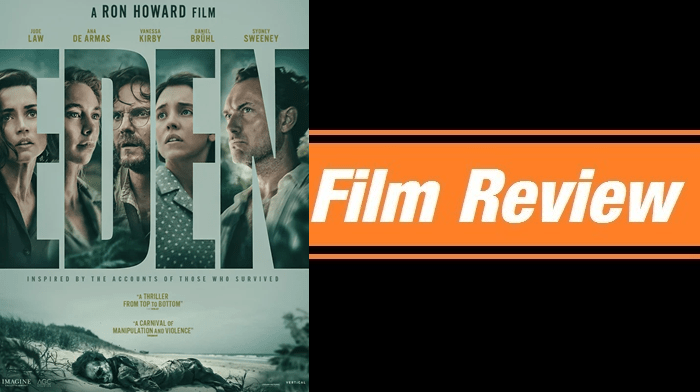
Ron Howard’s “Eden” isn’t a movie I’ll soon forget. Ambitious and audacious, this thorny survival thriller is considerably different than anything Howard has done before. “Eden” comes on the heels of the filmmaker’s brilliant 2022 gem “Thirteen Lives”. And while this is a much different movie, “Eden” sees Howard once again exploring a side of human nature through the inspiration of true events. In this case – it’s a much uglier side.

“Eden” is inspired by an astonishing true story that’s told through a star-studded cast, each of whom bring precisely what their uniquely positioned characters need. Howard is joined by screenwriter Noah Pink to deliver a bluntly presented critique of humanity’s dark side. It’s a deceptively smart analysis wrapped in a slow-simmering drama that can be unsettling, amusing, brutal, and even campy. Yet it works and gets its point across surprisingly well.

Image Courtesy of Vertical

In 1929, as the world lies in chaos in the wake of World War I, Dr. Friedrich Ritter (Jude Law) and his partner, Dora Staunch (Vanessa Kirby) flee Germany to an uninhabited island in the Galapagos called Floreana. There the two battle harsh conditions and rugged terrain to create their own isolated utopia built upon Ritter’s radical and evolving philosophies. As the two relish their seclusion, Ritter works on his manifesto which he believes will help save humanity from itself. His only connection to civilization is a series of letters he sends through passing trade vessels.

Little does Ritter know, his letters stir up much interest back in Germany. Among those captivated by his writings is Heinz Wittmer (Daniel Bruehl), a former soldier broken from his time in the war. Heinz makes the decision to leave Germany with his noticeably younger wife, Margret (Sydney Sweeney) and their son Harry (Jonathan Tittel) and venture to Floreana. But the Wittmer family’s unannounced arrival annoys Ritter and Dora who don’t appreciate having their solitude interrupted.

But the Wittmer’s are nothing compared to the island’s next visitor – Baroness Eloise Wehrborn de Wagner-Bosquet (a gloriously campy Ana de Armas). She arrives with her two subservient boy-toys, Robert (Toby Wallace) and Rudy (Felix Kammerer), with a cockamamie plan to build an exclusive island resort for millionaires. But first she needs investors, and what better way to woo them than by showing them the island first-hand.

It doesn’t take long for tensions to arise between the three parties. The baroness is a hedonistic whirlwind of privilege and self-absorption. Meanwhile the Wittmers are trying to make themselves a home although some once dormant family conflict makes it difficult. As for Ritter and Dora, they find their philosophies challenged by the invaders and it threatens to drive a wedge between them.

Image Courtesy of Vertical

Howard and Pink take their time unwrapping their characters and establishing the conflicts between them. The buildup demands patience and it makes for good drama. But lying at the story’s core is an shrewd examination the ugliness of humanity. Jealousy, deception, and betrayal inevitably breeds animosity and violence. Before long we find ourselves observing a series of nasty psychological chess matches where everyone’s true self come to light.

Again, in numerous ways “Eden” is unlike anything Ron Howard has previously directed. Said to be “Inspired by the accounts of those who survived“, Howard takes us on a twisted journey that is both devilishly intriguing and strikingly audacious. And that journey is fueled by a terrific cast whose commitment can be seen every step of the way. It may be a challenge for some, especially with its deliberate pacing and unflinching final act. But both are vital ingredients that ultimately help give “Eden” its kick. “Eden” hits theaters August 22.

VERDICT – 4 STARS

REVIEW: “Eddington” (2025)

Ari Aster’s short but attention-getting feature film career has been a fascinating rollercoaster. It began with a bang with his exceptional 2018 supernatural/psychological horror gem “Hereditary”. He followed it up with 2019’s “Midsommar” – a movie with a first half that is every bit as brilliant as his debut film and an unfortunate second half that goes completely off the rails. Things only got worse with 2023’s disastrous “Beau Is Afraid”.

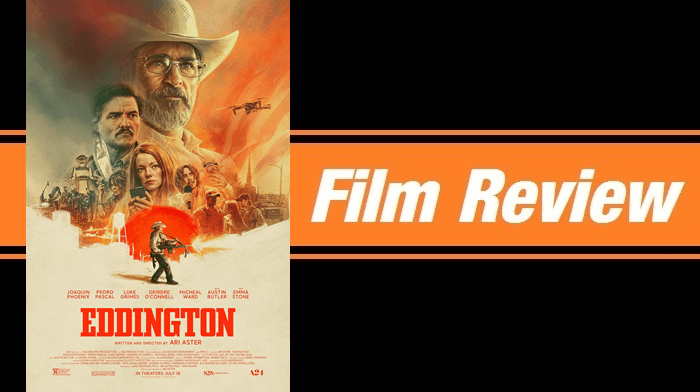
Now Aster is back with his fourth film and with it we see his career pendulum swinging back mightily the other way. Aster takes a bold and provocative swing with “Eddington”, shrewdly straddling the line between satirical black comedy and a Neo-Western thriller. His story is set in 2020 during the early days of the COVID-19 pandemic. He takes an unvarnished look at the heightened paranoia and anxieties that swept through communities while spotlighting the political opportunism and obstinance that only made things more complicated.

Adding to the already tumultuous landscape were the growing tensions following the killing of George Floyd. Impassioned protests swept across the country. But several were overthrown by aggressive rioters, sometimes prompted by well-funded outside agitators eager to plunge the country into violence. Aster’s willingness to take on such fresh wounds speaks to his audacity. But what’s amazing is how well he pulls this crazy thing off.

Image Courtesy of A24

While some may try hard to put “Eddington” in their political corner, the film openly fillets the political left, right, and most everyone in between. It should be stated that Aster isn’t fence-straddling. He offers frank and truthful observations through a fable that is as thematically chaotic as the times it represents (and fittingly so). Most will remember the events with alarming clarity which may make this a difficult watch. Yet Aster mines so many darkly funny moments out of the pointed, pathetic, and preposterous scenes that unfold before us.

The story plays out in Eddington, a small dried-up New Mexico town with a population of 2,435. It’s where we meet Sheriff Joe Cross (an exceptionally pitiful Joaquin Phoenix), a by-the-books rural conservative who keeps the law in his quiet town with the help of his two deputies, Guy (Luke Grimes) and Michael (Michael Ward). The only thing more frustrating to Joe than mask mandates and government imposed lockdowns is his live-in mother-in-law, Dawn (Deirdre O’Connell) who rarely misses a chance to scrutinize how he handles his dissociative wife Louise (an underused Emma Stone).

Joe doesn’t see the coronavirus or the growing unrest as Eddington problems. This puts him at odds with Ted Garcia (Pedro Pascal), Eddington’s incumbent mayor who is up for reelection. Ted stands for nearly everything Joe is against. He’s a good-looking and good-talking politician who is intent on protecting his political career by staying on his liberal governor’s good side. That means imposing and enforcing mandates and policies that don’t always apply to him. Far shadier is his involvement in a massive AI data center set to be constructed on Native American land outside of Eddington.

Image Courtesy of A24

As the tensions fester between Joe and Ted, a small but growing BLM-inspired protest breaks out on Main Street. They’re spearheaded by the impressionable Sarah (Amélie Hoeferle) whose verbiage and sloganizing sounds plucked from TikTok videos rather than out of organic conviction. She’s supported by Brian (Cameron Mann) who is more smitten with her than their cause. Joe is ill-equipped to either control the crowd or empathize with their cause which only makes things worse.

Aster throws in so many other things, all ripe for critique. Conspiracy theories, misinformation, social media dependency, cult leaders (a shaggy but captivating Austin Butler is a brief delight), white middle-class radicalism, etc. With so much laid out, the budding question became how would Aster wrangle it all together? The answer – with an insanely violent Tarantino flavored exclamation point at the end. It’s a wildly entertaining finish that speaks to where our intensifying divisions could eventually lead us.

“Eddington” feels like a movie some will need to wrestle with, not just for days but perhaps years. It’s a feature that demands a level of honesty and introspection. Those unwilling will likely contort the movie to fit their political dogmas or simply dismiss it altogether. But those willing to look deeper will find a well-conceived and well-crafted satire that is both ruthlessly funny and daringly insightful. Top it off with a terrific cast (none better than Phoenix), and you have Aster’s best film since his stellar debut. “Eddington” is in theaters now.

VERDICT – 4 STARS