
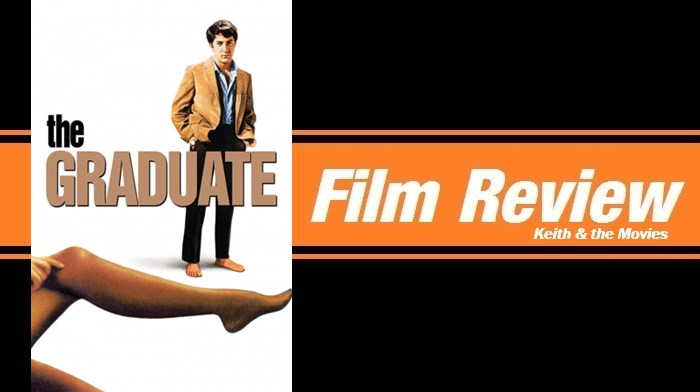
It could be called a comedy, a drama, or a romance. But truth be told, “The Graduate” is a little of all those things. More importantly, it’s a sharply conceived and slickly crafted film that in several ways ushered in a new approach to filmmaking. It’s been touted as a highly influential feature and has held high spots on some pretty prestigious movie lists. While I’ve never been as enamored with it as many have, it’s still a good film with its share of memorable moments.
“The Graduate” would go on to receive seven Oscar nominations, winning one for Mike Nichols’ direction. Screenwriters Buck Henry and Calder Willingham penned the script which was an adaptation of Charles Webb’s 1963 novella of the same name. The film was also a massive commercial success, becoming the highest grossing movie in 1967 by a pretty large margin. But what’s more interesting is hearing how it has aged in the minds of fellow critics.
This wasn’t Dustin Hoffman’s first official acting credit. That honor goes to the few seconds he appeared in “The Tiger Makes Out”. But it was “The Graduate” that gave him his breakthrough role. Hoffman plays Benjamin Braddock, a disconnected and isolated recent graduate from an east coast college. His parents throw him a graduation party to celebrate his accomplishments, but it does nothing to dent his general apathy towards grad school and his uncertainty for the future.
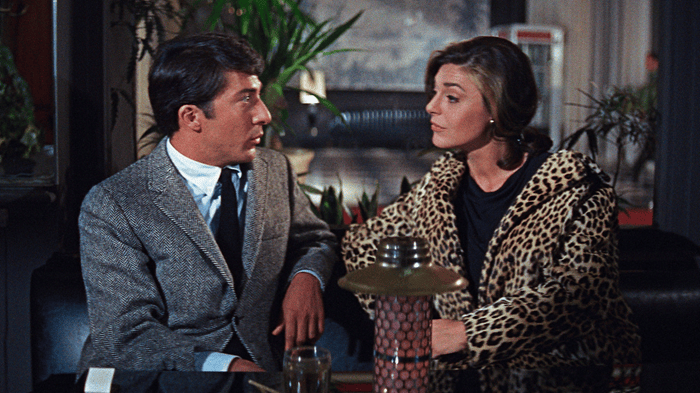
Benjamin is a fascinating character whose complexities show themselves in a variety of ways. He’s a bit of a social pariah who can sometimes come across as an irreverent jerk. He can be flippant and impudent, but he’s also a sad and melancholy soul. And we find out early on that Benjamin has a hard time discerning how to approach this new stage of his life. That internal struggle, though muted at times, lies at the core of the story.
Perhaps all of this is why Benjamin is such easy prey for Mrs. Robinson (Anne Bancroft). She’s a much older friend of the family who is married for the wrong reasons and is clearly unhappy with her circumstances. She baits Benjamin into an illicit affair which over time adds even more complications to his already muddled life. Much like the movie itself, opinions of Mrs. Robinson have also changed over the years.
Some have argued that Mrs. Robinson is the most appealing and alive character in the film. They praise her for seeing things as they are and pursuing her own happiness. I still see her a little differently. She can just as easily be viewed as shameless, dishonest, and self-absorbed. She too is in a difficult situation. But she goes the route of disgraceful self-indulgence with little to no moral conviction. And her maliciousness shows itself even more when Benjamin unexpectedly falls in love with her daughter Elaine (played by Katharine Ross).
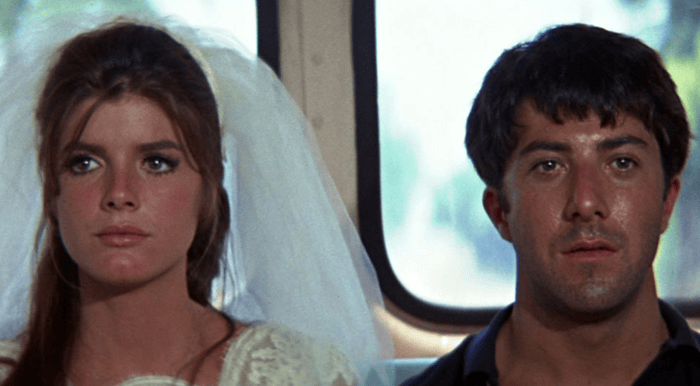
My biggest issue still centers around Elaine. Ross gives a solid performance but her character could really use more depth. At times it’s impossible to understand Elaine’s thinking, and her decision making can be rash and out of the blue. A tighter script might have sold the romance better in the second half by opening up her relationship with Benjamin and upping the stakes. I still love the ending. But things get a little clunky before we get to that unforgettable final scene.
While some views of the “The Graduate” have changed, for me it has maintained its resonance and insight, neither of which has been hurt by the passing of time. The film’s moments of humor are still funny, Benjamin is still a compelling character, and the iconic ending shot is still as potent as ever. Simon and Garfunkel’s perfectly placed songs still give several scenes an extra punch, and the direction from Mike Nichols is still satisfying.
After nearly 60 years, “The Graduate” has proven to deserve the near universal respect it has been given. It may not have the most tight-knit script and some key character relationships may be slightly underwritten. But it’s anchored by some rich themes, terrific performances, and a great soundtrack. It’s also a movie with a significant cultural legacy that still speaks to its many fans both old and new.
VERDICT – 4 STARS


This movie is still my favorite of all-time. It really explores the pathos of being a young man who doesnt want to rush into his future self right away, while exploring what young love is about.
Despite liking and basically learning from Mrs Robinson, Ben still wants to connect with the feelings of now and immediacy, which Elaine represents. Even Elaine struggles because young women then were more pressured into finding a suitable husband rather than self discovery or a potential career. That could be why her character is more half-baked(Like Ben’s plans with her)and mysterious, despite knowing that Braddock was somewhat stalking her.
The genius move on Nichol’s part was taking a story with blue-eyed wasp character and making him more jewish instead, which adds somewhat of a sentimental, and like you said Keith, a melancholic element to it.
The use of Simon and Garfunkel songs proved that movie-making could add more to its artistic aesthetic, punctuating visuals or dialogue with music that could grab at our heart and gut with a sense of acknowlegement.
I truly LOVE you enthusiasm for it. For me, the ending shot is one of the best thematic punctuation marks in movie history. For me it puts the whole movie into the proper context. I just love it.
Thanks Keith … that last shot truly represents what I feel young love is about. That naive, trust and willingness to take a huge dive into the unknown, where sadly, we will all eventually learn from where many of us will grow more selfish, apathetic and jaded and never really try again, though many people will marry and re-marry for the wrong reasons.
That shot was also an accident with the actors between direction but Nichols knew that it held alot of truth.
Dustin Hoffman always admired Anne Bankroft’s take on the Mrs Robinson character and her ballsy aggressiveness to use Ben’s body knowing his mind was confused and distracted.
I also feel thats why Elaine’s character confronts and questions Ben about his “rape” of her mother. She probably knew it never happened but wanted to address Ben’s pursuit of her in Berkley.
Agreed. Elaine was not given enough depth. And yes, the film resonates well.
Keith I think your mention of ‘seminal’ is important for younger audiences. It is this movie along with others like Bonnie and Clyde, Easy Rider, Midnight Cowboy, and 2001 that opened the possibilities for future American films. They became darker, twisted, and more powerful I guess.
sorry you didn’t mention seminal. It was Legacy!
I knew what ya meant! 😁👍🏼
It was definitely an era of emerging styles and approaches that set the course for cinema’s future.
well said, with or without seminal 🙂
thank you. those 60’s movies along with a few others are quite memorable and left an impression.
You are welcome and I agree.
This film is a bit overrated. I think it is a film as you get older, you realize there are some things that have not aged well. Notably the ending as you realize…. “oh…. they’re fucked”.
I agree and don’t really hold it as high up as a lot of people. I do love that final shot though. The reality of the moment hits pretty hard.
The ending version for a stage play adaptation of The Graduate that I once saw made a lot more sense to me in that regard.
Keith, you’ve written a good review on this old, (pun intended) gold, yet still relevant film. These kinds of human scenarios play out in variations across people, locations, and times. I do remember the advertisements with Mrs. Robinson’s leg in the foreground as the graduate walks into the room. What red-blooded young man could resist? If only he hadn’t fallen for the daughter. Shows the stark difference between hedonism and genuine caring. I love the movie, and you are right, S&G music is the icing on the cake.
Thanks so much. I really enjoyed revisiting it. Mark another one off the list…at least until the next time.
You’re welcome.