
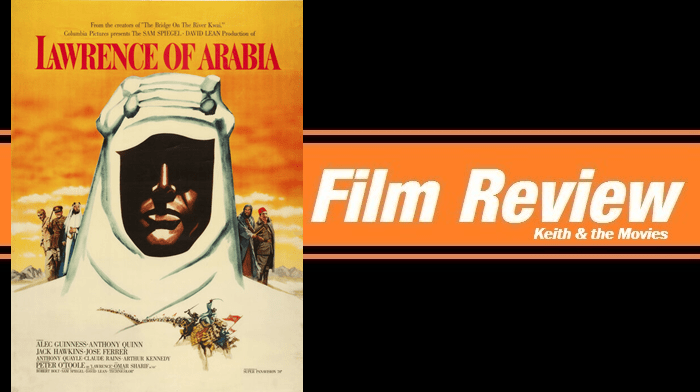
Director David Lean’s “Lawrence of Arabia” still stands as one of cinema’s most universally celebrated motion pictures. The breathtaking and beloved 1962 historical epic was the winner of seven Academy Awards including Best Picture. It also won Best Film at the BAFTAs and Best Motion Picture – Drama at the Golden Globes. But perhaps the ultimate testament to its greatness lies in the many acclaimed filmmakers it has influenced – Martin Scorsese, Steven Spielberg, George Lucas, Ridley Scott, Sam Peckinpah, Kathryn Bigelow, Oliver Stone, and James Cameron, just to name a few.
“Lawrence of Arabia” is an astonishing accomplishment, or as the late film critic Roger Ebert described it, “a bold, mad act of genius“. It’s a movie born out of ambition and imagination that dared to defy the conventional Hollywood formulas of its time. For example, it exchanged the traditional big screen war hero with a quirky, flawed protagonist. It fearlessly spends nearly four hours centering its grand spectacle with a deeply psychological character study. And it relies more on visual cinematic language than dense dialogue-driven exposition.
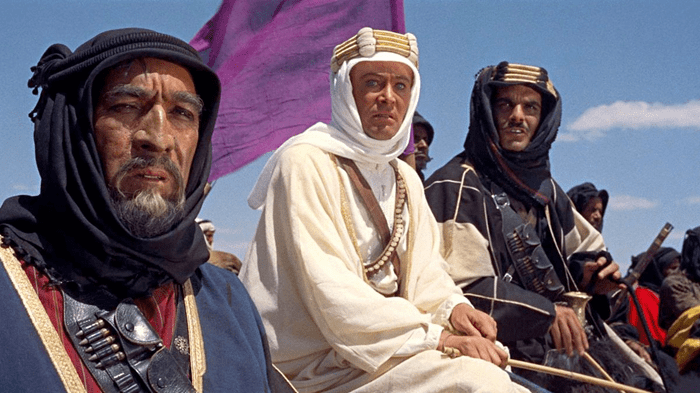
There are countless ways that “Lawrence of Arabia” could have went belly-up. Yet David Lean captains the production with confidence and even a necessary defiance. The screenplay by Robert Bolt and Michael Wilson is based on the life of British officer and diplomat T.E. Lawrence, and their portrayal of him and key moments in his history stirred up several controversies. But Lean doesn’t treat this as a standard biography or a purely historical piece. It’s a cinematic experience first and foremost, although one brimming with rich themes of imperialism, reality vs myth, and the corrupting nature of power.
Prior to “Lawrence of Arabia”, actor Peter O’Toole was a relatively unknown actor. But after first picks Albert Finney and Marlon Brando turned down the role of T.E. Lawrence, O’Toole was hired for the part that would make him a star. With his uniquely sculpted face, crystal blue eyes, and golden blonde hair, the lanky Englishman looked the part of the eccentric misfit in the British Army who would become a ruthless military leader struggling to live up to the growing myth surrounding him.
As the First World War is being waged, the enigmatic Lieutenant Lawrence is stationed in Cairo where he spends his time outlining maps and doing match tricks. He’s summoned by General Edmund Allenby (Jack Hawkins) and Mr. Dryden (Claude Rains) of the Arab Bureau who assign him a mission in the Arabian desert. He’s to meet with Prince Faisal (Alec Guinness) who is leading a revolt against the Turks. With the help of Colonel Harry Brighton (Anthony Quayle), Lawrence is to observe and assess the Prince’s forces and report back to Cairo.

But Lawrence steps beyond his orders in ways that impresses Prince Faisal. He goes from mere observer to a crafty strategist, urging the Prince to sanction a surprise attack on the heavily guarded Turkish port of Aqaba. Faisal gives Lawrence just fifty of his men including his most trusted advisor, Sherif Ali ibn el Kharish (Omar Sharif). Rather than being deterred, Lawrence gathers the men and heads for Aqaba. But it’s no ordinary journey. It’s a dangerous trek that requires crossing the harsh and unforgiving Nefud Desert.
The crossing of the Nefud Desert is one of the film’s most gripping scenes, in large part due to Freddie Young’s spectacular sun-soaked cinematography. Young shot the film on Super Panavision 70mm which features an ultra-wide, high-resolution aspect ratio that vividly captured the vastness of the scorching desert. It’s just as astounding elsewhere as we’re treated to one grand vista after another. Or when literally hundreds of extras fill the wide frame to a jaw-dropping effect.
The sands take its toll, but it’s also where Lawrence earns the trust of his men. They not only follow him across the desert, but into the camp of rival tribe leader Auda Abu Tayi (Anthony Quinn), who Lawrence cunningly recruits to join them for the attack on Aqaba. Now with an army at his disposal, Lawrence can carry out his true goal of Arab independence, by unifying the many tribes into one powerful force against the Ottomans. But he learns unity among lifelong enemies and independence in a land coveted by powerful foreign interests may be nothing more than pipe dreams.
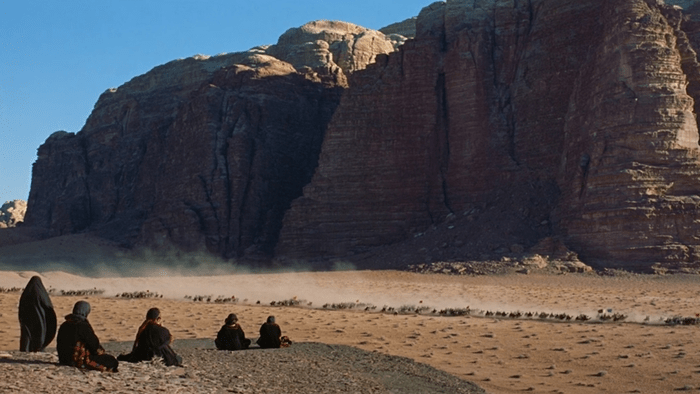
Lawrence’s successes turn him into a near mythic hero. But his attempts at living up to the myth cause him to slowly lose his moral compass. He begins a guerrilla war against the Turks which only feeds his growing god complex. Lawrence’s psychological evolution is masterfully explored and it forms the backbone of the story. Lean shows the intoxicating allure of notoriety and power. We also witness how violence hardens hearts and scars humanity. In Lawrence’s case, once reality sets in, he’s left broken and disillusioned. It makes for a riveting case study wrapped within one of the most visually stunning epics ever made.
In 1988, “Lawrence of Arabia” received an extensive restoration after film historians Robert A. Harris and Jim Painten discovered rusting film cans holding the original negative of Lean’s final cut sitting in the Columbia Pictures vault. The painstakingly reconstructed director’s cut featured over 30 minutes of restored footage that had been cut by distributors. Since then the film has received a digital restoration and is now available in full 4K resolution. So there’s no better time than now to finally see or revisit this true time-honored classic.
VERDICT – 5 STARS


This would be among a select group of much-older films I’d have no problem seeing in a theatre, having missed their original theatrical runs. Impressive in any format, but that director’s cut certainly would be magical on the biggest of screens. I haven’t seen it, but I need to.
The director’s cut is magnificent and that’s without seeing it in 70mm on the big screen. I can’t imagine how amazing that would be.
Do it Bruce, it’s awesome.
It will be done!
One of my favourite movies, and Phil bought me the reconstructed directors cut, which we watched the other week. It is truly sublime, and that’s a cracking write up you did, can’t do better. Did you know they had the original actors come back to do the missing vocals? Those still alive anyway!
Thank you so much. I really appreciate that. It’s funny, I watched the restored directors cut on Netflix and then immediately went and bought it from Amazon. It’s just extraordinary.
I need to re-watch this and The Bridge on the River Kwai as my Auteurs piece on David Lean has been on limbo for a few years as it is only half-finished so far.
It’s 100% worth a rewatch. I couldn’t recommend the director’s cut enough.
There’s a director’s cut?
Oh yes!
MovieBox has a simple and convenient browsing experience. I like how the content is presented clearly, making it easy to look through movies and shows. Visit: https://themovieboxdl.com/