REVIEW: “Hunter Killer” (2018)

HUNTERbig

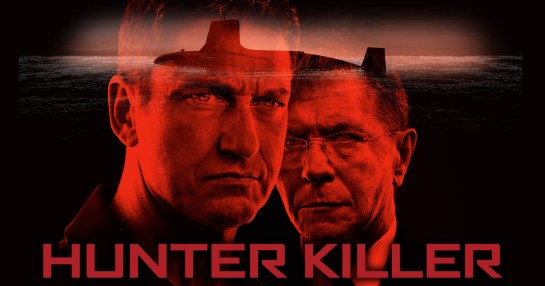
Am I the only one waiting for Gerard Butler to have that Matthew McConaughey-like renaissance? You know, where he lands that one movie that taps back into the talent that we once saw glimpses of before the cavalcade of hard-to-digest slop started churning out? Well, I hate to say it but “Hunter Killer” ain’t it.

Gerry Butler’s movies have almost become an absurd event for me. I would be lying if I didn’t admit to getting some type of weird entertainment value out of them. They’re routinely bad and always offer some level of goofiness to laugh at (most of the time unintentionally). “Hunter Killer” take a different approach. It nearly drowns in its own self-seriousness. That being said, here’s something funny – “Hunter Killer” isn’t as bad as it has every right to be.

HUNTER1

Now let’s not get carried away. This isn’t the movie that puts Butler back on track. Simply put, it’s impossible to take any part of this three-pronged story seriously. And the further you go the more you realize that it’s doing nothing that you haven’t seen many, many times before.

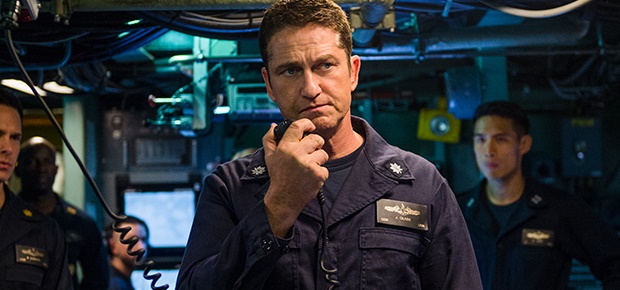
After a United States submarine suspiciously disappears in arctic waters, first-time Commander Joe Glass (Butler) is ordered to investigate. He takes the USS Arkansas and his new crew to do some deep seas super-sleuthing. Not only does he discover the fate of the U.S. sub but he stumbles upon a sunken Russian sub that has been sabotaged from the inside. Among its lone survivors is a dignified Russian Admiral played by Michael Nyqvist.

HUNTER2

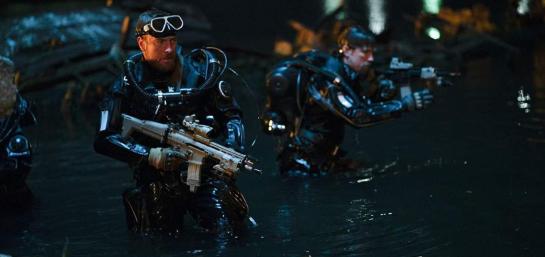
Meanwhile a four-man Navy SEAL team covertly airdrops into Russia where they are to secretly observe the goings-on at a suspicious Russian naval base. Their reconnaissance uncovers a coup led by a wild-eyed defense minister (Mikhail Gorevoy), so cartoony he could have been pulled from a late 80s comic book.

The third thread of this story takes place at the Pentagon where government officials scramble to make sense of all the intel pouring in from the Arkansas and the SEAL team. Gary Oldman grabs a quick paycheck as the Chairman of the Joint Chiefs while a stone-faced Common plays an Admiral with the emotional depth of a block of wood. Linda Cardellini gets a thankless role as a security advisor. Their roles consist of expressing various levels of concern as highly dramatic music looms in the background.

HUNTER3

Nothing in this three-story structure works particularly well on its own. You’ll have a hard time finding an original idea or interesting character in any of the scenarios. But when they all come together it does offer up some mindless entertainment. The pacing is good (which is probably a smart thing) and there are a handful of good action sequences that injects a little welcomed energy. We also get another good performance from the late Michael Nyqvist. It’s one of his final roles.

But despite my ability to squeeze a little enjoyment out of “Hunter Killer”, it’s still a movie that sinks more than swims. Pretty much every thing it does is by the numbers and while some of the casting may catch your eye, they’re more or less doing the same – checking boxes and offering up the best super-serious mugging they can muster.

VERDICT – 2 STARS

2-stars

REVIEW: “Happy Death Day 2 U”

HappyPOSTERBIG

Complete with an absurdly funny title and a crazy concept, 2017’s “Happy Death Day” was a nice little surprise. It was a waggish and off-beat horror movie that worked mainly due to it being both subversive and self-aware. It played around with several of the genre’s most familiar tropes and it did so with an ever-present tongue-in-cheek glee.

Now we get the inevitable sequel sporting an even more ridiculous title and taking the story to even more outlandish places. I say the sequel was inevitable because these meagerly budgeted horror films have proven to be a gold mine for producers like Jason Blum. The first film was made for under $5 million and made over $125 million at the box office alone. As I said, inevitable.

Happy1

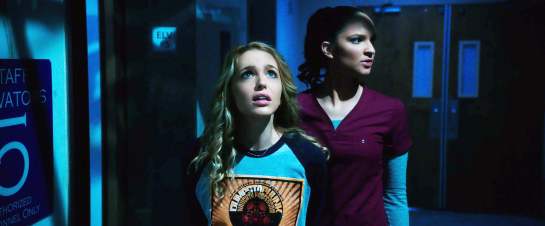
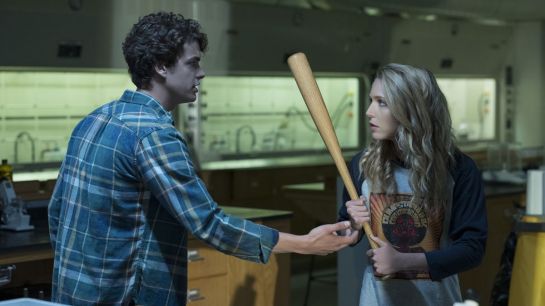
Jessica Rothe (now 31-years-old but still looking like a college student) returns to play Tree. The key piece from the first film, Rothe is asked to go even further here in terms of balancing the horror and comedy elements. She’s still a lot of fun to watch and is more than able to do most of the heavy lifting.

Tree and her now boyfriend Carter (a returning Israel Broussard) set out to help fellow Bayfield University student Ryan (Phi Vu) who is caught in a time loop much like the one she encountered in the first film. They link Ryan’s situation back to a quantum physics experiment fired off by him and his fellow science geek buddies. They conclude that the only way to fix things is to reenact the experiment, but in doing so Tree finds herself pulled back into her own personal “Groundhog Day” time loop. The film quickly shifts to her as she tries to figure out her predicament.

Happy2

Returning director Christopher Landon (who also writes the sequel) retains the original film’s playfulness while barely keeping it within its genre. It’s weird but this barely feels like a horror movie. There are a couple of jump scares and we’re reminded that you can chew up a lot of screen time by walking slowly down hallways or through darkened rooms. But that’s about it. You could try to fit it into the slasher sub-genre but even that feels like a stretch.

“Happy Death Day 2 U” ends up barely being a horror movie, kind of a comedy, and sort of science-fiction. Its story is goofy (I like to believe intentionally so) and I’m still trying to figure out what the heck actually happened in it. But here’s the funny thing, this peculiar mashup still manages to show its audience a good time. Rothe is an absolute blast. It has a specific story thread that is surprisingly touching. And the movie embraces its goofiness just enough to keep the whole thing afloat. It’s a movie so dependent on its central conceit that I’m not sure where it can possibly go next. But even though this is a pretty fun sequel, you get the feeling they need to come up with something new if they want to keep this series fresh.

VERDICT – 3 STARS

3-stars

REVIEW: “Hereditary”

Hereditaryposter

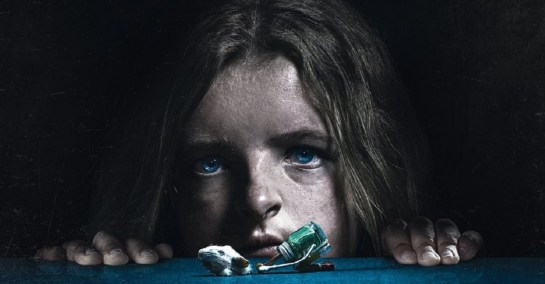
It’s probably a good indicator that you aren’t in for a happy two hours when the film you’re watching opens with a newspaper obituary. In “Hereditary” it turns out the obit is for 78-year-old Ellen Taper Leigh. It’s the launching point for this stunning and genuinely creepy filmmaking debut.

Writer-director Ari Aster’s fiendishly disturbing film gets under your skin through slow-boiling horror beats while patiently maneuvering its characters through scenes/stages of grief, mental and emotional instability, and finally full-blown terror. It’s one part a heart-wrenching family story, but as Aster begins carefully peeling away the surface layers of his tale, a dark and deeply unsettling heart is revealed.

Hereditary

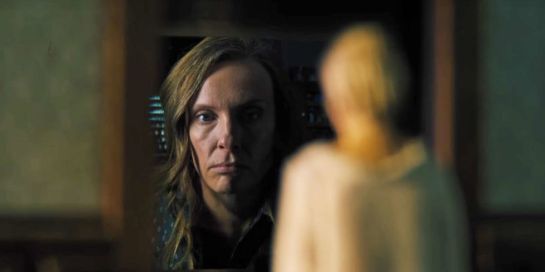
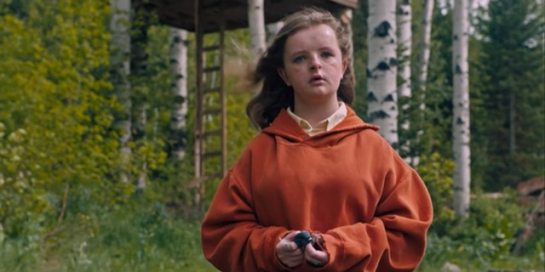
Toni Collette is extraordinary in the film’s lead role. She plays Annie, an artist who specializes in miniatures many of which are based on her own life experiences. She lives in the mountains with her soft-spoken husband Steve (Gabriel Byrne), their 16-year-son Peter (Alex Wolff) and 13-year-old daughter Charlie (Milly Shapiro). She happens to be the daughter of Ellen Taper Leigh. You remember, the woman from the above mentioned obituary?

As Annie eulogizes her mother at the funeral service it becomes clear their relationship was strained. We also learn Annie’s childhood was tough. Her father battled psychotic depression, her mom had dementia and her brother was a schizophrenic. All of it feeds into the estranged Annie’s frame of mind, but it also feeds into the wickedly uncomfortable horror element that simmers at the core of Aster’s film.

Hereditary2

Plot-wise being intentionally vague is pretty essential. The fewer details you have going in the better the effect. It starts a bit slow as its pieces are put into place, but once the psychological terror begins to uncoil the movie methodically grows more and more discomforting. Aster’s examination of grief and mental illness gets darker and more queasy with every scene.

“Hereditary” is a genuinely terrifying movie, not in the gory gruesome or lazy jump-scare sense. Instead it bores deep down under your skin much in the way Robert Eggers did with his exceptional 2016 film “The Witch”. With fine performances, a strong directorial debut, and soaked in the strategically menacing score by Colin Stetson, “Hereditary” slowly pulls you in before giving your nerves and your senses a good working over. That’s the kind of ‘horror’ that lands with me.

VERDICT – 4 STARS

4-stars

REVIEW: “Halloween” (2018)

HalloweenPOSTER

David Gordon Green’s “Halloween” is yet another entry into the four-decade-long slasher franchise sure to drive continuity hounds insane. If you’re into chronology finding a link through every Halloween movie is all but impossible.

Case in point: If you’re loyal to the original order you have “Halloween” 1-6. Maybe you choose the two “H2O” movies which followed the original “Halloween” and “Halloween 2” but nothing after. Then you had Rob Zombie’s completely unconnected reboots simply titled “Halloween” and “Halloween 2”. Now we have a new line that embraces the 1978 original but dismisses everything else. So with it you have “Halloween” followed by “Halloween”. Confused yet?

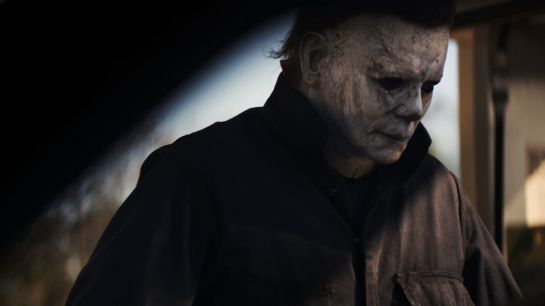
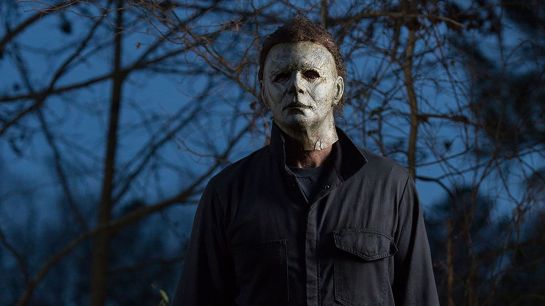
For many people none of that stuff matters much. It’s weird and messy but ultimately it all comes back to the masked butcher-knife wielding antagonist Michael Myers. Green’s “Halloween” aims to bring back the original conflict between Michael and Jamie Lee Curtis’ Laurie Strode. And what better time to do it than the 40 year anniversary of the ’78 John Carpenter classic.
Halloween2

Green was an unusual choice for a “Halloween” movie especially considering some of his raunchy swing-and-misses (“Pineapple Express”, “Your Highness” and “The Sitter”). But since those films he has shown a more intriguing side to his filmmaking (“Prince Avalanche”, “Joe”, and “Stronger”). So having him head a big slasher-horror franchise was intriguing.

In Green’s telling, Michael Myers was captured shortly after the murderous events of the first film (seems like something the audience should get to see but be that as it may). For 40 years since, Michael has been in an institution for the criminally insane under the care of Dr. Sartain (Haluk Bilginer), a former student of Donald Pleasance’s Dr. Loomis with the fascination for Michael’s psychology.

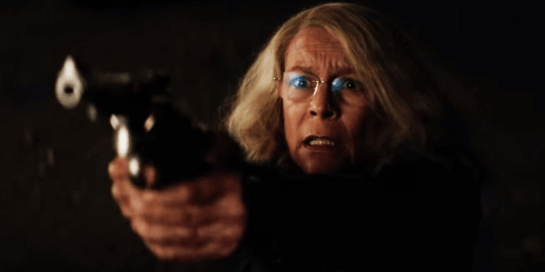
During this same time, Laurie Strode has closed herself off both literally and figuratively. She is a self-described basket case with two failed marriages and a strained relationship with her daughter Karen (Judy Greer) and granddaughter Allyson (Andi Matichak). The mental trauma and understandable paranoia has driven Laurie into seclusion on the outskirts of Haddonfield, barricaded in a fortified farmhouse full of booby-traps and firearms.

The institution schedules to transfer Michael, along with a busload of other patients, to a new facility on Halloween night. How’s that for timing? A crashed bus, a few dead bodies, and guess who is heading back to Haddonfield? And don’t worry slasher fans, Green gives his audience more than enough disposable characters to serve as Michael’s blood-soaked fodder. In fact, practically none of these characters are meaningful other than to raise Michael’s gory kill count and take screen-time away from Curtis who is very good here.

It’s impossible to deny the nostalgia for someone who loved the 1978 film. Green and co-writers Danny McBride and Jeff Fradley are routinely calling back to the original and in many instances borrowing from the very sequels they disavow. So aside from Laurie Strode’s journey and a particularly bizarre middle act twist, much of this movie will feel familiar to franchise aficionados and for slasher fans in general. It does little to differentiate itself.

What’s worse is that the movie just isn’t that scary. It throws in a smattering of jump scares but it’s never able to maintain the tension that John Carpenter nailed so well. I only recall one scene that had me antsy. Even the big finale had all the ingredients for a tense sequence but is drawn out too long before FINALLY giving us the overdue payoff (and it is a very satisfying payoff).
Halloween1

It’s also hurt by the fact that Michael Myers is simply not that interesting. A lot was made of Green’s decision to wipe out Michael and Laurie’s family connection. Here Michael seems aimless, often killing for no reason other than to allow the special effects team to one-up their last kill. And the movie’s weird jabs at humor tend to disrupt the tone (I’m sorry, but potty-mouthed little kids ran their course with me long ago).

Some have called this a horror film for the #MeToo and #TimesUp era. I think that is giving the movie way too much credit. It does aim to put Laurie Strode in the Ellen Ripley and Sarah Connor class. That’s a good thing and the film needed more of her. But that’s as far as the movie goes. It’s still a very basic slasher flick which is good for genre fans but it’s hardly one with a profound social conscience. Still there is definitely fun to be had.

It may sound like I’m down on “Halloween” when actually it works well enough within this 11-movie franchise. Jamie Lee Curtis is excellent and the film excels when she is highlighted. But when you have framed yourself as a direct sequel to an all-time horror classic and you’ve wiped out a lot of the series history it’s easy for us to expect a little more than a standard slasher film. Especially one that is so similar to several of the sequels it set out to replace.

VERDICT – 3 STARS

3-stars

REVIEW: “The Hate U Give”

hateposter

There seems to be a new wave of movies dealing with one of the hot button social issues of our day – police brutality. It’s an important issue but one often caught up in the mire of politics and emotion. Strong feelings on both sides often lead to the conversation spiraling away from the meat of the matter and into frivolous side debates.

Sometimes what we need is a pointed yet levelheaded examination. For the most part that is what we get in director George Tillman Jr’s “The Hate U Give”, a film adapted from Angie Thomas’ young adult novel of the same name. Without question “The Hate U Give” is looking at its issues from a specific point of view, but that doesn’t undercut the relevance of what it has to say nor does it negate the power with which it says it.

hate2

In what should be a star-making performance, Amandla Stenberg plays Starr Carter. She’s a bit of a chameleon, taking on different personas in the two worlds she occupies. During the day she is one of the only African-American kids in her mostly white private prep school. While there she hides anything that may hint at where she is from. And where is she from? The lower income and predominantly black neighborhood of Garden Heights where she back-pockets and keeps quiet about her school life especially her white boy friend Chris (KJ Apa).

Keeping her two worlds apart is the easiest thing for Starr, but it’s not without complications. A portion of the movie deals with her bouncing between cultures and finding it hard to fit into either. For Starr it becomes about putting off the facades, discovering who she is, and finding her own distinct voice. Unfortunately the catalyst for Starr’s evolution is a senseless act of violence.

Hate3

At a late night party in Garden Heights Starr bumps into childhood friend and first crush Khalil (Algee Smith). After gunfire rings out, Kahlil helps Starr out of the party and drives her home. On the way they are pulled over by a patrolman for a lane violation. Minutes later the cop panics, an unarmed Khalil lay shot to death, and Starr is the lone witness.

News of the tragedy reverberates throughout the community, the city, and eventually the nation. Starr’s father Maverick (a terrific Russell Hornsby) wants her to use her voice regardless of her apprehensions. Starr’s mother (an equally good Regina Hall) wants her to stay quiet fearing the repercussions of the spotlight. As Starr is torn between defending her friend and protecting her family, others unknowingly treat her like a pawn for their own agendas. It makes finding her voice even more of a struggle.

Hate4

While police brutality is the film’s central topic, it explores a host of other racial and socioeconomic issues. It looks at urban poverty, profiling, drug dealing, protesting, among several other things. Screenwriter Audrey Wells (who sadly died earlier this month) leans on her big lot of characters to explore these subjects. The characters are a strength and even the smallest are authentic and believable pieces of the story. There are a couple exceptions. Her white friends from school often come across as clichés intended to move the narrative in certain directions. And I loved Anthony Mackie as a local gang leader and drug pusher. He is intense and menacing but too often relegated to giving intimidating stares from a distance.

George Tillman Jr. works with a lot of moving parts and manages them with an able hand. He tells a good story while only occasionally dipping too far into melodrama. His movie is very open about about its feelings which is to its credit. At the same time its earnestness occasionally leads the film to paint in broad strokes and dabble in generalizations. But those instances are rare. Ultimately “The Hate U Give” is a film that speaks its mind but does so with optimism. The filmmakers want to make a difference and they truly believe their film can help do so.

VERDICT – 4 STARS

4-stars

REVIEW: “Hostiles”

Hostiles poster

A new traditional Western is somewhat of a rarity these days. You could say 2016 was the year of the subversive Western while 2017 didn’t offer much of anything for the genre. But then along comes “Hostiles” which sits somewhere between subversive and traditional.

“Hostiles” is written and directed by Scott Cooper, probably best known for his award-winning feature film debut “Crazy Heart”. The movie begins with the ‘traditional’ – a familiar but effective opening sequence showing a frontier family brutal attacked by a Comanche war party. The lone survivor, a wife and mother named Rosalie Quaid (played by an excellent Rosamund Pike), is left in a state of shock.

HOSTILES1

The story then moves to Fort Berringer, New Mexico. Captain Joseph Blocker (Christian Bale) has seen his share of frontier bloodshed. And while he tells himself he was justified by simply “following orders”, the killing has taken a toll. He reluctantly accepts a mission to escort an imprisoned, dying Cheyenne war chief (Wes Studi) and his family back to their Montana tribal homeland on orders from President Harrison.

Bale and his handpicked soldiers set out with their Native American prisoners to make the dangerous journey north. Cooper fills this party with some good faces. Bale is outstanding with a ‘less is more’ approach and I’ve always enjoyed Wes Studi. But we also get Rory Cochrane, Jesse Plemons, Adam Beach and current flavor of the year actor Timothée Chalamet. Pike joins them after her traumatized Rosalie is discovered among the charred remains of her frontier home. A blood-soaked pilgrimage follows with several characters forced to reckon with their past and present sins.

There is an interesting line “Hostiles” walks. On one side it openly recognizes the part bigotry and brutality played in American policy towards the indigenous peoples. On the other side it doesn’t insult Native Americans by portraying them as overly sentimental dramatic pieces. Walking that line is Blocker, disillusioned by the military he has blindly served and bitterly prejudiced because of the men he has lost in battle with the natives. He is the film’s centerpiece and while there are intriguing ideas about what he represents, I was just as much into his personal quest as a broken man in search of repentance.

HOSTILES2

“Hostiles” is a bleak and tough-minded movie. In Cooper’s portrayal of death and suffering neither discriminates and none of his characters are free from the sting whether it be during their trek north or from scars of the past. Cooper uses explosions of violence but he also allows for quiet meditative moments that aren’t without purpose. It makes for a slow burn which may not satisfy those looking for a more traditional western shoot ’em up. But as the group moves across Masanobu Takayanagi’s beautifully shot landscapes I appreciated the action as well as the contemplation.

Some of the responses to “Hostiles” have been curious. Many have criticized Cooper for his “white perspective” even going so far as to say the movie is an attempt to ease a nation’s guilt over their treatment of Native Americans. Those are dramatic stretches which tags the film with an unfair label. It never draws a broad equivalence between the motivations of the U.S. Army and the natives. Again, Blocker makes several references to his “job” which he knows is genocide. And the Army’s atrocities take various forms within the characters particularly Cochrane’s and in Ben Foster who appears later on. It’s even hinted at in the D.H. Lawrence quote which opens the movie — “The essential American soul is hard, isolate, stoic, and a killer. It has never yet melted.”

“Hostiles” is unquestionably solemn and dour yet fittingly so considering the subjects it wants to explore. But at the heart of the movie lies a message of reconciliation and healing which is especially welcome during our current times of such division. The wonderful final shot offers us a glimmer of hope. It’s filled with uncertainty and it’s far from tidy. Yet it’s hopeful in a way that brings the film’s ultimate message to light.

VERDICT – 4.5 STARS

4-5-stars