REVIEW: “His Three Daughters” (2024)

The impending death of their ailing father forces three estranged sisters back together in “His Three Daughters”, an intimate family drama written and directed by Azazel Jacobs. The movie had its world premiere over a year ago at the Toronto International Film Festival where it was picked up by Netflix for $7 million. What a bargain.

“His Three Daughters” is surprising in its simplicity. The opening line in this review is really the movie in a nutshell. But it’s that very simplicity that allows the film to set its feet and hone in on the raw, tangible emotions that drive its story. And Jacobs has just the right actresses to pull it off. Carrie Coon, Elizabeth Olsen, and Natasha Lyonne deliver unbridled performances of such authenticity and weight. Each help to anchor the film in their own distinct yet interconnected ways.

Image Courtesy of Netflix

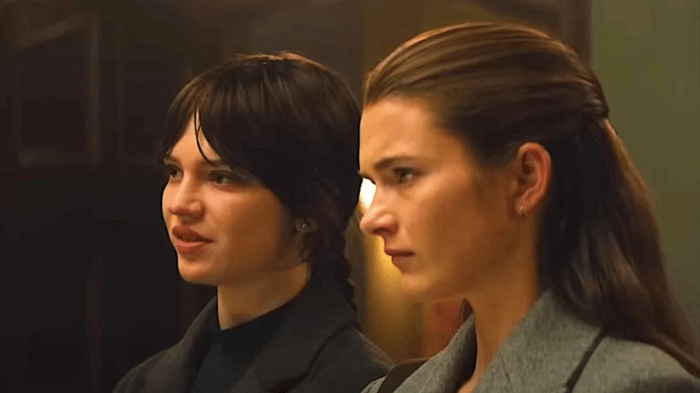
As their father’s battle with late stage cancer reaches its end, his three daughters, Katie (Coon), Rachel (Lyonne), and Christina (Olsen), gather at his apartment in New York City to be with him during his final days. They meet their hospice representative Angel (Rudy Galvan) who fills them in on what to expect and informs them that their goal should be to make their father’s remaining days as painless and peaceful as possible.

But the main drama is found in the frayed relationships between the three women. Each has their own unique personalities and baggage. Some of the tensions have been packed away for years, and their overall lack of communication and connection has led all three to reach very different conclusions about the others. They try to put those conclusions aside for the sake of their father. But it’s only a matter of time before their proverbial lids blow off.

Katie is the oldest and has a hard time holding back her opinions. She’s prickly, obsessive, drinks when she gets anxious, and is always quick to criticize Rachel. It’s a reflection of her own trouble back home which she keeps bottled up. As for Rachel, she’s crass, detached, and spends the majority of her time smoking pot and betting on sports. It helps her to keep her emotions buried while avoiding the inevitable. Then there is the gentle Christina who spends the bulk of her time keeping the peace between her warring sisters. She is open-hearted and optimistic to a fault, often so aggressively looking for the bright side of things that she misses reality.

Image Courtesy of Netflix

The more time we spend with these three women, the more we learn about them. And the more we learn, the better we understand them. Jacobs’ incisive script adds layers to each woman, taking the necessary time to allow them to fully form. Emerging bitterness and resentment leads to confrontations, yet Jacobs never paints anyone as the bad guy. They don’t always earn our approval, but they do earn our empathy. It’s due to the characters being sharply written and achingly authentic in nearly every regard.

If you have experienced watching a loved one die, “His Three Daughters” will speak to you in a number of profound ways. Jacobs approaches his subject with honesty and clarity, avoiding theatrics and never hitting a false note. But even as his characters navigate the valley of death, they insightfully speak to the deeper meaning of life. It’s all anchored by the sublime performances from Coon, Lyonne, and Olsen who make us laugh and break our hearts. And they do so while giving us hope that good can come from life’s most painful events. “His Three Daughters” is now streaming on Netflix.

VERDICT – 4 STARS

REVIEW: “Horizon: An American Saga – Chapter 1” (2024)

Expecting a proudly classical, old-fashioned Western to be anything other than polarizing in our modern movie climate is a bit naive. And I say that as someone who didn’t initially consider the landscape when reading the first wave of reactions to “Horizon: An American Saga – Chapter 1” – the first big screen installment in Kevin Costner‘s decades-in-the-making, multi-film passion project. It only required a little thought for me to understand many of the responses that should have been easy to predict.

Truth be told, classic Westerns have (unfortunately) fallen out of fashion, and over the years tastes have changed dramatically. Today many people trend towards social-realistic dramas, pseudo arthouse edginess, and low-budget horror, occasionally cleansing their palates with a big studio blockbuster. So when something like “Horizon” comes along, it shouldn’t surprise us that it doesn’t resonate with everyone. And that’s perfectly fine.

Image Courtesy of New Line Cinema

But some of the shots taken at it have been petty and disingenuous. Such as labeling it a “vanity project”. Or the cries of nepotism because he cast his son in a small role. My advice: toss all of those things aside. “Horizon: An American Saga” is clearly near and dear to Costner’s heart which is a big reason he is personally bankrolling a huge portion of the films. And you can see his passion in nearly every second of this vast, immersive, and handsomely shot frontier epic.

As this first chapter clearly shows, the Horizon saga isn’t your prototypical narrative driven movie. As Costner himself has put it, “it’s a journey, not a plot movie” and some people may struggle with that. But having his intentions in mind, along with a grasp of his audacious multifaceted vision going forward, energizes “Chapter 1” and helps set the table for something that could be truly magnificent.

Make no mistake, there is a lot of introduction and table-setting in “Chapter 1” and all of it is building towards the release of “Chapter 2” which comes to theaters this August. Again, it is unquestionably unconventional. But it works extremely well mainly due to the attention Costner gives to the several main characters and their uniquely personal storylines. While Costner himself gets top billing, his character, Hayes Ellison, is only one piece of this amazing character-driven tapestry.

Image Courtesy of New Line Cinema

With “Horizon”, Costner sets out to give us a broad look at the American West through a variety of frontier experiences across Kansas, Wyoming, Montana, and other captivating territories. Written for the screen by Costner and author Jon Baird, the individual stories each have surprising depth and a dramatic heft that not only grabs your interest but leaves you looking forward to what lies ahead.

And while Costner proudly embraces the grand old-fashioned vistas and classic Western flavor, it’s impossible to put his film in such a tiny box. That’s because he takes a nuanced look at frontier life. Anything perceived as romanticizing the “Old West” is often countered by the realities of violence and savagery. And he doesn’t sugarcoat the numerous themes he unearths such as freedom, morality, justice, grief, family, greed, and retribution just to name a few.

Among the key characters we encounter is Costner’s Hayes Ellison, a former gunslinger who finds himself at odds with the thuggish Sykes family and their matriarch played by the always compelling Dale Dickey. He and a prostitute with a heart of gold named (go figure) Marigold (Abbey Lee) head to the mountains in hopes of avoiding a conflict with the Sykes bunch.

Image Courtesy of New Line Cinema

Elsewhere in the film’s most harrowing sequence, Frances Kittredge (a standout Sienna Miller) and her daughter Lizzy (Georgia MacPhail) barely survive a massacre of their settlement by an Apache war party. They’re taken in by the United States Calvary where she takes a liking to Lt. Trent Gephardt (Sam Worthington). We also meet members of a wagon train driven by their reluctant leader Matthew Van Weyden (Luke Wilson). And we follow a young boy, thirsty for revenge after his family is murdered. A series of unfortunate events puts him in the company of a brutal gang of killers butchering natives for profit.

An incredible ensemble not only brings these stories to life, but they also introduce personal stories within the stories. Admittedly it’s a lot to keep up with. But it’s worth the effort, in large part thanks to the superb performances from the main stars and sturdy reliables like Michael Rooker, Danny Huston, and Will Patton. Add in Costner’s bold and ambitious vision that trusts in his audience’s ability to understand what he’s going for as well as their willingness to go along on the journey. I know I’m ready. “Horizon: An American Saga – Chapter 1” is in theaters now.

VERDICT – 4.5 STARS

REVIEW: “Hit Man” (2024)

Richard Linklater has been cemented as a favorite filmmaker of mine for a long time and he seems to justify that status with every new movie he makes. Even films of his that may not hit every right note still do something to me that I have a hard time describing. At the risk of sounding corny, Linklater speaks a language in his movies that has always resonated with me in a number of fascinating ways. He does it again with his latest, the fun yet uneven “Hit Man”.

“Hit Man” is one of those Linklater movies that doesn’t hit every right note yet it had me in its corner from the very start. It’s a bit erratic, especially in regards to tone. And there were several times where it didn’t seem certain of the kind of movie it wanted to be. For example, the first third is vintage Linklater, brimming with his signature style and oddball humor. A little later the humor somewhat dries up as the movie takes a more romantic turn. Even later it turns into a Coens-lite crime thriller involving murder, dirty cops, and a big coverup.

Linklater’s “Hit Man” is based on a 2001 article of the same name that was written by Skip Hollandsworth and published in Texas Monthly magazine. It tells the “somewhat true story” of Gary Johnson, played by the current everywhere-man and regular Linklater collaborator, Glen Powell. Gary is an unassuming guy who seems to live a pretty mundane life. He’s a straitlaced psychology and philosophy professor at the University of New Orleans and lives quietly alone with his house plants and two cats, Id and Ego.

Image Courtesy of Netflix

But Gary has a second job working in a surveillance van for the New Orleans Police Department. And that’s where his life takes a wild and unexpected turn. After the slimy lead undercover cop (Austin Amelio) gets suspended for beating up two teenagers, Gary is thrust in as a desperate last-minute replacement, wired and posing as a contract killer, tasked with getting the unsuspecting mark to hire him. Not only does he pull it off, but he’s stunningly convincing.

Gary becomes the police’s go-to undercover guy, drawing from all his geeky knowledge of movies and pop culture to tailor his hitmen for every individual client. Most of them are everyday ordinary folks with one small exception – they want to off their spouse, neighbor, business partner, etc. and are willing to pay for it to be done. Gary’s costumes and personas progressively get more outrageous and over-the-top, but his arrest rate only grows.

Admittedly it all sounds utterly preposterous. Would the police toss a civilian into such a situation with such little thought? Was there really an epidemic of people hiring hitmen that the cops needed a special task force dedicated solely to it? Isn’t this some shady form of entrapment? Linklater doesn’t bother with any of those questions and often just goes along with the absurdity of it all. How much these things stick out to you may very well impact how far you can go with “Hit Man”.

Image Courtesy of Netflix

Gary’s transition from nerdy nobody to super-cool undercover agent is threatened following a coffee shop meeting with a women named Madison (a saucy Adria Arjona in full femme fatale mode). Distraught, reluctant, yet flirty, Madison wants him to kill her abusive slimeball husband. But Gary, working as a hunky self-assured charmer he calls Ron, discourages her from going through with it and saves her from being arrested. The move confuses his colleagues but leaves quite the impression on Madison. Before long they’re secretly dating on the sly which sees the movie take on a distinctly noir flavor.

Powell’s performance is a key ingredient that makes the film tick. Admittedly, it takes more than a pair of glasses and his hair parted to the side to truly sell him as a nerdy professor. Yet Powell makes it work thanks to his innate sincerity and slightly goofy charm. But its his leading man versatility that stands out most as the actor seamlessly transforms from one identity to the next. Arjona shines as well and builds some great chemistry with Powell despite the relationship between their characters needing more depth.

There’s a lot to like about “Hit Man” from the first-half humor, to Linklater shooting on location, to the unpredictable directions the story goes. Yet despite all of that, the movie is never quite as funny as you expect it to be, nor quite as sexy as it clearly wants to be, and not quite as thrilling as it could be. Still, Linklater is a filmmaker who always puts something compelling on the screen. That may sound like a strange compliment, but it testifies to what he delivers with “Hit Man”. “Hit Man” premieres June 7th on Netflix.

VERDICT – 3 STARS

Sundance Review: “Handling the Undead” (2024)

Director Thea Hvistendahl weaves a creepy and captivating web with “Handling the Undead”, a Norwegian horror drama based on Swedish writer John Ajvide Lindqvist’s 2005 novel of the same name. Aside from its genuinely intriguing premise, the feature film adaptation (which just showed at the 2024 Sundance Film Festival) stars Renate Reinsve who dazzled audiences with her performance in 2021’s critically acclaimed “The Worst Person in the World”.

The story of “Handling the Undead” (written for the screen by Hvistendahl and Lindqvist) is in many ways a metaphor-rich meditation dressed as a genre film. Yes, it’s a zombie movie but with an intensely human focus. Hvistendahl isn’t concerned with carnage and chaos. Instead she takes three unrelated families in Oslo, each in different stages of grief, and explores the raw emotions and internal conflict that might follow a loved one being reanimated from the dead. It’s an audacious and strikingly original approach that shatters expectations.

While the idea of the dead coming back to life is a central ingredient, it’s the cutting social realism intrinsic to Hvistendahl’s storytelling that sets the movie apart. It’s seen from the opening scene where we’re introduced to the first of the three families. A man named Mahler (Bjørn Richard Sundquist) bags up some food from his fridge and walks it over to an apartment building where his daughter Anne (Reinsve) is getting ready for work. The two barely speak – a lingering aftereffect following the recent death of Anne’s young son Elias.

Image Courtesy of NEON

Elsewhere an elderly woman named Tora (Bente Børsum) is the lone attendee at a funeral for her partner Elisabet (Olga Damani). She pays her last respects before a funeral director wheels away the casket holding the remains of her loved one to the back of the stylishly cold and echoey parlor. Tora then gets in a taxi and returns to her spacious and now heartbreakingly empty home.

Then there is a mostly stable family of four that includes a father David (Anders Danielsen Lie), a mother Eva (Bahar Pars), their teenage daughter Flora (Inesa Dauksta), and their younger son Kian (Kian Hansen). Aside from the occasional spat with the rebellious Flora, everything looks great until Eva is involved in a serious car accident that leaves her on life support. A devastated David has to break the news to their children while struggling to get any updates from the hospital.

Then out of the blue a shrill high-pitched sound pierces the air, setting off car alarms, knocking out radio signals, making traffic lights go haywire, and sending flocks of birds into a swirling panic. The chaos eventually ends with a brief blackout. And then a short time afterwards and without warning, the dead begin coming back to life.

The source of the disturbance is never revealed and what follows it is never explained. But those aren’t the kind of questions Hvistendahl or her characters are interested in. Instead David wants to know if his dying wife’s suddenly strong heartbeat means she’s on the mend. Tora is just happy that her crippling sorrow and loneliness is over following the sudden reappearance of Elisabet. Anne and Mahler are more concerned with the government taking Elias away if they find out he’s alive again. These are the kinds of deeply personal and viscerally human concerns that Hvistendahl surveys.

Again, it can’t be stressed enough that this isn’t a movie about some grisly apocalypse. Yes, it involves the reanimated dead. But rather than brain-munching terrors, Hvistendahl views the few zombies we see as shades of people once loved. Despite their gruesome appearances, Elias, Elisabet, and Eva are seen through the eyes of their loved one. It’s a painful perspective especially as we watch family members love on their recently resurrected only to get nothing in return. No acknowledgment; no response. It poses a number difficult questions.

Of course the zombie genre conventions are never too far out of mind and loom just enough to maintain a low-simmering sense of dread. They eventually surface in the final act but even then Hvistendahl handles things with remarkable restraint. That very same kind of control is seen all throughout “Handling the Undead”, making it a hauntingly unique movie and a penetrating first feature from an exciting new filmmaker.

VERDICT – 4 STARS

REVIEW: “He Went That Way” (2024)

Jacob Elordi had quite the breakout year in 2023. First came his much talked about performance as Elvis Presley in Sofia Coppola’s “Priscilla”. Then came his role in Emerald Fennell’s try-hard disappointment “Saltburn”. Regardless of your thoughts on the movies, the 26-year-old Aussie took a major step up from his “Kissing Booth” features on Netflix and has positioned himself as one of the most interesting young talents in the business.

Elordi kicks of 2024 with yet another role that tests his range. He plays a serial killer in first-time director Jeffrey Darling’s “He Went That Way”, a true-crime thriller based on Conrad Hilberry’s 1987 nonfiction book “Luke Karamazov”. The film is built upon an inherently interesting premise and it certainly emphasizes Elordi’s magnetism. But it’s hindered by an inconsistent tone and a lack of emotional resonance which minimizes our connection to the characters and their stories despite being entertained by them.

Image Courtesy of Vertical

Darling (who sadly died in a surfing accident in 2022) begins his movie with the tag “This really (mostly) happened.” Set along the infamous Route 66, the story takes place during the Summer of 1964. It’s a period marked by a shift in American culture – something eluded to in an early montage but never really followed up on. From there we’re introduced to Bobby (Elordi) a tall, handsome, and unhinged roamer dumping a dead body in Death Valley, California.

A scene or two later we meet a fidgety Pepto-guzzling animal trainer named Jim (Zachary Quinto) as he’s traveling Route 66 with some rather unusual cargo. Jim is transporting his pet chimpanzee named Spanky to Chicago for a “private engagement”. We learn Spanky was once a fairly big celebrity, known by many and frequently making appearances on television. But his fame has fizzled leaving Jim to take their act on the road.

While stopped at a gas station Jim sees Bobby hitchhiking and decides to offer him a ride. Bobby is on his way to Michigan where he has a girlfriend named Bonnie (or so he says). But it doesn’t take long before Bobby starts showing his poorly suppressed violent side. He brandishes his beloved Derringer and intimidates the considerably more unassertive Jim who suddenly finds himself on a road-trip across the Southwest with a young sociopath.

Image Courtesy of Vertical

It’s easy to assume you know where the story is going. But Darling and writer Evan M. Wiener attempt to throw us a few curveballs. Most come in the strange relationship that forms between Jim and Bobby. The two begin warming up to each other in their own weird (and kinda twisted) ways. As they do, we’re fed tidbits of information about each of them although never enough to get a good grasp of who they are. The feelings and motivations that drive them are even more opaque, making it hard to have anything other than a surface-level connection to them.

Despite there being a flimsiness to their characters, the performances from Elordi and Quinto keep our attention and help elevate the material. But they can’t quite compensate for the lack of depth nor can they do much to steady the script’s uneven tone. There is some good tension from the grittier thriller side of the story and there are some amusing bits from the swings it takes at dark comedy. But the movie has the hard time balancing the two, leaving us often wondering what kind of movie Darling is going for. “He Went That Way” hits select theaters on January 5th.

VERDICT – 2.5 STARS

REVIEW: “The Holdovers” (2023)

In “The Holdovers” Paul Giamatti once again reminds us of how great he can be when given a good character and good material. He gives an awards-worthy performance in director Alexander Payne’s latest. This is Payne’s first feature film since 2017’s so-so “Downsizing”. Call it a return to form or whatever you want. I’ll just enthusiastically say that even with its few minor issues, “The Holdovers” is one of Payne’s best films to date.

The story, written by David Hemingson, is set in 1970 around the Christmas holiday. At the New England boarding school of Barton Academy Paul Hunham (Giamatti) is a classical antiquities teacher who is widely hated by his students and is an outcast among the faculty. He’s a sad and lonely sort although he keeps his misery hidden, at times even from himself.

Image Courtesy of Focus Features

With its two-week Christmas break looming, students and teachers begin packing to head home for the holidays. But every year there remains a small group of kids with nowhere to go. They’re called holdovers and this year Paul gets the duty of staying on campus and looking after them. It’s not that he minds. After all he has no place to go himself. Among this year’s batch of five boys is Angus Tulley (Dominic Sessa), a smart but frustrated student who is left at school after his selfish mother and her new husband decide to take their belated honeymoon over the holidays.

A rather convenient something happens that gives the four other boys a ‘Get Out of Jail Free’ card. That leaves Angus and Paul, two seemingly polar opposites whose disdain for each other quickly festers. But “The Holdovers” is a movie about looking beyond what you think you know about someone. It’s about the empathy that comes from seeing and understanding the real person underneath their hardened exterior. So Angus and Paul slowly begin letting down their guards, and as a result they begin learning more about each other and themselves.

A key reason their stubborn hearts begin to soften is a school cafeteria worker named Mary. She’s played by Da’Vine Joy Randolph whose Oscar-caliber performance is full of heart and pathos. Mary is no stranger to tragedy which is one reason she too stayed at school through the holiday break. She’s a wise but straight-shooting woman who offers eye-opening perspectives that (at different times) both Paul and Angus desperately need to hear.

Image Courtesy of Focus Features

Payne clearly loves this unusual trio and he puts plenty of attention towards growing each character. He takes his time unpacking their individual stories which Hemingson lays out in deep personal detail. Both writer and director do a great job defining these distinctly different yet beautifully complimentary personalities. There’s also plenty of lighthearted moments such as Mary introducing Paul to The Newlywed Game or Paul’s choice of Christmas gifts for his newfound ‘family’ of sorts.

“The Holdovers” is bound together by Payne’s keen direction, Hemingson’s compassionate script, and some stellar performances particularly from Giamatti and Randolph who should be on every voter’s shortlist (the way Giamatti spouts things like “you hormonal vulgarian” without cracking a smile is awards-worthy in itself). It’s a little longer than it needs to be due to a slow starting first half. But once it hits its emotional stride, the film really connects. And anyone with a beating heart is sure to be moved by this unexpected delight. “The Holdovers” is out now in select theaters.

VERDICT – 4 STARS