REVIEW: “Infinitely Polar Bear”

POLAR POSTER

Balancing mental illness with comedy can be a precarious undertaking. Filmmakers who shoot for a direct and straightforward comedy have an easier time, but those mixing elements of humor with a more dramatic lean can sometimes subvert the aim of their film. “Infinitely Polar Bear” is an example of a movie taking a more dramatic look at mental illness but lacing it with smart, responsible humor which doesn’t overthrow the film’s purpose.

Maya Forbes writes and directs this semi-autobiographical portrayal of her life living with her bipolar father. Forbes created a fictionalized version of herself and cast her own 12 year-old daughter Imogene Wolodarsky for the role. She sets her film in Boston sometimes in the late 1970s and chronicles a year of intense ups and downs brought on by her father’s bipolar disorder.

POLAR1

The film begins with Cam Stuart (Mark Ruffalo) in nothing but red briefs and a red bandana banging on a car as his wife Maggie (Zoe Saldana) and their two children (Wolodarsky and Ashley Aufderheide) sit terrified inside. The initial absurdity tempts us to laugh, but Forbes quickly acquaints us with the reality of the situation. Cam has had a serious mental breakdown. He loses his job and is sent away for rehabilitation. As a result Maggie has to move into a low-rent apartment where she struggles to provide for her daughters.

Over time Cam progresses and is soon moved to a halfway house where he has an opportunity to reconnect with his daughters. Unable to sufficiently provide for her family, Maggie decides to go back to school to get her M.B.A. and eventually a better job. But that would require Cam to take care of the kids during the week while she is away at Columbia. His doctor thinks the responsibility would be good for him. Maggie is desperate. Cam reluctantly agrees.

The bulk of the film focuses on this mentally frail father getting by on lithium and cigarettes while trying to relate to and take care of his two young girls. There are numerous opportunities for humor and Forbes gives them to us, but you can sense her personal touch on the story and the characters. Cam isn’t a mean-spirited lout or a target for our judgements. It’s clear he represents the real-life father who Forbes truly loves. At the same time she doesn’t gloss over the realities of their struggles and the film is better due to that honesty.

POLAR2

It also works thanks to some strong performances particularly from Mark Ruffalo. Ruffalo is a guy who is always solid but who is often defined by his laid-back and relaxed performances. Here he is given material that allows for him to expand himself. One minute Cam can be even-tempered and playful while the next may see him wound tighter than a top. When things get stressful we see him impulsively bouncing from one mood to the next, his kids often being the victims. Ruffalo handles it all with such authenticity. Saldana is also very good it would could be a thankless role. It’s Ruffalo that gets the spotlight but Saldana’s earnestness is crucial.

In the end “Infinitely Polar Bear” succeeds in looking at mental illness with a careful mix of humor and drama. There are portions of the story that feel shortchanged and the film sometimes seems uninterested in plot points that I would like to know more about. But Forbes stays true to the heart and soul of her movie and her connection to the subject matter shows itself in the pleasing end results.

VERDICT – 4 STARS

4 Stars

REVIEW: “Into the Storm” (2014)

STORM POSTER

Tornadoes and heavy CGI devastation. “Into the Storm” put all of its eggs (and money) into that basket and hoped it was enough to win an audience. With a budget of $50 million and a box office take of $160 million I would say the movie more than accomplished its goal. Less discerning fans will leave satisfied with the numerous twisters and their swirls of dirt and debris. But if you happen to be looking for anything more than that “Into the Storm” will leave you wanting.

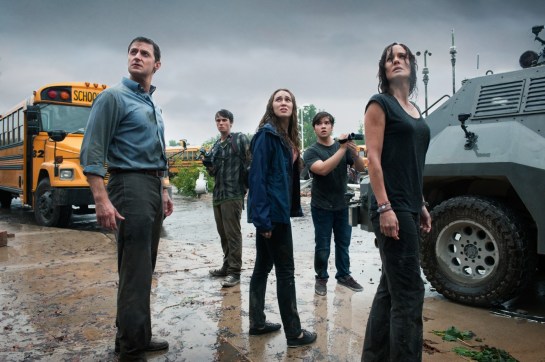
The story follows a couple of groups in and around the small town of Silverton, Oklahoma. One is a group of storm chasers led by Pete (Matt Walsh). He is a veteran chaser who is also working on a documentary, but the storms haven’t been good to him. He’s desperate to track down a tornado and he has brought in meteorologist Allison Stone (Sarah Wayne Callies) to help. She’s on a short leash especially after missing a recent storm and costing Pete some good footage. Pete reluctantly follows Allison’s storm tracker hunch and they head to Silverton.

STORM1

In Silverton school vice-principal Gary Fuller (Richard Armitage) is a widower and father of two high school boys. Donnie (Max Deacon) is his more quiet and reserved son. Trey (Nathan Cress) is his more obnoxious younger brother. Neither have had the best or most open relationship with their father since their mother died. It won’t help matters that Donnie shirks his duties of filming a graduation ceremony to help the girl of his dreams with her video school project.

As you can guess a massive storm front comes through spawning a number of tornadoes in Silverton. The movie takes us back and forth between our two groups as they encounter one destructive twister after another. Eventually both groups come together and must survive the queen mother of all tornadoes. I know this is true because one character actually says something like “It’s the biggest tornado ever”. This movie does that a lot. We aren’t allowed to glean information for ourselves. Everything is spelled out for us. Also don’t expect to find interesting and compelling characters. Everyone feels unoriginal and scripted. But to be fair plot, dialogue, and character development aren’t priorities here.

STORM2

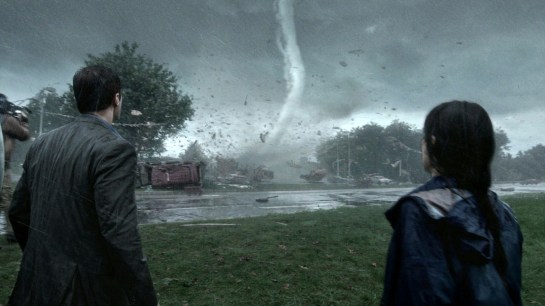
“Into the Storm” partially redeems itself with its visual presentation. It’s hard not to be impressed with the CGI twisters blowing down trees, tearing through buildings, and slinging 18 wheelers like footballs. The special effects are thrilling, well conceived, and very satisfying. Clearly a huge hunk of the budget went towards the visuals and that’s okay. Most people will see the movie for Mother Nature’s spectacle and it doesn’t disappoint. The only thing that hampers the looks of the film was the decision to go the found-footage route. It’s implementation is clunky, annoying, and quite frankly I’m tired of the gimmick.

At a brisk 89 minutes “Into the Storm” doesn’t exhaust its welcome. It aims for one rather uninspired target and for the most part it hits it. In that regard I had fun with it. But the overly familiar characters, the bland and sometimes silly dialogue, and the plot’s lack of any originality whatsoever makes this just another run-of-the-mill disaster movie. And this leads me to a question: Can we not have a smart and engaging weather based disaster flick? I don’t know, maybe rain, wind, and intelligent creative writing don’t mix.

VERDICT – 2.5 STARS

REVIEW: “Interstellar”

INTER Poster

While some people may not love his movies, even they would have to admit that Christopher Nolan is a cinematic artist who has given us a number of movies known for their artistry and uniqueness. Personally I find myself smitten with every feature he brings to the screen. Nolan creates experiences. Through breathtaking visuals and challenging narratives, he takes his audiences places that must be navigating by the senses AND the intellect. I think he is a brilliant filmmaker, but even the greats sometimes miss the mark. There have been a lot of mixed opinions about Nolan’s latest work “Interstellar”. Is this his first shoot and miss?

Much of “Interstellar’s” divisiveness is rooted in extremely high expectations and/or the audiences’ willingness to not just quickly consume the film’s themes but to chew and meditate on them. It’s a film rich with ideas and questions, some of which are only barely touched on but which are still relevant and worth our attention. “Interstellar” is also soaked in science, not in the arrogant or haughty sense, but in a way that convincingly melds science fiction and reputable theory. It’s also ripe with emotion, something that I never expected going into it. In other words it’s a movie with a number of different components but none of which conflict thanks the masterful control Nolan has of his material.

Inter1

I firmly believe that the less you know about “Interstellar” going in the better. But to offer a little about its story, Matthew McConaughey plays a widowed ex-NASA pilot named Cooper who now runs a farm with his father-in-law, teenaged son, and 10-year-old daughter. It’s the future and times are hard for the human race. A devastating blight has ravaged crops and able farmers have become more valuable than pilots or engineers. Government programs like NASA and the military have been abandoned and the focus put on the urgent need of food. In reality Earth’s plight is incurable and Cooper is recruited by an old acquaintance Professor Brand (Michael Caine) to head a space expedition to find a habitable planet. But it would require Cooper to leave what he holds dearest in order to potentially save it.

Nolan takes his time developing his scenarios and his characters. It starts with McConaughey and his fabulous performance. His weather-worn face and calloused hands puts him right at home on the dustbowl that Earth has become. McConaughey has a natural and magnetic presence that helps him sell every scene he’s in. It may be a poignant scene with his young daughter Murphy (remarkably played by Mackenzie Foy) or a vigorous debate with a room of physicists. I connected with his character early on and stayed invested until the end.

There is also a host of fantastic supporting work. Anne Hathaway is great as Professor Brand’s daughter and fellow scientist. I also enjoyed David Gyasi as a physicist who joins the expedition. And later on Jessica Chastain appears and gives a performance that grounds and emotionally energizes the second half of the film. Once again she is fabulous. Other castings that I really liked included John Lithgow, Casey Affleck, David Oyelowo, and Ellen Burstyn. Only one performance stuck out like a sore thumb. Neither Topher Grace nor his character ever quite fit.

INTER2

But just having a great cast isn’t good enough. There has to be good material for them to work with and Christopher Nolan, along with his brother Jonathan, provide it. Their script pulls influence everywhere from “2001: A Space Odyssey” to “Alien”. From “Metropolis” to “Wall-E”. Yet despite that “Interstellar” is uniquely Nolan’s. Like many of his films it is cinematic brain food. It challenges us on a personal level by looking at our decisions and their consequences. It looks at self-sacrifice and the costs that some pay. It also challenges us on a philosophical level. What is our purpose of being? What is our place in the world?

And as I mentioned earlier there is a lot of science. This leaks into one of the complaints I’ve read in several places. Many count the film’s numerous science-laced conversations as a flaw. Some have seen them as nothing more than convoluted exposition. I couldn’t disagree more. Exposition is filling in gaps with back story or explanation and there is certainly some of that. But so many of the conversations center around the peril the characters are in and ways to handle it. They are dealing with unknowns, not providing filler. And of course I didn’t understand all of the talk about quantum physics, relativity, singularities, etc., but I believed it because the characters believed it and were passionate in their conversations about it. I bought into them so their knowledge was all I needed.

And then there is the emotional component of it. Surprisingly “Interstellar” is a film so full of emotion and some have had a hard time connecting with it. That’s a shame because emotion is the centerpiece of the film. At the core of “Interstellar” lies the one human force that transcends time and space. This is a movie about love. And it actually dares to be unashamedly sentimental, something else that many have viewed as a flaw. Again, I couldn’t disagree more. That’s because none of the heavy emotional scenes (all connected to the central theme of love) feel false or fabricated. In fact on several occasions I found myself deeply effected and more than once I was wiping tears from my cheeks. To add some perspective, that is very rare for me. But that’s not the only human side we see. Selfishness, cowardice, and deception all show their heads. Some at odds with love. Others born out of a twisted form of love.

inter3

It should go without saying that “Interstellar” looks and sounds amazing. Whether it’s the dry, abrasive, decaying Earth ushering in mankind’s extinction or space and its beautiful palette of stars, planets, clusters, and wormholes, the film offers a number of stunning effects and visual treats. It’s never as spectacular as last year’s “Gravity” but it’s equally impressive. There is a style employed that reminded me of real archived footage. It made many of the sequences all the more immersive. I also loved the use of sound from the space ambiance to Hans Zimmer’s precise score. “Interstellar” is a technical delight.

So why is “Interstellar” a divisive film? I can see a few areas where some may struggle with it. Some may find it too talky. Some may find it to confusing. Some may find it too sentimental. I respect those criticisms yet disagree with each of them. “Interstellar” is a space opera that is inspired by many films but it lays its own course. It’s a contemplative adventure and an emotional exploration that captivated me from its opening moments. More than that, it is one of the deepest and most moving experiences I’ve ever had with a film. It challenged me to self-reflect. It asked questions that I’m still tossing around in my head. It entertained me in a way that few movies of the last decade have. Boring, overly sentimental, convoluted? No way. It’s a graceful, stimulating, a beautiful movie that gave me a motion picture experience I won’t soon forget.

VERDICT – 5 STARS

5 STARSs

5STAR K&M

REVIEW: “Inside Llewyn Davis”

LLEWYNPOSTER2

I am such a fan of Joel and Ethan Coen. Dating back to 1984 with their first film “Blood Simple”, the brothers have put together an incredible filmography, etching out a prominent name for themselves in the process. Not only that, they have developed into some of the greatest filmmakers of our time. Armed with a sharp wit and an undeniable style, the Coens have taken their special brand of cinema to a variety of places. Their latest is the early 1960s New York folk music scene. The film is “Inside Llewyn Davis” and while it may not be the best Coen brothers movie, it is undeniably theirs.

I was so glad to hear that Oscar Isaac had gotten the lead role. This criminally underrated actor has amazing acting chops yet rarely gets big leading parts. Here he plays Llewyn Davis, a down-on-his-luck musician struggling to get by in 1961 New York City. Llewyn’s singing partner has committed suicide, his solo album isn’t selling, and he is flat broke. He spends his nights on the couches of different acquaintances and his days trying to get enough gigs to get by until his big break comes.

LLEWYN1

There really isn’t a lot of plot in “Inside Llewyn Davis”. We basically spend a few days with Llewyn witnessing his routine and seeing the nature of his struggles. It doesn’t take long to learn that Llewyn is his own worst enemy. He’s constantly driving people away whether it’s fellow musicians, family, hospitable friends, or even girlfriends. Llewyn is selfish, uncompromising, and irresponsible yet he never casts an examining light on himself. He’s not a character who will draw the audience’s affection. Much like the other people in his life, we can’t get that close to him even though we feel sympathy towards him. Llewyn is an extremely talented musician. He just needs to get himself out of the way.

This is a colder Coen brothers picture that clearly has no desire to be hopeful or uplifting. Perhaps that why I had trouble embracing the film at first. Don’t misunderstand me, I’m not saying a movie has to be uplifting or hopeful. I don’t believe that at all. But watching Llewyn continually self-destruct for the entire film had me wishing for a glimmer of hope. There are a few scenes of the Coen’s signature dark humor that occasionally lighten things up, but mostly this is a pointed, unflinching character drama that captivated me while still holding me at arms length.

LLewyn3

As with all Coen brothers films this one is loaded with an assortment of interesting characters and captivating faces. We get quick but great roles for John Goodman and F. Murray Abraham. Justin Timberlake is surprisingly good as a fellow musician who is married to Llewyn’s ex-girlfriend Jean. She’s played by Carey Mulligan who is very good in the role. But her character is one of the few Coen creations that could have been handled better. She’s abrasive and profane to the point of being distracting. There is a subtle attempt at humor with Jean and her harsh personality but she disappears before we are allowed to see the compassionate side we are teased with. But this is Oscar Isaac’s show and he gives an Oscar-worthy performance. He brilliantly flexes his acting and singing muscles in what I hope is some career-launching work.

“Inside Llewyn Davis” has all the other traits you would expect from Joel and Ethan Coen. There is beautiful cinematography. The sense of time and place is impeccable. The music is unforgettable and the film features arguably the best soundtrack of the year. And it’s certainly a smart film featuring great vision and unquestionable craftsmanship. But for me it doesn’t quite rank up there with the Coen’s best pictures. That said, this is another time capsule experience brought to us by two of the best in the business, and anytime they make a movie it’s something special. Better yet, it has stuck with me and different themes from the film keep coming to mind. That a sign of something good.

VERDICT – 4.5 STARS

REVIEW: “The Ides of March”

IDES POSTER

Early on in George Clooney’s “The Ides of March” I began to feel that I was watching another heavy-handed exercise in political persuasion wrapped up as motion picture drama. I really hadn’t read much about the movie so I didn’t know what to expect. Thankfully the story moves away from that and gets into some much more interesting territory. This movie is a behind-the-scenes look at political campaigns, the closed-door wranglings, and the ‘win at all cost’ mentalities. And while the movie does get bogged down in its own sense of self-importance, there are some really intriguing things going on here.

Clooney directs, co-produces, and co-writes this 2011 political drama. He also plays Pennsylvania Governor Mike Morris who is involved in an extremely tight Democratic Primary race against an Arkansas Senator. Morris is a prototypical politician – a talking points robot but with the charm that causes followers to swoon. Now that was my impression of him. But the movie and many of the characters see him as a true light and hope for the country. In that group is the film’s main star Ryan Gosling who plays Stephen Meyers, Morris’ junior campaign manager. He’s an idealistic young man who is smitten with Morris’ vision and the political system.

IDES 1

Stephen begins to have his eyes opened at how the political campaign system works especially in a primary where the stakes are so high. He’s shown the ropes by the seasoned senior campaign manager Paul Zara (Philip Seymour Hoffman) and gets romantically involved with a campaign intern and daughter of the DNC Chairman (Evan Rachel Wood). Before long Stephen makes some critical and poor professional and personal decisions that puts him in the crosshairs of his enemies and those he thought were his friends. Several moral quandaries only complicate things for him and he quickly learns that the internal world of big politics isn’t as pure as he may have thought.

“The Ides of March” tries to be the “Wall Street” of the political campaign scene and it manages to pull it off in some instances. The whole ‘young energetic guy with big dreams comes face-to-face with reality’ angle isn’t that fresh but it works well enough. But perhaps the most entertaining parts of the film are when we get to see the inner workings of political campaigns. The jostling between the candidate’s staffs, the crunching of numbers, the state-by-state strategies, and the pursuit of pivotal endorsements are just some of the fascinating elements that Clooney is able to show us.

As the movie progresses, Clooney seems to put his foot on the throat of idealism. I appreciated what he was trying to do at this point in the movie and the statement he makes on our vision of politics and politicians is an interesting one. But basically the movie becomes a story of a bunch of bad people doing bad things because of bad choices. That works for a bit but after a while I knew I wanted more.

Ides 2

The movie’s strongest point lies with its cast. George Clooney is just a solid actor and he’s really good here. Hoffman is also just as good as he always is. I also really liked Paul Giamatti as the rival’s campaign manager. He feels sneaky and conniving but he definitely knows the game. Then there’s Jeffrey Wright as an opportunistic North Carolina Senator who is offering his state’s delegates to the highest bidder. It’s a small role but a really good one. But the one weak performance of the entire movie is Ryan Gosling. He does an okay job but he has no range of emotion. Sheepish grins and a few raises of his voice are about the only changes we get from him. He gives a passable performance but he could have added much more to this character.

“The Ides of March” is strange in that it doesn’t do anything really bad. But when looking at the movie as a whole it’s all over the map. The performances are strong except for the most important one and the story has too many lulls wrapped around its few high points. There’s a little bit of political preachiness but its offset by the crappy characters of those preaching it. But the biggest thing is that it’s just not as insightful and daring as it tries to be.

VERDICT – 2.5 STARS

REVIEW: “The Illusionist”

the-illusionist-poster

I am not the biggest animated movie fan which is actually kind of funny considering I watch so many of them. But to be honest it’s not automatically a conscious choice of mine. Since my two children came into the world my knowledge of animated movies has skyrocketed. So they deserve the thanks for opening me up to the genre. Yet while I do appreciate animated pictures, very few of today’s efforts really connect with me. That’s why it’s such a pleasant surprise when I come across a movie like “The Illusionist”. It turns out to be another example of my hardheaded procrastination hindering me from seeing a very good film.

“The Illusionist” is a smart and stylish animated feature from French writer and filmmaker Sylvain Chomet. His first feature length animated film, “The Triplets of Belleville”, was highly praised even earning two Oscar nominations. With “The Illusionist” he takes the same hands-on approach. He directs, edits, handles the music, and co-writes the story. But the movie’s real punch comes from its source. The story is taken from an unproduced script from acclaimed filmmaker Jacques Tati and has been called “a personal letter to his estranged eldest daughter“. Others dispute that saying it was written for his other daughter Sophie because “he felt guilty that he spent too long away from his daughter when he was working.” Either way its deeply personal material and Chomet brings that out in ever scene of “The Illusionist”.

The_Illusionist 1

The story takes place in 1959 and follows an aging, down-on-his-luck magician who finds his audiences shriveling due to newer and flashier acts. With his venues drying up, he agrees to do a show at a bar on a remote Scottish Island. It’s there that he crosses paths with a young orphan girl named Alice who is convinced his magic is real. She travels with him to Edinburg where he gets a steady gig. He uses the money he makes to put them up in a hotel and to buy Alice gifts. He finds happiness in watching her excitement over a new pair of shoes or a pretty new dress. But soon he and several other traditional acts run into the same problems as before. As his audiences dry up the magician is forced to take several less desirable jobs to keep food on the table and to keep buying gifts for Alice.

In many ways “The Illusionist” is a sad story that deals with a very familiar conflict that was found in almost every Tati film – the cold, loud, impersonal, present versus the content, happy, passionate past. It’s the story of a dying age and dying breed of performers who love their craft and sacrifice for it but are being put out to the pasture by a new generation. This was a trend Tati saw in his day and he addressed it in his very first film “Jour de fete” and throughout his popular Mr. Hulot movies.

Illusionist 2

But it’s not just the themes that resemble a Tati picture. Chomet and company go even further to make this feel like a movie that could slide right into Jacques Tati’s catalog. Like Tati, he puts a heavy emphasis on visual comedy and sound, but with hardly any dialogue. We are mainly told the story through our eyes with the unintelligible speaking being more of a dictator of tone and attitude. To go even further, the magician is patterned after Tati himself from his postures and mannerisms right up to his lanky frame and facial features. The resemblances are uncanny.

“The Illusionist” is certainly not a traditional animated feature. It’s mature in its storytelling and it doesn’t use popular conventions that we so often see. I think my biggest pleasures were in the beauty and grace in which the story is told and in the historical and cinematic similarities it has with its author. The comedy is often times subtle which works well and the characters each have something important to provide. Then there’s the animation which is beautiful to behold. An argument could be made that “The Illusionist” doesn’t capture the charm and wit of Tati’s films. Personally I’m amazed at how Sylvain Chomet was able to do what he did via an animated picture. Maybe I’ve been wrong about animation after all.

VERDICT – 4.5 STARS