REVIEW: “Munich – The Edge of War” (2022)

(CLICK HERE to read my full review in the Arkansas Democrat-Gazette)

Jeremy Irons plays Neville Chamberlain in Netflix’s new wartime feature “Munich – The Edge of War”. The film offers up a reappraisal of the often maligned British Prime Minister, a man that quickly became synonymous with humiliation, weakness, and appeasement. This film (an adaptation of the Robert Harris bestseller) dares to question the long-held perception of the complicated leader. Not to absolve him of naïveté or poor judgement. But to make a case that Chamberlain’s motivations were rooted in strategic foresight rather than incompetence.

Chamberlain was a firm believer in peace through diplomacy. In September 1938, with Germany preparing to invade Czechoslovakia and with his military in no shape to mount a defensive, Chamberlain arranged a meeting with Adolf Hitler, French Minister Edouard Daladier, and Italian dictator Benito Mussolini in Munich. The short-term goal of the conference was to discourage the Führer from invading Czechoslovakia. Long-term it was to avoid the growing possibility of a Second World War.

The meeting ended with Britain and France acquiescing to Hitler’s demands, handing over to him the Sudetenland region of Czechoslovakia. Chamberlain hoped it would quell the Führer’s increasing appetite for territory. It didn’t. Chamberlain returned home, telling an enthusiastic and relieved British public that he had secured “peace with honor“. But just as his harshest critic and eventual successor Winston Churchill predicted, it only took Hitler a few short months to prove Chamberlain wrong. Germany seized what remained of Czechoslovakia and shortly after invaded Poland, setting World War II in motion.

Image Courtesy of Netflix

Directed by German filmmaker Christian Schwochow and penned by screenwriter Ben Power, “Munich – The Edge of War” factors in all of the above history to tell the story of the Munich Agreement but from a unique point-of-view. While Irons’ Neville Chamberlain is certainly a key player, the historical account mostly unfolds through the fictional friendship of two Oxford graduates – one British and one German.

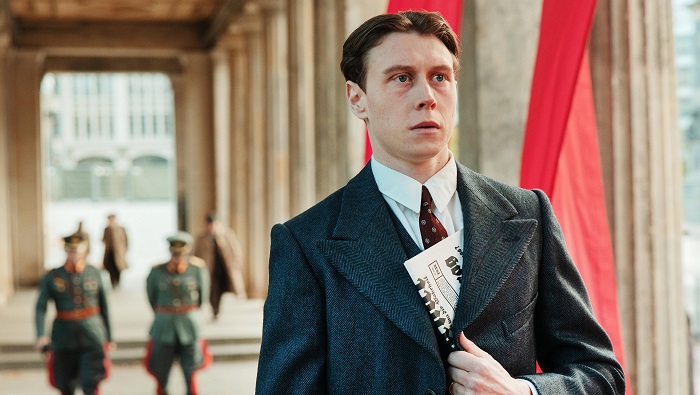
British diplomat Hugh Legat (George MacKay) and German foreign ministry aide Paul von Hartmann (Jannis Niewöhner) were best of friends until a dictator’s politics tore them apart. But with war looming on the horizon, both young men find themselves fighting for peace yet from two very different positions. Hugh works closely with the Prime Minister as he prepares to meet with Hitler. Paul is part of a secret opposition group within the German government whose plan to oust the Führer is stymied by the Munich conference.

Schwochow and Power pluck several pieces from history, add in their own twists, and graft them into this gripping story which turns out to be equal part political drama and spy thriller. While the disastrous result of the Munich meeting are well known, the movie’s real drama surrounds secret documents that detail Hitler’s real expansionist plans (seemingly inspired by the real-life Hossbach Memorandum). When they fall into the opposition’s hands, Paul is tasked with smuggling them to Munich where he is to secretly use the documents to dissuade Chamberlain from signing a treaty with Hitler. But to get close to the Prime Minister he’ll need the help of his old friend, Hugh.

Image Courtesy of Netflix

The movie also puts its own spin on the Oster Conspiracy, a secret plan proposed by high-ranking German officers in 1938 to assassinate Hitler and overthrow the Nazi regime. In the movie, the German opposition consider a backup plan to kill Hitler in case Paul and Hugh are unable to convince Chamberlain in Munich. Adding yet another dramatic layer, August Diehl (so good in 2019’s “A Hidden Life”) plays a German SS officer who begins to suspect that Paul and Hugh are in cahoots.

The movie is energized by Tim Pannen’s stellar production design. One of the keys was the choice to film in the real locations including the actual Führerbau – the very building in Munich where the Czechs were sold-out by their British “ally”. There’s also a tremendous attention to detail from the period-accurate costumes to the vintage cars that fill the streets to the scarlet Nazi banners adorning buildings, cars, and uniforms. Everything here looks exactly right.

And back to the performances, to no surprise Irons is brilliant, portraying Chamberlain as warm and endearing yet blinded by his own optimism. We also get passionate and textured work from MacKay and Niewöhner. Everyone here clicks and so does this movie – a riveting and entertaining blend of history and fiction that may not convince everyone to reconsider Neville Chamberlain, but it certainly gives us plenty to chew on. “Munich – The Edge of War” is now streaming on Netflix.

VERDICT – 4 STARS

REVIEW: “Marry Me” (2022)

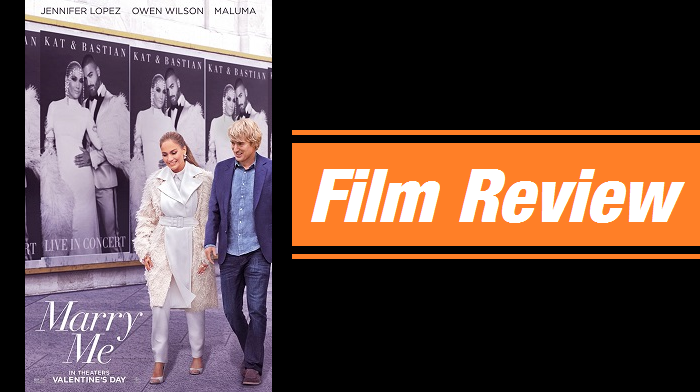
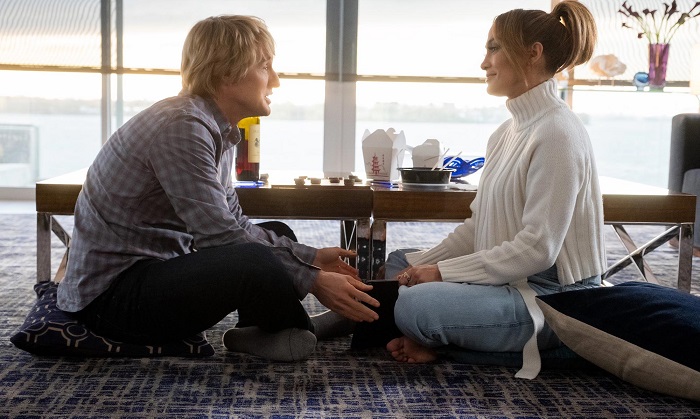
If I were to take a survey asking people to choose two stars they think would be perfect for an on-screen romance, I doubt many of you would say Jennifer Lopez and Owen Wilson. Yet guess who stars in the new romantic comedy “Marry Me”, a movie built around an preposterous premise but that manages to work because of the sheer star wattage and (I can’t believe I’m saying this) chemistry of its two leads.

On paper, nothing about “Marry Me” should work. And before you get too carried away, you should know it does come unglued during its corny and cloying final 15 minutes or so. But for a stretch “Marry Me” actually clicks. And I mean it really clicks in sweet, smart, and genuinely funny ways. Director Kat Coiro, along with the writing trio of John Rogers, Tami Sagher and Harper Dill, give space for the film’s central relationship to develop and grow. The committed and charismatic couple of Lopez and Wilson handle the rest. That is until the movie eventually caves to the more mawkish and conventional.

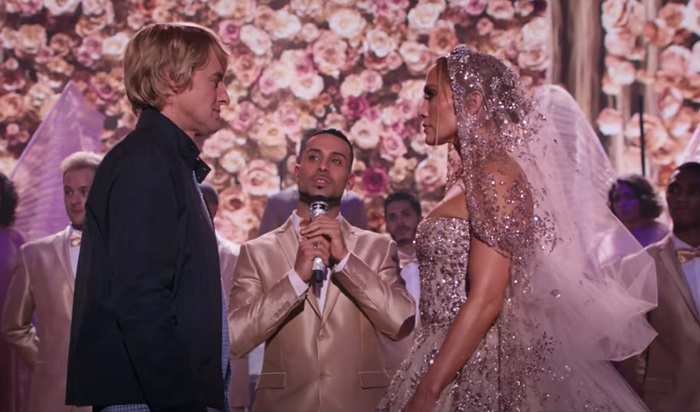
Lopez plays Kat Valdez, a pop superstar adored by millions of fans around the globe. Her highly publicized romance with fellow Latin sensation Bastian (Maluma) makes headlines and routinely sets social media ablaze. Their agents come up with a publicity stunt for the ages – have a concert/wedding where the recently engaged super-couple take their vows on stage in front of a live New York City crowd and with 20 million people watching worldwide.

Image Courtesy of Universal Pictures

Wilson plays the blandly named average-Joe Charlie Gilbert (apologies to all the Charlie Gilberts out there). He’s a buttoned-up and slightly neurotic junior high math teacher – kinda like a domesticated Gil Pender. But rather than being infatuated with Paris, its equations and formulas that butter Charlie’s biscuit. And sponsoring the school’s math club (hilariously called the “Pi-thons”) is as close as he comes to an actual social life.

Charlie is perfectly content with his dull and boring existence, but he’s having a hard time connecting with his 12-year-old daughter Lou (Chloe Coleman). In an effort to convince Lou that he’s “fun”, Charlie heeds the advice of his friend and colleague Parker (Sarah Silverman) and takes Lou to Kat and Bastian’s big show. But as Kat takes the stage to get married in front of the world, a video goes viral showing Bastian cheating on Kat with her assistant.

A hurt and humiliated Kat sees Charlie in the crowd holding his daughter’s “Marry Me” sign (it’s the name of Kat and Bastian’s new hit single). On a whim, she calls Charlie to the stage and agrees to marry him on the spot. A stunned but sympathetic Charlie goes along with it and is immediately thrust into the spotlight. Kat’s handlers, specifically Collin (John Bradley) urge her to end the charade. But she refuses to let the world or Bastian see her heartbreak. So she and Charlie go on a whirlwind publicity tour, and (of course) grow closer in the process.

Image Courtesy of Universal Pictures

From there it’s not too hard to see where things are going. You have two vastly different people from wildly different worlds which leads to the quintessential (and inevitable) ‘opposites attract’ romance. But it works because of the two stars. Wilson has a disarming sincerity and an infectious charm that’s impossible to resist. He’s very much playing an Owen Wilson character, and (once again) he does it to perfection. Meanwhile, Lopez leans into her glamorous persona while also bringing sensitivity and compassion to her larger-the-life character.

But eventually (and most unfortunately) the filmmakers pull out the old Hallmark blueprint. You know, where things look great for our bubbly couple until that one conflict (in this case a ridiculously shallow one) pulls them apart and threatens to end their fairytale romance. Of course we know how things are going to turn out which is another reason I’m tired of this stale rom-com formula. And it’s not helped by the ending – a predictable and super-syrupy finish that’s too scripted and phony to convey the sweetness it’s going for.

But let’s get back to the stars. Lopez and Wilson may not be the most obvious on-screen couple. But both deserve a ton of credit for what they manage to do in “Marry Me”. They take this utterly ridiculous concept from a mostly formulaic and predictable movie and actually make us care. They make us care about their characters and their prospect of a future together. And it’s all because of that unexpected chemistry. They can’t make the trite suddenly original or the schmaltz more truthful. But they do make the film not only watchable, but surprisingly enjoyable. “Marry Me” opens tomorrow (February 11th) in theaters and streaming on Peacock.

VERDICT – 3 STARS

REVIEW: “Moonfall” (2022)

(CLICK HERE to read my full review in the Arkansas Democrat-Gazette)

Roland Emmerich and the phrase “global cinematic destruction” go together like peanut butter and jelly. A quick gander at his Wikipedia page will give you a good idea of the 66-year-old German-born filmmaker’s penchant for blowing up our world. He’s done it with aliens (twice), a giant lizard, extreme weather, and whatever the heck was happening in his 2009 flick “2012”. In fairness, Emmerich has done more than just disaster movies, but they are what clearly whets his appetite.

New to theaters this weekend is “Moonfall”, Emmerich’s latest exercise in computer-generated decimation of our planet. As the film’s title makes glaringly clear, this time it isn’t extraterrestrial armies or the next Ice Age that’s threatening us. Nope, this time it’s our moon which has been knocked out of its orbit and is barreling towards earth. Absurd you say? Well rest assured, “Moonfall” is every bit as ridiculous as it sounds, and that’s part of what makes it such a surprisingly fun ride.

Sometimes movies hit you at just the right time. Such is the case with “Moonfall”. After over two months of cramming awards season features followed by a jam-packed week covering the Sundance Film Festival, I was ready for a light and breezy popcorn flick. “Moonfall” certainly fits the bill. It’s the kind of movie that you go into knowing exactly what you’re going to get. If you’re hoping for more, you’ll probably be disappointed.

Image Courtesy of Lionsgate

In 2011, astronauts and close friends Jocinda “Jo” Fowler (Halle Berry) and Brian Harper (Patrick Wilson) are on a routine satellite repair mission above Earth. While working on a relay and debating the lyrics of Toto’s 1982 pop hit “Africa”, they are suddenly walloped by a mysterious swarm-like force that destroys the satellite and kills the third member of their team. The mysterious entity (later defined as a “technological space anomaly”) heads to our moon and begins boring a hole in its surface.

Jump ahead ten years where Jo and Brian are no longer on speaking terms. A decade earlier he tried to tell the world that the incident was the result of an attack by something never seen before. She stuck with the “officially statement” from NASA, that it was the result of a solar flare. Jo was able to keep her job with the space program. Brian lost everything and now spends his days working on his old sports car and dodging eviction notices.

But then self-described megastructuralist and astronaut wannabe K. C. Houseman (John Bradley) makes an alarming discovery – the moon is out of its orbit and heading towards Earth. NASA won’t return his calls and Brian brushes him off. So he takes it to the media. In the meantime, Jo and her team make the same discovery. They send up a lunar recon mission which ends disastrously after it’s confronted by the same swarm-like entity Brian warned them about.

So for those keeping tabs, you have the moon hurtling towards Earth, an unidentified but clearly aggressive “technological space anomaly”, and roughly three weeks for our leaders to come up with a plan to save humanity. And as you can probably guess, it’ll all come down to our three unlikely heroes: a disgraced astronaut, the former friend/colleague who sold him out, and a conspiracy theorist who a week earlier was working the window at a burger joint. Normally that wouldn’t leave much cause for hope. But in the movies…

Image Courtesy of Lionsgate

Eventually the film boils down to the events unfolding on two fronts. You have what’s happening in space as Brian, Jo, and K.C. launch into orbit to meet the moon head-on. Then you have what’s happening on Earth where Brian’s estranged son, Sonny (Charlie Plummer) and several other underdeveloped side characters try to survive amid the tidal waves, crashing moon debris, and the occasional shotgun-toting rednecks. Both allow Emmerich ample opportunities to shower his audience with eye-popping spectacle.

“Moonfall” almost plays like two genre films wrapped in one. The cornier and less interesting stuff on Earth is your standard-issue disaster material – dazzling large-scale digital destruction and characters in constant peril. The much better space stuff is full-blown science fiction. It’s surprisingly dense and well conceived and is inspired by everything from the Dyson sphere theory to Larry Niven’s “Ringworld”. Better yet, it goes further down the rabbit hole than I was ever expecting (and that’s a compliment).

Of course all of it is undeniably preposterous and there is no shortage of unintentional laughs (My favorite may be our dimwitted government whose plan is to nuke the moon. You heard me right – they literally think nuking our moon is a viable option. Fifth grade science anyone?). But if I’m honest, that kind of nuttiness is half the fun with a movie like this. It may prove too much for some, but for me “Moonfall” hit at just the right time. And I would be lying if I didn’t admit to being entertained. “Moonfall” opens today exclusively in theaters.

VERDICT – 3.5 STARS

REVIEW: “Memoria” (2021)

Tilda Swinton is haunted by a mysterious sound in the otherwise quiet and meditative “Memoria”, the evocative new drama from director, writer, and producer Apichatpong Weerasethakul. This is Weerasethakul’s first movie made outside his native Thailand, but those familiar with his work will almost instantly notice his distinct style of storytelling.

I was fortunate enough to see “Memoria” thanks to NEON’s awards season screener bundle. Otherwise it’s going to be a tough movie to catch. From what I understand, Weerasethakul has no plan for a physical home release or even a conventional theater run. Instead he’s taking his film on the road for a long run of week-long engagements at different stops across the country. It’s an unusual release strategy and one that’s certain to cost him some viewers. But at the same time, “Memoria” isn’t the kind of movie aimed at large crowds.

Image Courtesy of NEON

“Memoria” is a movie that defies definition. You could consider it a sensory journey that isn’t interested in plot as much as experience. Weerasethakul wants his audience to feel. But to do so will require viewers to get on his unique and unconventional wavelength. Admittedly, at first I found that to be a challenge. But once I was in tune with his patient and observant rhythm, “Memoria” turned into something I wasn’t expecting. Soon I found myself swept up by feelings of fascination, bewilderment, curiosity and full-on admiration.

You could also consider it slow cinema. Some will be quick to assert that often “nothing happens”, a perspective that Weerasethakul’s style partially contributes to. In many cases his scenes aren’t simply long takes, but they extend to well after the scene’s action has finished. Rather than cutting, Weerasethakul keeps his camera locked in place, allowing his audience time to soak up every detail of the frame. And as we do, not only are he pulled deeper into the film’s beguiling mystery, but Weerasethakul slyly put us into a similar headspace as the film’s central character, Jessica (Tilda Swinton).

I’m not sure any actress could be more fitting for this role than Swinton. She is perfectly tuned into Weerasethakul’s enigmatic frequency and she effectively channels the very apprehension and incertitude that we the audience also feel. Interestingly, everything about her character Jessica feels out of place. First, she’s a Scottish botanist living in Medellín, Columbia (the movie’s most overt sign of displacement). But she comes across as more than a foreigner in a new country. She conveys this perpetual sense of lostness, like someone trying to get a hold of the world she’s in.

The movie opens with Jessica shaken from her sleep by a jolting boom in the middle of the night. It’s a mysterious sound that she later describes as “a big ball of concrete that falls into a metal wall which is surrounded by seawater“. She travels to Bogotá to visit her sister Karen (Agnes Brekke) who is hospitalized with a sudden illness. While there she hears the sound again and realizes that only she can hear it. Later Jessica is shaken again by the sound as she sits in an otherwise quiet park at night.

Image Courtesy of NEON

Not only do the mystifying whomps startle Jessica, but they jar us as well thanks to the film’s exquisite sound design. Soon the film’s gaunt, soft-spoken, and curious protagonist sets out (with us in tow) to determine the source of the assaultive sound in her head. A music professor friend connects her with Hernán (Juan Pablo Urrego), a sound engineer who tries to recreate the sound for Jessica. He succeeds but it doesn’t get us any closer to the sound’s source. “I think I’m going crazy,” she tells a friend.

As Jessica continues her search we’re fed very little in the form of answers. That’ll come as no surprise to those familiar with Weerasethakul’s work. But that doesn’t mean Jessica’s journey is empty or meaningless. Quite the opposite. It gets back to what I mentioned above – this is more about experiencing. There is an answer to the big question in the final few shots (an answer that I’m still chewing on days after seeing the film). But ultimately it’s about getting to that point. It’s about joining Jessica on her lonely melancholy peregrination. But to do so you have to still your mind, watch and listen. That’s where the real joy of Weerasethakul’s entrancing film is to be found.

VERDICT – 4.5 STARS

REVIEW: “The Matrix Resurrections” (2021)

Toss me into the camp with the few who never really got into the “Matrix” movies. The first film of the series, 1999’s “The Matrix”, was entertaining and built itself around a pretty cool premise. The second film, “The Matrix Reloaded”, features three spectacular action scenes but little else worth revisiting. The third movie, “The Matrix Revolutions”, was a forgettable slog that mercifully brought the series to an end (or so we thought).

While the idea behind “The Matrix” is interesting and its video game-ish action can be fun, it’s the series creators, the Wachowskis, that I’ve often struggled with. Their movies tend to be built around big ideas but too often feel cold and empty. Movies like “Cloud Atlas” and “Jupiter Ascending” are shining examples of how high ambition mixed with overindulgence can overpower good storytelling.

Now some 18 years since the last movie, one-half of the Wachowskis, Lana, steps back into the Matrix with “Resurrections”, a movie that seems to have been made with die-hard fans in mind. There’s nothing inherently wrong with that and maybe there’s enough of that fan base to make this movie worthwhile. But for lukewarm viewers like me, or for those who have moved on from the near 20-year-old trilogy, there’s not much here to latch onto. Even worse, “Resurrections” is a slog, overburdened by endless exposition and lacking anything that feels remotely fresh.

Image Courtesy of Warner Brothers

Wachowski’s fourth installment sees Keanu Reeves reprising his role of Neo. Following his sacrifice in the previous film, Neo has been brought back and programmed into the Matrix as video game developer Thomas Anderson. He’s the creator of a popular trilogy of games inspired by a series of unexplained dreams that are actually memories from his previous time in and out of the Matrix.

After their offices are attacked by tactical troops who shoot so poorly they make Stormtroopers from Star Wars look like expert marksmen, Thomas/Neo is approached by a duller but sharper dressed Morpheus (Yahya Abdul-Mateen II). He once again gives the whole Red Pill/Blue Pill spiel which offers Neo a chance to have all his questions answered. Meanwhile Trinity (a returning Carrie Anne Moss) has been reinserted into the Matrix as a married mother of three named Tiffany who likes motorcycles and coffee (who doesn’t, right?)

After learning Trinity’s whereabouts, Neo wants to save her. But he’s informed by an old friend Niobe (Jada Pinkett Smith reprising her role from the last two movies) that doing so could jeopardize the new underground human sanctuary called Io. But with the help of an ambitious and awe-struck young captain named Bugs (Jessica Henwick) and her utterly forgettable crew, Neo defies Niobe’s warning and sets out to free Trinity. But a new force at the center of the Matrix has other plans.

Of course that is a very short summary of the story. There’s actually a ton of information crammed in along the way. In fact, for a while it feels as if every other scene includes yet another long and often tedious info dump. Everyone Neo meets seems to have a lot of explaining to do before the film can ever move forward. It’s so noticeable that you can’t help but laugh as you wait for their long-winded conversations wrap up.

Among the other new faces we meet is Neil Patrick Harris who plays Thomas’ therapist who tries to help Neo distinguish his reoccurring dreams from “reality”. We also get a dry and bland Jonathan Groff as a new version of Neo’s arch-nemesis Agent Smith. It’s obvious Groff is trying his best to recreate the villain made famous by Hugo Weaving in the first three films. Unfortunately he can’t muster half the charisma or menace that Weaving brought to the role. As a result, this iteration of Smith falls flat.

Image Courtesy of Warner Brothers

There are several other noticeable issues that I couldn’t quite shake. For example, early on there’s this whole weird self-aggrandizing meta angle where Wachowski uses game designers in a brainstorming session to tout how smart, challenging, and subversive the Matrix movies are. The problem is it never feels natural to the story. Instead it feels like a filmmaker trying to be funny or clever (honestly it’s hard to tell which).

There’s also the issue of the movie’s rather generic effects. Like them or not, the Matrix movies have always had a slick and cool look, especially during the stylish action sequences. But here nothing stands out which is surprising considering how far digital effects have come. But even the fight scenes lack energy and come across as uninspired.

As for the performances, everyone is doing the best they can. But the script (co-written by Wachowski, David Mitchell, and Aleksandar Hemon) gives them painfully little to work with. Even the movie’s philosophical ramblings (a staple of the earlier films) aren’t nearly as smart or engaging as the movie thinks they are. Ultimately we’re left with a sequel that may have enough nostalgic callbacks to satisfy hardcore fans. For the rest of us it’s a needless revisit that lacks the originality of the first film and the memorable action sequences of the two earlier sequels. “The Matrix: Resurrections” is now showing in theaters and is streaming on HBO Max.

VERDICT – 2 STARS

REVIEW: “The Many Saints of Newark” (2021)

Prior to the revolution that dramatically changed the way we consume television, most of us counted on the major networks for our daily allowance of small screen serial entertainment. But a lot changed on the evening of January 10, 1999. That’s the night when HBO premiered the pilot episode of “The Sopranos”. The immensely popular hour-long mob drama would change the way people looked at and thought of serial television. And it opened the door for the countless cutting-edge shows that would follow.

“The Sopranos” wasn’t HBO’s first venture into television, but nothing changed the television landscape quite like the esteemed crime series which earned big ratings despite being on a premium cable network. The show would go on to receive a total of 111 Emmy nominations while winning 21 statues over the course of its six-season 86-episode run.

The success of the “The Sopranos” led to HBO changing their business model and investing more in original programming. It also paved the way, not only for other cable networks, but also for the lucrative streaming world we currently live in. It’s hard to overstate the show’s impact.

Image Courtesy of Warner Bros.

Built around the amusing premise of a mob boss seeking therapy to lower his stress levels, “The Sopranos” would evolve into a much more thoughtful and layered study. It was essentially a psychological family drama fused together with a grounded and gritty gangster story. The late James Gandolfini’s iconic Anthony “Tony” Soprano was the perfect anchor – an Italian-American wiseguy based in New Jersey with as many headaches at home as he had running his underworld business. While the series covered quite a bit of ground, there was still plenty of story left to be told.

Enter “The Many Saints of Newark”, a prequel to “The Sopranos” that sees show-runner David Chase return to the characters he spent years nurturing. Directed by Alan Taylor and co-written by Chase and Lawrence Konner, the story heads back to Newark, New Jersey and unfolds during the tumultuous 1960s and early 70s when the city’s racial tensions were at a boil and as rival gangs were springing up and taking aim at the powerful DiMeo crime family.

This is the world Anthony “Tony” Soprano grew up in. ”The Many Saints of Newark” begins in 1967 when the future mafia don (played early on by William Ludwig) was just a kid. Later it moves to the 1970s where, in an audacious bit of casting, James Gandolfini’s son Michael plays the younger version of the character his father made famous.

Perhaps most interesting is the way “Saints” tells Tony’s backstory. It doesn’t take the traditional route of following some detailed timeline of the central character’s life. Instead it unveils Tony’s story through the people closest to him. Chase puts a ton of effort into showing us where Tony came from, mostly centering on the knotty family history between the Sopranos and the Moltisantis. As you would expect, their history is marked by family drama, crime, betrayal and violence which a young Tony takes in while mostly sitting in the background.

The one principal figure in the story is Tony’s uncle in name only, Richard “Dickie” Moltisanti (Alessandro Nivola). Dickie is a suave and confident mob soldier working under his father, Aldo “Hollywood Dick” Moltisanti (a terrific Ray Liotta). Dickie is a handsome smooth-talker, brandishing a disarming smile and barely repressing a vengeful violent side. While he’s a good business man, Dickie’s judgement when it comes to family is a little wobbly. Such as when he takes a liking to his pompous father’s new (and considerably younger) trophy wife Guiseppina (Michela De Rossi). But he’s good to Tony, taking him under his wing while the kid’s father, Giovanni “Johnny Boy” Soprano (Jon Bernthal) was doing time in prison.

Image Courtesy of Warner Bros.

Dickie makes for a fitting centerpiece, but “Saints” truly is an ensemble film. Chase fills his world with both new and familiar names, telling their stories with the same moral ambiguity as the series. They’re brought to life through phenomenal performances top to bottom. Among the best is Vera Farmiga as Tony’s paranoid and borderline neurotic mother Livia. Corey Stoll playing the younger Corrado “Junior” Soprano complete with his signature glasses and crankiness. And a fierce Leslie Odom Jr. as an ambitious numbers runner Harold McBrayer, who once worked under Dickie but is inspired by the city riots to start an underworld racket of his own.

Not everything works as well as it should. There’s a love triangle of sorts that springs out of nowhere. And considering how it ends, the angle really needed some kind of buildup. As for setting up Tony Soprano’s entrance into mob life, the movie does a great job presenting the influences that led him down the path. Yet it never lets us see him take the first step from aspiring football player and rock-n-roller into a life of organized crime.

Still, “Saints” is a solid “Sopranos” companion piece. There’s a fair amount of fan service and it helps to at least have a working knowledge of the characters. For those reasons, it may not be the most accessible entry point for newcomers. But with its stellar performances and the same alluring style of character-driven storytelling that made the series such a hit, “Saints” has plenty to offer to even the most casual mob movie fan.

VERDICT – 4 STARS