REVIEW: “Minari” (2020)

Minariposttt

One of the most exciting and talked about features from this year’s Sundance Film Festival was Lee Isaac Chung’s “Minari”. The film won two of the festival’s top awards and earned high praise for its lead Steven Yeun. A star on the rise, Yeun followed up his well received television run on “The Walking Dead” with several impressive big screen supporting roles most notably 2018’s critically-acclaimed “The Burning”. In “Minari” the 36-year-old Yeun teams with a superb cast to tell a tender slice-of-life story that leaves an unforgettable mark.

This is the fifth film from Chung and easily his most personal so far. Inspired by the birth of his daughter, Chung began writing down memories from his own childhood in Arkansas, most of them were from when he was around 6-years-old. He then began building a narrative arc, full of autobiographical nuggets but with its own distinct story to tell. The results are sublime. With “Minari” Chung has made a quietly affecting film, one of such understated beauty and with a soothing intimacy that stirs the soul.

MINARI1

Image Courtesy of A24

Jacob Yi (Yeun) and his wife Monica (Yeri Han) came to America in the early 1970s, working briefly in Seattle before settling in California. There they had two children while making a living chicken sexing (for the uninformed like me, that’s when you separate male and female chicks). Tired of barely scratching by, Jacob moves his Korean-American family from California to rural Arkansas. That’s where Chung settles in and patiently unfolds his gentle yet bracingly authentic immigrant/family drama.

The film opens with Jacob driving a moving van and Monica close behind in their station wagon with the kids. They travel along several miles of gravel roads before finally arriving at their new home – a mobile home sitting on five acres of rugged Ozark farmland. All Jacob sees is potential and a chance at some version of the American Dream. Monica’s doubt is evident from her first startled look at the house trailer. “That’s not what we agreed on.” This sets up a crucial family conflict that simmers throughout most of the story.

As their parents struggle to plant their feet in their new life, the children offer a unique and unvarnished perspective. Their pre-teen daughter Anne (Noel Cho) seems mature beyond her age and you get the feeling she has a better idea of their situation than she lets on. Their 7-year-old son David (played by captivating newcomer Alan S. Kim) has a heart murmur but you’d never notice. Bright and precocious, David has a lively and mischievous spark and his childlike honesty offers up some of the film’s funniest moments. He has a scene-stealing charm that’s sure to leave people talking.

MINARI2

Image Courtesy of A24

Feeling overwhelmed, the couple invite Monica’s mother Soonja (Yuh-Jung Youn) from Korea to help with the kids. The arrival of the abrasive and unrefined grandma creates an entertaining shift in the family dynamic. Youn is an absolute treat especially when paired with Kim. Their characters have a wonderfully combative relationship that inevitably softens over time. Soon Youn is teaching her grandson how to play cards while he introduces her to the simple joys of pro wrestling and “mountain water” (which is actually Mountain Dew). “It’s good for you“, he earnestly explains.

Even wackier is Will Patton’s Paul, an eccentric yet strangely endearing local who spends his Sunday’s dragging a life-sized cross down miles of dirt road. But he also knows how to work the land and when he’s not exorcising evil spirits from the Yi family’s property he’s helping Jacob jump-start his Korean vegetable garden. But it proves to be hard work (ask the property’s former owner) and it begins to eat into the family’s limited funds. And as Jacob is digging a well, buying a used tractor, and courting potential buyers of his produce, Monica is at home growing more and more disillusioned with her husband’s dream.

Perhaps Chung’s most powerful creative choice comes in his consistent focus on the personal moments. “Minari” is all about relationships: a struggling husband and wife, a puckish young boy and his crass grandmother, two community outsiders building a garden together. Big things do happen but often off screen or in the background. Instead Chung relishes the intimate interactions which are so often found in the minutiae of everyday living. And while the film does deal with a Korean-American family’s assimilation into a white rural community, Chung’s beautifully realist lens is much more focused on the personal things that bring us together and sometimes tear us apart.

MINARI3

Image Courtesy of A24

I can’t help but mention a quiet but meaningful scene where Soonja takes her grandson to a creek on the edge of the family’s property. There she takes some seeds brought from Korea and plants minari along the bank (minari is an East Asian herb that can grow almost anywhere). Over time the foreign plant takes root and flourishes in the fertile Arkansas soil. It’s a small piece of story so sweetly told and ripe with meaning. It ends up being one of the film’s most poignant metaphors while highlighting one of its many thoughtful themes.

With its emotionally textured story, captivating performances, and lived-in production design, “Minari” takes us on an immersive personal journey firmly anchored in the human experience. It’s a thoughtfully subdued film yet one bursting with naturalistic beauty. Within minutes I was caught up in Lee Isaac Chung’s clear-eyed true-to-life perspective and swept away by the aching rhythm which moves us from one scene to the next. I can’t quit thinking about it. Like I said, it really leaves its mark. “Minari” is scheduled for a limited release on December 11th ahead of its full release February 12, 2021.

VERDICT – 4.5 STARS

4-5-stars

REVIEW: “Mank” (2020)

In 1939 24-year-old hotshot wunderkind Orson Welles was heavily courted by a struggling RKO Pictures. The studio signed Welles to a two-picture deal and gave him complete creative control including final cut privilege, something unheard of in the studio era. Welles began putting the idea together for what would become “Citizen Kane”. To help with the script Welles hired Herman J. Mankiewicz, a boozy, self-destructive and self-defined loose cannon believed by many in Hollywood to be washed up. Mankiewicz ended up winning an Academy Award for what many argue is the greatest film ever made.

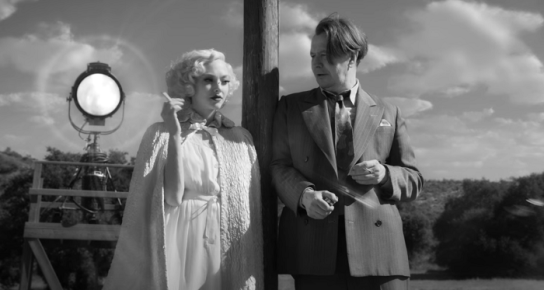
In David Fincher’s “Mank” the acclaimed filmmaker both celebrates and admonishes Hollywood’s Golden Age through the character of Herman Mankiewicz, honing in on his time wrestling with his version of the “Citizen Kane” script. Fincher uses the same time-hopping techniques as Welles’ 1941 classic to visit key moments from Mankiewicz’s past which helped inspire and form pivotal elements of “Kane’s” story. “Mank” was originally conceived by David Fincher’s late father Jack Fincher who was inspired by Pauline Kael’s 50,000 word essay “Raising Kane” published in 1971.

Image Courtesy of Netflix

The opening shot feels plucked straight out of old Hollywood. It’s 1940. Two cars speed down a dusty California highway on their way to North Verde Ranch near Victorville. There Herman Mankiewicz (Gary Oldman), bed-ridden with a broken leg following a car accident, sets up shop. He is given sixty days (originally 90 until Welles cut off a month) to complete his draft under the supervision of John Houseman (Sam Troughton). Helping is Rita Alexander (Lily Collins), a lightning fast British stenographer with a boatload of patience and a husband serving in the war effort overseas.

Fincher never stays in one place very long. The scenes at the ranch are frequently broken up with rapid-fire flashbacks that can be disorienting until you get a grasp on what the director is going for. We get a scene from 1930 where Mank (as Mankiewicz is affectionately called) meets and impresses newspaper mogul William Randolph Hearst (Charles Dance), the inspiration for the Charles Foster Kane character. He also meets Hearst’s carefree and endearing mistress Marion Davies (Amanda Seyfried), a young actress who immediately takes a liking to Mank. In many ways their relationship is the heart of the film and its a really good turn from Seyfried.

Later Fincher takes us back in time to Paramount Studios to witness a hilarious brainstorm session in the writer’s room. Then we swing by MGM where blustering studio head Louis B. Mayer (Arliss Howard) waxes not-so-eloquently about his movie philosophy before duping a group a employees with a ‘times are hard‘ speech. Fincher makes several of these studio stops through flashbacks landing some firm shots at their top-heavy structure but also admiring their vibrant creative energy. Each studio scene is richly textured, full of period detail and ambiance, and exquisitely captured through Eric Messerschmidt’s black-and-white cinematography.

More flashbacks show Mank giving himself over to booze and self-loathing, steadily losing his goodwill with studio heads and straining close relationships. Look no further than his exasperated wife Sara who is played by a terrific Tuppence Middleton working at just the right temperature. And then you have his unique friendship with the powerful Hearst which in many ways makes his eventual “Kane” script feel like something of a betrayal on top of being controversy. History tells us Hearst was enraged by “Citizen Kane”. Mankiewicz’s friendship with the mogul soured and Mank was tossed from Hearst’s social circles.

Image Courtesy of Netflix

Fincher also uses Mank’s eyes to observe the 1934 California gubernatorial race between socialist Upton Sinclair and the conservative Republican incumbent Frank Merriam. Again we see many nuggets that not only influenced aspects of “Citizen Kane” but that also cut with a sharp present-day relevance. Backdoor politics, yellow journalism – its all here. Eventually everything meets at a combustible dinner party scene where Mank’s off-putting drunken monologue screeches things to a halt. It’s a big performance moment for Oldman who throughout the film captures every facet of Mankiewicz’s brilliant yet self-defeating personality. But the scene draws out too long and is too showy even for a movie as showy as this one.

“Mank” offers a very particular point-of-view on the longstanding debate over who wrote “Citizen Kane”. Much like Kael’s controversial and since discredited essay, Fincher is clearly sympathetic towards Herman Mankiewicz. He highlights Mank’s work while Orson Welles (portrayed by Tom Burke) mostly exists on the periphery of his story. But Fincher wisely doesn’t discount Welles’ contribution and ultimately his film is about more than just authorship. It’s an ambitious ode to a bygone Hollywood era. It’s a story about damaged genius and self-destruction. Above all it’s an applause-worthy celebration of the art of cinema – a visual and performance-rich delight. I was amazed yet unsure of it after one viewing. I was captivated and convinced after a second. “Mank” premieres today on Netflix.

VERDICT – 4.5 STARS

REVIEW: “Mamakrom” (2020)

mama111

Sitting upon the endless red clay of northern Ghana is the village of Mamakrom and a school built on the very foundation of hope and compassion. The new documentary, understandably titled “Mamakrom”, is made with the same passion and solicitude as its namesake. Filmmakers Joseph Pelegreen and Matt Lang have put together something anchored by a heartfelt love for a struggling region and a genuine desire to see true and meaningful change.

“Mamakrom” showed at this year’s Hot Springs Documentary Film Festival and competed in the International Features category. The film is clearly a passion project and is imbued with the empathy and aspiration of its makers. It’s an eye-opening doc inspired by a decade’s worth of first-hand observation and experience. From the opening frames it’s clear this is something near and dear to hearts of those in front of and behind the cameras.

Mamakrom2

You could say “Mamakrom” is as educational as it is inspirational. Pelegreen (who serves as the film’s director) puts a lot of time into developing the setting and situation for his viewers. Through evocative imagery and the words of local workers for change, the film vividly captures the region’s abject poverty. It talks about famine and drought. It highlights the dangers of malaria and waterborne diseases in a place with limited access to healthcare. This directly connects to the most heartbreaking reality – the high mortality rate specifically among children.

With a clear-eyed perspective Pelegreen and Lang highlight the region’s most critical needs: health, development, and (the film’s biggest focus) education. “Educate a child and you’ll change his life forever.” But doing so in northern Ghana comes with its own set of intense challenges. The lack of infrastructure, the poor quality of the schoolhouses, the inability to find and maintain teachers – all of these things combined with the deeper health and quality of life struggles puts any aspiration of a burgeoning education system instantly behind the proverbial eight ball.

Mamakrom1

But one of the joys of “Mamakrom” is that it offers hope that even obstacles which seem insurmountable can be overcome by those willing to commit themselves and answer the call to action. This is embodied in the missions-based ESI Foundation (an acronym for Every Souls Important). The group has been a steady presence in Marakrom pouring time, money, and love into the children and their future. The film shows the fruits of the ESI’s investments – the construction of new school buildings, a library, and teachers quarters. More importantly, we get a taste of the impact they are having on the lives of the students. It’s all working towards building a better future for the people of Ghana, not through dependability but self-sustainability.

The film makes several other insightful observations, such as how the the aforementioned high mortality rate actually leads to a higher birth rate as families painfully try and compensate for the children they will inevitably lose. Or how the influx of used clothing and imported produce, though well-intended, has adverse effects on local markets. But while the health crisis is heartbreaking and the region’s economic complexities are compelling, the film always comes back to its faith-fueled hope of a better future for Ghanaians. “Mamakrom” doesn’t hide its intentions. It wants to open eyes and move people to action. And what better way to do that than by showing that such actions are not in vain.

“Mamakrom” is scheduled to show at several upcoming film festivals and it’s currently fielding offers for distribution.

VERDICT – 4 STARS

4-stars

REVIEW: “MLK/FBI” (2020)

MLKsmall

The dark and troubling relationship between Martin Luther King, Jr. and J. Edgar Hoover’s FBI is well known and has been well documented. But I’m not sure it has ever been as thoughtfully considered as it is in Sam Pollard’s new documentary “MLK/FBI”. I had the opportunity to see the film at this year’s Hot Springs Documentary Film Festival and it has been on my mind ever since.

Pollard’s film is timely considering the country’s current conversations about race relations and social justice. It’s equally fitting that it comes out during a time when the FBI is under scrutiny and face accusations of (once again) abusing their powers. I’m sure Pollard is aware of his film’s relevance, but he wisely lets it come through naturally, covering his subject from a clear-eyed historical perspective.

MLK1

“MLK/FBI” uses two parallel but frequently intersecting timelines in its effort to chronicle Hoover’s evolving FBI and King’s rise as a civil rights leader. Pollard uses a fascinating collection of archived footage, audio recordings, and news feeds accompanied by insightful narration from a handful of authors, historians, former FBI agents, as well as a friend and speechwriter for Dr. King.

J. Edgar Hoover was the very first director of the Federal Bureau of Investigation and ran the organization for 37 years until his death in 1972. He served through a total of eight presidencies from Coolidge to Nixon. Under Hoover one of the the FBI’s chief undertakings was rooting out and exposing communists. Stanley Levison was a New York attorney with communist connections. He was also an advisor and friend to Dr. King which led Hoover to put his sights on the civil rights movement.

King was steadily growing in popularity and influence. His words of equality resonated with African-Americans across the country culminating with the famous March on Washington in August 28, 1963. Two days later the FBI’s head of domestic intelligence would deem King “the most dangerous Negro in the future of this nation from the standpoint of communism.” A year later and with the permission of Attorney General Bobby Kennedy, Hoover began wiretapping King, compiling countless tapes of private conversations and uncovering numerous adulterous affairs. While his actions were morally repugnant, King did nothing illegal so the Bureau put together a smear campaign aimed at staining the leader’s reputation.

Pollard’s examination isn’t exhaustive nor can it be considering the tapes connecting King and the FBI are sealed in a National Archives vault until February 2027. But what he does do is construct a strong moral case against the FBI’s targeting of King while also using the flimsiness of their communist ties claims to reveal far more troubling motivations. Hoover’s cooperation with the Kennedy’s and Lyndon Johnson adds an even darker shade to their political power and influence.

MLK2

But at the same time Pollard doesn’t sugarcoat King’s transgressions. If the FBI was eager to create their own smoking gun, King’s extra-marital affairs provided them with the bullet. “MLK/FBI” challenges the almost saintly mythos surrounding Dr. King today while still showing him as the victim of a concentrated effort by the government’s principal law enforcement agency to discredit and silence not only him, but the entire civil rights movement. The film ends by posing a thought-provoking question – does an individual’s personal sins negate their work as a leader and their voice for change?

With “MLK/FBI” Sam Pollard merges history with cinema to reconstruct the often contentious relationship between the United States government and one of nation’s most iconic leaders. For better or for worse the film’s clinical, just-the-facts approach can feel a lot like a history lesson. And it does veer ever so slightly into conspiracy theory territory when speaking of King’s assassination. But Pollard doesn’t linger on the unknown. His film is about examining what we do know, highlighting the abuse of federal power to thwart a powerful national movement. The rest will have to wait until 2027.

“MLK/FBI” is appearing in several North American festivals before its scheduled release in January 2021.

VERDICT – 4 STARS

4-stars

REVIEW: “Missing in Brooks County” (2020)

MISSINGposter

I had the honor of serving as a juror at this year’s Hot Springs Documentary Film Festival and once again the festival’s program featured a wealth of talented filmmakers presenting their work. One of the most gripping documentaries I had the opportunity to see was “Missing in Brooks County”, a thoughtful and immersive look at the lingering US/Mexico border crisis.

The film comes from documentarians Lisa Molomot and Jeff Bemiss. The two directed, filmed and produced this affecting examination of a critical issue that has in many ways been lost in the noise of battling bureaucracies and political parties. As is obvious from the title, the film is set within Brooks County, Texas, much of it in and around the small town of Falfurrias.

For a little history, during Bill Clinton’s presidency measures were taken by his administration to address the increasing flow of illegal migrant traffic crossing the southern border. The idea was to strengthen border security in order to funnel migrant traffic to the most dangerous areas. While some casualties were expected, the hope was to discourage illegal crossers from attempting the long, arduous journey. Predictably that’s not at all what happened.

MISSING1

In Brooks County, some 70 miles from the US/Mexico border, migrants are brought in by coyotes who gave them a jug of water and directions around the checkpoints. The groups then walk for miles across hot, dry, privately owned ranch land. Many never make it to their destination, losing their way and dying due to the harsh and rugged elements. It’s believed that since 2008 an estimated 2,000 migrants have died in their attempt at making the dangerous trek. Yet considering how many are never found, the total could be considerably higher.

Molomot and Bemiss begin by introducing us to Eddie Canales, a 70-year-old advocate running the South Texas Human Rights Center. With limited resources but maximum heart and effort, Eddie works to help families looking for missing relatives. He also works with willing ranchers to place water stations on their property in hopes of reducing the number of migrant deaths. But not everyone sees this as noble work. We hear from some who question Eddie’s motivations, even theorizing that he is involved with smuggling people past the checkpoints. It creates a local tension that exacerbates the problem more than helps.

There is also a real-life mystery element as we follow two different families trying to find their loved ones who attempted to cross Brooks County but have never been heard from since. We also feel the pulse of others directly affected by the crisis including the border patrol, human rights workers, and the understaffed local sheriff’s department who is tasked with covering approximately 900,000 square acres of jurisdiction.

MISSING2

Through them all Molomot and Bemiss vividly capture the complexity and the far-reaching effects of the situation. To the film’s credit it doesn’t pretend to have a perfect solution. Instead it’s aim is to focus on the humanity, something often lost in today’s black-and-white politicization of the issue. Outside of a few overt political pop-shots, the movie keeps us at the epicenter by concentrating solely on the viewpoints of those directly impacted. It’s the essential ingredient to the film’s potency.

Another strength is the cinematography which places us close to the people on the ground and offers us an effective emotional connection to them and their circumstances. It also does a great job presenting the south Texas territory whether on foot or through soaring high-resolution drone footage. Both reveal the sparse foreboding landscape consisting of thousands of acres with few distinguishable landmarks. The vast ominous sameness is striking. This strong sense of setting adds a sharp visual clarity to the issues Molomot and Bemiss are exploring.

“Missing in Brooks County” is a clear-eyed exposé of a troubling situation that isn’t as simple as “opening our borders” or “building a wall”. The documentary shows that the situation in this poor South Texas county is far more complicated and personal. Again the film doesn’t pretend to have the answers nor does it get lost in the inflammatory rhetoric and political posturing that surrounds this important issue today. Instead the film’s interests are in the human costs and in challenging its audience to look past the surface-level nonsense in order to understand the real stakes at the heart of the crisis.

“Missing in Brooks County” made its world premiere at the Hot Springs Documentary Film Festival where it won for Best Southern Feature. Look for it to be expanding to other festivals in the near future.

VERDICT – 4.5 STARS

4-5-stars

REVIEW: “Mulan” (2020)

MULANposter

If you’re wondering how the new “Mulan” stacks up against its animated predecessor or even the more recent Disney live-action remakes, this might not be the review you’re looking for. Full disclosure: I’ve never seen the original 1998 animated feature. And I haven’t watched any of the latest not-so-warmly received live-action reheats. But I have seen Disney’s new $200 million “Mulan”. You know, the $30 ‘stream at home’ version. And guess what – it’s not bad. Is it worth the high price tag to watch right now? I’ll let you decide.

“Mulan” comes from director Niki Caro and the writing team of Rick Jaffa, Amanda Silver, Elizabeth Martin, and Lauren Hynek. Their retelling of this inspirational tale aims at capturing the spirit of the original animated film while also making meaningful choices that set their version apart. The way it sounds, the more recent live-action remakes went to great lengths to follow their originals. “Mulan” 2020 attempts to carve its own identity with a more realistic vision, no songs and no celebrity-voiced comic sidekick. The results aren’t perfect, but they’re pretty darned impressive.

MULAN1

Photo Courtesy of Disney

Liu Yifei plays Mulan, the spirited eldest daughter of honored war veteran Hua Zhou (Tzi Ma). The two have a loving bond with the father aware that there is something special about his daughter. But his deep devotion to archaic traditions leaves Mulan bound by the expectations of her family, village, and culture. “A daughter brings honor through marriage“, Hua Zhou lectures. “Your job is to bring honor to the family.” Yet in this world of ‘honor’ through marriage, she can’t even choose her own husband.

Meanwhile on the outskirts of the empire a warlord with a grudge named Böri Khan (Jason Scott Lee) begins attacking imperial garrisons. Lee is a striking presence, with the look and the snarl of a menacing villain. Unfortunately he’s the victim of an all-too-familiar problem in modern blockbusters – bad guys with hardly any depth and the barest motivations. Basically Böri Khan sets out to quench his thirst for revenge by killing the emperor and becoming the new ruler of the kingdom. Not the most original crusade, but he and his soldiers sure look cool carrying it out.

With the attacks intensifying, the Emperor (played with stoic distinction by Jet Li) calls for one male member of every family to join the fight to quell the enemy invasion. Hua Zhou, the lone male in their family, prepares to join the war effort despite his failing health. Knowing her father’s chances of survival are slim, Mulan takes his sword and armor and sneaks away, posing as his son and joining the Fifth Battalion led by esteemed Commander Tung (played by Chinese screen legend Donnie Yen). It’s her first venture into the male-dominated world and if her ruse is discovered she’ll have more to worry about than shame and dishonor.

null

Photo Courtesy of Disney

The bulk of the film’s second act concentrates on the training of the young soldiers. Mulan is easily the most skilled warrior in her regiment, but showing her abilities would draw too much attention and risk exposing her secret. Therefore much of this segment is spent with Mulan concealing her identity from the other recruits especially the curious and charismatic Chen (Yoson An). What’s missing is the emotional toil. There is certainly an interesting thematic conflict between loyalty to duty and embracing one’s true self. But we rarely see Mulan wrestling with it on an emotional level. We get a few of those scenes and they work really well. We just get too few of them.

From there the film moves to an action-filled final third. Surprisingly “Mulan” never quite reaches the scale I was expecting. This could be due to misguided expectations on my part, but the film isn’t a huge sprawling epic. It has all the dressings, but when it comes to the action the film’s snappy pace never keeps it in one place for too long. For that reason some of the action scenes are unexpectedly short and tame, perhaps the result of being a Disney property.

But that doesn’t mean there aren’t stunning images throughout “Mulan”. Caro and her DP Mandy Walker shoot some exquisite shots both when filming the diverse landscapes or capturing the gravity-defying fight sequences. One showdown set inside a tight hallway is shot with incredible style and energy. Another fight through some bamboo scaffolding features several ingenious camera tricks and wonderful framing. At the same time Oscar winner Grant Major’s production design and Bina Daigeler’s costumes add something interesting to every composition.

MULAN3

Photo Courtesy of Disney

Cast-wise Liu Yifei shows nice range moving from a rambunctious rebel by nature to a battle-ready warrior exemplifying courage and leadership. She does good with what emotional material she’s given and her physicality is unquestioned. Donnie Yen and Jet Li are great presences but get little opportunity to show the martial arts prowess what made them such stars. Perhaps the most compelling character is an exiled sorceress named Xianniang (Li Gong). She’s a servant and weapon of Böri Khan who doesn’t take kindly to being called a “witch”. There are hints of a rich and thoughtful backstory, but sadly all we get are crumbs – fleeting references to a pained past that I would love to have known more about.

I can see “Mulan” pulling people in a variety of directions. Lovers of the animated original may take issue with some of its creative choices. Those looking forward to its more realistic spin may find it too restrained and safe. For me, the film’s strengths definitely outweigh its shortcomings. “Mulan” pulls us into a vibrant and fascinating world while telling a story full of inspiration and relevance. At the same time I found myself constantly wanting it to go further. Did being a Disney property hold it back? Were my expectations out of whack? I’m not sure. So I end up still unable to tell you if the movie is worth the $30 price tag. Once again, I’ll let you decide. “Mulan” is now available exclusively on Disney+.

VERDICT – 3.5 STARS

3-5-stars