2015 Blind Spot Series: “My Life to Live”

BLIND SPOT

“My Life to Live”

“Vivre sa vie” or “My Life to Live” is a French New Wave film that also feels distinctly different from some of the more prominent movies of the highly influential movement. Director Jean-Luc Godard released the film in 1962, two years after his groundbreaking debut “Breathless”. Viewers will undoubtedly see similarities between the two films, but “My Life to Live” differentiates itself both in structure, subject, aesthetic, and style. “My Life to Live” undoubtedly attempts to buck common, overused movie trends – something French New Wave films sought to do. At the same time Godard makes “My Life to Live” distinctly its own.

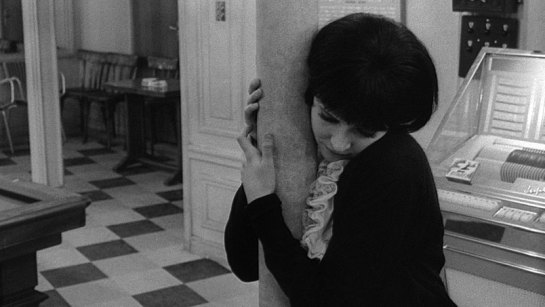
The captivating Anna Karina plays the lead character Nana and she was Godard’s wife at the time. Interstingly, Godard first noticed Karina in a series of Palmolive ads. Godard was preparing for “Breathless”, his feature film debut, and offered Karina a small role in the picture. She turned him down but his persistence led her to be in his next three films and his wife for four years. Their relationship is evident in the movie. Godard’s camera seems enamored by Karina’s face, by her expressions, by her countenance. His concentration on her eyes, the features of her face, the language of her body. Unquestionably much of Godard’s story is told through the lens of his star.

LIFE1

The film is broken down into twelve chapters each with basic synoptic captions. The first introduces us to Nana who is at a cafe with her husband Paul. We learn that she has just left him and their infant daughter to pursue acting. The revealing scene paints a complex picture of Nana. Adding to that complexity is the intriguing camera work by Godard and long-time cinematographer Raul Coutard. The focus is mostly on the back of the two character’s heads. The camera shifts back and forth while strategically giving us glimpses of their faces often through a mirror’s reflection. It leaves us curious about Nana and unsure how we are to feel about her.

Nana’s acting dream seems unrealistic. We see her working in record shop but apparently she can’t make ends meet. She asks different people to borrow money and one particular scene shows her being forcibly removed from her apartment. Out of a sense of desperation she turns to prostitution. But is it desperation or simple necessity? Nana is never easy to read. She approaches life with an open book mentality yet I always found a cloud of mystery around her. At times she seems impervious to possible consequences of her actions. Other times there is a playful life-loving personality that bubbles out. At other times she feels overwhelmed by her circumstances. Mainly she wants to be able to define her life and she wants to be the one to live it.

Life 2

The film’s look into prostitution of the day adds another level of intrigue. We see Nana grow more and more comfortable and content, but at the same time we the audience begin noticing cracks and concerns within her environment. Godard goes to great lengths to educate us on the mentalities, practices, and laws that made up the Paris prostitution scene of early 1960s. It gives us a better perspective even if it sometimes feels a bit dry and procedural. The coolest thing is how the approach to this element draws from the cinéma vérité documentarian style.

“My Life to Life” is a captivating film slowed down only by the occasional lulls – moments when Godard’s experimentation feels like experimentation instead of storytelling or progression. Still, it’s hard not to be drawn in by the portrait Godard paints. And his cinematic model Anna Karina is a mesmerizing expression of energy, wonder, and reality. Surround her with intoxicating style, layers of cultural references, and a grounded story and you have “My Life to Live” – a film that is uniquely its own nestled within the French New Wave.

VERDICT – 4 STARS

4 Stars

THE END

REVIEW: “Mad Max: Fury Road”

MAX POSTER

Has it really been 30 years since Mel Gibson last drove across George Miller’s dystopian desert wasteland in “Mad Max Beyond Thunderdome”? My how time flies. Between 1979 and 1985 visionary filmmaker Miller gave us three films: the intriguing but lethargic “Mad Max”, the fabulous cult classic “The Road Warrior”, and the fun but commercial “Beyond Thunderdome”. While the second film was the real standout, I have always had a natural soft spot for the entire franchise. So of course I would be enthusiastic when it was announced that a fourth installment was finally seeing the light of day.

For years Miller has toyed with the idea of bringing Max back to the big screen but there were always obstacles that hindered him. Mel Gibson was set to reprise his role and at several points the project seemed good to go. Several years have passed, Tom Hardy replaces the aged Gibson, and “Fury Road” is a reality. What’s truly amazing is that this is the wildest, craziest, and most visually arresting installment yet and all from the mind of its now 70-year old creator.

MAX1

The first three films had a combined budget of less than $20 million. For “Fury Road” Miller was given $150 million and you will instantly see the benefits. The visuals are an essential component to this film. This is an unapologetic, full-throttle thrill ride, and a textbook lesson on how to make an action movie. Make no mistake, the action in “Fury Road”  is intense and relentless. The vehicular carnage is unlike anything most people have seen before. The story is a bit lightweight and clearly intended to serve the plot’s madness. This all may be enough to scare away some people. For me, it was the film’s unflinching, fuel-injected focus that made it the best movie experience I’ve had this year so far.

The film opens with a gruff Hardy saying “My name is Max. My world is fire and blood”. His world is an energy-starved, post-apocalyptic desert wasteland where he is haunted by his past and driven only by survival. Within the first few minutes, the nomadic Max is captured by the army of a savage and wickedly grotesque tyrant named Immortan Joe (Hugh Keays-Byrne). Max’s capture leads him to cross paths with Imperator Furiosa (Charlize Theron) who attempts to smuggle Joe’s five enslaved childbearing wives to safety. This invokes the wrath of the maniacal leader who brings his entire army after them. And guess what, Max is caught right in the middle.

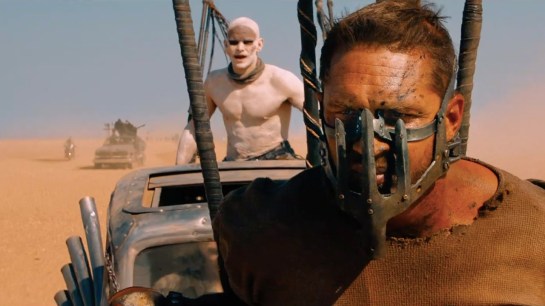
I can’t think of a more fitting actor to take on the role of Mad Max than Tom Hardy. His dialogue is sparse and he mainly tells his story through grunts, expressions, and outright physicality. And he does it all to sheer perfection. It’s a very unorthodox role. He’s not asked to say much and he spends a good third of the movie with his face partially obscured by a metal contraption. But he masterfully sells us this tough, surly, and untrusting Max character. But the real surprise was watching Charlize Theron match his toughness punch for punch and bullet for bullet. She is so good here.

MAX2

But of course the true star and the main attraction is George Miller and his insanely energetic action and presentation. “Fury Road” is a visual delight – a movie filled with “wow” moments, unbelievable stunts, and mind-blowing vehicle action sequences. Miller shoots his action with a chaotic precision and cinematic fluidity. Many modern action directors should take notes. But equally impressive are the stunning amount of practical effects used. When mixed with the top-notch CGI, it makes this one amazing looking film. And going along with the stellar visuals is Junkie XL’s vibrant and invigorating score.

Some of us had given up on Mad Max ever returning to the big screen. After 30 years it was a reasonable conclusion. But after seeing “Fury Road” I can boldly say it was worth the wait. George Miller has given us an installment that stands right there with (and probably an inch or two above) his phenomenal “The Road Warrior”. This is pure action cinema – a beautiful mixture of old-school style and modern movie technology. And after this taste of Miller’s vision, I can only hope he has more Mad Max movies plan for the future.

VERDICT – 5 STARS

5 STARSs

5STAR K&M

REVIEW: “Maggie”

MAGGIE POSTER

One could make the argument that the cinema landscape has been saturated with zombie movies. There have been numerous interpretations of zombie horror. We have had zombie comedies. We’ve even had a weird zombie romance flick. Yet with so many variations of zombie movies, I’ve seen nothing quite like “Maggie”. Writer John Scott 3 pens a story that pulls the focus off of the normal zombie movie machinations and tropes. Instead he shoots for a more personal approach by spotlighting intimacies rarely considered in these types of films.

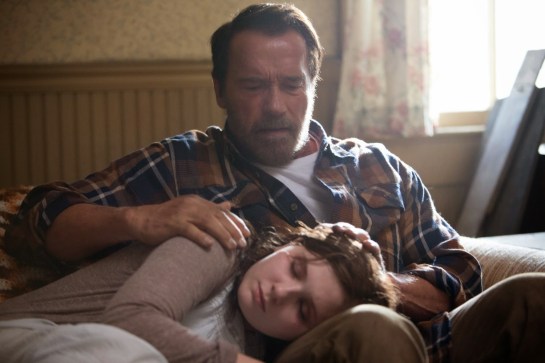
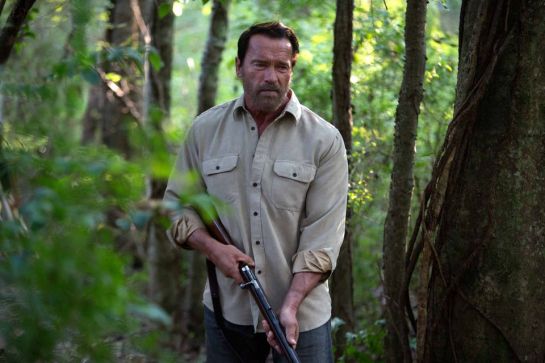
“Maggie” is a movie full of surprises. Perhaps the biggest comes in the lead performance from Arnold Schwarzenegger. In a dramatic departure from anything he has done before, Arnie plays a father whose daughter has been bitten and infected with a deadly, incurable virus. The majority of the story focuses on their time together between the onset of the virus and what looks like the inevitable outcome. Schwarzenegger dials it back and shows an understated side to his acting that is absolutely essential to his character, Wade Vogel. His bearded face is worn and weathered and he is clearly a man tormented by his new reality.

MAGGIE1

Abigail Breslin plays his daughter Maggie. We first meet her making a phone call to her father telling him not to come looking for her. Soon after she is caught in town past the city curfew and it is revealed she has been bitten and infected by the fatal disease that has ravaged most of the world’s population. Wade is allowed to take Maggie home for her final days until the virus reaches a point where she must be sent to what is called Quarantine to be “processed”. Joely Richardson is very good as Maggie’s caring but nervous stepmother. She struggles to balance her support for Wade with her fears of Maggie’s condition.

In a way “Maggie” could be called a family tragedy. It just happens to take place during a zombie apocalypse. But zombies are never the focal point. Their threat lingers in the background occasionally showing itself. Director Henry Hobson keeps his film from becoming a ‘zombie movie’. He effectively uses that backdrop to energize the movie’s sad and hopeless setting, but whenever the film is potentially moving into conventional directions his restraint becomes obvious and he pulls us back to the primary focal point.

Maggie2

As a whole, Hobson’s direction is yet another of the film’s surprises. It’s always nice to see a first time director throw aside a number of conventions and add a degree of style. This is clearly seen in the great job he does capturing mood and atmosphere. It’s well realized through Hobson’s camera, by his strategic use of David Wingo’s score, and through the telling expressions of his cast. Without the right tone the story would have fallen flat. I also like the deliberate pace of the story, something that Hobson and Scott clearly aim for. I can see where some may find it slow and even languid, but I never felt that at all. I fell right into the pacing and the story itself.

“Maggie” intrigued me from its first trailer, but the actual movie was even more enjoyable than I expected. It is such an interesting mix of subtle horror and emotional family drama. And even when it leans a little heavy on the melodrama, it feels surprisingly earned and acceptable. There is also an earnest sweetness at the heart of “Maggie”. The central father/daughter relationship is what drives the film and provides its satisfying emotional core. And that relationship is strengthened more by two very good performances particularly Schwarzenegger who shows us a side that I hope to see again.

VERDICT – 4 STARS

REVIEW: “Mood Indigo”

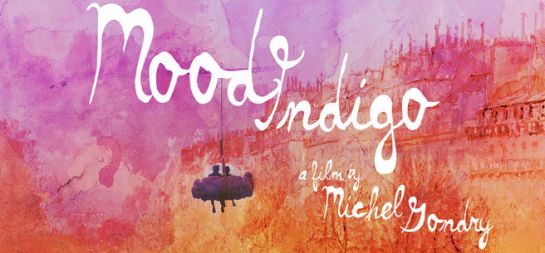
MOOD POSTER

Filmmaker Michel Gondry has had his hands in all sorts of projects. He’s made music videos, short films, documentaries, and even television commercials. He has also made a handful of feature films of which I have seen two – the visually striking and potent “Eternal Sunshine of the Spotless Mind” and the painfully unwatchable “The Green Hornet”. His most recent film “Mood Indigo” falls somewhere in between the two.

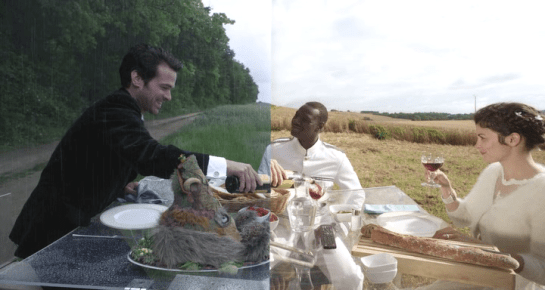
I was really excited for “Mood Indigo” not so much because of Gondry but because of its cast which features some of France’s most recognized performers. Romain Duris, Audrey Tautou, and Omar Sy bring a huge spark to this strange romance fantasy, but they can only do so much. Gondry goes all-in creating his surreal Dali-esque dreamworld. He bombards us with it and within the narrow bounds of a two hour movie it’s just too much.

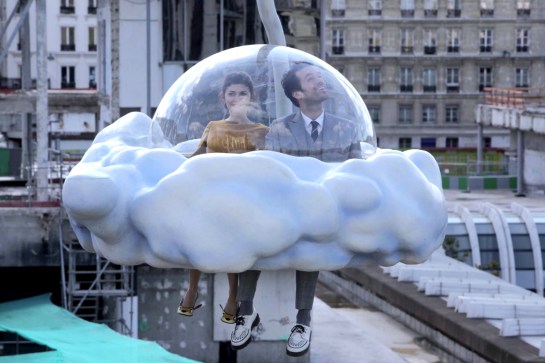
MOOD1

The film is based on “Froth on the Daydream”, a 1947 novel by Boris Vian. It tells the story of a wealthy and happy man named Colin (Duris). He loves his life. He loves the food and company of his cook Nicolas (Sy). He has a wonderful and trustworthy best friend Chick (Gad Elmaleh). Gondry shows us Colin’s life through a wild assortment of off-the-wall but playful imagery and gadgetry. This is important because it is truly intended to be a visual representation of Colin’s state of mind. The visuals grow more whimsical and colorful when he meets and falls in love with Chloé (Tautou). The two hit it off and in no time are married.

Colin and Chloé’s relationship drive the remainder of the film both visually and narratively. The two are madly in love and Gondry visualizes it in a number of vibrantly wacky and bizarre ways. But that changes when Chloé is diagnosed with a terminal illness. Not only does the story take on a more depressing tone, by the visuals go from bright and playful to dreary and bleak. It’s a direct reflection of Colin’s mood and state of mind as his life literally decays right before our eyes. It’s a fascinating stylistic approach that shows Gondry’s insanely cool creative side.

MOOD2

At the same time it is Gondry’s wild surreal world that is the movie’s biggest flaw. While the craziness does a great job of interpreting feelings it also goes overboard and becomes an annoyance. Gondry never pulls back and he sometimes smothers his story with his relentless imagery. Quite frankly some of it made no sense and came across as indulgent. I appreciate the film telling a good story in a very unorthodox way, but I often found myself distracted from the main story and at times uninterested in what Gondry was doing. Too much is too much.

Gondry’s stylistic excesses hurt the film but they don’t hurt the performances. Duris and Tautou have always been able to act with charisma and charm and it’s no different here. Both gracefully move from jaunty and merry to downcast and broken. But I had the most fun watching Omar Sy. He may be the most unique character in the film and Sy gives one of the best supporting performances of 2014. These three are joys to watch and they are the film’s most appealing components. As with the moving and poignant story, their performances sometimes get overshadowed by Gondry’s relentless visual wackiness. That’s unfortunate because ultimately that is what keeps “Mood Indigo” from being as good as it could have been.

VERDICT – 3 STARS
REVIEW: “Me and My Moulton” (2014)

MOULTON POSTER

Hopefully last Thursday’s announcement of this year’s Academy Award nominees will drive people to see films in some of the smaller, lesser known categories. That’s one of the things I love about the Oscars – being introduced to new films that I otherwise would have missed. This year there are several well made gems that earned some attention on the festival circuit and now have received Academy Award nominations. The animated short film “Me and My Moulton” is a shining example.

Torill Kove writes and directs this semi-autobiographical look at childhood feelings we all can relate to. Kove, who won an Oscar in 2007 for her animated short “The Danish Poet”, draws from her personal memories and for 14 minutes places us in the head of a 7-year old girl from Norway. She has two sisters, one older and one younger. Her mother and father are unorthodox which sometimes discourages the little girl. Through this young child Kove reminds us of feelings and attitudes we surely had at her age.

MOULTON1

The little girl is embarrassed by her parents and their unconventional ways. At one point she laments her father’s mustache saying “10,000 men in our town. One single mustache. And it has to be on my dad. It makes my stomach hurt.” We also see this through her envy of her friend’s family. Her friend’s mother buys them pretty and fancy clothes. Her mom makes her clothes. Her friend’s dad is handsome and adventurous. Her dad is plain and humble. Her friends have bicycles. Her parents can’t afford one. She wants the cool, normal, bourgeois family, but let’s just say something happens with her friend’s family that changes her perspective.

“Me and my Moulton” is a beautiful film both narratively and visually. The animation is simple but perfectly in tune with the story. It’s bright, colorful, and vivid as if shining through a child’s perspective. There are also subtle bits of humor and more heart than many feature length films can muster. It’s such an wonderful and touching little package that comes together in a perfectly satisfying ending. Torill Kove knows how to engage an audience. She also knows how to tell a great story and she doesn’t need two hours and $100 million to do it.

VERDICT – 4.5 STARS

You can find “Me and My Moulton” HERE.

REVIEW: “Magic in the Moonlight”

Magic poster

There is no doubt that Woody Allen falls into the ‘hit or miss’ category. The 79-year old Allen is still writing and directing his films and we get a new movie every year. This self-imposed annualized system of his had led to several fairly rotten films. On the other hand, when Woody Allen is on his game, he can deliver some of the sharpest and wittiest character-driven movies you’ll find. His latest picture is “Magic in the Moonlight” and the big question was which Woody Allen were we going to get?

I have to admit my expectations for this film were pretty tempered. Critics seem to be split down the middle on it and even the positive reviews rarely featured high praise. So I sat down to watch the film preparing to be disappointed to some degree. But an interesting thing happened. The film hooked me after its first few scenes. As it went on I found myself more interested in its characters, more taken by its charms, more amused by its humor, and more satisfied with its simplicity. As it turns out I really liked this movie.

Magic1

As with many of Allen’s films, “Magic in the Moonlight” follows a very eccentric lead character. Colin Firth plays Stanley, a famous traveling illusionist in late 1920s Europe. He is a smug, snarky fellow who we quickly learn to dislike. His arrogance really shows itself in his obsession with mortality, specifically debunking any notion of mysticism or an afterlife. When describing himself and his perspective on the subject Stanley states “I’m a rational man who believes in a rational world. Any other way lies madness.” His close-minded cynicism and innate stubbornness won’t allow him to entertain the possibilities of there being more beyond what we see.

One of Stanley’s side pleasures is exposing psychics as frauds. He is recruited by a childhood friend (Simon McBurney) to travel with him to the French Riviera where a young American clairvoyant named Sophie Baker (Emma Stone) has wooed a very wealthy family. No one has been able to disprove Sophie’s “mental vibrations”, but that doesn’t deter the overly confident Stanley. After arriving at the Côte d’Azur, insulting most of the people he meets, and sitting in on a séance, Stanley finds himself baffled at Sophie’s abilities. Complicating matters even more, he soon finds himself smitten with her.

MAGIC2

When Allen’s material is clicking he can give us some truly fascinating characters. Stanley is a pompous and pretentious jerk. He’s insulting and confrontational, but there is another layer to the character. He’s also a miserable man whose facade of self-assuredness can’t hide his neurotic insecurities. The wily Colin Firth is fabulous and he handles Allen’s dialogue like a fine sculptor with clay. He delivers a character that is detestable, sympathetic, and sometimes laugh-out-loud funny. Much of it is due to the signature sharp writing, but a big part is all because of Firth. The man is incapable of a bad performance.

But it’s Eileen Atkins who almost steals the entire show. She plays Stanley’s wise and straight-shooting Aunt Vanessa. She practically raised him since birth and knows him better than anyone else. She’s a subtle firecracker and her frank but loving dealings with Stanley offer up some of the film’s best lines. I was a little less enthusiastic about Emma Stone. She certainly isn’t bad by any means, but in some scenes she just doesn’t quite feel right for the part. It may be that she clashes with portions of Allen’s writing style. I can’t quite put my finger on it.

MAGIC3

One of the true stars of the film is cinematographer Darius Khondji. This is the fourth film he has shot for  Woody Allen and his work is fabulous. More and more locations are becoming bigger characters in Allen’s films. Here the gorgeous French Riviera setting is vividly captured. Sometimes it playfully lingers as a backdrop. Other times Khondji seems to be framing a beautiful postcard right up until someone enters the frame. And then there is the percolating 1920s setting. I loved the conscientious attention given to the many period details.

I can see where “Magic in the Moonlight” would be too lightweight for some people. For some it may not be funny enough. For others it may not be romantic enough. Overall it has underwhelmed a lot of people. I found myself happily wrapped up in its setting, its humor, and its simplicity. Now don’t misunderstand me. This doesn’t have the magic of “Midnight in Paris”. But it is a film I enjoyed getting lost in, and when the final credits rolled I had a big smile on my face.

VERDICT – 4 STARS