REVIEW: “Me and My Moulton” (2014)

MOULTON POSTER

Hopefully last Thursday’s announcement of this year’s Academy Award nominees will drive people to see films in some of the smaller, lesser known categories. That’s one of the things I love about the Oscars – being introduced to new films that I otherwise would have missed. This year there are several well made gems that earned some attention on the festival circuit and now have received Academy Award nominations. The animated short film “Me and My Moulton” is a shining example.

Torill Kove writes and directs this semi-autobiographical look at childhood feelings we all can relate to. Kove, who won an Oscar in 2007 for her animated short “The Danish Poet”, draws from her personal memories and for 14 minutes places us in the head of a 7-year old girl from Norway. She has two sisters, one older and one younger. Her mother and father are unorthodox which sometimes discourages the little girl. Through this young child Kove reminds us of feelings and attitudes we surely had at her age.

MOULTON1

The little girl is embarrassed by her parents and their unconventional ways. At one point she laments her father’s mustache saying “10,000 men in our town. One single mustache. And it has to be on my dad. It makes my stomach hurt.” We also see this through her envy of her friend’s family. Her friend’s mother buys them pretty and fancy clothes. Her mom makes her clothes. Her friend’s dad is handsome and adventurous. Her dad is plain and humble. Her friends have bicycles. Her parents can’t afford one. She wants the cool, normal, bourgeois family, but let’s just say something happens with her friend’s family that changes her perspective.

“Me and my Moulton” is a beautiful film both narratively and visually. The animation is simple but perfectly in tune with the story. It’s bright, colorful, and vivid as if shining through a child’s perspective. There are also subtle bits of humor and more heart than many feature length films can muster. It’s such an wonderful and touching little package that comes together in a perfectly satisfying ending. Torill Kove knows how to engage an audience. She also knows how to tell a great story and she doesn’t need two hours and $100 million to do it.

VERDICT – 4.5 STARS

You can find “Me and My Moulton” HERE.

REVIEW: “Magic in the Moonlight”

Magic poster

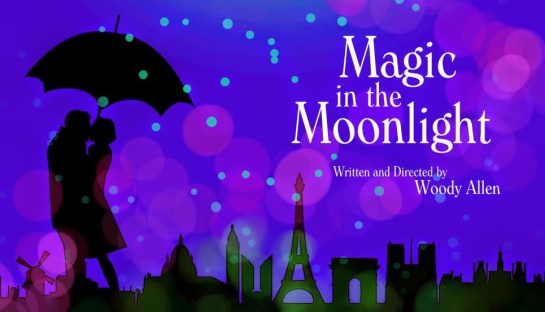
There is no doubt that Woody Allen falls into the ‘hit or miss’ category. The 79-year old Allen is still writing and directing his films and we get a new movie every year. This self-imposed annualized system of his had led to several fairly rotten films. On the other hand, when Woody Allen is on his game, he can deliver some of the sharpest and wittiest character-driven movies you’ll find. His latest picture is “Magic in the Moonlight” and the big question was which Woody Allen were we going to get?

I have to admit my expectations for this film were pretty tempered. Critics seem to be split down the middle on it and even the positive reviews rarely featured high praise. So I sat down to watch the film preparing to be disappointed to some degree. But an interesting thing happened. The film hooked me after its first few scenes. As it went on I found myself more interested in its characters, more taken by its charms, more amused by its humor, and more satisfied with its simplicity. As it turns out I really liked this movie.

Magic1

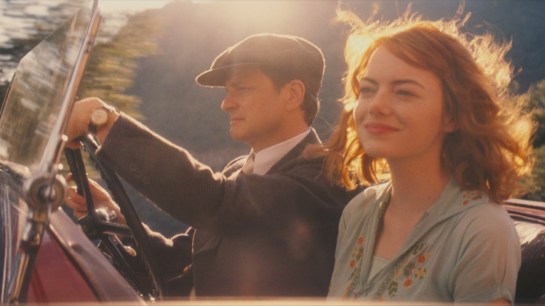
As with many of Allen’s films, “Magic in the Moonlight” follows a very eccentric lead character. Colin Firth plays Stanley, a famous traveling illusionist in late 1920s Europe. He is a smug, snarky fellow who we quickly learn to dislike. His arrogance really shows itself in his obsession with mortality, specifically debunking any notion of mysticism or an afterlife. When describing himself and his perspective on the subject Stanley states “I’m a rational man who believes in a rational world. Any other way lies madness.” His close-minded cynicism and innate stubbornness won’t allow him to entertain the possibilities of there being more beyond what we see.

One of Stanley’s side pleasures is exposing psychics as frauds. He is recruited by a childhood friend (Simon McBurney) to travel with him to the French Riviera where a young American clairvoyant named Sophie Baker (Emma Stone) has wooed a very wealthy family. No one has been able to disprove Sophie’s “mental vibrations”, but that doesn’t deter the overly confident Stanley. After arriving at the Côte d’Azur, insulting most of the people he meets, and sitting in on a séance, Stanley finds himself baffled at Sophie’s abilities. Complicating matters even more, he soon finds himself smitten with her.

MAGIC2

When Allen’s material is clicking he can give us some truly fascinating characters. Stanley is a pompous and pretentious jerk. He’s insulting and confrontational, but there is another layer to the character. He’s also a miserable man whose facade of self-assuredness can’t hide his neurotic insecurities. The wily Colin Firth is fabulous and he handles Allen’s dialogue like a fine sculptor with clay. He delivers a character that is detestable, sympathetic, and sometimes laugh-out-loud funny. Much of it is due to the signature sharp writing, but a big part is all because of Firth. The man is incapable of a bad performance.

But it’s Eileen Atkins who almost steals the entire show. She plays Stanley’s wise and straight-shooting Aunt Vanessa. She practically raised him since birth and knows him better than anyone else. She’s a subtle firecracker and her frank but loving dealings with Stanley offer up some of the film’s best lines. I was a little less enthusiastic about Emma Stone. She certainly isn’t bad by any means, but in some scenes she just doesn’t quite feel right for the part. It may be that she clashes with portions of Allen’s writing style. I can’t quite put my finger on it.

MAGIC3

One of the true stars of the film is cinematographer Darius Khondji. This is the fourth film he has shot for  Woody Allen and his work is fabulous. More and more locations are becoming bigger characters in Allen’s films. Here the gorgeous French Riviera setting is vividly captured. Sometimes it playfully lingers as a backdrop. Other times Khondji seems to be framing a beautiful postcard right up until someone enters the frame. And then there is the percolating 1920s setting. I loved the conscientious attention given to the many period details.

I can see where “Magic in the Moonlight” would be too lightweight for some people. For some it may not be funny enough. For others it may not be romantic enough. Overall it has underwhelmed a lot of people. I found myself happily wrapped up in its setting, its humor, and its simplicity. Now don’t misunderstand me. This doesn’t have the magic of “Midnight in Paris”. But it is a film I enjoyed getting lost in, and when the final credits rolled I had a big smile on my face.

VERDICT – 4 STARS

REVIEW: “My Favorite Wife”

FAVORITE WIFE POSTER

How can any true movie fan not love the screwball comedies of the 1930s and 1940s? The once popular genre was recognized for its witty rapid-fire dialogue, wacky situations, bold and brash female leads, occasional slapstick humor, and a feverish battle of the sexes. During this wonderful time for comedies many actors and actresses saw their careers flourish including Cary Grant. In “My Favorite Wife” Grant matches wits with Irene Dunne in what is a shining portrait of this great genre.

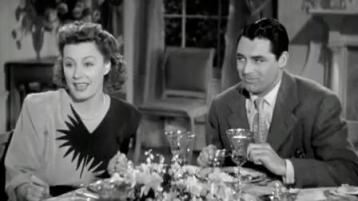
The movie starts with arguably the funniest courtroom scene ever filmed. Nick Arden (Grant) is before a judge seeking to have his wife Ellen (Dunne) declared legally dead after being missing at sea for seven years. He’s there with Bianca (Gail Patrick) who he plans to marry after the judge’s ruling. Everything goes as planned but as with all screwball comedies the harmony doesn’t last long. You see, Ellen isn’t dead and she shows up after being rescued from a deserted island.

FAVORITE WIFE1

When Ellen reveals herself to Nick things get pretty complicated. He’s crazy about her yet he doesn’t know how to end it with Bianca. It also doesn’t help that he’s a bit spineless and cowardly. He drags things out leading to one comedic complication after another. And that’s what makes this movie so great. The nutty situations, the back-and-forth banter, and the hilarious head-butting between the two leads.

One of the biggest strengths of “My Favorite Wife” lies in its screenplay. It’s sharp, funny, and void of any of the trappings that befall many of today’s “comedies”. You’re always running across a great scene or hilarious line. For instance take the opening courtroom scene. Veteran character actor Granville Bates plays the grumpy and cantankerous Judge Bryson. He steals the scene with his growls and impatience. It’s a perfect tablesetter for the fun and playful tone that carries through the entire picture.

FAVORITE2

Of course a movie like this has to have good performances from capable talents who can pull it all off. I’ve already talked about Cary Grant and as expected he is fabulous. He has his usual charisma but he also shows off his impeccable comedic timing. But the real star just may be Irene Dunne. Dunne has been called the greatest actress to never bring home Oscar. Watch her here and you may understand why. She matches Grant line for line and gag for gag. She gives a great performance and steals one scene after another. Randolph Scott and Gail Patrick are also a lot of fun in solid supporting roles.

“My Favorite Wife” is a really good film. It features a sharp and sometimes corny wit and some really fun performances. Even though it was nominated for three Academy Awards, the film is rarely mentioned among the list of the great screwball comedies. And while I’ll admit that it may be missing that special ‘something’ which may hold it back, I still think it’s a great picture that any lover of comedy or movies should see.

VERDICT – 4 STARS

REVIEW: “The Monuments Men”

MONUMENTS poster

Inspired by an incredible true story and armed with a wonderful ensemble cast, “The Monuments Men” has all the ingredients to be a sure thing. The talent behind the film starts with George Clooney who co-writes, stars, and takes another turn at directing. Clooney has directed some fantastic movies but “Leatherheads” and “The Ides of March” showed us that he’s far from infallible. But I was excited once I saw “The Monuments Men” on the horizon and it quickly became one of my most eagerly anticipated films. Pretty high expectations, right?

I first heard the story of “The Monuments Men” from author Robert Edsel. He was doing an interview and talking about his new book which told the true story of Allied soldiers who sought out and saved important works of art from Hitler and the Nazis during World War 2. It’s incredible stuff and once I heard about a film adaptation I was hooked. Clooney’s picture is loosely based on the actual events which feeds the movie’s strengths but also its weaknesses. So far people have pounced on the film expecting more from it or wanting something entirely different. Personally I thought “The Monuments Men” was fantastic.
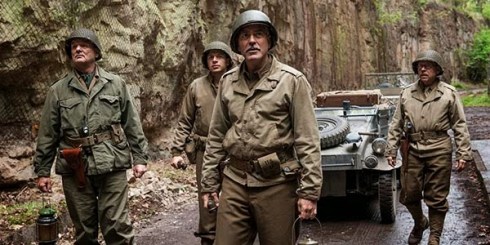
Monuments2While watching the film my very first feelings were nostalgic. “The Monuments Men” is a throwback to the old ensemble war pictures but with its own unique twist. I immediately began thinking of movies like “The Green Berets”, “The Guns of Navarone”, and “The Dirty Dozen”. Even the end credits hearken back to those older pictures. My father loved these films and growing up I was able to watch them and learn to appreciate them. I think Clooney gets that and he knows what he’s doing. I give him a ton of credit for recapturing the vibes and nuances of those past genre pieces.

But the big difference between this film and the older ones can be found in the characters. This team isn’t comprised of hardened frontline soldiers. These are common men who possess particular skills needed to complete this unique mission. They are museum curators, art historians, and architects. They are older men who are more comfortable with Picassos and Monets than machine guns and hand grenades. Their mission brings them in as the war in Europe is ending. But even though they slip around the battlefields and combat, eventually the elements of the war effects them. They are at times joking and playful – it’s what you could expect from these types of characters. But they are no longer curating museums, designing skyscrapers, or painting. They are in the war and they constantly come across sober reminders of that.
Monuments1

I love this entire dynamic which diverts the movie from a common action-oriented path. There really isn’t much action at all which hurts the film in some people’s estimation. Personally I don’t think the story calls for much action. Instead it focuses on the mother of all treasure hunts through an assortment of beautiful European locales. But their mission isn’t easy. There are still wartime tensions, a greedy Russian army, and the Nazis who are under direct orders from Hitler to destroy everything. The seven who make up The Monuments Men split up and spread out across Europe hunting clues, fleeing danger, and tracking down as much stolen art as they can.

Clooney’s film has plenty of shifts in tone. The movie sometimes feels easygoing and lighthearted only to be dark and somber a few scenes later. Some have taken issue with this saying the humor feels out of place. I completely disagree because I found the humor to be measured and conscientious. The humor was there but it felt light. There were never any attempts at big laugh-out-loud moments which would have really been jarring.

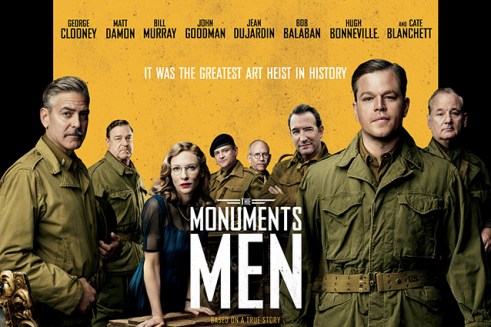
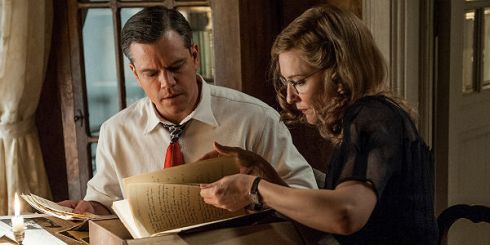
And then there is the cast. I love watching good actors act and we certainly get to do that. Clooney plays the team leader and he’s joined by Matt Damon, Bill Murray, Jean Dujardin, John Goodman, Bob Balaban, and Hugh Bonneville. Everyone of them gives fine performances and there is some unique chemistry that develops. Cate Blanchett is also excellent playing someone based on the fascinating real Rose Valland. All of these characters are given their moments to shine and we are given small bits of information about them along the way. Unfortunately it’s not enough to fully develop the characters – only to make us want to know more about them. That was a little disappointing although a movie like this could get bogged down with layers upon layers of backstory.

monuments3

Phedon Papamichael (who also did brilliant work in 2013’s “Nebraska”) offers up some fine cinematography and the war-torn set designs look amazing. Alexandre Desplat’s score adds to the film’s old-school flavor that Clooney is obviously shooting for. The performances, the nostalgia, the clever balance of the script, the uniqueness of the story. Everything I’ve mentioned comes together in a film that I found satisfying but many others clearly didn’t. What has caused the strong backlash to this film? Was it the lack of action, the deliberate pacing, the scattered storytelling? These things are certainly present but for me they made it a better film and they help steer it away from the conventional movie we could have gotten.

As a lover of art and World War II history, the story of “The Monuments Men” connected with me from the start. As a lover of the fun ensemble war pictures that were all but gone by the end of the 1960s, Clooney’s vision and approach hits the target. To say I’m bewildered by the negative reception to this film is an understatement. I don’t quite know what to make of it. But movies are a funny thing and they certainly effect people differently. For me this was a real treat – a movie that doesn’t pander to conventionalism, moves at its own pace, and treats its subject with respect. It’s not a masterpiece, but it’s certainly not a bad film either and I for one loved it.

VERDICT – 4.5 STARS

REVIEW: “Mr. Smith Goes to Washington”

Classic Movie SpotlightSMITH POSTERSome say that 1939 was the greatest year for movies. It’s hard to argue with them. I mean listen to this list of films that came out that year: “Gone with the Wind”, “The Wizard of Oz”, “Ninotchka”, “Stagecoach”, “Wuthering Heights”, “Dark Victory”. Oh, and there was also a little movie called “Mr. Smith Goes to Washington”. This Frank Capra classic was a bit controversial when first released due to its strong look at the American political system. Yet over time it has earned its status as a classic and continues to be remembered as a glorious showcase for the great Jimmy Stewart.


“Mr. Smith Goes to Washington” initially ruffled a few feathers among U.S. Senators and a select few among the Washington press. Numerous complaints were hurled its way including accusations that this film was pro-Communist and anti-American. It was said the film would damage our standing in Europe and in other countries. Others stated it was a shameful distortion of the United States Senate. But others felt the movie was a revelation. They viewed it as one of the first movies to expose a side of the political system never seen before.

The story itself centers around a simple and naive boy scout leader (called Boy Rangers in the film because the Scouts refused to lend their name) who is appointed by the governor to fill in a recently vacated Senate seat. The governor has a crooked political boss named Jim Taylor (Edward Arnold) pressuring him to appoint a controllable stooge while others seek someone who will bring meaningful change to Washington. The governor plays it down the middle and chooses Jefferson Smith (Stewart), an honest and good-hearted bumpkin with strong patriotic beliefs in American exceptionalism.

SMITH3

But the core of the movie deals with Smith’s principled ideals coming face-to-face with the political corruption of a powerful Washington machine. It’s pure ideals versus the thirst for prominence and power. Smith first seeks council from a respected Senator and family friend Joseph Paine (Claude Rains). He also looks for help from his secretary Clarissa Saunders (Jean Arthur). She served Smith’s predecessor and she’s well versed on how things work on Capitol Hill. But Smith quickly learns that trusting people in Washington, whether they are politicians or the press, is a hard thing to do.

Despite its detractors, “Mr. Smith” was nominated for 11 Academy Awards. But due to the crowded field of amazing movies it only took home one statue. Lewis Foster won for Best Original Story, an Oscar that is no longer awarded. Still the recognition of the film and its achievements was warranted. Foster’s story was great but so was Sydney Buchman’s brilliant screenplay. Buchman perfectly creates a political fish-out-of-water story that balances slight doses of humor with compelling and thought-provoking drama. He also gives us the right amount of political jargon and atmosphere that immerses us instead of drowning us. He takes a scalpel and opens up the system and asks us to see a side of the political landscape that at the time had never been seen. This made some squirm but others found it to be wonderful and powerful cinema.

And then there are the performances led by Jimmy Stewart. I swear he’s one of the best actors to ever grace a big screen. This role seems tailor-made for him. Smith is a humble, sincere, and down to earth – all qualities that Stewart has always been able to bring out of his characters with ease. This is called the role that made him a star and his performance earned him his first Academy Award nomination. The film also featured an impeccable supporting cast including Claude Rains and Harry Carey who played the head of the Senate. Both received supporting actor Oscar nominations. We also get Thomas Mitchell, Dick Elliott, Beulah Bondi, and H.B. Warner – all who Capra would later bring back to join Stewart in “It’s a Wonderful Life”.

SMITH2

But I also have to take time to praise Jean Arthur. I think she is fantastic and her performance is one of my favorite things about this film. Arthur began her career as a silent movie star but was able to make the transition to the talkies. Capra had used her prior to “Mr. Smith” so he knew her sharp and unshakable talents. Arthur defines her role by bringing charm, wit, sarcasm, and energy to the character. She has such a natural enthusiasm that bleeds over into the performance which in turn is a real strength of the film.

I could go on and on about the Oscar nominated art direction from Lionel Banks or Joseph Walker’s inspiring cinematography. There is just so much to love about this film. One of the only gripes I’ve had with the movie was with the ending. Capra abruptly pulls the plug and closes up shop leaving several loose ends untied. It’s not a frustrating or unsatisfying ending at all. I just really would have liked to see a bit more considering what has taken place. Aside from that “Mr. Smith Goes to Washington” is a true classic and a testament to the smart and capable filmmaking that we so often lack today. If you haven’t taken time to see this gem, you owe it to yourself. It’s that good.

VERDICT – 4.5 STARS

REVIEW: “Mildred Pierce” (1945)

Classic Movie SpotlightMildred PierceJoan Crawford had an interesting career to say the least. In 1937 she was called “The Queen of the Movies” by Life magazine but she would be called “Box Office Poison” only one year later. A few moderate successes would follow before her 18 year run with MGM studios was ended. Hungry for a new start, Crawford signed with Warner Brothers. One of her first pictures with her new studio was “Mildred Pierce”. The film was a huge success and Crawford would go on to win the Best Actress Oscar. Her performance was rightly recognized and her career was revived.

“Mildred Pierce” was directed by Michael Curtiz. The acclaimed director didn’t want Crawford as his lead but after his first choices bowed out (Bette Davis, Barabara Stanwyck, Olivia de Havilland), she got the job. The film was adapted from James Cain’s edgy 1941 hardboiled novel. Several plot lines from the book couldn’t be included in the picture due to the movie content code restrictions of the time. This allowed for the film’s introduction of the murder angle and several other creative differences.

Speaking of that, the movie opens with a murder. In a wonderful opening scene dripping with noir flavor, a man is shot several times by an unseen assailant who then flees the scene. The police bring in a successful restauranteur named Mildred Pierce (Crawford) for questioning. The murder victim turns out to be Mildred’s second husband Monte Beragon (Zachary Scott) and the cops believe they know who did it. The main plot structure is built around her interrogation. Through flashbacks we are introduced to the main players and we follow Mildred’s rise from a hard working single mother to an owner of multiple restaurants in the Southern California area.

But we are also introduced to a darker side of Mildred’s life. It’s a side featuring two failed marriages, an unthinkable tragedy, and a bitter, contentious relationship with her oldest daughter Veda. It’s Veda who may be Mildred’s biggest failing. We watch her become a selfish and materialistic young girl who is actually a product of Mildred’s own making. Her desire to shower upon her daughter the most lavish things creates a scheming young girl who looks down with great haughtiness on the ‘have-nots’. Ann Blyth plays Veda and she is sublime. Blyth was actually on loan from Universal Studios at the time. Her performance garnered well-deserved praise which culminated in a Best Supporting Actress Oscar nomination. Blyth would make several more films but none as memorable as “Mildred Pierce”. She was only 17 at the time but this performance showed an astuteness and attention usually associated with the greats.

Mildred Pierce1

There is an assortment of other great side characters that help tell Mildred’s story. Bruce Bennett plays her first husband Bert who subverts any good intentions he may have with his carousing and disrespect. Yet you end up wondering if he knows more about Mildred than we first do. Then there is Bert’s real estate partner Wally (Jack Carson) who is never beyond an occasional flirt or a shady business deal. He’s a rather slimy fellow who also has self-centered intentions. Eve Arden gets some wonderful lines as Mildred’s friend and restaurant manager. And Butterfly McQueen has some good moments as Mildred’s maid.

While the film revolves around the murder of Beragon, the life of Mildred Pierce is the centerpiece. Much of the movie’s brilliance is shown in its storytelling style and in the clever ways it depicts Mildred’s changes. She’s an entirely different person by the film’s end. She becomes a woman enslaved by the poisonous relationship she has with her daughter. Things become darker and more twisted as the film moves along which gives “Mildred Pierce” a unique sense. It slices up and mixes portions of film noir, mystery, and romance to form a sordid yet thoroughly compelling whole.

I’m a big fan of “Mildred Pierce” and it’s easily one of my favorite Joan Crawford pictures. She is exceptional here as is her supporting cast, particularly young Ann Blyth. Ranald MacDougall’s adaptation is smart and crafty and it works seamlessly with Michael Curtiz’s style of direction. The film takes a few unavoidable diversions from the novel but they nicely translate cinematically. It all resulted in a spirited film that showcased a still relevant Crawford. It’s also a true classic that still packs a hefty punch today.

VERDICT – 4.5 STARS