REVIEW: “Mean Girls” (2024)

The latest popular movie from the past to get a modern-day makeover is “Mean Girls”. The 2004 teen comedy was a big hit with audiences and critics, eventually spawning a made-for-television sequel and even a Broadway musical. Now co-directors Samantha Jayne and Arturo Perez Jr. have brought us a 2024 big screen update that’s based on the stage adaptation of the original 2004 hit movie. And all of it is based on Rosalind Wiseman’s 2002 book “Queen Bees and Wannabes”. Confusing?

“Mean Girls” 2024 sets out to mix its teen comedy roots with snazzy musical numbers but the results aren’t great. The screenplay by Tina Fey taps into a few things that long-time fans might appreciate. But overall it’s a wildly uneven film, hampered by flaccid attempts at humor and songs with no resonance whatsoever. Even worse are the characters – a woeful collection of shallow teens who leave you worried for the future of whatever world they live in.

Image Courtesy of Paramount Pictures

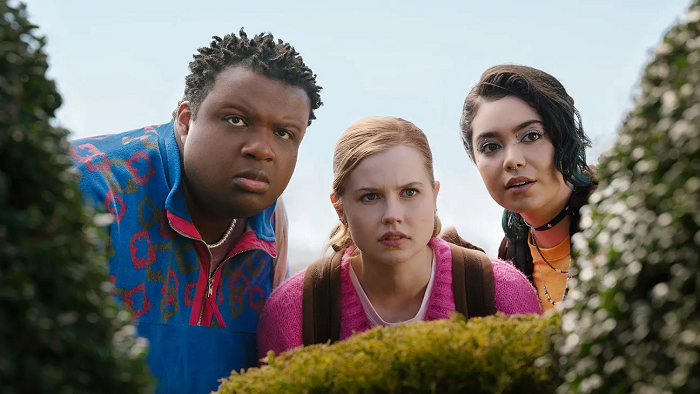
The film stars Angourie Rice, a good young actress who deserves better than what she gets here. She plays Cady Heron, a smart and formerly homeschooled teenager attending her first day at North Shore High School. The filmmakers go out of their way to make Cady as uncomfortable as possible, immediately overwhelming her through the cult-like stares from the students and the exaggerated cliques that no normal person would fit in with. But two best friends and (kinda) loners, Janis (Chloe Auliʻi Cravalho) and Damian (Jaquel Spivey) take Cady under their wings and show her the ropes.

But Cady’s high school experience takes a dramatic turn after she’s noticed by three rich, snooty, and ultra popular girls dubbed The Plastics. They’re led by the “Queen Bee” of the group and the school, Regina George (Reneé Rapp). Following her around like puppies is the idolizer Gretchen (Bebe Wood) and the ditzy Karen (Avantika). Cady’s “friendship” with Regina leads to a boost in her own popularity and status. But when Regina finds out Cady is crushing on her ex-boyfriend Aaron (Christopher Briney), things get a little nasty.

From there the bulk of the movie follows the friends-turned-enemies as they both dole out various forms of payback. And that’s really the movie in a nutshell. It seems to relish the meanness, to the point of nearly forgetting the more thoughtful themes that deal with bullying, peer pressure, etc. It’s only in the last ten minutes or so that we get an overtly tidy finish reminding everyone to be nice to each other. Hardly what you would call a convincing conviction.

Image Courtesy of Paramount Pictures

Jayne and Perez Jr. try and capture the spirit of “Mean Girls” but all they can manage is a grating, uninspired pastiche. The music numbers only complicate matters, ranging from mediocre to dreadful. Altogether the movie plays like a current-day ABC Afterschool Special, littered with groan-inducing TikTok reels and second-rate MTV music videos. There are some terrific voices (Rapp can flat-out belt). But the songs tend to be forgettable at best and annoyingly distracting at worst.

“Mean Girls” ends up being a toothless retread that feels custom-made for the January dumping ground. The teen comedy side of it offers little in terms of laughs and gives us nothing to chew on. And rather than energizing this unfortunate reincarnation, the consistently underwhelming song choices and musical numbers weigh the film down. Fey, Tim Meadows, Jon Hamm, and Ashley Park offer some star wattage in their utterly thankless roles. But they can’t save this mess of an adaptation that fumbles pretty much everything it’s trying to remake and recapture. “Mean Girls” is in theaters now.

VERDICT – 1.5 STARS

REVIEW: “Mayhem!” (2024)

It didn’t take long for the first ‘action movie of the year’ candidate to emerge. “Mayhem!” (and yes, the exclamation point is included) is a blistering action thriller fueled by ferocious fight choreography yet laced with an unexpected dose of heart. While its American title doesn’t do it any favors (it released as “Farang” elsewhere), director Xavier Gens delivers big where it counts, taking his time getting where he’s going and then rewarding our patience with an explosive payoff.

The movie’s centerpiece is its chiseled French-Algerian star, Nassim Lyes. The 35-year-old former MMA fighter and kickboxer comes packaged with a simmering intensity and remarkable physicality which is exactly what his character demands. The story around him seems to pull from a number of inspirations including Jacques Audiard’s “A Prophet”, 2011’s “The Raid”, and even a few dashes of “John Wick”. It may not match up with those heralded films, but it’s plenty strong enough to stand on its own.

Lyes plays Samir Darba, a quiet and solemn young man with a troubled background. We first meet him in a Paris prison where he has worked hard to straighten himself out while learning to resist his urge towards violence. Samir’s good behavior pays off and he is granted a day parole. He immediately looks to stabilize himself by finding a steady job to help him stay out of trouble. But it doesn’t take long before his past comes back to haunt him. An old contact jumps him as he’s on his way back to the penitentiary. Samir kills the thug in an act of self-defense. But knowing how it looks and fearing the consequences, he decides to flee France.

Image Courtesy of IFC Films

Five years later we see Samir working on a boat near Bang Chan in East Thailand. He has seemingly left his old life behind (yea right) and found happiness in the cozy little fishing village. He’s found a wife, Mia (Loryn Nounay) and together they have a young daughter Dara (Chananticha Tang-Kwa) and a baby on the way. To help pay the bills and save some money, Samir also works as a baggage handler and van driver for a luxury hotel. And he does some kickboxing on the side, occasionally throwing a fight for a greedy and crooked local promoter.

Samir and Mia have been eyeing some gorgeous oceanfront property with dreams of opening their own beachside restaurant. But just as they’re ready to purchase, they learn they’ve been outbid by a Frenchman named Narong (played by the great Olivier Gourmet). He turns out to be a powerful crime lord who offers Samir a proposal – successfully deliver a small amount of drugs and the property is theirs. Without telling Mia, Samir accepts the job, seeing it as the only way for him and his family to realize their dream.

Of course the drop goes terribly bad with Samir barely managing to escape. Knowing the consequences of failure, he rushes home to get his family to safety, but Narong’s goons arrive before they can leave. A savagely violent fight ensues that leaves the pregnant Mia stabbed to death, Dara kidnapped, and a severely wounded Samir left for dead. Samir survives after he is found by his trainer and father figure Hansa (the really good Vithaya Pansringarm) who nurses him back to health.

Image Courtesy of IFC Films

As you can probably guess, Samir doesn’t sit idly by. He sets out on a personal mission to save Dara and dole out punishment on those who killed his wife and unborn child. In some ways it plays like a conventional revenge story. But Samir does a good job selling us a tortured father who’s desperate to get back his young daughter. It adds an extra dramatic layer to the story and helps to earn our empathy for his plight.

But the movie’s meat and potatoes is the action. Gens keeps things surprisingly subdued for much of the way, content to feed us morsels and leaving us hungry for the main course. You could make a case that he waits a little too long, leaving us wondering when the movie is going to finally let Samir (and Lyes) off his chain. It finally does and it proves to be worth the wait. The fight scenes in the kinetic final act are intensely violent and downright brutal with blood-splattering and bones-cracking galore. Lyes is an absolute force while Gens, DP Gilles Porte, and editor Riwanon Le Beller skillfully frame and shoot the sequences with style and energy.

The final 20 minutes offer up a hard-hitting (literally and figuratively) punctuation mark to a story that has its slow patches but knows how to stick its landing. Gens does a good job unpacking his story while slipping in some not-so-subtle commentary on child abduction and sex trafficking. The film also looks great, shooting on a number of immersive locations. But everything comes back to the action which takes a while to kick into gear. But once it does, Gens puts the pedal down and (again) flexes his prowess as an action filmmaker.

VERDICT – 4 STARS

REVIEW: “Memory” (2023)

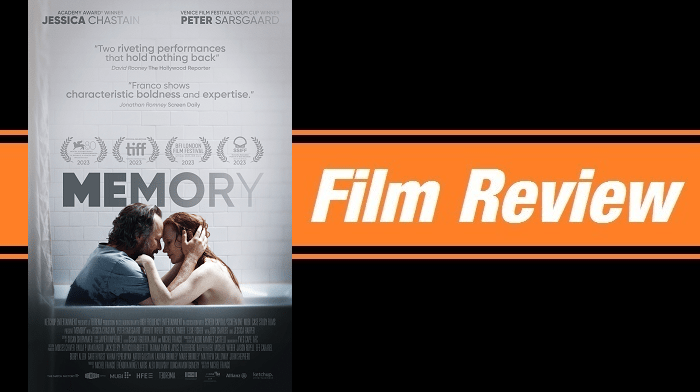
The immensely talented duo of Jessica Chastain and Peter Sarsgaard lead the way in “Memory”, the new film from the often provocative yet thoughtful Michel Franco. This engrossing adult drama about two broken souls finds its strength in the transcendent performances of its two leads and in Franco’s resonating script which analyzes the human condition from a perspective we’re not used to seeing in his films.

Chastain plays Sylvia, a single mother and recovering alcoholic. When not working at an adult daycare center or attending AA meetings, she’s raising her daughter Anna (Brooke Timber) the best way she knows how. Sylvia is a loving mother, but overprotective which is a byproduct of her own childhood trauma. It’s a past that still haunts her and has defined so much of her adult life.

The story takes off in earnest after Sylvia agrees to attend a high school reunion with her well-meaning but persistently uncomfortable sister, Olivia (Merritt Wever). As Sylvia sits at a table, alone and detached, an unknown bearded man (Sarsgaard) locks his eyes onto her from across the room. He slowly makes his way to her and takes a seat. His sudden appearance prompts her to grab her coat and hurriedly leave. The man creepily follows her from a distance, first to the subway, and then as she makes the dark walk home.

Franco infuses the scene with mystery. Who is the man? Why is he following her? Why is she so afraid of him? The questions only mount the next morning after Sylvia discovers the man asleep outside of her apartment building. We soon learn the man’s name is Saul Shapiro and he has early stage dementia. Through a series of unlikely circumstances a relationship develops between the two. Sylvia is even hired by Saul’s brother Isaac (Josh Charles) and niece Sara (Elsie Fisher) to sit with him during the day.

As the story progresses we notice some striking parallels between Sylvia and Saul. They went to the same high school and they both are outsiders (in their own ways) within their upper-class families. Yet there’s more to their stories, especially Silvia’s which comes to light after some dark secrets are unearthed. But Franco doesn’t paint every detail or spell out every emotion. Even more, he never caters to our expectations. There are several moments where he lures us in only to flip the script and go in an entirely different direction.

“Memory” wraps up with a moving third act that brings the film’s mature themes to a thoughtful and satisfying place. As with the rest of the movie, it doesn’t take our emotions for granted. Franco does a good job earning our investment and he delivers a touching payoff. He gives his two stars some really good material to work with and has the smarts to let them carry the bulk of the dramatic load. As a result, Chastain and Sarsgaard turn in two of the year’s best performances, cementing Franco’s latest as an exciting and unexpected turn for the notoriously daring filmmaker.

VERDICT – 4 STARS

REVIEW: “Maestro” (2023)

Bradley Cooper directs, co-writes, co-produces, and stars in “Maestro”, Netflix’s new biopic based on the life of American conductor and composer Leonard Bernstein. While the musical artistry of the incredibly talented Bernstein is on display, the movie’s central focus is on his complex and layered marriage to Costa Rican-Chilean actress Felicia Montealegre Bernstein, played with scene-stealing vitality by Carey Mulligan.

Along with Cooper, “Maestro” features a list of producers that includes Steven Spielberg and Martin Scorsese, both of who at different times were considered to direct. But after screening Cooper’s 2018 highly acclaimed box office hit “A Star is Born”, Spielberg handed the actor the reins. As a result, Cooper has made an arresting biography-esque movie that avoids many biopic traps. But in doing so it skimps on some helpful details.

First off “Maestro” works under the assumption that its audience already knows the professional/artistic merit of Leonard Bernstein. In one sense it’s a plus as we’re spared from getting yet another ‘cradle to the grave’ story. But for those lacking at least a working knowledge of Bernstein’s acclaim, it may be difficult latching onto “Maestro”. It’s a creative choice that’s both a strength and a liability depending on how much you know going in.

Image Courtesy of Netflix

But I don’t want to shortchange what Cooper has accomplished. He captivates, both through his acting and in the director’s chair, showing off an extraordinary command of the camera (along with DP Matthew Libatique) and delivering a performance that should garner all kinds of awards season attention. Cooper’s intense commitment propels the movie in a number of ways. But it’s Mulligan who is the film’s true heart and soul.

The movie’s full-color opening takes us to the Bernstein’s Connecticut home where Leonard (more affectionately called Lenny) is giving a television interview. He plays a few aching chords on his piano while lamenting how desperately he misses his late wife Felicia. After a quick shift to striking black-and-white, Cooper transports us back in time to November 14, 1943. On that faithful day a 25-year-old Leonard Bernstein, the assistant conductor of the New York Philharmonic, gets the call to fill in for the orchestra’s ailing lead conductor. The rest is music history.

“Maestro” glazes over Leonard Bernstein the artist, alluding to his renown more than exploring it. People from his professional life routinely pop up with practically no explanation of who they are or what they do. They become nothing more than poorly sketched familiar faces. But Cooper doesn’t completely shelf Bernstein’s gifted artistry. He gives us a handful of revealing scenes, none better than his show-stopping recreation of Bernstein’s conduction of Mahler’s “Resurrection” inside Ely Cathedral. It’s an electric scene with currents of creative energy emanating from Cooper’s every pore.

But those scenes are few. Instead Cooper sets out to show us the Leonard Bernstein beyond the spotlight. The Lenny we see is a man of endless contradictions. His concern for his legacy is only outdone by his intense fear of being alone. And his obvious genius is only matched by his equally evident hedonism. His behind the scenes life was marked by social posturing, affairs with both men and women, and a number of poorly veiled insecurities. Yet Lenny maintained an indomitable spirit and a domineering passion that often clashed with the times he lived in while feeding a nearly insatiable love of self.

Image Courtesy of Netflix

But a stabilizing force comes in the person of actress Felicia Montealegre played with such empathy and resolve by Mulligan. Felicia and Lenny meet in 1946 and there was an instant connection. Driven by their deep yet contradictory love, the two marry and eventually have three children. But over time the long-suffering Felicia finds herself lost in the shadow of her famous husband. Yet she remained devoted despite his overwhelming creative impulses and frequent dalliances with other men. And his dependence on her is such that she becomes the proverbial “woman behind the man”.

Cooper and Singer’s script moves “Maestro” from a love story to a domestic drama and eventually to a full-blown tearjerker. Along the way we’re treated to an assortment of directorial flourishes. Early on Cooper uses black and white and an academy ratio, shooting his scenes in a sumptuous Old Hollywood hue. Later scenes burst with a vibrant Technicolor glow. And it’s all surrounded by an appealing collection of Bernstein’s original music.

There’s so much to appreciate about Bradley Cooper’s “Maestro” yet there remains that one nagging issue. Cooper’s striking portrayal gives us a compelling sketch of Leonard Bernstein. But his artistic achievements are an afterthought. So much so that it feels like a huge chunk of the man is missing. And if you don’t understand his significance going into it, “Maestro” may leave you a little cold. Yet there is still plenty to love in Cooper’s direction, the performances, and the top-notch makeup and costumes. It may not be the most complete portrayal. But it’s a solid enough introduction to a man as layered as his musical compositions.

VERDICT – 3.5 STARS

REVIEW: “May December” (2023)

I really didn’t know what to expect heading into “May December”, the new film from Todd Haynes that’s ever so loosely based on the headline-making Mary Kay Letourneau scandal. For those unfamiliar, in 1997 the 34-year-old Letourneau was arrested and convicted on two counts of felony second-degree child rape for having sexual relations with her 12-year-old student, Vili Fualaau. While serving her seven and a half year sentence, Letourneau gave birth to two daughters with Fualaau. Once released she and Fualaau married.

So what would a filmmaker like Haynes do with such a lurid and queasy story of sexual abuse? Did he need to choose this very specific material, which will undoubtedly hit painfully close to home for many, just so he can examine ideas such as identity, perception, and mass media culture? It’s a question I feel unfit to answer. But let me say there’s more to his movie than any surface-level reading might reveal. And it’s the genius inclusion of one crucial character (played by a sublime Natalie Portman) that allows Haynes the opportunity to examine and critique his film’s troubling central relationship among a handful other things.

In screenwriter Samy Burch’s story the offense is the same but a few details have changed. Gracie (Julianne Moore) had a sexual affair with a 7th grade boy named Joe (played as an adult by Charles Melton). She was 36 and he was 13. Their shockingly salacious story dominated the news outlets and tabloids. Now some twenty-plus years later, it has mostly faded from the public consciousness. Since then the couple and their three children, one already in college and two on the way, have lived deceptively normal lives in the comfort of their cozy Savannah estate.

Image Courtesy of Netflix

But their story is about to be revived thanks to an upcoming independent film based on the scandal. Elizabeth Berry (Portman), a well known television actress with Juilliard credentials, is set to play Gracie and has been invited to the couple’s home to help prepare for her role. Gracie and Joe hope their input can help shape how they’re portrayed in the movie. Elizabeth’s motives are somewhat murkier despite her thoughtful and empathetic veneer.

Elizabeth arrives as Gracie and Joe are hosting a neighborhood garden party. It’s all smiles and laughter with the lone exception being a package of feces left at their front door (Joe is quick to point out that such demonstrations of disgust don’t happen as often as they once did). Almost immediately, with pencil and notepad firmly in hand, Elizabeth begins observing and absorbing every detail of Gracie’s life.

At first Gracie and Elizabeth have a mutually respectful rapport. But the more Elizabeth digs the more cracks she finds in Gracie’s domestic facade. She begins interviewing those close to Gracie (or once close) including her ex-husband (D.W. Moffett) and her estranged son from her first marriage (Cory Michael Smith). It’s all meant to help Elizabeth slither deeper into Gracie’s skin. After all, it’s all about enhancing her performance, right?

Image Courtesy of Netflix

As for Gracie, the sanctioned intrusion into their lives proves to be more trying than she anticipated. She puts on a good show, inviting Elizabeth to dinner, sharing old memories (of her choosing), even showing how she fixes her hair and applies her makeup. But alongside Elizabeth, we pick up on subtle clues that tell a different story. Clues like Gracie’s poorly concealed insecurities; her bursting into tears over the smallest things; her passive-aggressiveness mothering of her husband whose demeanor and body language hints at a wounded child buried inside a 36-year-old man’s body.

In reality both women are performing. The reasons behind Gracie’s act are obvious. But it’s Elizabeth who is the most beguiling, especially once Haynes slyly turns his critical eye towards her. Elizabeth is building her own character, partly from the information she has gathered but also from her own obsessive compulsion. She turns into a destabilizing force but also a sexual deviant. We see the latter in the way she relishes the lustful gaze of a teenage boy, in the suggestive way she describes shooting sex scenes to a high school drama class, and most of all in her subtle self-satisfying come-ons to a confused and vulnerable Joe.

I could go on and on about this fascinating feature that’s destined to be divisive yet certain to be analyzed for years. It’s a film that plays in moral gray areas while a pitch-black cloud perpetually looms above it. It’s discomforting but with unexpected dashes of wry humor that are often accompanied by the delightfully intrusion piano chords of Michel Legrand’s theme from “The Go-Between”. There are a few on-the-nose metaphors and some puzzling omissions. For example, is there even a mention of Gracie’s years in prison? Still, there’s so much to mine out of this crafty and complex Todd Haynes concoction. “May December” releases November 17th in theaters and on Netflix.

VERDICT – 4 STARS

REVIEW: “The Marvels” (2023)

I think by now even the most hardcore fans of the Marvel Cinematic Universe would have to admit that the once dominating phenomenon has lost some steam. For many people MCU movies once felt like events and audiences couldn’t wait for the next chapter to hit the big screen. But over-saturation, bad choices, and even worse ambitions has led to an uninteresting, unfocused, and overstuffed mess that hasn’t felt on track since “Avengers: Endgame”.

But that hasn’t stopped Disney’s Marvel machine. Yet another shining example of the MCU’s current state is “The Marvels”, a $275 million cosmic girl-power adventure directed by relative newcomer Nia DaCosta. This is only DaCosta’s third feature with her most prominent prior work being 2021’s underwhelming “Candyman” sequel. Obviously there’s risk in investing that much money in inexperience and we should know this weekend if their gamble paid off. But money talk aside, it’s the movie that we should be looking at and sadly it’s not very good.

The trailers for “The Marvels” weren’t that encouraging and watching a slew of lackluster Disney+ streaming shows just to keep up has long lost its appeal. Yet that’s what the movie demands and even then I’m not sure that what we get makes much sense. And that’s just one of several nagging frustrations that make “The Marvels” as bland, clunky and uneven as most of the other post-Endgame material that has came and went before it.

Image Courtesy of Marvel Studios

Written by DaCosta, Megan McDonnell, and Elissa Karasik, “The Marvels” is a scattershot mess of a movie. It’s hampered by a jumbled narrative, uninspired CGI, and yet another wafer-thin villain. The movie is tonally schizophrenic and is constantly straining for laughs or applause. But worst of all, it does nothing to build excitement for the current state of the MCU nor does it build much anticipation for things to come (despite a pretty cool mid-credits scene that’s meant to do just that).

“The Marvels” leans heaviest on the so-so chemistry of its three central characters, Carol Danvers aka Captain Marvel (Brie Larson), Monica Rambeau (Teyonah Parris), and Kamala Khan (Iman Vellani). Together the three have a handful of good moments and the actresses certainly give it their all. But because of the numbingly bad writing, they aren’t the most compelling trio. Carol has been established as a powerful MCU superhero. But here she spends much of the time bemused and even aimless. There’s not much to say about Monica as most of her MCU development has happened offscreen. And call me a bad guy, but a little of the starry-eyed Kamala Kahn goes a long way.

As for the story, there’s not much to latch onto. Basically Carol, Monica, and Kamala are brought together after their exposure to a potent energy causes them to switch places whenever they use their powers (or at least sometimes when they use their powers). Meanwhile the film’s horribly underwritten villain, Dar-Benn (Zawe Ashton) Is running around ripping holes in space and stealing resources from planets that Carol holds dear. We learn there’s some bad blood between them and Dar-Benn (of course) wants revenge.

Image Courtesy of Marvel Studios

About the closest we get to a human heartbeat involves some sad history between Carol and Monica. But it’s barely an emotional blip in a movie that is essentially a handful of action scenes stitched together by bad characterizations, poor attempts at comedy (most from Samuel L. Jackson’s returning but wasted Nick Fury), and dull exposition full of cosmic mumbo-jumbo about quantum bands, a “Universal Weapon”, ruptures in space-time, etc. etc. etc. Oh, and there’s a weird planet where people only speak in song – a true low point in the movie and for what passes as creativity within the current MCU.

Not to pile on, but there also several baffling oversights such as head-scratching time lapses, Kamala’s vanishing outfit (I’ll let you discover that one), and perhaps craziest of all, the unintentionally hilarious ending that basically renders everything before it unnecessary. It leaves you wondering how such a big-budget project was allowed to release in such a state.

The movie wastes no time trying to divert our attention away from “The Marvels” and point us forward with an eye-rolling final scene that may excite die-hards and a mid-credits scene that teases some potentially cool things IF you still have faith that Kevin Feige and the MCU can deliver. Admittedly my faith had already waned and “The Marvels” only reassured my disillusion. But for others, if you can set your expectations low enough you might find some disposable entertainment in “The Marvels”. But that in itself is sad. Especially for those of us who once anxiously counted the days to every new MCU release. Those days seem so long ago. “The Marvels” open in theaters today.

VERDICT – 1.5 STARS