
REVIEW: “Mea Culpa” (2024)

It seems that Tyler Perry’s latest self-branded feature “Mea Culpa” wants to be a number of things including a legal thriller, an erotic thriller, and a psychological thriller. The problem is there’s not a thrill of any kind to be found in this astonishingly bad, completely hollow, and downright trashy straight-to-streaming debacle. In fact, it’s only the unintentional laughs (and there are MANY of them) that make the film the slightest bit bearable.

Produced, written, and directed by Perry, “Mea Culpa” is the kind of movie that will find an audience just by being plastered all over the Netflix homepage. And to be fair, a lot of people will watch it just because Perry’s name is attached. But that doesn’t excuse the kind of shoddy quality that we get in “Mea Culpa”. While Perry’s direction is nothing to write home about, the real culprit is his writing from the utterly absurd storyline, to the incredibly shallow characters, to the laughably bad dialogue.

Image Courtesy of Netflix

Kelly Rowland is given the unenviable task of playing Mea Harper, a defense attorney whose marriage is on the rocks. Her husband Kal (Sean Sagar) lost his job as an anesthesiologist for showing up to work wasted. Even worse, he may have cheated on Mea. To complicate matters even further, Kal has an unhealthy attachment to his domineering and dying mother, Azalia (Kerry O’Malley) – a baffling addition to the story that plays out about as poorly as possibly.

While at her law firm, Mea is approached by an edgy contemporary artist named Zyair Malloy (a bone-dry and lifeless Trevante Rhodes). He’s suspected of killing his girlfriend and is set to be prosecuted by the District Attorney. The police have gobs of evidence against him yet Zyair claims his innocence. He wants Mea to defend him in court and after lengthy consideration she agrees. After all, with her husband not working they need the money.

There’s only one problem with Mea taking the high-profile case – the District Attorney is her brother-in-law, Ray (Nick Sagar) who has aspirations of running for mayor and plans on using a conviction of Zyair as part of his campaign. Obvious family conflicts ensue, most of which begin sending the story in a new direction that happens to be as predictable as it is implausible.

To avoid the paparazzi (and to provide a convenient reason for them to be alone), Mea begins meeting in Zyair’s loft to discuss the case. But to no one’s surprise the legal talk quickly takes a back seat to seduction. Despite there not being an ounce of notable chemistry between Rowland and Rhodes, the insipid sexual deviant Zyair begins wooing the supposedly sharp and intelligent Mea.

Image Courtesy of Netflix

And that gets to one of the film’s biggest problems. Everything that plays out makes the allegedly ‘strong female lead’ as dumb as a box of rocks. The terrible choices she makes, her inability to see the obvious, her overall lack of good instincts and judgement – Mea gets shockingly dumber as the story progresses which I’m guessing wasn’t what Perry was going for. Yet the material is so bad leaving Rowland in a no-win situation. There’s simply nothing she can do to make us believe in the Mea that Perry wants.

None of the supporting cast or characters fare any better (and I do mean NONE). I mentioned the deflated Rhodes who can’t muster a spark of energy or charisma. Everyone else is cranked up too high – the overly oblivious Kal, the overly ruthless Azalia, the overly haughty Ray. And then there’s Mea’s friend, Jimmy (RonReaco Lee), one of the worse private investigators you’ll find in a movie. But again, the cast can only do so much with such a dreadful script. And Perry’s direction routinely puts them in positions that no amount of good acting could overcome. “Mea Culpa” is now streaming on Netflix.

VERDICT – 1 STAR

REVIEW: “Miller’s Girl” (2024)

Jade Halley Bartlett writes and directs “Miller’s Girl”, a wobbly new thriller backed by Seth Rogen’s Point Grey Pictures production company. It’s a film that tries hard to take a nuanced approach to the familiar story of a teacher-student relationship that crowds or crosses the line of appropriateness. But what we get is a movie full of potential that’s never realized.

“Miller’s Girl” teases us with some interesting and possibly complex ideas only to muddle them with its own cleverness. The script is the main culprit, oscillating between artfully provocative and downright silly in its attempt to be subversive and heady. What’s more of an issue is that we are never given a reason to care about any of the characters. There’s no emotional attachment or investment whatsoever, making the story hard to connect with beyond a few surface-level flashes of humanity.

Image Courtesy of Lionsgate

Martin Freeman plays Jonathan Miller, a frustrated middle-aged man reserved to being stuck in a rut both professionally and personally. Jonathan is a failed writer who now teaches high school literature. Meanwhile at home he gets no support from his wife Beatrice (Dagmara Dominczyk), an unsavory alcoholic who never passes up on a chance to emasculate her husband and take shots at his insecurities. There’s clearly more to their marriage story than what we’re given, but as with so much else in the story it’s merely glazed over.

But things take a turn at school with the arrival of a new student to his class, Cairo Sweet (Jenna Ortega). She’s an 18-year-old writing prodigy who has been left alone by her parents to live in their rural Tennessee mansion. As a character, Cairo comes across as smart and assured but ultimately impossible to read. Nothing she does makes much sense. This is especially true after she decides to seduce her teacher for reasons murkier than a glass of muddy water. Is it an act of naïveté from a young girl drawn to her teacher’s attention? Is it a devious use of her sexuality to get what she wants?

As for Jonathan, he’s instantly impressed by his promising new student who shows a surprising amount of interest in her assignments and in him. Their teacher-student relationship grows as Jonathan tries to encourage Cairo to push her creative boundaries. But one particular creative writing assignment pushes things too far, blurring the lines between mentorship and attraction.

Image Courtesy of Lionsgate

Bartlett steers her audience towards what she hopes is a multilayered examination of sexual politics and power dynamics. But the whole thing is paper-thin and comes across as little more than a half-baked erotic thriller. There are efforts to challenge our notions of complicity and make us question who’s to blame – the feckless attention-starved Jonathan or the overly cryptic and sexually charged Cairo. But too many details are missing, and too much time is wasted on side stories that go nowhere, such as the seductive cat-and-mouse game between Cairo’s notoriously flirtatious best friend Winnie (Gideon Adlon) and a coach (Bashir Salahuddin).

To their credit, Freeman and Ortega navigate the shaky material the best they can, almost convincing us to buy into their characters. But even they can’t add bite to a mostly toothless story that’s not nearly as prickly or as uncomfortable as it should be. Bartlett shows she has a knack with the camera and we get flashes of ambition that you don’t always see from first-time filmmakers. But her story and her characters need a more focused script – one that would give the time and attention necessary to make a movie like this have the impact it should. “Miller’s Girl” opens in theaters Friday, January 26th.

VERDICT – 2 STARS

REVIEW: “Mean Girls” (2024)

The latest popular movie from the past to get a modern-day makeover is “Mean Girls”. The 2004 teen comedy was a big hit with audiences and critics, eventually spawning a made-for-television sequel and even a Broadway musical. Now co-directors Samantha Jayne and Arturo Perez Jr. have brought us a 2024 big screen update that’s based on the stage adaptation of the original 2004 hit movie. And all of it is based on Rosalind Wiseman’s 2002 book “Queen Bees and Wannabes”. Confusing?

“Mean Girls” 2024 sets out to mix its teen comedy roots with snazzy musical numbers but the results aren’t great. The screenplay by Tina Fey taps into a few things that long-time fans might appreciate. But overall it’s a wildly uneven film, hampered by flaccid attempts at humor and songs with no resonance whatsoever. Even worse are the characters – a woeful collection of shallow teens who leave you worried for the future of whatever world they live in.

Image Courtesy of Paramount Pictures

The film stars Angourie Rice, a good young actress who deserves better than what she gets here. She plays Cady Heron, a smart and formerly homeschooled teenager attending her first day at North Shore High School. The filmmakers go out of their way to make Cady as uncomfortable as possible, immediately overwhelming her through the cult-like stares from the students and the exaggerated cliques that no normal person would fit in with. But two best friends and (kinda) loners, Janis (Chloe Auliʻi Cravalho) and Damian (Jaquel Spivey) take Cady under their wings and show her the ropes.

But Cady’s high school experience takes a dramatic turn after she’s noticed by three rich, snooty, and ultra popular girls dubbed The Plastics. They’re led by the “Queen Bee” of the group and the school, Regina George (Reneé Rapp). Following her around like puppies is the idolizer Gretchen (Bebe Wood) and the ditzy Karen (Avantika). Cady’s “friendship” with Regina leads to a boost in her own popularity and status. But when Regina finds out Cady is crushing on her ex-boyfriend Aaron (Christopher Briney), things get a little nasty.

From there the bulk of the movie follows the friends-turned-enemies as they both dole out various forms of payback. And that’s really the movie in a nutshell. It seems to relish the meanness, to the point of nearly forgetting the more thoughtful themes that deal with bullying, peer pressure, etc. It’s only in the last ten minutes or so that we get an overtly tidy finish reminding everyone to be nice to each other. Hardly what you would call a convincing conviction.

Image Courtesy of Paramount Pictures

Jayne and Perez Jr. try and capture the spirit of “Mean Girls” but all they can manage is a grating, uninspired pastiche. The music numbers only complicate matters, ranging from mediocre to dreadful. Altogether the movie plays like a current-day ABC Afterschool Special, littered with groan-inducing TikTok reels and second-rate MTV music videos. There are some terrific voices (Rapp can flat-out belt). But the songs tend to be forgettable at best and annoyingly distracting at worst.

“Mean Girls” ends up being a toothless retread that feels custom-made for the January dumping ground. The teen comedy side of it offers little in terms of laughs and gives us nothing to chew on. And rather than energizing this unfortunate reincarnation, the consistently underwhelming song choices and musical numbers weigh the film down. Fey, Tim Meadows, Jon Hamm, and Ashley Park offer some star wattage in their utterly thankless roles. But they can’t save this mess of an adaptation that fumbles pretty much everything it’s trying to remake and recapture. “Mean Girls” is in theaters now.

VERDICT – 1.5 STARS

REVIEW: “Mayhem!” (2024)

It didn’t take long for the first ‘action movie of the year’ candidate to emerge. “Mayhem!” (and yes, the exclamation point is included) is a blistering action thriller fueled by ferocious fight choreography yet laced with an unexpected dose of heart. While its American title doesn’t do it any favors (it released as “Farang” elsewhere), director Xavier Gens delivers big where it counts, taking his time getting where he’s going and then rewarding our patience with an explosive payoff.

The movie’s centerpiece is its chiseled French-Algerian star, Nassim Lyes. The 35-year-old former MMA fighter and kickboxer comes packaged with a simmering intensity and remarkable physicality which is exactly what his character demands. The story around him seems to pull from a number of inspirations including Jacques Audiard’s “A Prophet”, 2011’s “The Raid”, and even a few dashes of “John Wick”. It may not match up with those heralded films, but it’s plenty strong enough to stand on its own.

Lyes plays Samir Darba, a quiet and solemn young man with a troubled background. We first meet him in a Paris prison where he has worked hard to straighten himself out while learning to resist his urge towards violence. Samir’s good behavior pays off and he is granted a day parole. He immediately looks to stabilize himself by finding a steady job to help him stay out of trouble. But it doesn’t take long before his past comes back to haunt him. An old contact jumps him as he’s on his way back to the penitentiary. Samir kills the thug in an act of self-defense. But knowing how it looks and fearing the consequences, he decides to flee France.

Image Courtesy of IFC Films

Five years later we see Samir working on a boat near Bang Chan in East Thailand. He has seemingly left his old life behind (yea right) and found happiness in the cozy little fishing village. He’s found a wife, Mia (Loryn Nounay) and together they have a young daughter Dara (Chananticha Tang-Kwa) and a baby on the way. To help pay the bills and save some money, Samir also works as a baggage handler and van driver for a luxury hotel. And he does some kickboxing on the side, occasionally throwing a fight for a greedy and crooked local promoter.

Samir and Mia have been eyeing some gorgeous oceanfront property with dreams of opening their own beachside restaurant. But just as they’re ready to purchase, they learn they’ve been outbid by a Frenchman named Narong (played by the great Olivier Gourmet). He turns out to be a powerful crime lord who offers Samir a proposal – successfully deliver a small amount of drugs and the property is theirs. Without telling Mia, Samir accepts the job, seeing it as the only way for him and his family to realize their dream.

Of course the drop goes terribly bad with Samir barely managing to escape. Knowing the consequences of failure, he rushes home to get his family to safety, but Narong’s goons arrive before they can leave. A savagely violent fight ensues that leaves the pregnant Mia stabbed to death, Dara kidnapped, and a severely wounded Samir left for dead. Samir survives after he is found by his trainer and father figure Hansa (the really good Vithaya Pansringarm) who nurses him back to health.

Image Courtesy of IFC Films

As you can probably guess, Samir doesn’t sit idly by. He sets out on a personal mission to save Dara and dole out punishment on those who killed his wife and unborn child. In some ways it plays like a conventional revenge story. But Samir does a good job selling us a tortured father who’s desperate to get back his young daughter. It adds an extra dramatic layer to the story and helps to earn our empathy for his plight.

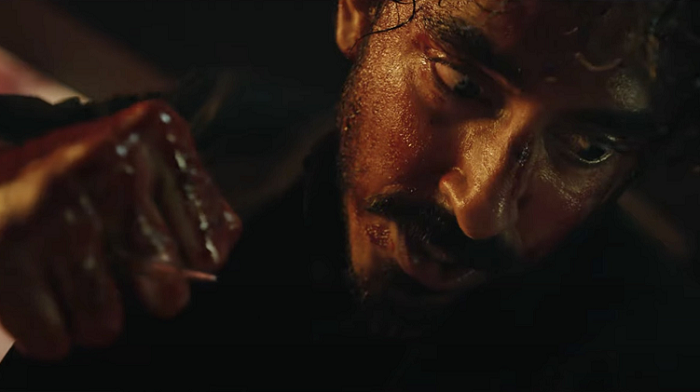
But the movie’s meat and potatoes is the action. Gens keeps things surprisingly subdued for much of the way, content to feed us morsels and leaving us hungry for the main course. You could make a case that he waits a little too long, leaving us wondering when the movie is going to finally let Samir (and Lyes) off his chain. It finally does and it proves to be worth the wait. The fight scenes in the kinetic final act are intensely violent and downright brutal with blood-splattering and bones-cracking galore. Lyes is an absolute force while Gens, DP Gilles Porte, and editor Riwanon Le Beller skillfully frame and shoot the sequences with style and energy.

The final 20 minutes offer up a hard-hitting (literally and figuratively) punctuation mark to a story that has its slow patches but knows how to stick its landing. Gens does a good job unpacking his story while slipping in some not-so-subtle commentary on child abduction and sex trafficking. The film also looks great, shooting on a number of immersive locations. But everything comes back to the action which takes a while to kick into gear. But once it does, Gens puts the pedal down and (again) flexes his prowess as an action filmmaker.

VERDICT – 4 STARS

REVIEW: “Memory” (2023)

The immensely talented duo of Jessica Chastain and Peter Sarsgaard lead the way in “Memory”, the new film from the often provocative yet thoughtful Michel Franco. This engrossing adult drama about two broken souls finds its strength in the transcendent performances of its two leads and in Franco’s resonating script which analyzes the human condition from a perspective we’re not used to seeing in his films.

Chastain plays Sylvia, a single mother and recovering alcoholic. When not working at an adult daycare center or attending AA meetings, she’s raising her daughter Anna (Brooke Timber) the best way she knows how. Sylvia is a loving mother, but overprotective which is a byproduct of her own childhood trauma. It’s a past that still haunts her and has defined so much of her adult life.

The story takes off in earnest after Sylvia agrees to attend a high school reunion with her well-meaning but persistently uncomfortable sister, Olivia (Merritt Wever). As Sylvia sits at a table, alone and detached, an unknown bearded man (Sarsgaard) locks his eyes onto her from across the room. He slowly makes his way to her and takes a seat. His sudden appearance prompts her to grab her coat and hurriedly leave. The man creepily follows her from a distance, first to the subway, and then as she makes the dark walk home.

Franco infuses the scene with mystery. Who is the man? Why is he following her? Why is she so afraid of him? The questions only mount the next morning after Sylvia discovers the man asleep outside of her apartment building. We soon learn the man’s name is Saul Shapiro and he has early stage dementia. Through a series of unlikely circumstances a relationship develops between the two. Sylvia is even hired by Saul’s brother Isaac (Josh Charles) and niece Sara (Elsie Fisher) to sit with him during the day.

As the story progresses we notice some striking parallels between Sylvia and Saul. They went to the same high school and they both are outsiders (in their own ways) within their upper-class families. Yet there’s more to their stories, especially Silvia’s which comes to light after some dark secrets are unearthed. But Franco doesn’t paint every detail or spell out every emotion. Even more, he never caters to our expectations. There are several moments where he lures us in only to flip the script and go in an entirely different direction.

“Memory” wraps up with a moving third act that brings the film’s mature themes to a thoughtful and satisfying place. As with the rest of the movie, it doesn’t take our emotions for granted. Franco does a good job earning our investment and he delivers a touching payoff. He gives his two stars some really good material to work with and has the smarts to let them carry the bulk of the dramatic load. As a result, Chastain and Sarsgaard turn in two of the year’s best performances, cementing Franco’s latest as an exciting and unexpected turn for the notoriously daring filmmaker.

VERDICT – 4 STARS

REVIEW: “Maestro” (2023)

Bradley Cooper directs, co-writes, co-produces, and stars in “Maestro”, Netflix’s new biopic based on the life of American conductor and composer Leonard Bernstein. While the musical artistry of the incredibly talented Bernstein is on display, the movie’s central focus is on his complex and layered marriage to Costa Rican-Chilean actress Felicia Montealegre Bernstein, played with scene-stealing vitality by Carey Mulligan.

Along with Cooper, “Maestro” features a list of producers that includes Steven Spielberg and Martin Scorsese, both of who at different times were considered to direct. But after screening Cooper’s 2018 highly acclaimed box office hit “A Star is Born”, Spielberg handed the actor the reins. As a result, Cooper has made an arresting biography-esque movie that avoids many biopic traps. But in doing so it skimps on some helpful details.

First off “Maestro” works under the assumption that its audience already knows the professional/artistic merit of Leonard Bernstein. In one sense it’s a plus as we’re spared from getting yet another ‘cradle to the grave’ story. But for those lacking at least a working knowledge of Bernstein’s acclaim, it may be difficult latching onto “Maestro”. It’s a creative choice that’s both a strength and a liability depending on how much you know going in.

Image Courtesy of Netflix

But I don’t want to shortchange what Cooper has accomplished. He captivates, both through his acting and in the director’s chair, showing off an extraordinary command of the camera (along with DP Matthew Libatique) and delivering a performance that should garner all kinds of awards season attention. Cooper’s intense commitment propels the movie in a number of ways. But it’s Mulligan who is the film’s true heart and soul.

The movie’s full-color opening takes us to the Bernstein’s Connecticut home where Leonard (more affectionately called Lenny) is giving a television interview. He plays a few aching chords on his piano while lamenting how desperately he misses his late wife Felicia. After a quick shift to striking black-and-white, Cooper transports us back in time to November 14, 1943. On that faithful day a 25-year-old Leonard Bernstein, the assistant conductor of the New York Philharmonic, gets the call to fill in for the orchestra’s ailing lead conductor. The rest is music history.

“Maestro” glazes over Leonard Bernstein the artist, alluding to his renown more than exploring it. People from his professional life routinely pop up with practically no explanation of who they are or what they do. They become nothing more than poorly sketched familiar faces. But Cooper doesn’t completely shelf Bernstein’s gifted artistry. He gives us a handful of revealing scenes, none better than his show-stopping recreation of Bernstein’s conduction of Mahler’s “Resurrection” inside Ely Cathedral. It’s an electric scene with currents of creative energy emanating from Cooper’s every pore.

But those scenes are few. Instead Cooper sets out to show us the Leonard Bernstein beyond the spotlight. The Lenny we see is a man of endless contradictions. His concern for his legacy is only outdone by his intense fear of being alone. And his obvious genius is only matched by his equally evident hedonism. His behind the scenes life was marked by social posturing, affairs with both men and women, and a number of poorly veiled insecurities. Yet Lenny maintained an indomitable spirit and a domineering passion that often clashed with the times he lived in while feeding a nearly insatiable love of self.

Image Courtesy of Netflix

But a stabilizing force comes in the person of actress Felicia Montealegre played with such empathy and resolve by Mulligan. Felicia and Lenny meet in 1946 and there was an instant connection. Driven by their deep yet contradictory love, the two marry and eventually have three children. But over time the long-suffering Felicia finds herself lost in the shadow of her famous husband. Yet she remained devoted despite his overwhelming creative impulses and frequent dalliances with other men. And his dependence on her is such that she becomes the proverbial “woman behind the man”.

Cooper and Singer’s script moves “Maestro” from a love story to a domestic drama and eventually to a full-blown tearjerker. Along the way we’re treated to an assortment of directorial flourishes. Early on Cooper uses black and white and an academy ratio, shooting his scenes in a sumptuous Old Hollywood hue. Later scenes burst with a vibrant Technicolor glow. And it’s all surrounded by an appealing collection of Bernstein’s original music.

There’s so much to appreciate about Bradley Cooper’s “Maestro” yet there remains that one nagging issue. Cooper’s striking portrayal gives us a compelling sketch of Leonard Bernstein. But his artistic achievements are an afterthought. So much so that it feels like a huge chunk of the man is missing. And if you don’t understand his significance going into it, “Maestro” may leave you a little cold. Yet there is still plenty to love in Cooper’s direction, the performances, and the top-notch makeup and costumes. It may not be the most complete portrayal. But it’s a solid enough introduction to a man as layered as his musical compositions.

VERDICT – 3.5 STARS