Talking animal movies aren’t usually my cup of tea. Maybe it’s because I’m in my late 40’s which puts me about 40 years older than the target audience. Yet I can still appreciate movies like “The One and Only Ivan”, a sweet and gentle family film with plenty of heart. It’s a movie with a very old-school Disney vibe which is good for the reasons mentioned above. But it also means we get a pretty formulaic story that doesn’t hold back on the occasional cheese.
Bryan Cranston plays Mack, the ringmaster of a big top animal show located inside of a dried-up shopping mall. The show is headlined by a silverback gorilla named Ivan (soulfully voiced by Sam Rockwell) who Mack adopted as a baby after he was saved from poachers. Other animal acts include a wise pachyderm Stella (Angelina Jolie), a neurotic seal (Mike White), a prissy poodle (Helen Mirren), a rooster with stellar hand-claw coordination (Chaka Khan), and a rabbit who drives a toy firetruck (Ron Funches). And there’s also Ivan’s best friend, a stray dog (Danny DeVito) who sneaks into his pal’s cage at night.

Photo Courtesy of Disney
This is one of those movies where the animals speak to each other in fluent English which the humans never hear. That’s actually not a gripe. Like others before her, director Thea Sharrock does a good job selling it and we viewers have seen enough of these type films to understand the rules. The animals are given a wide range of personalities. Most are fun while a couple border on caricature. And only a handful get meaningful screen time. The others are easy to forget about, only occasionally popping up when the movie needs a group scene.
With the mall steadily losing business to the bigger and more modern Galleria, Mack’s audience size dwindles. Realizing he’s a few sparse crowds away from shutting down, Mack brings in a precocious baby elephant named Ruby (Brooklynn Prince). She becomes the show’s new headliner creating a tinge of jealousy in Ivan. But a young human girl named Julia (Ariana Greenblatt), the daughter of Mack’s handyman, helps Ivan to see himself in Ruby. He determines to help Ruby have the freedom he lost when he was her age.
One of the film’s strengths is found in the human element. Cranston’s Max is hardly a villain. He’s a lonely fellow who genuinely loves his animals despite being impervious to the effects of their captivity. It adds a much more interesting dynamic than if Mack were a hateful, physically abusive brute. That character type has been done many times before.
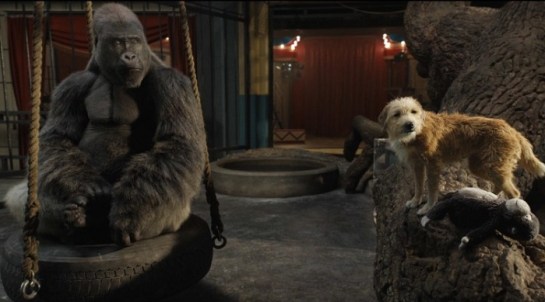
Photo Courtesy of Disney
Other strengths include the excellent GGI and even better voice work that bring the animal characters to life. There is such a soothing, easy-going quality to Rockwell’s voice while Jolie speaks with a sage-like elegance. DeVito’s playful banter is a nice fit while young Prince conveys an irresistible sweetness. They all work together with visual effects supervisor Nick Davis and his team of animators who seamlessly handle the integration of computer-generated characters into a live-action space. We’ve seen it done before, but rarely better than here.
Unfortunately the film isn’t without its flaws. Writer Mike White’s adaptation of K. A. Applegate’s children’s novel starts strong and does a nice job developing its main characters. But the story shows signs of stress especially as it threatens to turn into an animal version of “The Great Escape”. White (thankfully) dials it back and points towards a potentially better finish. Instead we end up with a rushed and on-the-nose final act that’s partially saved by a bittersweet ending which (either intentionally or not) is both happy and heartbreaking. I like interpreting it that way. It makes “The One and Only Ivan” a little more than a run-of-the-mill family drama.
VERDICT – 3 STARS







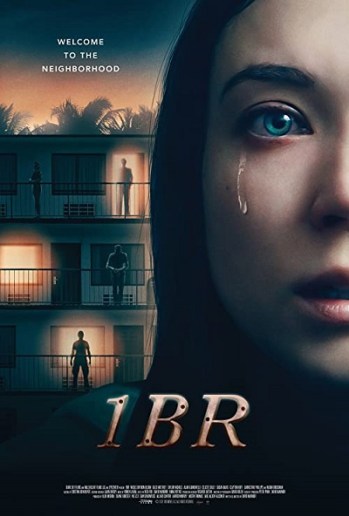 Sarah is a twenty-something aspiring fashion designer whose world is shaken after the death of her mother to cancer. To make matters worse, her estranged father had an affair while his wife was on her deathbed. This drives Sarah to leave home and move across the country to Los Angeles in hopes starting a new life. But I’ve been told finding a good place to stay LA can be tough.