EDFF REVIEW: “Scrap”

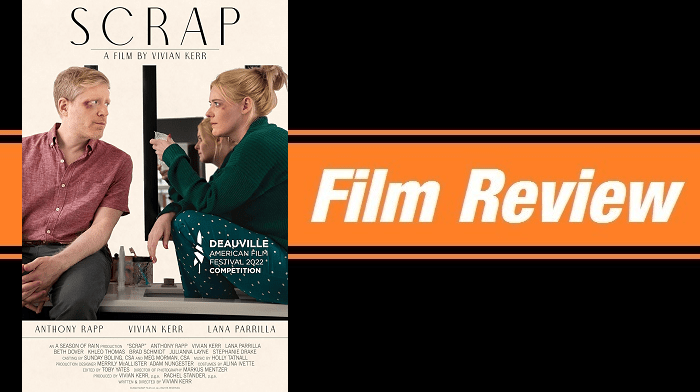
Writer-director Vivian Kerr brought her short film “Scrap” to the El Dorado Film Festival in 2019. In 2022 she adapted it into a feature film and has since been screening it on the festival circuit, winning several awards along the way. Now “Scrap” returns to the EDFF as a thematically rich and emotionally grounded feature-length drama anchored by strong character-driven storytelling and three fantastic performances.

With “Scrap”, Kerr has offered up thoughtful and genuine examinations of a number of resonating themes. Among them are brother-sister relationships, maneuvering through life’s trials, coming to grips with the hand you’ve been dealt, and taking responsibility. At the same time issues of homelessness, single motherhood, infertility, and disillusionment are woven into the fabric of Kerr’s story, all handled honestly and thoughtfully.

In addition to working behind the camera, Kerr also stars in the film, playing a single mother named Beth who was recently laid off from her well-paying corporate job due to downsizing. As a result she has lost her home and now finds herself at a crossroads. In the meantime, Beth’s adorable young daughter, Birdy (Julianna Layne) has been staying with her brother Ben (Anthony Rapp of “Dazed & Confused” and “Rent” fame) and his wife Stacy (a scene stealing Lana Parrilla).

Beth has Ben and Stacy believing that she’s away on business trips. In reality she’s desperately running from one highly sought job interview to the next during the day while spending her nights parked in upscale Los Angeles neighborhoods sleeping in her car. As we watch Beth’s routine, it’s hard to miss the desperation, the heartbreaking moments of shame, and most notably the denial. That last one is the basis for the impressive but crumbling facade she has constructed.

Ben and Stacy suspect something is going on with Beth. But they are having a crisis of their own. They’re a loving and successful couple – she’s an attorney and he’s an author of a popular series of fantasy novels. They have done very well for themselves. Now they’re ready to have a child, but infertility has made it difficult. They have taken treatments, but with every unsuccessful outcome more stress is added to their marriage.

In many ways Ben and Stacy are the antithesis of Beth. They are stable, established, and dependable people. They witness how irresponsible and careless Beth is with her daughter and it frustrates them, especially as a couple desperately wanting a child of their own. This really affects Stacy who has a difficult time hiding her aggravation. It creates a palpable tension between the two women.

Despite her faults, Beth is never portrayed as a bad person. Quite the opposite. She sincerely loves her daughter and wants what’s best for her. But far too often her obsession with reclaiming her former status blinds her to her responsibilities to Birdy. It leads to several bad choices that only make her situation worse. And her unwillingness to be truthful with a genuinely concerned Ben risks alienating the one person willing to help her.

There is some really good brother-sister chemistry between Beth and Ben as seen in the pointed arguments, the warm encouragements, and the playful insults. As more context is given, we begin to see their relationship as more layered and textured. Kerr’s direction is key, but even more crucial are the performances. Though a touch stilted at times, she and Rapp have an organic rapport that sells us on every exchange. Even better is Parrilla who is able to make Stacy the most nuanced and sympathetic character in the film.

“Scrap” is an impressive feature film debut from director, writer, and producer Vivian Kerr. From the very start she shows such good control of the material, throwing in a handful of good laughs and some tender moments while never losing sight of the the more serious slice-of-life drama that gives the movie its punch. It’s a well-paced film, propelled by (mostly) richly developed characters and fleshed out relationships, both of which are critical to the movie’s success. “Scrap” recently screened at the El Dorado Film Festival.

VERDICT – 3.5 STARS

REVIEW: “Suncoast” (2024)

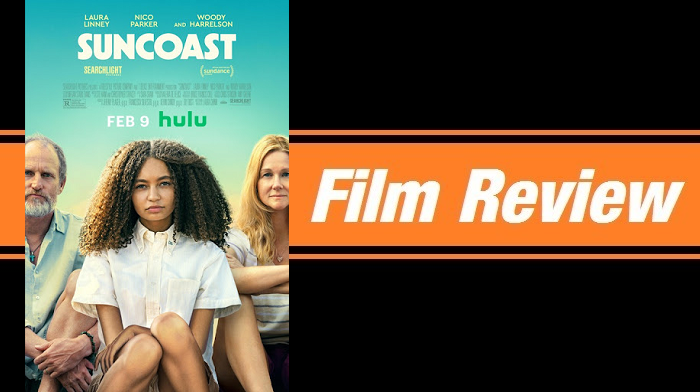
While Sundance Film Festival attendees got an early first look, others won’t have to wait long to see “Suncoast” which is set to premiere on Hulu February 9th. And trust me, it’s a movie you’ll want to see. It’s a semi-autobiographical and deeply personal story from first-time writer-director Laura Chinn. Made in the memory of her own late brother, “Suncoast” is a film certain to resonate with a number of people in a variety of different ways.

Aside from Chinn’s assured direction and her (mostly) absorbing script which is an endearing combination of heart and humor, “Suncoast” thrives thanks to the utterly delightful breakout performance from Nico Parker. The 19-year-old star brings a fresh and nuanced perspective to the coming-of-age drama, navigating a handful of irksome tropes and still relaying an emotional richness and authenticity that often evade movies like this.

Image Courtesy of Sunlight Pictures

Parker plays Doris, a shy and sheepish 17-year-old who spends most of her time helping care for her brother Max (Cree Kawa) who is dying of brain cancer. Ever since her father passed away Doris’ mother, the brash and impertinent Christine (wonderfully played by Laura Linney), has worked long hours to be able to support her family. That’s left Doris to watch over Max, who is immobile and unable to communicate, sacrificing her own teenage experience in the process.

As Max’s health worsens and the end draws closer, Christine admits him into a hospice care center in hopes of making his last days as comfortable as possible. Meanwhile her relationship with her daughter has steadily deteriorated. Regardless of her efforts, nothing Doris does is good enough for her mom. Adding to it, Christine’s preoccupation with Max has led to an unwitting neglect of Doris. Chinn’s measured handling of this mother-daughter tension is crucial. And no matter how hard Christine is on Doris, she’s never presented as a villain. It’s all a byproduct of repressed grief which she refuses to deal with.

At Clearwater Christian High School Doris makes friends with an annoying gaggle of air-headed preppies after offering to host a party at her house while her mom is away. The tired teen antics and shallow drama we get is by far the movie at its weakest. Far more interesting and entertaining is the unexpected friendship that springs up between Doris and a local activist and grieving widower named Paul (a perfectly cast Woody Harrelson). Some of the film’s most organically funny and heartfelt moments are when the two are together.

Image Courtesy of Searchlight Pictures

But the key relationship in the movie remains between Doris and Christine. Linney will have you laughing the hardest with her no-filter directness and quite possibly tearing up the most as she inevitably comes to terms with her grief. Meanwhile Parker delivers such a perfect melding of vulnerability, frustration, and angst. She keenly captures the essence of a teenager forced to grow up too fast yet still yearning for the experience she has missed out on.

Chinn’s affections for her characters comes through in every scene as does her personal connections to key elements of her story. There’s an honesty in her approach and even the most emotionally-charged moments feel truthful. Again, the overly conventional teen stuff get old and can sometimes weigh the movie down. But it doesn’t overshadow the film’s many strengths nor does it take too much away from what is a truly marvelous debut from Laura Chinn. Sign me up for whatever she does next. Premieres February 9th on Hulu.

VERDICT – 4 STARS

REVIEW: “The Settlers” (2023)

In the revisionist Western “The Settlers”, director Felipe Gálvez sits us down in 1901 Tierra del Fuego, Chile during the Selk’nam genocide. That’s when land-hungry sheep ranchers backed by large livestock companies and protected by the Chilean and Argentine governments carried out the systematic extermination of native tribes that populated the area. It was yet another dark and vile stain on human history.

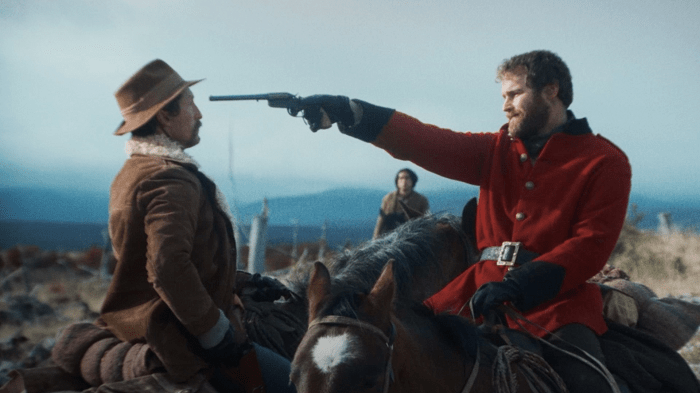
Gálvez begins by introducing us to a young Chilean mestizo named Segundo who is our eyes and ears for much of the harsh and uneasy 90 minutes that follow. Segundo (played with such quiet yet pained intensity by Camilo Arancibia) works in the fields under the cold-hearted Alexander MacLennan (Mark Stanley), a former British lieutenant who is now a foreman for a wealthy rancher named José Menéndez (Alfredo Castro).

Image Courtesy of MUBI

The haughty Menéndez claims that the local indigenous tribe, the Onas, are killing and stealing his sheep. So he sends MacLennan on a lengthy expedition across his land. It’s under the guise of scouting a path for him to safely move his sheep to the Atlantic Ocean. In reality there is something far more sinister behind it – a secret agenda at the heart of the mission.

MacLennan orders Segundo to come along without letting him in on the details of their expedition. They’re joined by Bill (Benjamin Westfall), a ruthless, racist, and borderline cartoonish American mercenary who is Menéndez’s right-hand man. The three head out on horseback across the vast open territory eventually arriving at the base of the snowcappeed Andes Mountains.

Along the journey, Gálvez and his co-screenwriter Antonia Girardi give us a clear sense of who these three men are. This is especially true when the trio happen upon a small camp of Ona. The sheer barbarism at the hands of MacLennan and Bill along with their cold and calloused indifference is hard to stomach. Meanwhile the mostly silent Segundo is horrified by what he witnesses but is too frightened to try and stop it. His feelings of complicity torture him through the rest of the film.

The story is broken down into chapters tagged with ever so slightly pretentious headings like “The King of the White Gold”, “The Half-Blood”, and “The Ends of the Earth”. Yet it gives us a harrowing and unflinching dive into Chile’s colonial past, offering a piercing and fittingly uncomfortable critique. And all to the backdrop of DP Simone D’Arcangelo’s stunning John Ford-esque canvas.

Image Courtesy of MUBI

Gálvez makes a bold choice for the final 30 minutes – a turn that’s both mesmerizing and frustrating. It sees the story suddenly bolt forward seven years. In these scenes an envoy of the Chilean president named Vicuña (Marcelo Alonso) confronts Menéndez about the massacres across his land in an effort to make amends with what remains of the indigenous people. It’s utterly engrossing and ends the movie with a morally repugnant gut-punch. But that jump in time leaves a big gap full of questions that never get satisfying answers.

Even with that conflicting miscalculation, Gálvez has his points to make and he does so by handling his material in a manner that you wouldn’t expect from a first-time filmmaker. He shows a willingness to take risks and makes choices that may not completely work as intended, but that show confidence and vision. And for a movie like this one, that’s the kind of approach that proves to be invaluable.

VERDICT – 4 STARS

REVIEW: “Sunrise” (2024)

I’m an unapologetic Guy Pearce fan. I make no bones about it. I stand by my long held assertion that he is one of the more underrated and undervalued actors working today. Throughout his nearly 35-year career, Pearce has made a name for himself playing an assortment of heroes, drifters, historical figures, and police detectives, just to name a few. And less you forget, he can also play a really good villain.

He gets to go full antagonist in the new film “Sunrise” from director Andrew Baird. While Pearce does a good job portraying a character that you’ll find easy to detest, the movie as a whole isn’t nearly as successful. “Sunrise” is a slow and messy hodgepodge of interesting ideas that never gel into anything worthwhile. The script (penned by Ronan Blaney) has enough ingredients for three or four different movies. But corralling them into one proves to be too much.

Image Courtesy of Lionsgate

The film opens with some title cards telling us about a “sacred” forest demon in the Pacific Northwest. It’s said to have the power to grant eternal life but it be feeds on the blood of its victims to maintain that power. We’re told that animal sacrifices to the demon date back hundreds of years to the First Nations, but over time the sacrifices offered became bigger. As the mythology grew the demon became known as Red Coat.

Now that sounds like an ominous setup to a potentially creepy supernatural horror movie. Well, not exactly. As it turns out, reading those title cards is the scariest thing in “Sunrise” and the ‘demon’ is so poorly developed that it feels like an afterthought. Instead the movie spends its time hopping between genres. Sometimes it plays like a rural crime thriller. Other times it wants to be a thoughtful family drama. One minute you think you’re watching a vampire movie. The next minute you’re getting a heavy-handed critique of the American dream. If only they came together in an entertaining way.

In a small blue-collar town nestled in the mountains, a vile, greedy and unashamedly racist local business named Joe Reynolds (Pearce) has his eye on a patch of land owned by an Asian American man named Loi. In a fit of anger, Reynolds murders Loi for refusing to sign over the land rights. He then has his goons dispose of the body, leaving Loi’s wife Yan (Crystal Yu), son Edward (William Gao), and young daughter Emily (Riley Chung) not knowing what happened to their husband and father.

Three months pass and Reynolds is still pressuring the family to leave town. His numerous threats quickly evolve into violence which Yan stands up to the best she can. But then out of the blue a sickly man named Fallon (Alex Pettyfer) stumbles onto their property in the dead of night, barely able to walk and with labored breathing. Yan decides to take him in and nurse him back to health without much thought at all. Fallon is quiet but seems appreciative. He even runs off one of Reynolds’ goons who tries to stir up trouble.

Image Courtesy of Lionsgate

But there is something weird about Fallon. He’s not into personal hygiene. He actively dodges the sunlight. Oh, and there’s the whole “I need blood” request. All signs seem to indicate that he is a (gulp) vampire. But as with so many other things, the movie doesn’t do much with it. Its attention is quickly diverted elsewhere.

Baird tries to add some backstory and depth through constant flashbacks to ten years earlier. Unfortunately these scenes do more to convolute things that offer any compelling layers or revelation. It’s a shame because there are some good pieces here including the ruggedly immersive setting and a seemingly able cast. But the overstuffed story proves to be too much to manage. And despite its ambition, we’re left with big ideas that never get the attention they need. “Sunrise” opens January 19th in select theaters and on VOD.

VERDICT – 2 STARS

REVIEW: “Society of the Snow” (2023)

On October 13, 1972 a plane carrying an Uruguayan rugby team crashed high in the snow-covered Andes Mountains. Many among the 40 passengers and five crew members were killed instantly. Several more died shortly afterward from the severity of their injuries combined with the bitter cold temperatures. Authorities searched for the wreckage but canceled after eight days. More died from starvation, exposure, and a horrific avalanche. After surviving 72 days, 16 survivors were rescued.

The true story of that ill-fated flight has been brought to screen several times including in Frank Marshall’s 1993 film “Alive” starring a young Ethan Hawke. “Society of the Snow’ from director and co-writer J. A. Bayona is the latest and arguably the best. Appreciators of “Alive” will recognize many of the same touches in Bayona’s film. But “Society of the Snow” expands a bit further beyond the survival element and uses its own thoughtful framing device to offer a fresh and unique perspective that honors both the living and the dead.

Image Courtesy of Netflix

Adapted from journalist Pablo Vierci’s 2009 book of the same name, “Society of the Snow” pulls no punches with Bayona’s focus on realism. His film is uncomfortably yet respectfully authentic, staying true to every horrific detail without ever being sensational or lurid. It makes for a viscerally immersive survival saga. But just as potent as the sensory experience is the simple yet profound message at its core – one about the indomitable human spirit as seen through the steadfast will to live and the sacrifice for those you hold dear.

Bayona tells the majority of his story from the perspective of 24-year-old Numa Turcatti (Enzo Vogrincic Roldán). His voiceover offers some intriguing observations and insight. And later on he poses a haunting question, “Who were we in the mountains?” It’s a difficult, soul-straining consideration that he labors over through much of the film, ultimately answering it the best and only way he knows how.

The depiction of the plane crash itself is brief but intense and not for the faint of heart. It’s a terrifying sequence as the Fairchild FH-227D strikes a mountain, losing both wings and the tail section, and sucking out several helpless passengers. What’s left of the fuselage barrels down an icy mountain at over 200 mph. The gruesome images before it finally comes to a stop will make even the ‘toughest’ viewer wince. But wisely and mercifully, Bayona doesn’t draw it out. The whole thing lasts a couple of minutes tops and then we’re faced with the aftermath.

What follows is a harrowing story of survival that’s as unsettling as it is inspirational. We watch as those who lived through the crash suffer through even more perilous situations – intense sub-zero cold, no food, and the mounting deaths of their friends and family. As days pass hopelessness sets in, leading the weakened and starving group to make a desperate choice. With the inevitability of death lingering, they painfully decide to eat from the dead bodies. It’s a heart-rending turn handled with great empathy. Bayona stays focused on the humanity, showing the group laboring over their options, weighing the spiritual consequences, and bearing the psychological toll.

Image Courtesy of Netflix

Pedro Luque’s striking cinematography is as vital as any other storytelling component. At times he takes your breath away by the sheer beauty of the scenery he captures. Yet he’s able to take those very same images a create feelings of isolation and despair. Just as effective are the intense closeups and tight quartered shots which emphasize the severity of the group’s circumstances.

Bayona’s impressive vision is also helped by the immersive sound design as well as Michael Giacchino’s resonating score. And perhaps most of all by the sublime performances from the mostly unknown Uruguayan and Argentine cast. There are so many crucial ingredients and Bayona uses them to craft what could be considered the definitive telling of this unimaginable true story. And even if you know the real account, “Society of the Snow” will still leave you astonished by the sheer tenacity of the filmmaking and the passion in its storytelling. Premieres January 4th on Netflix.

VERDICT – 4.5 STARS

REVIEW: “Silent Night” (2023)

In the world of action cinema few have left a mark like John Woo. For 55 years the revered filmmaker has put together quite the résumé from his Hong Kong classics such as “The Killer” and “Hard Boiled” to his stateside hits like “Hard Target”, “Broken Arrow”, “Face/Off”, and “Mission: Impossible II”. Woo’s distinct style has been emulated by the likes of Quentin Tarantino, Robert Rodriguez, and Michael Bay. And his influence can be seen in everything from “The Matrix” to the John Wick films.

After a lengthy hiatus, the legendary 77-year-old auteur is back with “Silent Night”. It’s Woo’s first American feature film in twenty years but fans shouldn’t worry. His signature aesthetic is once again on bold display in this blistering action thriller shrewdly built around a mostly dialogue-free script. That’s quite a challenge, but screenwriter Robert Archer Lynn has crafted a smart and sturdy framework. From there, Woo handles the rest, delivering on everything you would expect from a film with his name stamped on it.

The movie is led by a perfectly cast Joel Kinnaman who can effortlessly emit intensity like few others. He plays Brian Godlock and Woo wastes no time revealing the tragedy that will drive his damaged protagonist throughout the story. Within the opening few minutes Brian and his wife Saya (an excellent Catalina Sandino Moreno) have their happy lives suddenly and irreparably shattered.

Image Courtesy of Lionsgate

On Christmas Eve while playing with their young son Taylor in their front yard, a stray bullet from a gunfight between two warring street gangs hits Taylor and kills him. An enraged Brian chases the thugs down only to be shot in the throat and left for dead by their vicious leader (Harold Torres). Brian survives and eventually recovers physically, but he can no longer speak. On top of that, once home from the hospital he’s forced to face the painful reality that his beloved son is gone.

First Brian goes into mourning, cutting himself off from his wife while attempting to drown his sorrow in booze. But when that doesn’t work his sadness turns into rage, sending him on a bullet-riddled and blood-drenched quest for revenge. Brian decides to hunt down and kill the gangbangers responsible for his boy’s death. He gives himself nearly a year to plan, prepare and train, marking Christmas Eve as the day he will avenge the killing of his son.

As with so many of his past films, Woo puts a lot of effort into setting up the big action. Pacing has always been key to his approach and here Woo steadily ratchets up our anticipation, building towards the story’s inevitable ultra-violent crescendo. From there it’s vintage Woo as our silent protagonist unleashes his pain through a number of fierce and kinetic set pieces. They include wild car chases, brutal fight scenes, and incredibly choreographed shootouts that are almost operatic in their design.

Image Courtesy of Lionsgate

As you watch these spectacular scenes play out, Woo’s trademark style can be seen everywhere. From techniques such as his frequent use of slow-motion and shooting single scenes from multiple angles, to staples such as duel-wielding handguns, Mexican standoffs, and his symbolic use of birds. Once it kicks into gear the action is non-stop. It’s brutality is matched by its artistry. Yet it’s undergirded by a surprising amount of heart and humanity.

While’s Woo’s craftsmanship is clearly a draw, Kinnaman proves to be an essential ingredient. His ability to channel pain and vulnerability adds pathos while his physicality combined with a palpable fury energizes the action. And amazingly it’s all conveyed with no dialogue whatsoever. Moreno is great in her small but meaningful role, and an underused Scott “Kid Cudi” Mescudi is solid (with what little he’s given) as a local police detective. But Kinnaman is the force who bring’s Woo’s vision to life.

“Silent Night” advertises itself as an alternative holiday movie of sorts with its witty title and killer trailer that utilized all kinds of Christmas motifs. But deep down it’s a visceral no-nonsense revenge thriller with a clever twist made by a filmmaker who once helped revolutionize a genre. “Silent Night” may not have the kind of landscape altering impact of Woo’s more celebrated films, but it’s a firm (and thoroughly entertaining) reminder of why he is rightly lauded as a legend of action cinema.

VERDICT – 4 STARS