REVIEW: “Saltburn” (2023)

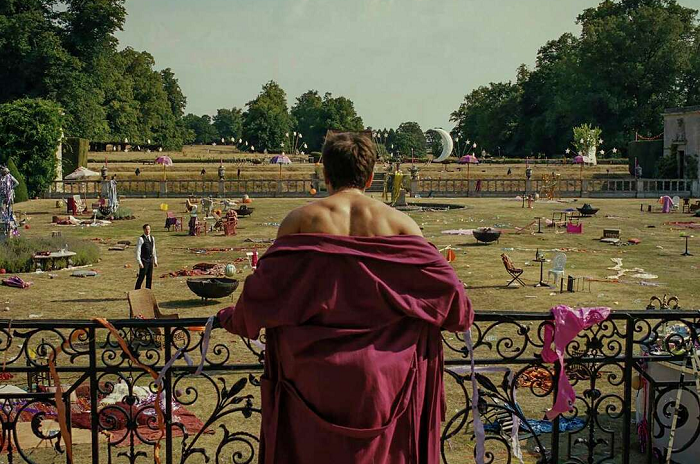
We get yet another takedown of the rich and privileged in Emerald Fennell’s proudly smutty satire “Saltburn”. Excoriating the wealthy on the big screen has almost become old hat. But that hasn’t stopped filmmakers from beating that familiar drum, often to their own tunes. In “Saltburn” Fennell’s tune is more of an obnoxious drone – a persistent clamor of shallow, uninspired revelry and shock value hiding behind a beautifully shot veneer.

Fennell’s 2020 feature film debut “Promising Young Woman” was a sassy and sharp-edged thriller that had something to say. It was gutsy, provocative, and timely, taking on warped views of masculinity with its fists clenched and a twinkle in its eye. “Saltburn” is quite the opposite. It’s a mostly rhythmless confection that’s obsessed with its own coolness and edginess. Its intentions are rarely a mystery and its salacious swings at provocation offer little more than smug and hollow commentary at best.

Image Courtesy of Amazon MGM Studios

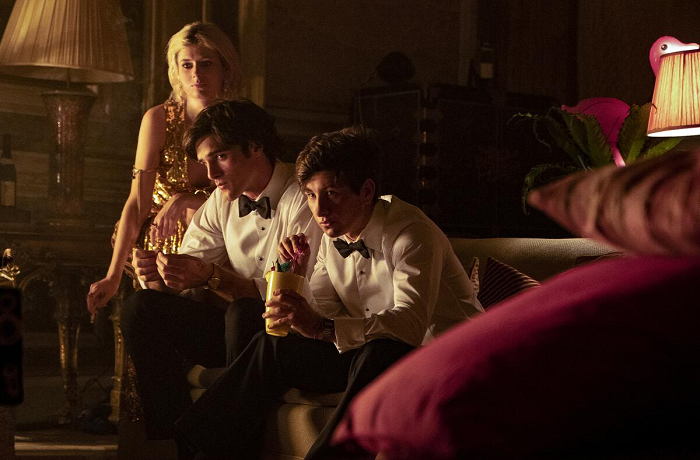
Fennell certainly has the star power starting with her Oscar-nominated lead, Barry Keoghan. He plays Oliver Quick, a studious outcast in his first year at Oxford University. It doesn’t take long for the quiet and unassuming Oliver to earn our sympathies, especially after we hear that he’s an only child and is estranged from his parents due to their mental health and addiction issues. But we feel for him even more after he becomes enamored with the hunky, popular, and extremely wealthy Felix Catton (Jacob Elordi).

The two meet after Oliver helps Felix out of a jam. Oliver desperately wants into Felix’s upper-class social circle. Felix seems sympathetic, especially after Oliver gets word that his father has died. The two form a friendship although the depth of it is never really clear (well, maybe in the final 15 minutes). As finals approach Felix makes a rather spontaneous gesture. He invites Oliver to spend the summer with him and his family at their lavish estate called Saltburn.

Things are going pretty good up to this point. But from the moment Felix introduces Oliver to his family at Saltburn, Fennell begins losing her grip. Her story turns out to be pretty barebones and basic but surprisingly ends up woefully underserved. That’s because Fennell loses her creative self within this glaringly phony world of debauchery and opulence. As a result, things like narrative structure, story progression, and character development get tossed aside for warped and edgier grasps for attention.

Among the casualties of Fennell’s overcooked hankering to push the envelope are the characters themselves. Take Felix’s aristocratic family: his wild-haired father Sir James Catton (Richard E. Grant), his oblivious mother Lady Elsbeth (Rosamund Pike), his indolent sister Venetia (Alison Oliver), and his freeloading cousin Farleigh (Archie Madekwe). In a way each of them serve their purpose. But they’re little more than disposable playthings for Fennell to toy around with and disregard. And none of them ever grow beyond what we initially learn of them. Felix – spoiled beyond his own comprehension but with a heart of gold – is easily the most compelling.

Image Courtesy of Amazon MGM Studios

As for Keoghan, he certainly commits to Fennell’s twisted vision. The Irish actor is no stranger to playing off-center characters who sheepishly skulk around on the periphery. But here the material is so lacking that his eventual transformation from meek and nebbish into something more devious and depraved is a hard sell. This is especially true in the final act where Fennell rushes to bring Oliver’s story to some kind of credible conclusion. But it’s so lazy and outlandish. Even worse, Fennell spoon-feeds us every single answer, leaving nothing for the imagination.

The movie ends with an eye-rolling, self-indulgent final sequence that’s a perfect encapsulation of everything wrong with “Saltburn”. It’s a doltish and pointless finish that reveals a filmmaker more infatuated with kinky excesses than satisfying storytelling. And that’s a shame because we get teases of a better movie. And Fennell’s shrewdness with the camera is undeniable. But that’s nowhere near enough to save this narcissistic poster child for style over substance. “Saltburn” is now showing in select theaters.

VERDICT – 1.5 STARS

RETRO REVIEW: “The Stone Killer” (1973)

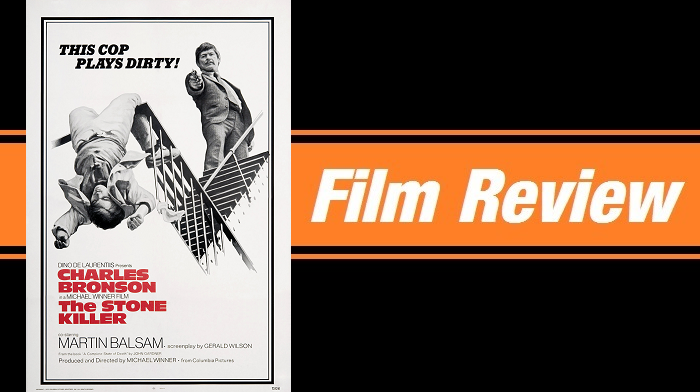
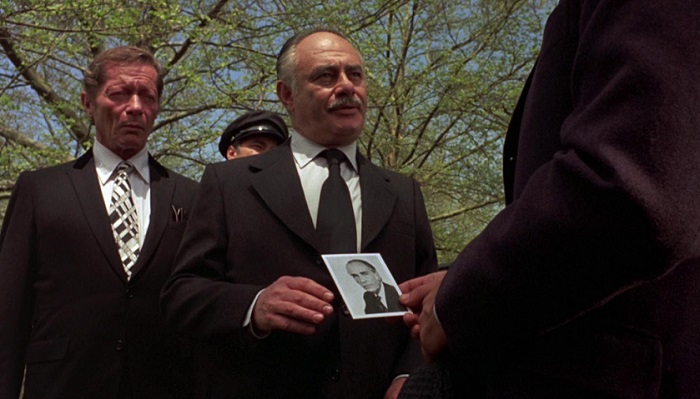
With any discussion on the best movies of Charles Bronson’s career it’s likely that many of the same titles will pop up: “Once Upon a Time in the West”, “The Magnificent Seven”, “The Great Escape”, “The Dirty Dozen”, “Death Wish”. I’m doubting that “The Stone Killer” gets mentioned much in those conversations. But what can I say, after 50 years it remains one of my favorites out of Bronson’s many crime genre forays.

“The Stone Killer” was one of six Bronson collaborations with director Michael Winner. It fell in between 1972’s “The Mechanic” and 1974’s “Death Wish”. Written for the screen by Gerald Wilson, the film is a loose adaptation of John Gardner’s 1969 novel “A Complete State of Death”. It’s one of several notably violent cop movies that came in the wake of the successful “Dirty Harry”. But this isn’t just another clone of that popular Clint Eastwood vehicle. If anything, it more closely resembles the poliziotteschi subgenre of crime movies that were popular in Italy at the time.

Image Courtesy of Columbia Pictures

In Spanish Harlem, an 18-year-old is wanted for shooting and wounding a police officer during a liquor store robbery. He runs into an old apartment building as police officers gather outside. Detective Lou Torrey (Bronson) arrives and immediately goes in after him, chasing the suspect upstairs and out on a fire escape. The young man pulls a gun and Torrey shoots him dead. We’re quickly told that it’s the third teenager shot and killed by the New York Police Department in four weeks. This latest death leads to the Mayor receiving a flood of new complaints from angry citizens.

Quickly branded a “gun-happy cop” by the local media, Lou is forced to turn in his gun and badge. Frustrated with it all, he leaves New York and heads to Los Angeles where he takes an LAPD detective position offered by his old friend and new captain Les Daniels (Norman Fell). Paired with a racist partner named Mathews (Ralph Waite), Lou nabs a drug peddler named Armitage (Eddie Firestone) who’s wanted on a murder charge in New York. Lou is tasked with escorting Armitage back to New York to stand trial. But after arriving, Armitage is gunned down in the airport parking lot by a drive-by shooter.

As Lou starts investigating Armitage’s murder he finds clues pointing to it being a mob hit. Meanwhile, a New York mafia boss named Al Vescari (Martin Balsam) begins planning an ambitious serious of assassinations. His targets are fellow dons across the nation. It’s his long-awaited revenge for “The Night of Sicilian Vespers” – a mythologized mass killing of mob bosses orchestrated by Charles “Lucky” Luciano in 1931. Needless to say Don Vescari holds a grudge.

Don Vescari’s grand plan involves hiring Vietnam vets to carry out the killings rather than the using mob guys (hence the movie’s title). Lou begins connecting dots leading to a combustible third act where the mystery and police procedural elements give way to more action. Winner let’s loose with a couple of well executed set pieces that fit right in Bronson’s wheelhouse. It all leads to a fitting payoff that’s more than your predictable run-of-the-mill finish.

Image Courtesy of Columbia Pictures

There are several great faces scattered throughout the movie and you can’t help but make some fun connections. Among the best is seeing John Ritter in an early role. He and Norman Fell were only a few years away from starring together in the extremely popular sitcom “Three’s Company”. And it’s a hoot seeing Ralph Waite, the righteous patriarch in the wholesome family series “The Waltons” play such a despicable louse.

But Bronson is the clear star of the show. While “The Stone Killer” doesn’t get much attention when it comes to his movies, he delivers a strong and well-rounded performance. Both Winner’s direction and Wilson’s script gives the tough-as-leather Bronson material that feeds his strengths. He doesn’t have a ton of dialogue, but he doesn’t need it either. Bronson has always been an actor who can carry a movie with his formidable presence. That’s certainly the case here.

VERDICT – 4 STARS

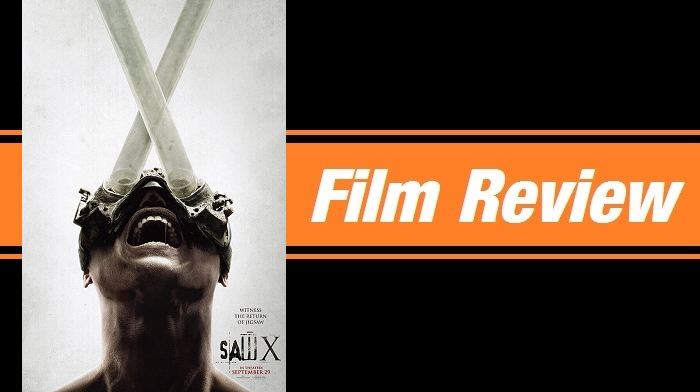
REVIEW: “Saw X” (2023)

Full disclosure: I have no vested interest in the Saw franchise. I haven’t seen all the movies so I can’t tell you how the tenth installment, “Saw X” stacks up against the previous films. But I’ve seen enough of them to know what’s going on. And despite not liking the 2021 spin-off “Spiral”, the trailer for “Saw X” was enough to convince me to give it a shot. Color me surprised.

Regardless of my own personal history with it, the Saw series clearly has a following. It has grossed over $1 billion at the box office and usually against relatively modest production budgets. It’s no wonder Lionsgate has kept the franchise going.

Image Courtesy of Lionsgate

Director Kevin Greutert (“Saw VI” and “Saw 3D”) returns to helm the latest which is said to be a direct sequel to the original 2004 “Saw” and a prequel to 2005’s “Saw II”. Tobin Bell (now 81-years-old) is back as John Kramer, the ruthlessly principled killer known as “Jigsaw”. I’m not well versed enough to fully understand how this fits in the Saw timeline, but the movie opens with John Kramer finding out he has terminal brain cancer. John struggles with his grim prognosis and even joins a cancer support group to help him cope.

John learns about The Pederson Project, a radical experimental cancer treatment in Norway developed by Dr. Finn Pederson. It touts a success rate of over 90% but the doctor has been forced into hiding by the big drug companies. John reaches out and is contacted big the doctor’s daughter Cecilia (Synnøve Macody Lund). She’s taking her father’s treatment on the road for trials and schedules John for a procedure in Mexico City for a small fee of $250,000.

Unexpectedly, a large chunk of the film plays like a thoughtful drama, following John as he’s forced to reckon with his fate and later as he finds hope after thinking all was lost. Not only does this add some interesting layers to the John Kramer character, but it offers Tobin Bell a chance to extend himself as an actor. He gives a subtly rich performance with some surprising emotional depth.

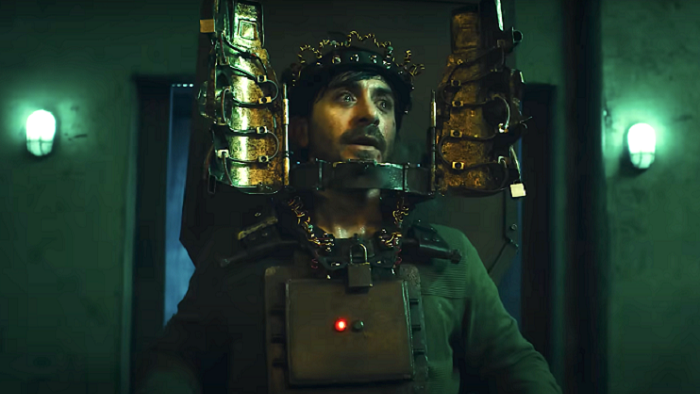
But don’t worry Saw fans, Greutert and co-writers Peter Goldfinger and Josh Stolberg know what you come to a Saw movie for. I won’t spoil how, but John’s new lease on life is shattered after he finds himself the victim of a heartless con (boy did they pick the wrong guy). With the help of his young apprentice Amanda Young (Shawnee Smith), John begins rounding up everyone involved and forcing them to play a new round of cleverly designed and gruesomely gory games.

Image Courtesy of Lionsgate

“Saw X” runs a little long and it has a few slow patches. But Greutert and company tell a tight and well-structured story built firmly around a riveting Tobin Bell performance. He’s grizzled and pitiless; still driven by his warped moral code. Yet he also brings a human pulse to both John Kramer and the movie as a whole. Bell is crucial to the film’s success.

But again, franchise die-hards need not worry. Greutert still delivers the gag-worthy gore they demand including what might be the craziest scene involving a pile of intestines you’ll ever see on screen (sorry, I couldn’t resist mentioning it). It’s still very much a Saw movie although one that makes a little more sense of the bloody carnage and chaos the franchise is known for. And that makes “Saw X” a welcomed surprise. “Saw X” is in theaters now.

VERDICT – 3.5 STARS

REVIEW: “Simulant” (2023)

Having a cracking concept can be a hard thing to live up to. Case in point – “Simulant”, a science-fiction thriller built around a slightly familiar yet generally intriguing premise. It’s an entertaining enough feature film, but one that has a tough time maintaining the kind of energy and tension it wants. Not all of its pieces fit together and it lacks a few key ingredients to make it stand out. Still, a solid cast and an impressive production value help overcome its handful of noticeable limitations.

Director April Mullen, working from a script by Ryan Christopher Churchill, does a good job creating and developing a not-so-distant future where technology has advanced but humanity’s fallibility still leaves its mark. It’s a world where humans co-exist with humanoid creations called simulants. The early generation models are obviously synthetic and are relegated to mere service work. But the newer models as so realistic they’re virtually indistinguishable from humans.

Concerned over a growing autonomy among the newer model simulants, ACE (Artificial-Intelligence Compliance Enforcement) was formed to ensure simulants followed their programming (mainly to never harm humans and to obey their human owners). Among ACE’s most dogged agents is Kessler (Sam Worthington) who is driven by a personal tragedy to prove that simulants are ignoring their programming and pose a serious threat. He believes a simulant named Esmé (Alicia Sanz) and her relationship with the mysterious Casey (Simu Liu) is key to uncovering the truth.

Meanwhile a wealthy artist named Faye (Jordana Brewster) and her dutiful husband Evan (Robbie Amell) live a comfortable and seemingly loving life together. But they have a not-so-well-concealed secret (revealed within the first 30 minutes) that eventually connects them with Casey and Kessler. From there the story slowly morphs into a somewhat lukewarm mystery that opens up some interesting questions without ever offering any thought-provoking answers.

Yet Mullen and Churchill keep their audience involved even if the rather ambiguous payoff doesn’t exactly blow our socks off. There are some crafty ideas and even occasional glimmers of brilliance. But it shows its cards early and everything afterwards plays out pretty much the way we expect. Even worse, the stakes never feel as high as they’re meant to. So even though the movie does a good job holding our attention, we never feel the gravity of anything. That’s the biggest weight holding this solid but underwhelming effort down. “Simulant” is now available on VOD and streaming on Hulu.

VERDICT – 2.5 STARS

REVIEW: “Slotherhouse” (2023)

It should go without saying, but with a title like “Slotherhouse” audiences should know exactly what kind of movie they’re in for. The filmmakers aren’t hiding anything. They’re giddily conscious of the kind of movie they’re making. And it’s that brazen (and utterly delightful) self-awareness that makes this unapologetically silly horror-comedy work way more than it should.

Directed by Matthew Goodhue and written for the screen by Bradley Fowler, “Slotherhouse” brings back memories from the 1980s when perusing the sizable horror section at our local video rental store became a weekly ritual. The colorful VHS boxes for countless B-movie horror flicks just like “Slotherhouse” lined the shelves and I can’t tell you how many I watched (some multiple times over). So there’s a natural draw that makes movies like this hard for me to resist.

“Slotherhouse” borrows from all kinds of movies from the horror and teen comedy genres and it does so with a twinkle in its eye. One of the things that makes it so funny is that everyone plays it straight which actually makes the film’s utterly bonkers premise stand out even more. Think about it – a killer sloth carving up college girls at a sorority house pretty much speaks for itself.

Image Courtesy of Gravitas Ventures

Whether they’re attacked by natural predators or hunted by human invaders, life can be tough for the notoriously slow-moving and easy-going tree sloths in the rain forests of Panama. Take the one we see in the opening scene (a hilariously obvious puppet that coos like a human baby). She’s minding her own business in her natural habitat before being tranquilized and nabbed by a poacher. She ends up in the hands of a slimy trader (Stefan Kapicic) who illegally buys and sells wild animals in the United States. But here’s the thing, this isn’t your run-of-the-mill tree sloth.

Meanwhile Emily (Lisa Ambalavanar) and her best friend Madison (Olivia Rouyre) are preparing for their senior year at college. But rather than thinking about classes, graduation, and her future, Emily is more concerned with her pitiful social media follower count and with impressing her sorority sisters. Soon she’s butting heads with the popular and profoundly obnoxious Brianna (Sydney Craven), the resident mean girl with a gaggle of acolytes who do her bidding.

I’ll skip the details, but Emily’s obsession with being popular leads to her “acquiring” the sloth, naming it Alpha, and introducing it as the new sorority house mascot. What could possibly wrong? Well for starters, remember that bit about this not being your run-of-the-mill sloth? That’s something the girls of Sigma Lambda Theta violently and often hilariously learn that the hard way.

Image Courtesy of Gravitas Ventures

To no surprise there are numerous things in the story that make no sense at all. Characters routinely make dumb choices, gaping plot holes abound, obvious questions never get answered. But to be fair, measuring the logic of a movie like this seems utterly pointless. And that gets to the comedy side. A big part of the fun I had with “Slotherhouse” was laughing at these glaring “issues”. The filmmakers know what they’re doing and getting that kind of audience interaction is exactly what they want.

All of that said, “Slotherhouse” does have its faults which no amount of over-the-top absurdity can cover. While there is plenty of fun to be found throughout the movie, it has to really stretch itself to fill 93 minutes. It ends up spending too much time on sorority girl drama which frankly isn’t that interesting. Also (and I don’t say this often) the movie is hampered by its PG-13 rating. So much of the potentially good stuff happens off screen. I can only imagine how ridiculously gonzo this thing could have gotten if the film had really went for it.

Yet I sit her typing this review with a smile on my face, remembered the incredibly silly and laugh-out-loud moments scattered all throughout this truly wacky concoction. Goodhue and Fowler definitely succeed in putting together a preposterous genre cocktail, custom-made for a late-night viewing in a dark theater with an all-in crowd. It makes for a pretty good evening at home on the couch as well. “Slotherhouse” opens September 19th in select theaters and on VOD.

VERDICT – 3 STARS

30 Years Later: “Schindler’s List”

Filmmakers have looked at the Jewish Holocaust from a variety of angles. Different films that examined it through the eyes of children. Some have focused on specific regions. Others have highlighted individuals who went to great lengths to help the Jews. A well done movie on the subject always has a strong effect on me. Not solely because of the horrific events or troubling images recreated on screen. It’s the fact that they deal with a very real and devastating time in human history. The Nazi slaughter of six million Jews marks one of the world’s darkest times. But it’s also a period that should never be forgotten and thoughtful movies can help ensure that we remember.

Several movies have done a superb job responsibly depicting the Holocaust. Among the very best is Steven Spielberg’s “Schindler’s List”. Released 30 years ago, it has had the strongest impact on me personally. I recently revisited the film after putting it off for many years. That’s because it’s not an easy movie to watch. It features some of the most realistic and graphic depictions of Nazi violence towards Jews and doesn’t shy away from presenting it in crushing detail. From their initial relocation to Krakow’s Jewish Ghetto to their brutal and deadly time spent in the Nazi extermination camps, we see the Jews experience cruelty and brutality made all the more disturbing by its roots in reality.

Image Courtesy of Universal Pictures

The Jewish plight is brilliantly and cleverly realized through the true story of Oskar Schindler. Schindler (brilliantly played by Liam Neeson) is a German businessman who arrives in occupied Krakow in hopes of making a load of money exploiting the war. At first Schindler is a self-absorbed, money-hungry man who quickly finds acceptance by kissing up to an assortment of high-ranking German SS officers. Through bribes and his Nazi Party membership, Schindler obtains several contracts to make metal pots and pans for the German soldiers in the field.

To secure even more money for himself Schindler brings in a Jewish workforce whose labor is considerably cheaper than the local Catholic Poles. To keep his fledgling company up and going he hires Itzhak Stern (Ben Kingsley), an accomplished Jewish accountant and highly regarded member of the Jewish community. It’s through this key relationship that Schindler’s perceptions begin to change.

Coinciding with the arrival of SS Officer Amon Goeth (a truly sinister Ralph Fiennes) to the Plaszow concentration camp, the Germans raid and empty the Krakow Ghetto, slaughtering hundreds of Jews in the streets and shipping the rest to the camp. As Schindler witnesses the atrocities he’s deeply troubled and an internal conflict forms between his desire for a money-making business and his growing affection for his Jewish workers. He’s tempted to take his money and leave the city. Instead he sets out to use his fortune to save his workers and as many other Jews as he can. But to do so he’ll have to get close to high-ranking Nazi’s like Goeth which is no easy task.

Image Courtesy of Universal Pictures

The story of Oskar Schindler and his personal transformation is quite powerful. Neeson’s Schindler is a confident and looming opportunist. Even Spielberg’s camera makes him stand head and shoulders above so many of the people he encounters. Particularly stirring is the relationship between Schindler and Stern. Initially the two are strictly business with neither liking or trusting the other. But as mentioned it’s their growing friendship that plays a pivotal role in Schindler’s transformation. Neeson and Kingsley are terrific together.

Then there’s Fiennes and his stunning work as Goeth, a sick and twisted personification of evil. While Schindler finds ways to manipulate Goeth, his inherent wickedness is ever-present and manifested through some of the movie’s more disturbing scenes. What makes the character more terrifying is that Spielberg doesn’t stray too far away in his portrayal of the real Amon Goeth. He was a sadistic cold-hearted murderer who is killed countless Jews himself, not counting the thousands he ordered to be executed. Several scenes emphasize Goeth’s savage tendencies including his sick penchant for sniping Jewish workers from the terrace of his château overlooking the camp.

Image Courtesy of Universal Pictures

“Schindler’s List” was a technical achievement. Spielberg’s choice to shoot in black-and-white along with the hand-held camerawork and strategically set wide-angled shots adds to the authenticity and at times has a near documentary feel. The movie is also helped by being filmed on or near the locations of the actual events. Spielberg’s desire for realism really pays off and the locations were a big part of it. But that same desire for realism also made filming difficult for the director. It’s been said he cried repeatedly during the filming and there were certain scenes he literally couldn’t watch.

“Schindler’s List” is a great movie yet understandably hard to watch. It’s disturbing and emotionally draining. But it’s also a film of immense power and deep sincerity. It’s a visually stunning work that forces us to deal these horrific historical events. It’s also a story of a man’s incredible transformation. The movie has stood the test of time in large part thanks to Spielberg’s personal connection. It seeps into every facet of the film, moving us, informing us, and reminding us of a time we should never forget and of events we should never repeat.

VERDICT – 5 STARS