REVIEW: “Sonic the Hedgehog 2” (2022)

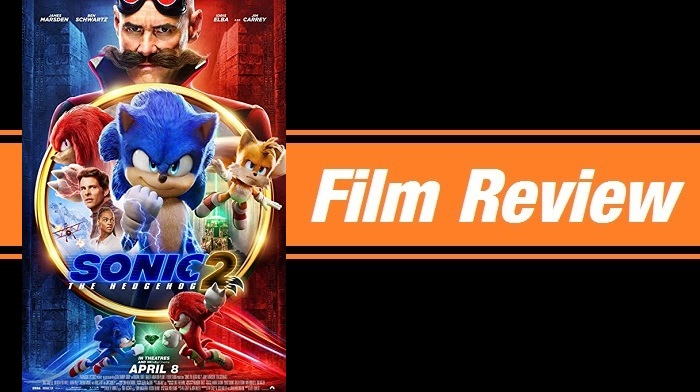
“Sonic the Hedgehog” surprised a lot of people in 2020 in terms of both quality and box office numbers. Based on the classic SEGA video game platformer, the movie had its flaws. But overall it was a fun and often funny family feature that earned nearly $320 million. A sequel was all but guaranteed and we got it earlier this year. As of today, “Sonic the Hedgehog 2” has earned just over $400 million and now it’s available to stream on Paramount+.

Back is director Jeff Fowler along with screenwriters Pat Casey and Josh Miller (they’re joined this time by John Whittington). Also returning is Ben Schwartz voicing the blue anthropomorphic hedgehog with lightning speed, James Marsden as small-town sheriff and Sonic’s adoptive father Tom Wachowski, and Jim Carrey, reprising his role as mad scientist Dr. Robotnik. The sequel includes a few more familiar faces (and voices) and a couple of new ones as well.

Despite mostly enjoying the first film, I wasn’t in a hurry to see “Sonic 2” (as evident by this late review). Call it lukewarm expectations. But to my surprise, the sequel turned out to be an entertaining romp and better than the first film in several areas. It doesn’t quite utilize its biggest strength (Carrey) the same way its predecessor did, but it has a few cool additions that brings new energy to the series.

Image Courtesy of Paramount Pictures

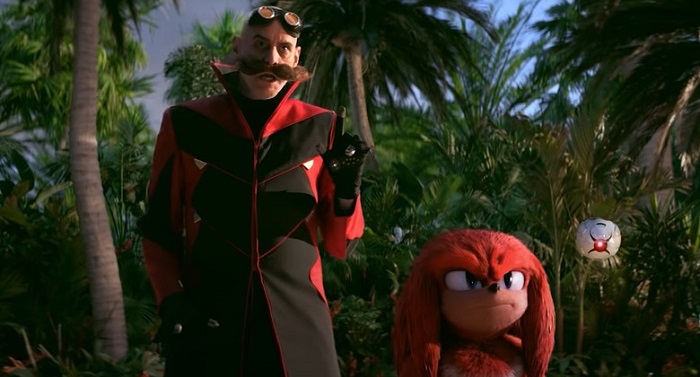
The movie opens with the delightfully maniacal Dr. Robotnik marooned on The Mushroom planet (see the first movie or check out its Wiki) and plotting his revenge against Sonic. Of course first he’ll need to find a way off the world. He uses what tech he can salvage from his crashed hovercraft and the energy from one of Sonic’s quills (again, see the previous film) and sends out an intergalactic pulse. It attracts the attention of Knuckles (voiced by none other than Idris Elba), a red echidna warrior endowed with super strength. He turns out to be Robotnik‘s ticket off the planet.

Meanwhile on earth, Sonic is overanxious to put his powers to use, even not-so-secretly posing as a superhero he calls Blue Justice. But his guardian Tom pleads with him to be patient telling him that his time to be a hero will come. As it turns out Sonic doesn’t have to wait long.

While Tom and his wife Maddie (Tika Sumpter) are attending a wedding in Hawaii, Robotnik and Knuckles arrive on earth. The honor-bound Knuckles, the last of his tribe, is after a powerful relic called the Master Emerald which grants its possessor the ability to turn thought into reality (Think of it as the “Sonic” franchise’s Infinity Gauntlet). Knuckles wants to honor his extinct tribe’s role as the relic’s protectors. Of course the diabolical Robotnik has far more sinister intentions. But watching from a distance is a flying two-tailed fox appropriately named Tails (voiced by Colleen O’Shaughnessey) who has arrived on earth to warn Sonic of the looming threat.

Much like the first film, “Sonic 2” is as much a lighthearted comedy as it is a frolicsome action-adventure. It has plenty of funny bits, the best coming from Carrey who owns every goofy scene he’s in. But we also get some good laughs from Natasha Rothwell playing Maddie’s sister who hates Tom, and Lee Majdoub who plays Robotnik’s loyal servant Stone. They’re just some of the characters who fill out the story, most of whom are entertaining and fit well within the world.

Image Courtesy of Paramount Pictures

But what I like most (and what separates it from so many of today’s animated features) is that the action never reaches an assaultive fever pitch. There’s plenty of it, but Fowler doesn’t go for the sensory overload. There some really good digital effects work and the blend of live-action and animation is practically seamless. And while I won’t spoil the climactic battle, I love how it took inspiration from certain Japanese Toho films.

Speaking of inspiration, “Sonic 2” features countless other nods to movies and pop culture. “Cast Away”, the “Indiana Jones” films, “Army of Darkness”, and “Poltergeist” just to name a few. There’s even a gag referencing the Vin Diesel and Dwayne Johnson feud. Toss in some good themes of friendship, responsibility, forgiveness, and family and you have a movie that will resonate in several ways with kids and adults.

Now I don’t want to oversell it. There are some lazy gags (will we ever get away from the fart jokes?) and certain segments of the story don’t really feel necessary. And the two-hour runtime may wear some viewers out. But I can’t lie, “Sonic the Hedgehog 2” surprised me. I had fun with the characters, was impressed by the visuals, and enjoyed all the winks to other movies and genres. And perhaps most surprising – I’d be up for a third film. Just one request – more Jim Carrey please. “Sonic the Hedgehog 2” is available on VOD and is streaming on Paramount+.

VERDICT – 3.5 STARS

REVIEW: “Spiderhead” (2022)

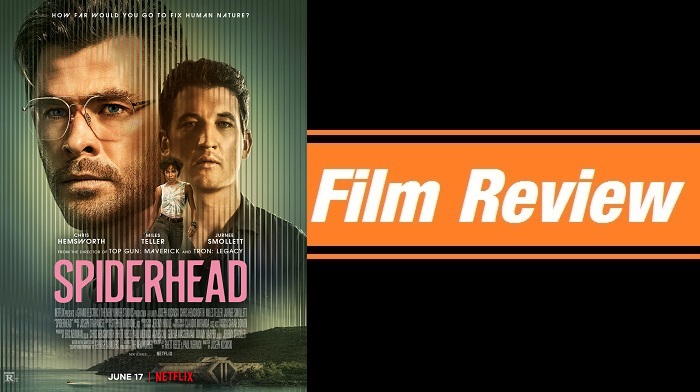
Chris Hemsworth sheds his golden God of Thunder locks and takes on the role of a mad scientist (of sorts) in the new Netflix thriller “Spiderhead”. The film re-teams actor Miles Teller and director Joseph Kosinski who are both fresh off of the biggest box office hit of the year so far, “Top Gun: Maverick”. Based on the George Saunders short story “Escape From Spiderhead”, the film adaptation opens up with a thought-provoking setup. Sadly, it’s mostly undone by a movie that ultimately has nothing to say.

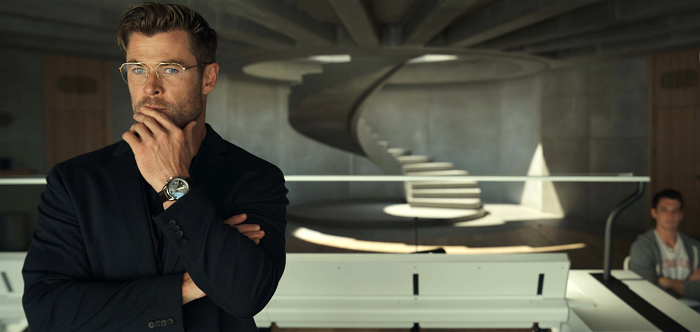
Again, things start promising. Hemsworth plays Steve Abnesti, a dapper and charismatic scientist/prison warden for the state-of-the-art Spiderhead penitentiary. But this is no ordinary prison. The remote complex is also a research facility where clinical trials take place on prisoners who have volunteered to be human lab rats. In exchange, they get lesser sentences along with a semblance of freedom they wouldn’t normally get. They have their own rooms, they can move about without strict supervision, and they get finely cooked meals.

Image Courtesy of Netflix

The first head-scratcher for me was the absence of prison guards. I mean there are literally no guards with the exceptions of two guys in pull-over polo shirts who pop up from time to time. Otherwise, it’s just Steve and his apprehensive assistant, Mark (Mark Paguio). The movie takes a weak swing at offering a possible explanation later on, but it’s hard to buy. These are essentially prisoners of the state and their crimes range from drunk driving to mass murder. Yet they roam around freely together without any concerns from the courts, law enforcement, or the government.

Inside the penitentiary, each prisoner is fitted with a white plastic dispenser on the small of their backs that looks like a cheap baby monitor. Inside of the contraption are five small vials of mood-altering chemicals with goofy names like “Darkenfloxx” and “Laffodil”. The dispensers are controlled by a cellphone app that Steve and Mark use during testing. They monitor their subjects and then record the results for some mysterious “protocol committee”. Unsure of the kind of work they’re doing? Don’t worry, the film is content with the tried-and-true line “The work we do could help millions of people.”

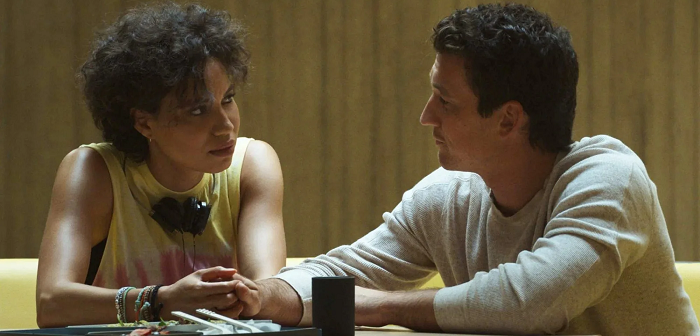
One such prisoner is Jeff (Miles Teller) who is in for accidentally killing his best friend while driving drunk. He’s haunted by the memories of that fatal mistake which makes him one of Steve’s favorite test subjects. When not being served sensory overloading “love drugs”, he hangs out with his love(ish) interest, Lizzy (Jurnee Smollett). Their lukewarm romance is supposed to add a little emotion. Instead, it never gets out of first gear.

Image Courtesy of Netflix

Despite having a thought-provoking setup, “Spiderhead” is ultimately undone by a number of flaws that no amount of Hemsworth charisma can overcome. For example, the paper-thin story leaves so much unexplained. I can’t get into the details without spoiling things, but let’s just say the ending does more to emphasis the story’s shallowness than offer any meaningful answers. It also reinforces the premise’s utter absurdity. The movie is also surprisingly empty in terms commentary. It wants to say something yet has remarkably little to say about much of anything.

I did get a kick out of some things (take the hilariously on-the-nose needle drops such as Thomas Dolby’s “She Blinded Me with Science”). But the disappointingly bland and hollow “Spiderhead” needs a lot more than that to get by. Maybe if you can completely turn off your brain, ask no logical questions whatsoever, and simply accept whatever you see at face-value, “Spiderhead” could work for you. For me, that proved to be too much to ask. “Spiderhead” is now streaming on Netflix.

VERDICT – 2 STARS

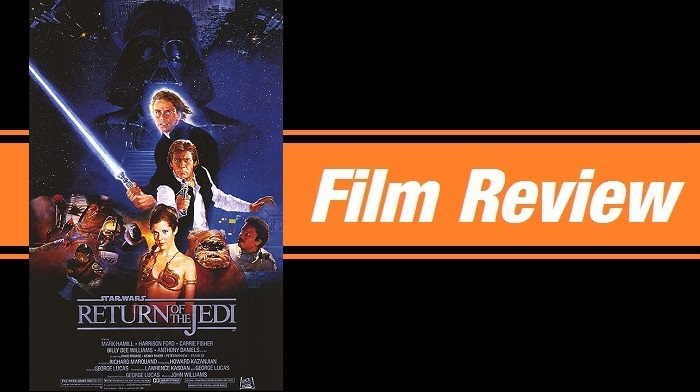
REVIEW: “Star Wars: Episode VI – “The Return of the Jedi” (1983)

A long time ago in a galaxy we call our own, an anxious 12-year-old me sat in my bedroom floor. In front of me, a mass of Kenner Star Wars toys lay spread out like a Thanksgiving feast. My imaginary battlefield was littered with action figures by the dozens, a Tie-Fighter, an X-Wing, an Imperial walker, an AT-ST, even a Tauntaun for good measure. Yet another battle between the Rebel Alliance and the evil Galactic Empire was about to break out on our tan and beige carpet.

That may sound like a suspiciously vivid memory, but it’s really not. That was a routine event in my room. I was (and in many regards still am) a massive Star Wars fan. And I would play for hours, reliving George Lucas’ stories with my toys and making up some new ones as well. I once had Star Wars toys galore, Star Wars storybooks, Star Wars blasters, a Star Wars lightsaber, Star Wars pajamas, Star Wars posters, you name it.

And it was all because of the movies. I’ve watched the original trilogy more than any other movies in my life. And I remember the experience of seeing them for the first time. In the early summer of 1983, all I could think about was “Return of the Jedi”, the third and final film in Lucas’ original trilogy. You couldn’t gauge my excitement for it. It was off the charts. And the movie didn’t disappoint. Even better, it’s still just as good, even a little weightier considering all of the Star Wars storytelling we’ve had since “Jedi” was first released.

This time Richard Marquand directed from a script written by Lawrence Kasdan and franchise mastermind George Lucas. The story picks up after the events of “Empire” and hands us a terrific opening that is Star Wars in a nutshell. We get a classic location, our favorite heroes, alien creatures galore, a slimy new villain, and a daring rescue. It was a delightfully energetic jolt back into the world.

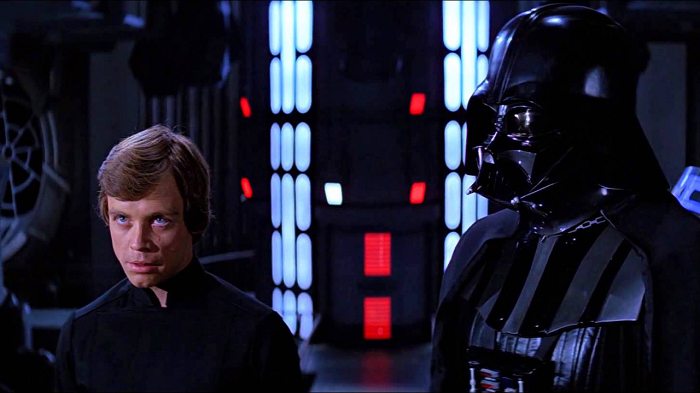
From there the movie sets the table for its big conclusion. We learn that the evil Emperor (Ian McDiarmid) and Darth Vader (David Prowse, voiced by James Earl Jones) are nearing completion of a new planet-killing Death Star. It sits under construction in orbit of the forest moon of Endor. The Rebels hatch a plan to destroy the Death Star similarly to how they did in the original movie. But to get a shot at the space station they’ll need to lower its protective shield which is powered by a generator on Endor.

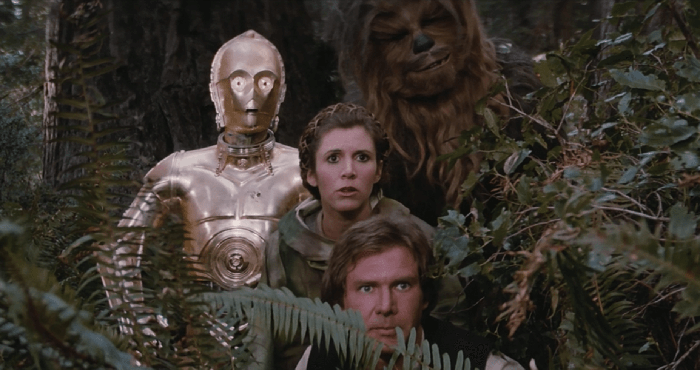
Enter our heroes. Han Solo (Harrison Ford), Leia Organa (Carrie Fisher), and Luke Skywalker (Mark Hamill), accompanied by droids C-3PO (Anthony Daniels) and R2-D2 (Kenny Baker), lead a team to Endor to destroy the shield generator. In the meantime, Lando Calrissian (Billy Dee Williams) and Chewbacca (Peter Mayhew), piloting the Millennium Falcon, lead the Rebel assault on the Death Star. The movie ends with an epic three-pronged finish as one team battles on Endor, another in space above, and Luke on the Death Star finally confronting Darth Vader.

While there is an argument to be made that the Endor scenes get a little bogged down with the introduction of a furry primitive tribe of creatures called the Ewoks, I love both the story’s buildup and its payoff. The back-and-forth editing between the three big climactic clashes in exhilarating and the story as a whole culminates in an epic finish that’s thrilling while also packing a strong emotional punch. And again, that punch is only amplified by the wealth of Star Wars storytelling since that has propelled Anakin Skywalker (aka Darth Vader) as a centerpiece of the saga.

Along with the fun space opera story and the great character work are the visual effects which were truly cutting edge for its time. Sure, some haven’t aged particularly well which is highlighted most in the high-definition editions that have released over the years. And some of Lucas’ digital tinkering definitely works better than others. But you can’t dismiss the amazing work of Lucas and the team at Industrial Light and Magic in bringing the story to life. Rewatching it for this review, I still found myself swept away.

Without fail “Return of the Jedi” ignites a near childlike enthusiasm inside of me every time I watch it. You can chip away at some aspects of the storytelling, and it’s not one of those sequels that holds up as stand-alone movie. But at that point Star Wars had firmly defined itself as a trilogy and “Jedi” offered a near perfect conclusion. Over time, fans have spent countless hours examining and dissecting it. Creators are still building upon it and expanding it. The influence of “Jedi” (and the original Star Wars trilogy as a whole) has gone well beyond the first three films and it still entertains legions of fans today. Much like it did 12-year-old me all those years ago.

VERDICT – 5 STARS

REVIEW: “Senior Year” (2022)

In the new Netflix teen-ish comedy “Senior Year”, a cheerleading accident leaves a high school senior in a coma. After she wakes up 20 years later, she sets out to finish her high school dream of being named prom queen. Sounds utterly ridiculous, right? Well, it pretty much is. And while first-time feature film director Alex Hardcastle deserves points for trying to make something out of this nutty premise, the utterly predictable movie can only manage a few mild laughs and even fewer interesting characters.

The movie begins by introducing us to Samantha Conway (played in the early scenes by a really good Angourie Rice). Since moving to the United States from Australia with her parents, Samantha has struggled to fit in with the popular crowd. She has her loyal yet eccentric friends Seth (Zaire Adams) and Martha (Molly Brown), but she really want to be in with the in-crowd. So Samantha begins her freshman year with a pledge to become the most popular girl in school.

Image Courtesy of Netflix

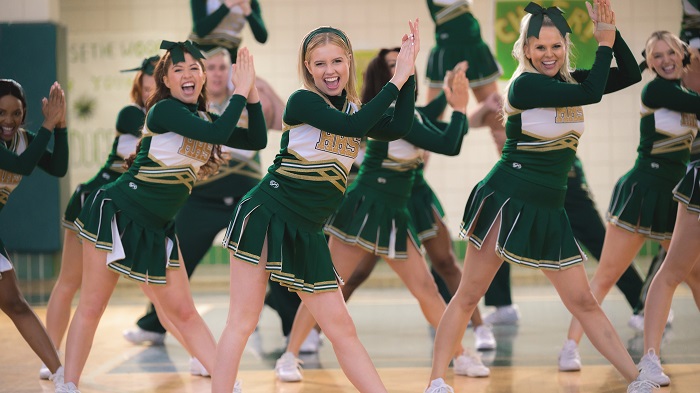
After reading a lot of magazines and fixing her hair a certain way (because apparently that’s all it takes to be most popular), Samantha becomes the toast of Harding High School. By her senior year she has the hunkiest boyfriend, Blaine (Tyler Barnhardt) and even wins cheerleader captain from her snooty rival, Tiffany (Ana Yi Puig). All she needs to cap off her self-centered popularity run is winning Senior Prom Queen.

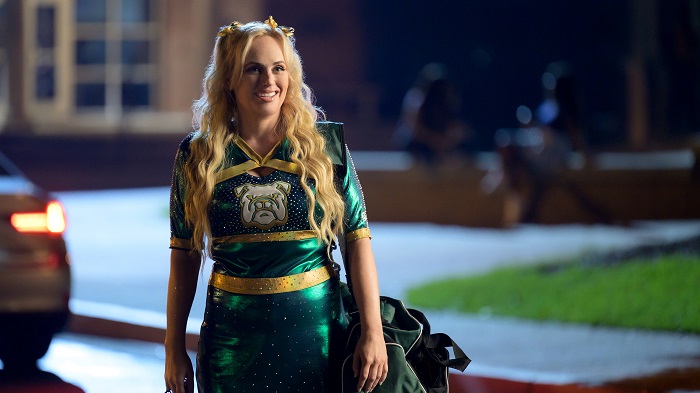
But then an cheering ‘accident’ during a pep assembly puts Samantha in a coma. Now played by Rebel Wilson, she wakes up 20 years later to an entirely new world. Older Blaine (Justin Hartley) has married older Tiffany (Zoe Chao), older Martha (Mary Holland) is Harding High’s principal, and older Seth (Sam Richardson) is the school librarian. You would think it would all be a shock for Samantha who’s physically 37-years-old but mentally still 17. Instead, she just picks up where her younger self left off, determined to finish her senior year, regain her popularity, and be voted prom queen.

But these days things are much different at Harding under the more buttoned-up Martha. The school has moved from the privileged, egocentric clique culture of Samantha’s youth to a more self-important, ultra-progressive, and hyper sensitive environment. So of course we get the inevitable bits where Samantha’s ways are constantly clashing with the new. Some are mildly amusing while others see the trio of screenwriters (Andrew Knauer, Arthur Pielli, and Brandon Scott Jones) working way too hard.

Yet despite it’s more enlightened exterior, Samantha learns Harding still has the same nonsense but in a different form. It’s embodied in the new most popular girl, Brie (Jade Bender), a social media maven who (of course) happens to be Tiffany’s daughter. She touts her social consciousness with the same smugness as Stephanie once brandished. But in today’s Harding, the popularity contest is determined by the number of online followers you have. So it’ll take an adjustment if Samantha wants to reach her dream of prom queen.

Image Courtesy of Netflix

The movie milks it central conceit dry and touches on several pretty obvious themes in the process – true friendship, reevaluating your dreams, learning what really matters in life, etc. Meanwhile the characters are more or less caricatures who click a wide assortment of genre boxes. Some still manage to be entertaining. Rice is quite good as a young Samantha, impervious to how her lust for popularity impacts those who love her. Wilson’s version of older Samantha has its moments, but it often feels like a performance rather than something genuine. I did like Chris Parnell as Samantha’s single dad. It’s a very by-the-book character but Parnell pulls some feeling from it. There’s also a great cameo later on that I’ll let you discover for yourself.

As the movie plays out it gets more and more predictable. Eventually everything falls right into place, exactly as expected. A few dance numbers are thrown in, but they aren’t particularly fun or well done. The worst one comes at the end – a corny cringe-soaked musical finish that turned this shallow yet watchable mess into something I was anxious to get away from. “Senior Year” is now streaming on Netflix.

VERDICT – 2 STARS

REVIEW: “The Sky is Everywhere” (2022)

(CLICK HERE to read my full review in the Arkansas Democrat-Gazette)

At first glance, “The Sky is Everywhere” looks like your standard-issue teen romantic drama or YA novel-inspired weepy. Its trailer drips with tropes and character types. And even the story itself (based on a 2010 young adult novel written by Jandy Nelson) seems custom-made for this kind of soapy genre treatment.

But if you take a deeper look, you’ll find several reasons to be intrigued by this movie which just premiered on AppleTV+. First, there’s the unexpected visual touches which interrupt the more routine bits and hint at something fresh and original. Second, it comes from director Josephine Decker whose last two features, “Madeline’s Madeline” and “Shirley”, were both unique and audacious projects. And third, it’s co-produced by A24, a respected distributor with a well-established history of backing smart and inspired independent films.

“The Sky is Everywhere” joins the parade of recent movies dealing with the heavy and deeply human subject of grief. Here it focuses on the loss of a sibling from a teenage girl’s perspective. Grace Kaufman plays Lennie Walker, a bright and talented high school senior with a love for music and big plans for her future. Everything was looking up for Lennie. She was First Chair in her school’s honor band, and her dream of being accepted into the Juilliard School in New York City seemed within grasp.

Image Courtesy of Apple TV+

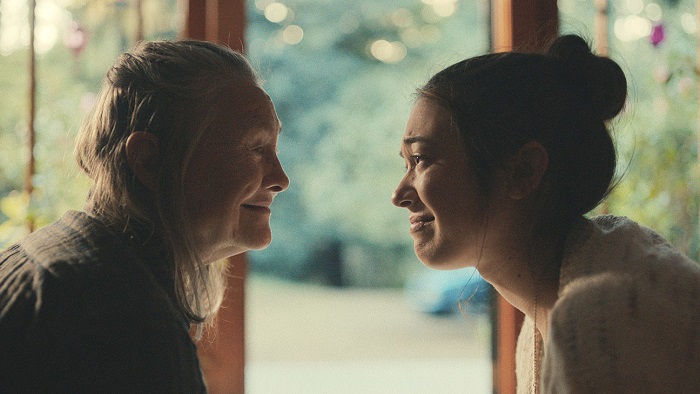
But then tragedy struck. While rehearsing the role of Juliet for an upcoming stage production, Lennie’s outgoing older sister Bailey (Havana Rose Liu) suddenly collapsed and died instantly from a fatal arrhythmia. Lennie was shattered. She and her sister were intensely close. They shared the same room, the same books, and (as Lennie puts it) “the same thoughts at the same moments“. They were inseparable.

The movie begins a short time after Bailey’s death. Overwhelmed by grief, Lennie has had a hard time picking up the pieces, and she’s struggling to hold her life together. She finds herself constantly calling Bailey’s phone just to hear her voicemail. She leaves Bailey’s clothes scattered around their room just to feel as though her sister is still there. There’s no more music in her heart; no more dreams of the future. For Lennie, time just stopped when her sister died. “I lost the one person on earth who understood me.“

Early on, Decker and Nelson (who wrote the screenplay) lean on narration to fill in the details of Bailey’s death and on Lennie’s fruitless attempts at coping. Voiceover can be tricky, but here it works as a nice introduction. It also moves the story to the place Decker and Nelson are most interested in examining – a critical juncture in the lead character’s life where the choices she makes will forever impact her future, yet an intense and consuming pain keeps her anchored to the past.

From there, Decker puts a lot of effort into developing this tight-knit world Lennie exists in. Much of it comes through the eclectic blend of side characters, each affecting Lennie’s life in different ways as she navigates her various stages of grief. In terms of family, there’s Lennie’s grandmother (Cherry Jones) and her Uncle Big (Jason Segel). “Gram” is well-meaning but a bit aggressive in her insistence that Lennie gets on with her life. Uncle Big is like a good-hearted reject from a hippie commune – puffing weed, studying bugs and occasionally adding a fatherly presence.

On the less convincing side is Lennie’s best friend Sarah (Ji-young Yoo) who doesn’t get the time or attention she needs to develop. As a result, her relationship with Lennie never feels the slightest bit authentic. And I could’ve done without Rachel (Julia Schlaepfer), the obligatory high school ‘mean girl’ and Lennie’s arch rival in band class. She’s more of a thinly sketched plot device than a real person.

Image Courtesy of Apple TV+

But the two most important supporting players are Toby (Pico Alexander) and Joe (Jacques Colimon). Both are potential love interests who represent two very different sides of Lennie. Toby (Pico Alexander) was the love of her sister‘s life. And while he and Lennie never got along, their shared grief and mutual heartache gives them a special bond. Joe is charismatic and full of energy. He looks at life the way Lennie once did – the way she hopes to again one day.

These characters fill out Lennie’s world, but Decker’s camera does a better job making us feel a part of it. Take the way she shoots the rustic country home Lennie shares with Gram and Big – surrounding it with a colorful array of rose bushes and towering California redwoods. Or the way we’re pulled inside Lennie’s head with these vibrant fantasy-like flourishes that range from corny to surprisingly poignant.

But the camera can only do so much, and the story begins to unravel the further it goes. It’s no fault of Kaufman who puts the movie on her back and carries it the best she can. But the supporting cast can’t match her, namely Alexander and Colimon who struggle when it comes to showing stronger emotion. And by the third act the movie is struggling too, knee-deep in cheese and unable to see its early potential through to the end. “The Sky is Everywhere” is now streaming on Apple TV+.

VERDICT – 2.5 STARS

REVIEW: “Seobok: Project Clone” (2022)

Based on its American title alone, “Seobok: Project Clone” sounds like some low-budget, straight-to-video, B-movie with Bruce Willis as its lead. In reality, South Korean director and screenwriter Lee Yong-ju offers up something considerably different – a movie that will have you anticipating one thing while delivering a dramatically different experience.

“Seobok: Project Clone” frames itself as a science-fiction action flick and there is certainly some of both in Yong-ju’s movie. But it doesn’t take long to notice that there is more going on underneath its showy surface. We quickly see that the film’s real interests are cerebral and philosophical rather than meeting any specific genre expectations. Yong-ju wants his his audience to think about and wrestle with the themes he presents. In this case, it’s mortality and the many layers of thoughts surrounding it.

Image Courtesy of Well Go USA Entertainment

Gong Yoo (“Train to Busan”, “Squid Game”) plays Ki-hun, a former intelligence officer who is commissioned by a shadow organization called “The Company”. They need him to escort a valuable asset to a safe house following the assassination of one of the group’s top scientists. Ki-hun is leery at first but agrees after being told by the cryptic Director Ahn (Jo Woo-jin) that the asset can save his life. We learn Ki-hun has been struggling with severe headaches and fainting spells, the results of a brain tumor that has left him with six months or so to live.

Ki-hun goes to a research laboratory hidden in the belly of a giant docked freighter where he is to retrieve the asset. Inside he learns that the asset is actually a clone named Seobok (Park Bo Gum). “He’s more of a new species that a direct human clone,” informs the new head scientist who goes on to explain the science and value of their creation. Turns out Seobok is believed to hold “the secret to conquering death.” Due to genetic manipulation, Seobok’s body produces special proteins that can cure any and all human diseases including Ki-hun’s cancer.

There is one rather notable side effect. Seobok is able control matter with his mind. It’s no small thing, and as you can probably guess, it’s something that definitely comes back into play as the movie moves forward.

With Seobok’s creator assassinated, it’s clear that some rather nefarious people want their hands on this genetic “technology“. And as the only successful source of their work, the Company needs Seobok protected at all costs. So Ki-hun and Seobok set out on a most unconventional road trip to a secret safe house where clinical trials can begin. Easier said than done. Soon the terrorists are hot on their heels and it quickly becomes evident that not everyone can be trusted.

Image Courtesy of Well Go USA Entertainment

While the movie features a couple of inevitable action scenes, the real surprise is found in the almost meditative nature of second-half. As he spends more time with Seobok, Ki-hun slowly moves from antagonistic to compassionate. And as he begins to see Seobok as more than a piece of technology, it opens up considerations that Ki-hun (and frankly the audience) never see coming. A rich and textured relationship forms which Lee Yong-ju uses to ask a series of thought-provoking questions.

As “Seobok: Project Clone” navigates through the moral dilemmas and murky ethics of its story, you can’t help but be impressed by how much it has on its mind. And it’s always nice to see a filmmaker using genre for more than just thrills and chills. In this case, Lee Yong-ju tries to cover a tad too much philosophical ground. This not only bogs his film down in spots, but it also leaves it feeling unfocused. Still the film still manages to deliver something fresh and surprising. And who doesn’t love being surprised. “Seobok: Project Clone” is now available on VOD.

VERDICT – 3.5 STARS