REVIEW: “The Sky is Everywhere” (2022)

(CLICK HERE to read my full review in the Arkansas Democrat-Gazette)

At first glance, “The Sky is Everywhere” looks like your standard-issue teen romantic drama or YA novel-inspired weepy. Its trailer drips with tropes and character types. And even the story itself (based on a 2010 young adult novel written by Jandy Nelson) seems custom-made for this kind of soapy genre treatment.

But if you take a deeper look, you’ll find several reasons to be intrigued by this movie which just premiered on AppleTV+. First, there’s the unexpected visual touches which interrupt the more routine bits and hint at something fresh and original. Second, it comes from director Josephine Decker whose last two features, “Madeline’s Madeline” and “Shirley”, were both unique and audacious projects. And third, it’s co-produced by A24, a respected distributor with a well-established history of backing smart and inspired independent films.

“The Sky is Everywhere” joins the parade of recent movies dealing with the heavy and deeply human subject of grief. Here it focuses on the loss of a sibling from a teenage girl’s perspective. Grace Kaufman plays Lennie Walker, a bright and talented high school senior with a love for music and big plans for her future. Everything was looking up for Lennie. She was First Chair in her school’s honor band, and her dream of being accepted into the Juilliard School in New York City seemed within grasp.

Image Courtesy of Apple TV+

But then tragedy struck. While rehearsing the role of Juliet for an upcoming stage production, Lennie’s outgoing older sister Bailey (Havana Rose Liu) suddenly collapsed and died instantly from a fatal arrhythmia. Lennie was shattered. She and her sister were intensely close. They shared the same room, the same books, and (as Lennie puts it) “the same thoughts at the same moments“. They were inseparable.

The movie begins a short time after Bailey’s death. Overwhelmed by grief, Lennie has had a hard time picking up the pieces, and she’s struggling to hold her life together. She finds herself constantly calling Bailey’s phone just to hear her voicemail. She leaves Bailey’s clothes scattered around their room just to feel as though her sister is still there. There’s no more music in her heart; no more dreams of the future. For Lennie, time just stopped when her sister died. “I lost the one person on earth who understood me.“

Early on, Decker and Nelson (who wrote the screenplay) lean on narration to fill in the details of Bailey’s death and on Lennie’s fruitless attempts at coping. Voiceover can be tricky, but here it works as a nice introduction. It also moves the story to the place Decker and Nelson are most interested in examining – a critical juncture in the lead character’s life where the choices she makes will forever impact her future, yet an intense and consuming pain keeps her anchored to the past.

From there, Decker puts a lot of effort into developing this tight-knit world Lennie exists in. Much of it comes through the eclectic blend of side characters, each affecting Lennie’s life in different ways as she navigates her various stages of grief. In terms of family, there’s Lennie’s grandmother (Cherry Jones) and her Uncle Big (Jason Segel). “Gram” is well-meaning but a bit aggressive in her insistence that Lennie gets on with her life. Uncle Big is like a good-hearted reject from a hippie commune – puffing weed, studying bugs and occasionally adding a fatherly presence.

On the less convincing side is Lennie’s best friend Sarah (Ji-young Yoo) who doesn’t get the time or attention she needs to develop. As a result, her relationship with Lennie never feels the slightest bit authentic. And I could’ve done without Rachel (Julia Schlaepfer), the obligatory high school ‘mean girl’ and Lennie’s arch rival in band class. She’s more of a thinly sketched plot device than a real person.

Image Courtesy of Apple TV+

But the two most important supporting players are Toby (Pico Alexander) and Joe (Jacques Colimon). Both are potential love interests who represent two very different sides of Lennie. Toby (Pico Alexander) was the love of her sister‘s life. And while he and Lennie never got along, their shared grief and mutual heartache gives them a special bond. Joe is charismatic and full of energy. He looks at life the way Lennie once did – the way she hopes to again one day.

These characters fill out Lennie’s world, but Decker’s camera does a better job making us feel a part of it. Take the way she shoots the rustic country home Lennie shares with Gram and Big – surrounding it with a colorful array of rose bushes and towering California redwoods. Or the way we’re pulled inside Lennie’s head with these vibrant fantasy-like flourishes that range from corny to surprisingly poignant.

But the camera can only do so much, and the story begins to unravel the further it goes. It’s no fault of Kaufman who puts the movie on her back and carries it the best she can. But the supporting cast can’t match her, namely Alexander and Colimon who struggle when it comes to showing stronger emotion. And by the third act the movie is struggling too, knee-deep in cheese and unable to see its early potential through to the end. “The Sky is Everywhere” is now streaming on Apple TV+.

VERDICT – 2.5 STARS

REVIEW: “Seobok: Project Clone” (2022)

Based on its American title alone, “Seobok: Project Clone” sounds like some low-budget, straight-to-video, B-movie with Bruce Willis as its lead. In reality, South Korean director and screenwriter Lee Yong-ju offers up something considerably different – a movie that will have you anticipating one thing while delivering a dramatically different experience.

“Seobok: Project Clone” frames itself as a science-fiction action flick and there is certainly some of both in Yong-ju’s movie. But it doesn’t take long to notice that there is more going on underneath its showy surface. We quickly see that the film’s real interests are cerebral and philosophical rather than meeting any specific genre expectations. Yong-ju wants his his audience to think about and wrestle with the themes he presents. In this case, it’s mortality and the many layers of thoughts surrounding it.

Image Courtesy of Well Go USA Entertainment

Gong Yoo (“Train to Busan”, “Squid Game”) plays Ki-hun, a former intelligence officer who is commissioned by a shadow organization called “The Company”. They need him to escort a valuable asset to a safe house following the assassination of one of the group’s top scientists. Ki-hun is leery at first but agrees after being told by the cryptic Director Ahn (Jo Woo-jin) that the asset can save his life. We learn Ki-hun has been struggling with severe headaches and fainting spells, the results of a brain tumor that has left him with six months or so to live.

Ki-hun goes to a research laboratory hidden in the belly of a giant docked freighter where he is to retrieve the asset. Inside he learns that the asset is actually a clone named Seobok (Park Bo Gum). “He’s more of a new species that a direct human clone,” informs the new head scientist who goes on to explain the science and value of their creation. Turns out Seobok is believed to hold “the secret to conquering death.” Due to genetic manipulation, Seobok’s body produces special proteins that can cure any and all human diseases including Ki-hun’s cancer.

There is one rather notable side effect. Seobok is able control matter with his mind. It’s no small thing, and as you can probably guess, it’s something that definitely comes back into play as the movie moves forward.

With Seobok’s creator assassinated, it’s clear that some rather nefarious people want their hands on this genetic “technology“. And as the only successful source of their work, the Company needs Seobok protected at all costs. So Ki-hun and Seobok set out on a most unconventional road trip to a secret safe house where clinical trials can begin. Easier said than done. Soon the terrorists are hot on their heels and it quickly becomes evident that not everyone can be trusted.

Image Courtesy of Well Go USA Entertainment

While the movie features a couple of inevitable action scenes, the real surprise is found in the almost meditative nature of second-half. As he spends more time with Seobok, Ki-hun slowly moves from antagonistic to compassionate. And as he begins to see Seobok as more than a piece of technology, it opens up considerations that Ki-hun (and frankly the audience) never see coming. A rich and textured relationship forms which Lee Yong-ju uses to ask a series of thought-provoking questions.

As “Seobok: Project Clone” navigates through the moral dilemmas and murky ethics of its story, you can’t help but be impressed by how much it has on its mind. And it’s always nice to see a filmmaker using genre for more than just thrills and chills. In this case, Lee Yong-ju tries to cover a tad too much philosophical ground. This not only bogs his film down in spots, but it also leaves it feeling unfocused. Still the film still manages to deliver something fresh and surprising. And who doesn’t love being surprised. “Seobok: Project Clone” is now available on VOD.

VERDICT – 3.5 STARS
REVIEW: “Studio 666” (2022)

(CLICK HERE for my full review in the Arkansas Democrat-Gazette)

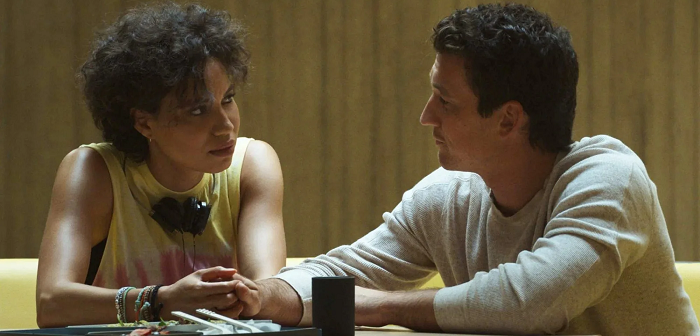
It’s hard to argue with the Foo Fighters’ sensational music career. Now the freshly minted rock and roll hall of famers take a brief detour from music to try their hand at movies with their first feature film “Studio 666”. While the group has been the subject of two documentaries, this is their first foray into drama. It’s a gallant effort. But after sitting through this baffling and at times astonishingly bad rock and roll horror comedy, I think the Foo Fighters might be better served sticking to their strength.

Just judging from the trailer, “Studio 666” looked outrageous and that’s a big part of what drew me to it. My impression was that the film would be a crazy mix of grisly grindhouse horror, absurd black comedy, and an assortment of old (and possible new) Foo Fighters tunes. Well, I got the grisly grindhouse horror part right. This thing goes all-out when it comes to gore – exploding heads, sprays of blood, entrails galore. It’s all present in unbridled over-the-top grindhouse glory. Even the title “Studio 666” resembles something you would see on a cheap mid-70s downtown marquee.

Image Courtesy Open Road Films

The black comedy part doesn’t work nearly as well. We get a few moments where the movie has fun with its more twisted elements, but not nearly enough of them. Instead of going full gonzo, the film often tries to be a straight comedy. But the numbingly bad gags rarely land – a problem that’s exacerbated by some horrible deliveries. To be fair, performances were never going to be a strongpoint here, and at times the band intentionally overplays certain scenes. But at other times it’s plain old bad acting and it becomes a distraction.

As for the music, don’t expect to hear any new Foo Fighters songs or to sing along to any of the band’s classics. Strangely there are none to be found. We get a couple of short jam sessions and a brief drum track or two, but that’s all. It’s an odd omission, and there were several times when I would have loved a Foo Fighters musical interlude to break up the growing monotony, especially in the first two acts (the third act isn’t great either, but it turns into a full-on splatter film which proves to be a welcomed distraction from all the other nonsense).

The film (directed by B. J. McDonnell, written by Jeff Bulher and Rebecca Hughes) is based on a story written by the band’s charismatic high-energy frontman Dave Grohl. It begins with the Foo Fighters butting heads with their manager (Jeff Garlin) over the group’s next record. It’ll be their tenth album so Grohl and bandmates Taylor Hawkins, Nate Mendel, Pat Smear, Chris Shiflett, and Rami Jaffee want to do something epic.

Their manager hooks them up with what seems like the perfect recording location – a mansion in Encino with a “rock and roll pedigree” (fun fact – it’s the same house where the band recorded their 2021 album “Medicine at Midnight”). Unfortunately for the Foo Fighters, that “pedigree” happens to include demonic possession, a gateway to Hell, and an unholy flesh-bound book ripped straight out of “The Evil Dead”.

Image Courtesy of Open Road Films

Rather than finding his creative energy in the spacious Encino estate, Dave suddenly loses his songwriting mojo. But just as his writer’s block (or as the movie so eloquently puts it, “songwriter’s constipation”) threatens to derail their much anticipated album, let’s just say Dave finds his much-needed “inspiration“ from a dark supernatural source. Horror hijinks ensue as the half-baked truth behind the house comes to light. Meanwhile several ‘friends of the family’ pop up in small roles or cameos including Lionel Ritchie, Will Forte, Whitney Cummings, Jenna Ortega, and Kerry King.

Ultimately the whole thing plays like one big running joke – one that might work if this were a 30-minute special on Netflix. But as a 100-plus minute feature-length movie, it’s tough to endure. The over-the-top gore-soaked final 20 minutes make it all a little more bearable, but not much. And while it’s true that without the Foo Fighters this movie would have never been made, it’s also true that without the Foo Fighters name stamped on it “Studio 666” would have never seen a movie theater screen. That’s because quality-wise it’s the kind of movie that drops unceremoniously on VOD only to end up in the digital bargain bin a few weeks later. And to be honest, they’re a dime-a-dozen. “Studio 666” is now showing in theaters.

VERDICT – 2 STARS

REVIEW: “Sundown” (2022)

(CLICK HERE to read my full review in the Arkansas Democrat-Gazette)

“Sundown” from writer-director Michel Franco opens with a shot of several fish on the deck of a boat. As they make their last gasps for oxygen, a man stares down at them with a solemn melancholy gaze. It’s a scene rich with meaning that over time will become clearer and clearer. And while the metaphor is easy to grasp, the details surrounding it are far more opaque.

With “Sundown”, Franco has crafted a shrewd and methodical story that’s as much of a puzzle as it is a drama. Information does come, but slowly and only when Franco sees fit to share it. That gives him plenty of room to challenge his audience. As things begin to happen, we’re lured into jumping to our own conclusions and making our own judgments. And that’s when Franco has us where he wants us.

The man in the opening scene is Neil Bennett and he’s played by a perfectly calibrated Tim Roth. Neil, a woman named Alice (Charlotte Gainsbourg) and two college-aged kids, Colin (Samuel Bottomley) and Alexa (Albertine Kotting McMillan), are vacating at a posh high-end resort in Acapulco. Franco deliberately holds back details, allowing us to piece together what we can through the characters and their interactions. They’re clearly wealthy as evident by their luxury accommodations, servers at every turn, and steak dinners costing a car payment apiece. 

Image Courtesy of Bleeker Street

Another thing is clear – Neil is troubled. Despite the swims in the beautiful turquoise waters, the sunbathing on a private beach, and being treated to the best cuisine, Neil seems detached, often lost in his thoughts and staring into oblivion. What’s wrong with him? Do Alice and the kids know? Is it due to something we’ve yet to learn or is it just a mark of their relationship? Franco eventually sheds light on it all, but only after his story takes some unexpected turns.

Their vacation abruptly ends after Alice gets a call from London that her mother is being rushed to a hospital. The four immediately pack and head to the airport, but once there, Neil informs his family he forgot his passport at the resort. He sends a distraught Alice and the kids ahead insisting he’ll catch the next flight. But rather than going back to the resort, Neil takes a cab to a cheap beachside hotel.

While Alice thinks he’s working with the consulate to get back to London, Neil actually spends the next several days slouched in a plastic chair on a crowded beach surrounded by locals, downing buckets of beer and staring up into the sun. His behavior becomes even more revolting once we learn Alice’s mother has died and she needs his help with with funeral arrangements. Instead of heading to London, Neil stops taking Alice’s calls altogether.

Image Courtesy of Bleeker Street

So what’s going on with this guy? Is it a midlife crisis? Is it deep depression or existential dread? Is he a bad person or is it something deeper than that? Franco’s deliberate and calculated approach to answering to those questions are what make Neil’s story so brutally compelling. And Roth, with his droopy oversized shirts, long shorts and sandals, gives a brilliantly cryptic performance that keeps his character’s emotions so tightly locked inside that he’s nearly impossible to read.

The only glimpses of potential happiness in Neil comes when he meets a local shop owner Berenice (Iazua Larios). The two hit it off and begin a relationship which raises even more concerns about this man. Everything seems to be careening towards a not-so-happy ending, but to get there Franco takes his story places you’ll never expect. Along the way he explores themes often found in his films – class, family dysfunction, violence, etc.

“Sundown” had its world premiere last September at Venice and it’s finally set for its US release (via Bleeker Street). It packs a lot into its lean 83 minutes. The story is bleak and at times appalling, but Franco never casts judgement on Neil or his actions. He leaves that to us. But he does so in such a crafty way that figuring things out and reaching our own conclusions is much of what makes the film so effective. “Sundown” is now showing in select cities.

VERDICT 4 STARS

Sundance Review: “Speak No Evil” (2022)

One of the more intriguing ‘horror’ films in this year’s Sundance program comes from Danish filmmaker Christian Tafdrup. It’s “Speak No Evil”, a smart but unsettling chiller but not in the traditional sense. In fact, the film didn’t start out as a horror movie. It was originally conceived as a psychological drama centered around a fairly simple idea. But as that idea grew, the movie took a new shape and Tafdrup begin utilizing horror elements in some shrewdly original ways.

Co-written by Taldrup and his brother Mads, “Speak No Evil” starts tame before festering into something unthinkably savage and deeply disturbing. But it’s the cinematic space in between that makes the film more than just a genre exercise in audience cruelty. With a surgical cunning, Taldrup cuts into themes of human nature, manhood, and social norms. But it’s the film’s bigger more ambiguous meaning that ultimately makes this such a terrifying experience.

Image Courtesy of Shudder

The film opens with a first-person view of a car driving down a dirt road at night. The drone of composer Sune Kolst’s haunting orchestral score soaks the scene in dread. But in a flash the camera suddenly switches to a sun-soaked swimming pool where the sounds of happy chatter, splashing water, and kid’s laughter fills the air. It’s not the only time Tafdrup will lay eerie ominous music over a seemingly innocuous scene.

The pool we learn is at a resort in Tuscany which is where we meet a vacationing Danish family, Bjorn (Morten Burian), his wife Louise (Sidsel Siem Koch), and their young daughter Agnes (Liva Forsberg). While there, they hit it off with a Dutch family – an outgoing doctor named Patrick (Fedja van Huet), his good-natured wife Karin (Karina Smulders), and their unusually quiet son Abel (Marius Damslev). The two families have lunch where we hear that familiar throwaway line from Karin, “Well you should come visit us sometimes.”

The story jumps ahead in time with Bjorn and his family back home in Denmark. One evening they’re surprised by a letter from Patrick and Karin inviting them to come to Holland for the weekend. After some lighthearted debate, Bjorn and Louise decide to go, with Louise even uttering those ill-fated words “What’s the worst that can happen?”

The trio leaves Denmark and heads for the Dutch countryside. When they finally arrive at the address they don’t find the kind of house you would expect a doctor to live it. Instead it’s a dated two-story wood-framed place in the middle of nowhere. And there you have the first warning sign out of many to come. While things feel a little weird at first, the two families begin reconnecting much like they did in Tuscany. But over time Peter and Karin’s behavior gets stranger and more uncomfortable. Soon the nice weekend getaway with “friends” turns into a horrifying nightmare.

Image Courtesy of Shudder

I’ll leave the rest for you to discover but be warned, “Speak No Evil” takes some shockingly depraved turns, and the final 30 minutes are as unsettling as anything you’ll see on screen this year. And by that I don’t mean that’s it’s gory and gross. I’m talking about the kind of brutal unpleasantness that you might find in certain Michael Haneke films. It will rattle you to your core.

Following its recent premiere at Sundance, “Speak No Evil” was quickly gobbled up by Shudder for distribution. So those of you who are interested (and gutsy enough), won’t have long to wait. To be honest, it’s not a movie I’m completely comfortable with recommending. Not because of poor quality (Tafdrup proves to be much too good of a filmmaker for that). But many will find it to be genuinely troublesome. Be that as it may, the sheer craft and control Tafdrup shows is top-notch, and I was glued to the screen throughout. I was thoroughly invested in the plight of this Danish family who were seduced by evil’s charms and then walked right into its trap.

VERDICT – 4 STARS

REVIEW: “Scream” (2022)

I still remember that December night in 1996. The late Wes Craven’s “Scream” had already been out a little over a week. I somehow convinced my wife of barely over a year to go see it with me. She didn’t like horror movies. I grew up on them. Thankfully we left the theater that night still happily married. That’s because not only did I enjoy “Scream”, but she did too. Well done Mr. Craven.

A fun, subversive and self-aware horror flick, the original “Scream” caught a lot of people by surprise. And while I never bought arguments that it dramatically changed the struggling genre, it certainly injected it with some much needed new energy. Not only did it launch its own series of sequels (one good, the others not so much), it also inspired a number of other blood-drenched young adult slashers, “I Know What You Did Last Summer” being the biggest.

But I don’t want to downplay the 1996 film’s impact. “Scream” was a blast and it knew how to utilize the genre’s strengths and have fun with all of its absurdities. It also did something that so many of its slasher predecessors couldn’t do – give us a broad cast of entertaining characters who we like being around and who are actually memorable. That’s a big reason why several careers were launched thanks to the movie.

Image Courtesy of Paramount Pictures

Co-directors Matt Bettinelli-Olpin and Tyler Gillett (“V/H/S”) set out to relaunch the series with their new film “Scream” (in keeping with the goofy horror movie trend of reusing the same title as the franchise’s first film). But the title isn’t the only thing they steal from the original movie. If you’ve seen the trailer you probably know it kicks off with a clear homage to the 1996 film’s iconic opening. The rest of the film features several other callbacks which range from fun fan service to unremarkably derivative. And then you get the final act which I won’t dare spoil. But let’s just say where the opening is a nice homage, the ending is a glaringly uninspired rehash.

Storywise, it’s been twenty years since the last brutal killings in the little town of Woodsboro. But wouldn’t you know it, in the opening scene a teenager named Tara (Jenna Ortega) is terrorized and then violently attacked by a knife-wielding psycho in a Ghostface mask. Yet unlike the 1996 opening scene (which this one is clearly mimicking), here the victim survives despite being stabbed multiple times.

After getting word of the attack, Tara’s estranged sister Sam (Melissa Barrera), who works at a bowling alley in Modesto, rushes back to Woodsboro with her generic tag-along boyfriend Richie (Jack Quaid). While it first seems like a tender reunion, we soon learn there’s some serious baggage between the sisters which once unpacked gives us one of the film’s more outrageous twists.

Oh, and then there is Tara’s gaggle of friends, your normal group of twenty-something’s playing high-schoolers. I could list their names but there’s not much point. They’re basically just fodder for the killer, and each time one is savagely flayed we scratch them off the suspect list. And yes, the 1996 film had its group of party-hardy teens. But none in this new batch are remotely memorable or have half the personality and presence as Ulrich’s Billy, Lillard’s Stu, McGowan’s Tatum, or Kennedy’s Randy. The one saving grace from the new cast is Barrera who does the very best she can with the hit-or-miss material.

The biggest way “Scream” 2022 connects with the previous films is by bringing back the franchise’s most beloved legacy characters. Neve Campbell returns as Sidney, David Arquette as Dewey, and Courtney Cox as Gale. Without question it’s fun to see these three back in a “Scream” movie. At the same time, their roles here feel more nostalgic than important to the story.

This movie also embraces the same meta aspect which gave the original film its fresh and playful energy. But here it isn’t nearly as effective as the filmmakers want it to be. That’s because they go to it a few too many times. It often comes across as disingenuous, and while we see the actress speaking the words, all we hear are the writers trying to be clever. At other times it’s haphazardly crammed into scenes, to the point where the movie begins to resemble lazy self-parody rather than anything smart and/or creative. This is meta overload.

Image Courtesy of Paramount Pictures

While slasher movies aren’t known for having the smartest characters, I was surprised at the sheer number of dumb decisions people make in this one. Especially in a series that has made pointing out horror movie clichés and tropes a key part of its storytelling. It’s head-scratching to watch characters be so smart one minute and as dumb as a box of rocks the next; wisely suspicious for one scene but then forget to be in the very next one. You can argue that’s kinda the point,

Then you have equally baffling holes in the story’s logic. Like the police deciding to move Tara away from people to a completely empty floor of a hospital. Brilliant. Or the weird idea of hitting a wild party only a few hours after one of your best friends was brutally murdered. But my favorite might be Ghostface, not just taking four rounds from a .357 magnum at close range, but hopping back up like nothing happened? How does he survive? We don’t know. The movie forgets to tell us. Oh well.

A lot of this may sound like nitpicking, especially for a self-aware blood-drenched slasher movie. I don’t know, maybe I was expecting too much from “Scream” 2022. Perhaps I was wrong for thinking that resuscitating this old franchise meant they had something new to bring to it. Unfortunately, if you take out the handful of new faces and few grisly new kills, all you’re left with is a pretty run-of-the-mill horror flick. One that clearly respects Wes Craven’s original “Scream”, but spends too much time milking his ideas rather than coming up with fresh ones of its own. “Scream” is now showing in theaters.

VERDICT – 2 STARS