
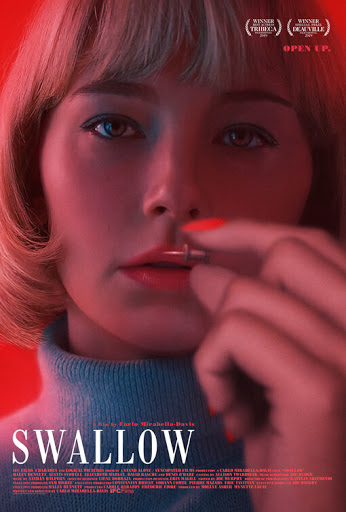
 “Swallow” is a frustrating movie that by the end will be seen as a battle cry for some and completely off-putting to others. It’s listed as a psychological thriller but I’m not sure the movie does enough to earn that title. It certainly has some of those elements, but it could just as easily be called a domestic drama, body horror, a twisted black comedy, or an on-the-nose political allegory. This identity crisis ends up making the film as a whole a little too hard to (wait for it…) swallow.
“Swallow” is most effective when it focuses on the main character’s Stepford existence and its…unhealthy consequences. Haley Bennett plays Hunter, a young woman who seems to be living the good life. She’s married to Richie (Austin Stowell), the hunky son of a gazillionaire and heir to his father’s fortune. They live in a posh modernist home in upstate New York. To top it off, she finds out the two are having a baby. It’s a far cry from the working class world she grew up in.
“I’m so lucky” she says to an inattentive Richie, trying harder to convince herself than her husband. Hunter is a testament to the idea that money can’t buy happiness, especially when the cost is your independence and agency. Her facade of bliss begins to breakdown and her loneliness becomes more pronounced. It becomes clear that she’s trapped in a world dictated by others, ensnared by their expectations and serving their needs.
The downside is that Richie is more of a one-note caricature than a flesh-and-blood human being. First-time director Carlo Mirabella-Davis (who also wrote the screenplay) isn’t much for subtlety or nuance. There is never an ounce of suspense when it comes to the paper-thin Richie or his motivations. His dastardly parents (David Rasche and Elizabeth Marvel) are even more glaringly villainous, checking off every predictable box. It would be fine if this were a straightforward satirical black comedy. But that’s not the movie’s aim so we are left with characters bordering on cartoonish.
As the patronizing and neglect start to take its toll, Hunter finds inspiration in these lines from a book: “Every day, try to do something unexpected. Push yourself to try new things.” She does. She begins swallowing things around the house starting with a marble and then a thumbtack. It gets worse from there. She may be mentally coming apart, but for the first time in her life she feels in control.

At times it’s hard to know how Mirabella-Davis wants us to feel. One minute he’s treating Hunter’s troubling new addiction as macabre and unsettling. Then we’ll get a scene or two where he plays it for laughs. Conversely it’s very clear how he wants us to feel about the pregnancy which is always portrayed negatively or forgotten altogether. It becomes more of a shameful plot device than a meaningful story thread.
It all culminates in a rushed final act where Hunter faces her current situation and past traumas. It leads to an iffy final shot that leaves a lot of questions but gives the movie an easy out. No spoilers here, but depending on where you land on certain things I can see the ending being interpreted as hopeful, tragic, or even repulsive. If you’re in with Mirabella-Davis’ convictions you’ll probably find it bold and liberating. If not you may see it as callous and appalling.
Almost lost in the film’s wobbly focus and dubious virtue is Katelin Arizmendi’s fabulous pastel-soaked cinematography and Haley Bennett’s quiet but forceful lead performance. “I just want to make sure I’m not doing anything wrong.” It may be the saddest line in the entire film and Bennett delivers it with such heartbreaking sincerity. It comes from a young woman so attuned to meeting the needs of others that she can’t even notice her own. If only “Swallow” had stuck with more of that.
VERDICT – 2 STARS












 What a roller-coaster adventure the last two years have been for Star Wars fans. Fair or not, Rian Johnson’s “The Last Jedi” sparked all sorts of fan backlash, enough to prompt some to even blame it for the 2018 “Solo” movie’s disappointing box office numbers. Without question much of the outrage was over-the-top which caused many of the legitimate criticisms to be lost in the noise. But equally over-the-top was the critical praise, some of which heralded it as “the best Star Wars movie ever made”. Much of that was rooted in a needless lust for subversion and rabid contempt for fandom.
 Abrams clearly listened to the criticisms which has already triggered the predictable whines of “fan service” from certain critic circles. But Star Wars has always been about continuity and connection. Even the “stand-alone” movies are inherently connected to the films that came before them. So it makes sense that Abrams would try to rein in some of Johnson’s care-free creative choices. And as a movie tasked with wrapping up an entire four decade-plus saga, you almost have to expect some level of “fan service”.
 The movie’s most captivating storyline remains the mysterious connection between young and raw Jedi extraordinaire Rey (Daisy Ridley) and tortured dark sider Kylo Ren (Adam Driver). Rey works hard to hone her skills but is still haunted by questions of her identity. Kylo (who steals the movie) uses every ounce of rage he can muster to smother out the glimmer of light within him. Both Ridley and Driver approach most of their scenes with a steely intensity befitting of their characters and their inevitable collision course.
 Abrams does do some patchwork to several of Rian Johnson’s more controversial choices: Rey’s parents, Supreme Leader Snoke, etc. The movie addresses them in a way that should please many of the fans while infuriating those who couldn’t care less about Star Wars continuity or lore. But let’s be serious, “The Rise of Skywalker” had no chance of pleasing everyone. It was a hopeless proposition. So, do you follow Johnson’s lead and kick more sand in the eyes of long-time fans? Or do you make a movie for the devoted fanbase and face the ire of scorned critics?
 Keith & the Movies