
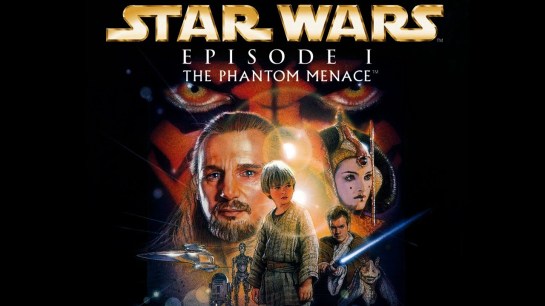
It’s the 20th anniversary of the first film in the Star Wars prequel trilogy. It landed in theaters on May 19, 1999 and fans still debate them today. What better time than now to rewatch and finally review these three fascinating movies.
There is perhaps no better monument to geekdom than the Star Wars franchise. Sure, Marvel’s MCU may have something to say about that, but it was George Lucas’ sprawling epic and personal cash cow that first leapt outside the bounds of movies and into television, novels, comic book series, and tons more. That doesn’t even count the loads of money brought in through toys and other merchandise. You don’t have to be a Star Wars fan to appreciated Lucas’ monumental accomplishment starting back in 1977. “A New Hope” was ground-breaking in regards to its visual style and special effects. The film spawned two intensely popular sequels, “The Empire Strikes Back” and “The Return of the Jedi”. But you already know that.
A jolt hit the Star Wars community in 1993 when Lucas announced he would be making a new trilogy, a prequel to the original three films. They would connect directly to the original trilogy and complete Lucas’ vision for the saga. In 1999, “Star Wars Episode I: The Phantom Menace” was released and I’m not sure any movie has ever released featuring more hype and scrutiny. Fanboys and critics alike looked for cracks and flaws in characterizations and continuity. And rarely did it escape comparisons to the original trilogy. This made judging Episode 1 on its own merits nearly impossible. But Episode 1 had a lot on its plate and while it may be among the weaker Star Wars pictures, after revisiting it yet again I found myself once again caught up in this universe I have always loved.

Since Lucas’ intent was to connect the two trilogies into one cohesive saga, I was always curious to see how he would begin his tale. In Episode I, Lucas sets everything in motion by focusing on (of all things) politics as the biggest weapon of manipulation. It’s politics that is first used to kickstart the tragic events that we all know will unfold. Lucas also showcases the Jedi in their prime. We spend most of the time with Jedi Master Qui-Gon Jinn (Liam Neeson) and his apprentice Obi-Wan Kenobi (Ewan McGregor) as they go from political negotiators to planet liberators. A young Natalie Portman plays a Naboo queen who has a major impact on future events. Another key part of the film is the introduction to Anakin Skywalker (played by Jake Lloyd), a young child slave on Tatooine who we know later becomes Darth Vader. Lucas’ focus on Anakin in the first three films ends up reshaping the actual focus of the overall saga, and for my money in a good way.
As a whole, the structure of “The Phantom Menace” is pretty impressive. It was a daunting task to make three films that could directly connect to the beloved original trilogy and do so in a way that’s cohesive and that survives the mythological scrutiny from fans. Episode I does a nice job of putting its key characters in place while only occasionally getting bogged down in its first half table-setting. Rewatching it I was surprised by the narrative layers and interesting world-building. I like the political unpinning and see it as often undervalued and underappreciated.
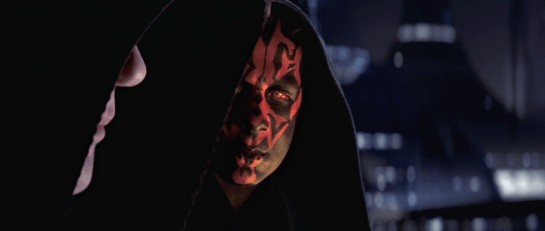
To no surprise several new characters are introduced. Some of them work really well while others, not so much. The dislike of Jar Jar Binks (Ahmed Best) has been well documented and understandable. Lucas overplays his hand by making the character nothing more than comic relief. Every scene and every line of dialogue seems aimed at nothing more than generating silly laughs. The result is an annoying and often distracting presence. On the flip side is the sinister Darth Maul, physically played by Ray Park and voiced by Peter Serafinowicz. Not only is he one of the coolest and most fercious looking Star Wars characters ever but his lightsaber fight with Obi-Wan and Qui-Gon remains a highlight for the entire franchise.
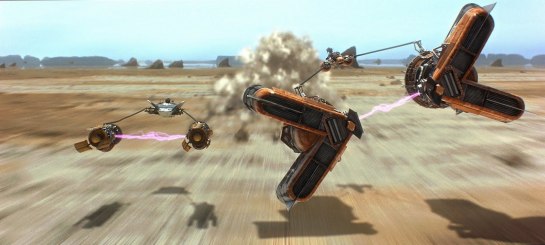
With “The Phantom Menace” Lucas clearly wanted to show off the benefits of the new technology available to him. In many ways it’s a good thing but in other ways it works against the film. There are instances where the movie becomes a barrage of “watch this” CGI moments. There are several scenes that could have easily been left out and the film would have been better for it. But there are also scenes where the special effects present Star Wars in a dazzling new light. The pod race on Tatooine is breath-taking and the space sequences are amazing. Most of the CGI characters share the space well with human actors and fit flawlessly into their environments. It’s certainly a visual step up in many regards but at times a bit overkill (something that becomes clearer in the next film).
And you can’t talk Episode I without mentioning the return of composer John Williams. He delivers yet another incredible score full of call-backs to the original trilogy and with new music that blends beautifully with the old.
“The Phantom Menace” has always been a satisfying Star Wars installment for me and nothing changed during my rewatch. It opens itself up to criticism through some shaky creative choices while other popular gripes don’t hold water (sorry, but I still don’t find Jake Lloyd insufferable). Most importantly it lays some intriguing groundwork, sparks more conversation between the Star Wars faithful, and offers a return to the magical universe I’ve loved since childhood. It may be flawed but it does what’s most important – it looks, sounds, and feels like a Star Wars picture.







 Keith & the Movies