REVIEW: “Springsteen: Deliver Me From Nowhere” (2025)

Bruce Springsteen is an interesting specimen. There is no denying his status as a rock ‘n’ roll legend. And while I’ve never been his biggest fan, he had a series of hits during the early to mid-1980s that I still love to this day. Yet Springsteen (affectionately known as The Boss) has always seemed like a regional favorite. For instance he remains much beloved in the Northeast but doesn’t have the same kind of following in the South.

Nonetheless, the 76-year-old Springsteen has released a total of 21 studio albums and sold over 140 million records worldwide. In addition, The Boss has won 20 Grammy Awards, two Golden Globes, and even an Academy Award. Those numbers alone speak volumes about the New Jersey native’s magnificent run. And now (as so often happens) he has his own music biopic. Unfortunately it doesn’t do justice to Springsteen’s life story or music career.

Based on the 2023 book of the same name by Warren Zanes, “Deliver Me From Nowhere” is a strangely unfocused sketch of Springsteen’s life. Writer-director Scott Cooper hones in on a specific time in the singer-songwriter’s history. It’s a compelling period that’s perfect for a ‘slice of life’ music biography. But instead of tightening its focus, the movie is frequently glancing back at another part of Springsteen’s life. Sadly we end up with a movie that’s hampered by two out of sync and underdeveloped stories competing for screen time.

Image Courtesy of 20th Century Studios

In one respect “Deliver Me From Nowhere” is about Bruce (Jeremy Allen White) in his early thirties fresh off the enormous success of his multi-platinum double album “The River”. After his final show of his year-long tour, Bruce informs his loyal and supportive manager Jon Landau (a terrific Jeremy Strong) that’s he’s going back home to New Jersey to “slow things down a bit”. While at Asbury, Bruce reconnects with his past which inspires him to start writing and recording a collection of new songs.

Bruce ends up writing several sure-fire hits. But instead of releasing them, his heart leads him towards something more personal. So he records a series of acoustic folk songs that would form his sixth album, “Nebraska”. But his record label wants to take full advantage of his popularity with a new album full of chart-toppers. An acoustic folk album is not what they had in mind. Still Bruce persists. And making it an even tougher sell is his insistence that there be no press, no singles, and no tours.

The creative tensions between Bruce staying true to his convictions and the desire of record executives to capitalize on his fame is when the movie is at its best. But there is another story that attempts to explore the more personal themes of generational trauma and depression. It consists of a series of flashbacks sprinkled throughout the movie that focuses on Bruce’s complicated relationship with his abusive alcoholic father (Stephen Graham).

Image Courtesy of 20th Century Studios

The father-son angle begins in 1957 during Bruce’s childhood and ends with a surprisingly tidy finish. The problem is we’re missing so many details that would better explain Bruce’s feelings towards his father. Even worse, their troubled relationship seems to haunt Bruce leading to bouts of depression. But his internal conflict doesn’t translate well to the screen. For much of the time we don’t know what’s wrong with Bruce. It isn’t until later that we get something resembling an explanation.

While the script bounces him back and forth between stories, White pours every bit of himself into portraying Springsteen. There are moments where the resemblance is uncanny both in his look and mannerisms. Other moments aren’t quite as convincing. Strong offers up another strong biographical supporting turn. And Odessa Young is very good as a single mother who becomes Bruce’s love interest. Unfortunately Young’s character is undercut by the muddied handling of Bruce’s mental state.

There’s no denying Bruce Springsteen is worthy of his own biopic. “Deliver Me From Nowhere” offers a mere glimpse of his creative journey rather than a celebration of it. Instead it attempts to balance music with a more personal story of strained family relationships and mental health. Cooper’s intentions are noble and he delivers some energetic scenes and enlightening moments (such as Bruce jamming with friends at The Stone Pony or his growing discomfort with fame). But it all feels curated to a fault, and there’s too much surface-level treatment to do justice to this music legend’s life and career.

VERDICT – 2.5 STARS

REVIEW: “Shaman” (2025)

Director Antonio Negret effectively explores the cultural clash of spiritual beliefs and less effectively observes the impact of colonialism in his new feature “Shaman”, a supernatural horror film penned by his brother, Daniel Negret. Their collaboration is both beautiful and terrifying, with the brothers using horror’s well-traveled possession subgenre as a means of examining its bigger and more specific themes.

The story is set in a remote part of Ecuador where a well-meaning Catholic missionary family have come to minister to the indigenous locals under the direction of a local priest, Father Meyer (Alejandro Fajardo). Candice (Sara Canning), her husband Joel (Daniel Gillies), and their teenage son Elliot (Jett Klyne) have jumpstarted a school, they offer medicines to the sick, and provide warm meals to those in need.

Image Courtesy of Well Go USA

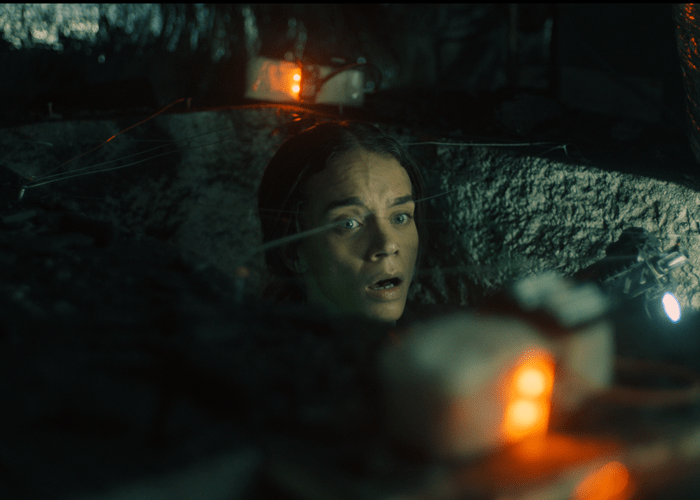
But things take a sinister turn after Elliot ventures into a nearby cave despite the warnings of some local kids. He inadvertently breaks a seal that unleashes a malicious spirit which is later identified as Supay, the God of Death. Unknowingly possessed by the evil Supay, Elliot returns home. But it’s not long before Candice begins noticing her son acting unusual. To no surprise his actions progressively get more disturbing, from disappearing in the middle of the night to throwing up blood (among other things).

Adding to the eeriness is a creepy old shaman (Humberto Morales) who takes an immediate interest in Elliot. The devout Candice wants no part of the shaman or his unsettling rituals. But his repeated presence raises concern. Is he someone who can help and can he be trusted? Or is he and his black magic the root cause of Elliot’s condition? That mystery plays a big part of the film’s second half. As Elliot’s condition worsens, a troubled Candice feels more helpless and the shaman’s presence grows more peculiar.

Image Courtesy of Well Go USA

“Shaman” is not for the squeamish. In addition to the strange totems, animal sacrifices, and creepy occult rituals, there is no shortage of graphic and squirm-worthy images to make you uncomfortable. Bleeding eyes, burning skin, cracking bones, scorpions. The movie throws in a variety of genre conventions plucked from all kinds of past possession movies. That inevitably strips away some of the tension for fans who have seen it all before. But the setting remains interesting even when the scares aren’t quite hitting their marks.

Thematically, the movie takes some swings at religion and colonialism through the clash between the family’s firm Catholic beliefs and the local culture. Meanwhile we get a slow drip of revelation that hints at past family troubles. But within the bounds of the story neither are explored in enough detail to matter much. Still “Shaman” manages to get under your skin just enough to be effective. And familiar possession tropes aside, the film does things with its unique setting to give the story its own distinct identity.

VERDICT – 3 STARS

REVIEW: “Stella. A Life.” (2025)

“Stella. A Life.” is a Holocaust drama that tells a true story unlike most others. It’s a fictional film that is based on historical facts that were researched from the 1946 trial records of the Soviet Military Court. At the center of the trial and this story is Stella Goldschlag, a young Jewish woman living in Berlin during the rise of Naziism. Like many Jews, Stella felt the devastating horror of Hitler’s unspeakable despotism. But unlike other Jews, the actions she took were every bit as unspeakable.

The film stars the captivating Paula Beer who was so good in her three collaborations with director Christian Petzold, “Transit”, “Undine”, and “Afire”. Here she takes on an especially challenging lead role that sees her character significantly and tragically transform over the film’s compelling two hours. To no surprise Beer is up to the task, keenly handling the emotionally heavy workload to such great effect that we find ourselves beguiled by Stella’s vivacity and charm. At least until the allure turns to repulsion.

Image Courtesy of Film Movement

The film opens in 1940 where we’re introduced to Stella Goldschlag (Beer), a spirited young woman living in Berlin with big dreams of becoming a jazz singer. Early on it seems as if she has everything going for her. Not only is she and her band getting gigs in fancy nightclubs, but they’ve even earned an invitation to one day travel to America and play on Broadway. But just as her dreams look to be within reach, Stella is faced with the crushing reality of being a Jew in Nazi Germany.

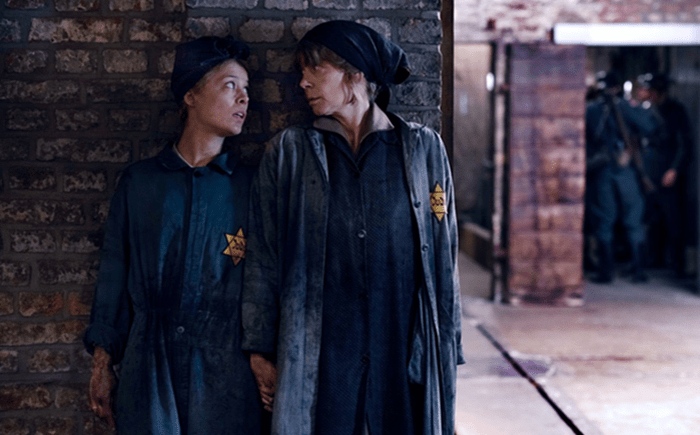
From there director Kilian Riedhof makes a sobering time jump to 1943 where we see Stella working in a factory making pistol clips for a German military. Gone are the elegant gowns, jazzy music, and spirited nights out with friends. And it only gets worse when Stella, her mother Toni (Katja Riemann), and her father Gerhard (Lukas Miko) are forced into hiding after the Nazi roundups begin.

Yet while everything is collapsing around her, Stella refuses to accept the reality of the world. She sneaks out at night, assimilating in with the non-Jewish crowds. “They don’t recognize me,” she naively tells her father, “I don’t look like a Jew.” And despite having married her longtime friend Fred (Damian Hardung), Stella spends many of those evenings cruelly cavorting with low-level German officers before eventually hooking up with an unruly forger named Rolf (Jannis Niewöhner).

Image Courtesy of Film Movement

Stella’s luck eventually runs out when she and her family are captured. Beaten and terrified of being sent to Auschwitz, Stella barters with the Gestapo and agrees to become a “catcher”, exposing the location of hidden Jews to the Nazis for modest wages and protection from deportation. She later recruits Rolf, and what begins as a desperate attempt to save her family turns into a shamefully willing betrayal marked by callousness and revelry.

Riedhof deftly handles Goldschlag’s complex story, showing both the root and consequences of her actions. He also superbly recreates the timeline through period-accurate costume and production design as well as performances that run the emotional gambit. And it all begins with Beer who takes on the challenge of finding humanity in a monster. True accounts state that hundreds to thousands of Jews were captured due to Stella Goldschlag’s betrayal. Yet Beer succeeds in gaining our empathy and turning our stomachs via a richly defined performance that’s not to be missed.

VERDICT – 4 STARS

REVIEW: “The Smashing Machine” (2025)

Dwayne Johnson and Emily Blunt reteam in a movie that’s far removed from their lighthearted “Jungle Cruise” adventure. “The Smashing Machine” is a biographical sports drama based on the 2002 John Hyams documentary “The Smashing Machine: The Life and Times of Extreme Fighter Mark Kerr”. As you can probably guess, it highlights the career of Mark Kerr, one of the pioneers in the world of mixed martial arts.

“The Smashing Machine” premiered at the Venice Film Festival where its director, Benny Safdie won the Silver Lion. And it was produced and is being distributed by none other than A24. Those things alone raised expectations. But surprisingly, “The Smashing Machine” is a fairly conventional sports drama. It follows a pretty familiar blueprint but with some notable traits all its own.

As many have rightly said, Dwayne Johnson delivers a revelatory performance portraying Mark Kerr. As a professional wrestler turned action star, it’s no surprise that the musclebound Johnson has the sheer brawn and in-ring prowess for a role like this. It’s what he does beyond the physicality that surprises most. It’s here that Johnson loses himself in the role (and he’s not the easiest guy to lose into anything).

Image Courtesy of A24

In many ways “The Smashing Machine” looks and plays like a slice-of-life documentary. Visually, Safdie (directing solo for the first time) and cinematographer Maceo Bishop shoot the film in a variety of formats, most notably VHS and 16mm. As a result, the gritty and grainy texture conveys authenticity as well as a distinct sense of time. Narratively, the movie sticks with one segment of Kerr’s life from 1997 to 2000, offering us a documentary-like profile of the man rather than more plot-focused story.

We first meet Kerr in the early stages of his professional career, before mixed martial arts became a global phenomenon. It was a time of few rules, no regulations, and no infrastructure around the sport. After turning heads with an undefeated run in Brazil, Mark agrees to a few fights in the growing Ultimate Fighting Championship. From there he takes off to Japan where he joins Pride FC with his close friend, trainer, and fellow fighter, Mark Coleman (Ryan Bader).

Safdie makes a point to show the crafted perception of the fighters and Mark’s determination to live up to it. The MMA organizations would portray their fighters as fiercely violent warriors surrounded with an aura of invincibility. But for Mark, the reality is dramatically different. Behind his brawny public image is a disarmingly kind and gentle man. He possesses a near childlike tenderness when things are going well. But when things get tough, it can be more of a childlike petulance. And things get really tough for Mark.

Image Courtesy of A24

Mark’s professional troubles begin in Japan with his shocking first loss – the result of a referee not calling the match according to the recent rule changes. His frustrations only get worse after his body begins showing signs of wear and tear, leading to an addiction to pain killers. Meanwhile at home, his volcanic relationship with his girlfriend Dawn (Emily Blunt) is an emotional rollercoaster with problems all its own.

The film is at its best when Mark and Dawn are together. Their beautiful yet blustery coexistence produces moments of potent domestic drama. The two truly love each other but frequently fight, sometimes due to Mark’s petty passive-aggressiveness; other times from Dawn’s bruising self-righteousness. There’s undeniably a dysfunctional quality to their relationship, but neither are villains. Their love is real but so are their frustrations which boil over into several heated clashes.

Johnson looks right at home in combat leading to some visceral fight scenes, effectively shot in a way that emphasizes the brutality. But it’s the humanity outside the ring that makes his performance so powerful. Blunt is equally good, bringing a whirlwind of emotional to a critical supporting character. That is until she suddenly vanishes for a big chunk of the second half. Along with the immersive visual style, these are all strengths that set this otherwise conventional sports drama apart from the many others that come down the pipeline. “The Smashing Machine” is in theaters now.

VERDICT – 3.5 STARS

REVIEW: “Stolen Girl” (2025)

In “Stolen Girl” Kate Beckinsale plays Mara, a down on her luck, divorced single mother living in Ohio with her four-year-old daughter Amina and her ailing father Joe (Matt Craven). Mara’s world is turned upside down after Amina wanders off while in a grocery store and is abducted. That kicks off this complicated story about a determined mother and the many obstacles she navigates in her efforts to find her daughter.

Directed by James Kent, “Stolen Girl” is inspired by a true story although the storytelling doesn’t always feel like it. Nagging frustrations such as narrative shortcuts, undercooked relationships, and instances of clumsy editing sometimes distract from the more serious issues at hand. But Kent, along with screenwriters Kas Graham and Rebecca Pollock, don’t take their subject lightly. And inside the film’s 1990s thriller veneer is a strong message that’s worth listening to.

Things escalate quickly after Amina’s disappearance as Kent hurries us through the first act. Basically Mara is convinced her ex-husband Karim (Arvin Kananian) took their daughter. The police check Karim’s home only to find it cleaned out with no signs of him. Everything points to Karim having left the country, but no one, from the local police to the CIA, offer much help. Two years leads to four years, and despite Mara’s determined efforts, there’s still no headway made.

A glimmer of hope comes when Mara is approached by a man who goes by Robeson (Scott Eastwood), an ex-Marine who now works as a child recovery specialist (aka a mercenary). He makes her a deal – help him find other people’s kids and he’ll help her find Amina. She agrees and a few scenes later she is accompanying Roberson and his partner Carl (Jordan Duvigneau) to Colima, Mexico. Her job is to “play mother” by keeping the recovered child calm while they transport him back to his rightful parent.

Too much of the film’s first half unfolds with very little meaningful buildup. Mara’s work to get answers both locally and in Washington DC is referenced more than it is realized. Her jump to mercenary fieldwork happens with practically no training whatsoever. Even her relationship with Roberson goes from strictly business to making out in a motel without a hint or spark of attraction.

But the story’s focus sharpens in the second half as the thriller elements take form. Eight years after Amina first disappeared, Mara gets a lead that Karim is in Lebanon. But unexpected obstacles arise from unexpected places paving the way to a surprising finish that packs the kind of emotional heft that almost makes you forget the rocky road to get there.

While the storytelling is a bit messy (specifically early on), the same could be said for the handful of action sequences that are hampered by clumsy edits, shaky cameras, and an over reliance of quick cuts. But to Kent’s credit he manages to hold it all together in large part thanks to Beckinsale. The sheer conviction in her performance brings home the weightiness of the subject matter. And there is never a moment where we question her character’s pain, frustration, and resolve. “Stolen Girl” is now available on VOD.

VERDICT – 2.5 STARS

REVIEW: “The Strangers – Chapter 2” (2025)

When the new trilogy from The Strangers film series was announced I was hopeful yet cautious. The three movies were set to be a prequel to the 2008 original film. That movie (written and directed by Bryan Bertino) was a straightforward and genuinely unsettling blending of psychological and home invasion horror. Unfortunately it’s follow-up, 2018’s “The Strangers: Prey at Night” was a considerable downgrade which (as I’ve said in an earlier review) is better left forgotten.

That brings us to the new trilogy, all consecutively shot under the direction of Renny Harlin. Chapter 1 didn’t kick things off on the best note as it stretched about 30 minutes worth of story into a 90-minute feature. To be perfectly honest, the same could be said for “The Strangers – Chapter 2”. But there is one notable and unexpectedly effective difference. Chapter 2 moves away from the home invasion angle and is essentially one extended chase, with the previous film’s formidable final girl on the run from three masked psychopaths.

Image Courtesy of Lionsgate

Madelaine Petsch returns as Maya Lucas, the young woman who barely survived her petrifying encounter with three masked strangers while staying overnight at a secluded Airbnb. Her fiancé Ryan (Froy Gutierrez) was brutally murdered by the strangers and Maya was left for dead. But she was saved by first responders and rushed to the Venus County Hospital. That’s a serviceable summary of “Chapter 1” which immediately sets up its follow-up.

“Chapter 2” begins with Maya recovering in the hospital while mourning the loss Ryan. With the killers still on the loose, she’s understandably fearful for he safety. But the creepy and cryptic Sheriff Rotter (the always beguiling Richard Brake) isn’t much help. Meanwhile her family is still on their way, leaving Maya alone in her hospital room for the night. Enter the three strangers, known in the credits as Scarecrow, Dollface, and Pin-Up Girl, who return to finish what they started.

From there the chase begins with Harlin patiently moving us from one location to the next as Maya tries to avoid being butchered by the ax-wielding Scarecrow and his two followers. It starts throughout what has to be the emptiest hospital you’ll ever see. From there we follow Maya out into the rainy darkness where she soon stumbles upon a horse ranch. And it goes on from there. At each stop she encounters eccentric locals and just knowing who to trust is a terrifying challenge.

As Maya’s fight for survival progresses, co-writers Alan R. Cohen and Alan Freedland sprinkle in brief flashbacks that hint at the origins of the three strangers. It’s more eerie than insightful, and it’s hard to know if it will eventually amount to much in a series about the utterly random nature of some violence. But it looks like the plan is to show how a bond formed between this deranged trio. How effectively it will play out is anyone’s guess.

Image Courtesy of Lionsgate

While storytelling isn’t a strength, “Chapter 2” has some genuinely good scenes. There’s a nerve-racking sequence in the hospital’s morgue. And later on there is a terrifically edited scene inside an SUV as a frightened Maya tries to gauge the intent of the four twentysomethings inside with her. Other moments don’t fair as well, such as Maya’s encounter with a glaringly obvious computer generated wild boar. It’s well staged, but the CGI is distracting. Or a scene where she goes full John Rambo and sews up her own stomach wound.

Even with its blemishes, “The Strangers – Chapter 2” is a surprising step up from its predecessor. The movie is essentially three murderous maniacs endlessly pursuing a young woman through a rural backwoods community. Nothing about that sounds remotely original, and it’s hard to make the case that “Chapter 2” has anything new to offer. Yet I can’t deny its entertainment value which is mostly the result of Harlin’s craftsmanship. It’s still hard to figure out what the trilogy is going for. But “Chapter 2” earns enough goodwill to bring me back for “Chapter 3”.

VERDICT – 2.5 STARS