REVIEW: “The Toll” (2021)

TOLLposter

Those itching for a new horror movie might find some relief with “The Toll”, a Canadian horror flick written and directed by Michael Nader (his feature film debut). “The Toll” is an exercise in unadulterated love for horror, pulling inspiration from every end of the genre. Nader will have you thinking of everything from “Poltergeist” to “The Slender Man”; from “The Shining” to “The Blair Witch Project”. Seeing those influences on screen is fun in itself. The problems come with the movie’s shaky execution of its own ideas.

Despite some logic-defying cracks the movie’s opening 30 minutes are easily its best. It begins with a rideshare driver named Spencer (Max Topplin) swiping through his Uber-like phone app looking for his next passenger. He passes over a hipster and a middle-aged guy to choose Cami (Jordan Hayes), a young woman at the Detroit airport just off of a delayed late night flight. She’s in town to visit her divorced father and instead of bothering him to pick her up she hops in the car with a strange guy in the wee hours of the morning. Maybe not the best example of decision-making but delayed flight, frustration, exhaustion, all that stuff so we’ll give her a pass.
TOLL1

Image Courtesy of Lionsgate

Spencer swings into the airport, picks up Cami, and then sets out for a long drive to her father’s house well outside of the city. During the drive Nader does a good job making us as uncomfortable as Cami. That’s because Spencer comes off as a creep, making awkward small talk, asking prying questions, and attempting jokes that no socially cognitive person would ever try. At the same time Spencer is never overtly aggressive or threatening. So the question becomes is he really dangerous or is the movie intentionally trying to throw us off.

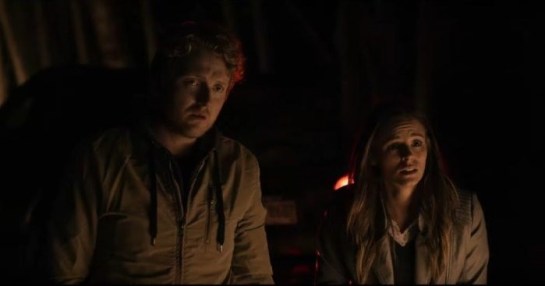
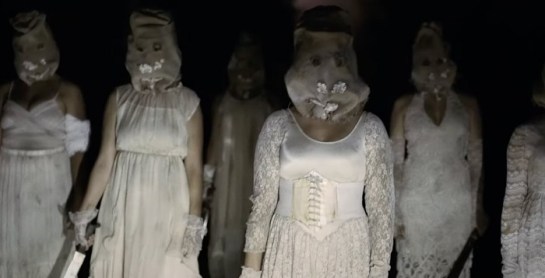
*Note to all horror movie characters: If you use a GPS expect bad things to happen. That’s definitely the case here. Spencer follows his GPS down a gravel road that winds through a dense forest. Suddenly his phone zaps out and his car dies. An apprehensive Cami thinks it’s all an act while Spencer swears to the contrary. Aside from the eerie things that begin happening in the woods around them, Nader keeps the suspicion and mistrust between his two stranded characters his focal point. At least until a creepy old lady on a tractor pulls up and tells them they have been marked by a schlocky terror called the Toll Man. And the only way off his road is to pay him…in blood.
TOLL2

Image Courtesy of Lionsgate

You would think this would lead to some meaty horror mythology where we learn of the Toll Man, his background, his motivations, etc. But actually we get none of that. Instead we just see the tall, slender, pointy-fingered being with a bag over his head terrorizing Cami and Spencer, mostly through life-like visions that poke at past traumas. Heavy references to suicide, child abuse, rape, and victim-shaming all come up but not in a way that adds much weight to either character. Just as a way to prod Cami and Spencer and drive them to do the Toll Man’s bidding. Meanwhile the poorly defined Toll Man himself is left as this ambiguous nothing. He and his minions have the horror movie look, but I never understood them or their existence.

One thing “The Toll” does really well is create atmosphere. The genre has already established that ‘nighttime in the woods’ is a great horror setting. Nader knows this and utilizes it to great effect. His camera choices and especially his strategic use of lighting give the film an uneasy kick. Unfortunately it’s the story that runs out of gas right when it should be picking up. The intro is tense and suspenseful, but by the end it’s inability to sell or even explain its big baddie left me questioning the point of the entire second half. “The Toll” is now streaming on VOD.

VERDICT – 2.5 STARS

2-5-stars

REVIEW: “Tom & Jerry” (2021)

TOMposter

You can count me among the many who grew up watching “Tom and Jerry”. Not the countless straight to DVD feature films, but the classic Hanna and Barbera shorts that have played and replayed for decades. And as a testament to their timelessness, my two kids (both in their upper teens now) latched onto the cat and mouse rivals when they were children, cackling at their wacky hijinks and watching them whenever they were on television.

This latest iteration of the titular slapstick duo has been in the works since 2009. Created as a live-action/computer-animated mash-up, “Tom & Jerry” is helmed by director Tom Story. The story takes place in New York City where all animals (and only animals) are animated. Don’t ask me why. I really have no idea. Weird singing pigeons, elephants, peacocks, a bengal tiger, and of course Thomas D. Cat and Jerome A. Mouse, all vividly animated and melded into the real-world setting. Right off the bat you notice the animation as one of the film’s strengths (except for the annoying pigeons but that’s enough about them).

You might think Tom and Jerry would be the stars of their own movie but that’s not the case. In fact they often play second fiddle to the human characters, namely Kayla (Chloë Grace Moretz). She’s a down-on-her-luck twenty-something who has lost her job but fibs her way into a temporary position at New York City’s Royal Gate Hotel. She wins the trust of the hotel’s manager Rob Delaney but catches the ire of Terrance (Michael Peña), the event manager and the film’s human antagonist. What’s funny is that he’s also the only person smart enough to recognize how ridiculous things become.

TOM2

Image Courtesy of Warner Bros.

It turns out the Royal Gate is set to host the proverbial ‘Wedding of the Century‘ between high society socialites Ben (Colin Jost) and Preeta (Pallavi Sharda). Preparations are underway but are instantly threatened when both Tom and Jerry arrive. Unfortunately we only get their signature chaotic mayhem in a few small bursts and in ways that only seems to serve the human characters and their stories. The film is mostly focused on Kayla who’s tasked with removing the mouse problem once Jerry moves into the hotel. And what better way to impress management and secure full-time employment than getting rid of the rodent and saving the big wedding? So she hires Tom to discreetly help. Guess how that goes.

So basically Tom and Jerry end up relegated to supporting duty for the trite and shallow human stories. In fairness asking two non-speaking animated characters who were at their best doing six-minute shorts to carry a movie like this is a tall order. But this movie needs more of them. Still “Tom & Jerry” does have a playful spirit which young kids will enjoy and it scatters a few giggles along the way which keep it from being too dry. And while this is no “Who Framed Roger Rabbit”, the classic 2-D animation is a warm and nostalgic touch. If only those pesky (and boring) human characters would have stayed out of the way. “Tom & Jerry” is now showing in theaters and streaming on HBO Max.

VERDICT – 2.5 STARS

2-5-stars

REVIEW: “The True Adventures of Wolfboy” (2020)

WOLFposterrr

I can honestly say I had no idea what to expect from “The True Adventures of Wolfboy”. I mean let’s be honest, its title alone lends itself to a wide range of expectations and conjecture. But the emotionally rich opening ten minutes let me know I had misjudged this coming-of-age indie. I’m not saying it’s without flaws, but don’t let it’s curious title fool you. “Wolfboy” has a heart and a message that will resonate with many. I just wish the second half was a little more sure-footed and the finish as impacting as the beginning.

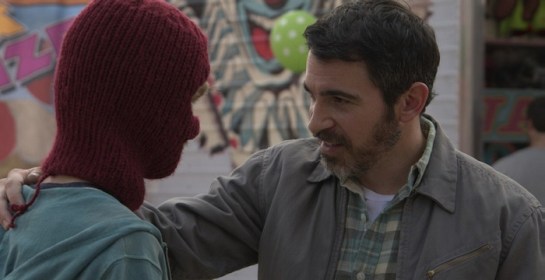
The opening scene hints that “Wolfboy” is more than your standard fare. A 13-year-old boy named Paul (Jaeden Martell of “It” fame) looks into a mirror desperately trying but failing to convince himself that he’s “a normal boy”. Paul has “a condition” that causes thick hair to grow all over his body including his face. As a result he’s considered an outcast and subjected to constant ridicule and bullying. It’s so bad Paul wears a ski mask to hide his face. It’s a heartbreaking scenario especially when it becomes clear the cruelty is taking a toll.

WOLF1

Photo Courtesy of Vertical Entertainment

Paul’s mother ran away after he was born leaving his father Denny (Chris Messina) to raise him. Denny clearly loves his son, but his well-meaning yet misguided “help” clearly isn’t working. Things like asking Paul to take off his mask at a crowded carnival so he can stand up for himself against the inevitable reactions he will get. Or offering to send him off to a private school for ‘special’ kids. It’s one of those cases of a father who never seems able to say the right thing. Meanwhile Denny is growing more and more frustrated at his inability to make things better for his son.

On his birthday a mysterious package arrives for Paul. Inside is a note from his mother claiming that answers await him at a Pennsylvania address whenever he’s ready. A flustered Paul grabs a map and sneaks away from home, heading to the Keystone State in hopes of finding his mother and the happiness that has long escaped him. But he quickly learns that it’s the journey itself which opens up the world to him and sets him on his path of true self-discovery.

It’s here that director Martin Krejčí and screenwriter Olivia Dufault shift to a road trip movie of sorts, introducing several unique characters for Paul to encounter along the way. First he has a run-in with a slimy, opportunistic carnival owner named Mr. Silk (John Turturro). After that he’s befriended and joined by the enigmatic Aristiana (Sophie Giannamore), a hard to figure out character who sometimes seems more fantasy than real. And later he meets a hellion named Rose (Eve Hewson) who sports a killer eye-patch and has a penchant for robbing convenient stores. For Paul it ends up being an adventure full of firsts.

WOLF2

Photo Courtesy of Vertical Entertainment

The ragtag group of new friends bounce from place to place on the road to Pennsylvania. It’s here that the movie hits a few snags. While the group’s antics convey a sense of liberation for Paul, the scattershot storytelling causes the film to lose some of its intimacy. Characters have some worthwhile moments together, but they’re often bookended by more playful yet far less compelling scenes. As a result the tone of the story ends up all over the place. It takes Paul reaching his destination for us to once again feel the same deep emotional draw as in the film’s earliest scenes.

Great talents like Chloe Sevigny and Stephen McKinley Henderson show up later in the film and are given pivotal roles but little screen time. Still both bring a needed gravitas to their characters and the story which ultimately plays out as part reality, part fairytale. The two don’t always meld together as smoothly as the filmmakers would like, but I admire its willingness to try new things even if they don’t always land. “The True Adventures of “Wolfboy” premieres October 30th on VOD.

VERDICT – 3 STARS

3-stars

REVIEW: “The Trial of the Chicago 7” (2020)

TRIALposterrr

In one way Aaron Sorkin is the perfect person to make a meaty courtroom drama about the notorious Chicago Seven. The accomplished wordsmith is more than capable of covering such a dense story and its numerous players. On the other hand Sorkin has never been shy about his firm political leanings, and this particular subject (especially in our current hyper-partisan climate) could offer temptations too tempting for him to pass up.

Sorkin’s new film “The Trial of the Chicago 7” proves to be a bit of both. It’s an enthralling, fast-moving and at times unexpectedly funny courtroom drama. At the same time you never doubt where Sorkin’s sympathies lie and history occasionally takes a backseat to the film’s obvious relevance-seeking predilections.

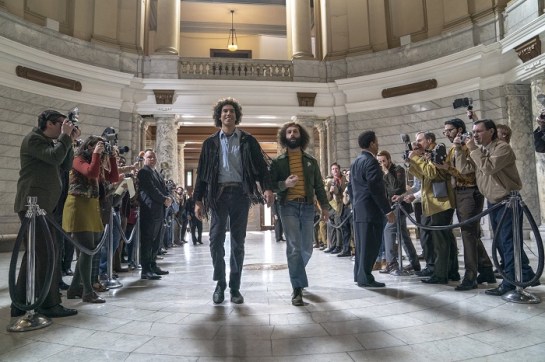
First slated as a Paramount Pictures big screen release before being sold to Netflix, “The Trial of the Chicago 7” follows a group (originally made up of eight and then eventually seven) of anti-Vietnam War and counterculture protesters who were arrested and charged with conspiracy and inciting riots (among other things) at the 1968 Democratic National Convention. They were considered leaders of various anti-establishment groups with diverse backgrounds and motivations – political activists, flower children, anarchists, and revolutionary socialists. Their reputations put them in the sites of the authorities and made them quick targets for the already defensive state and local governments.

TRIAL1

Photo Courtesy of Netflix

Sorkin tells the story completely from the points-of-view of the eight men charged and their supporters. Outside of a brief table-setting opening montage and a handful of flashbacks, the entire film is set in and around the courtroom. Sorkin puts a strong spotlight on the gross mishandling of the proceedings by a biased Judge Julius Hoffman (Frank Langella) even throwing in some fictional demonizing as if history needed it. He also shows the sheer circus the trial became in large part due to Judge Hoffman’s unconstitutional antics, but equally due to the showmanship of the defendants, specifically from yippie leader Abbie Hoffman (Sacha Baron Cohen).

The story proper begins with Joseph Gordon-Levitt’s Richard Schultz, a young, idealistic federal prosecutor handpicked by the Attorney General John Mitchell (John Doman) to get a conviction in the trial against the activists. Schultz is one of the only people outside the protesters circle with the slightest bit of nuance. He’s essentially a government pawn but he’s also the only one who sees the potential risks of prosecuting this particular case. “We are giving them exactly what they want” he warns his boss, “a stage and an audience.”

Across from him is defense attorney William Kunstler (Mark Rylance), a radical lawyer and activist who knows the law and quickly begins to realize the deck is stacked against him. He has the toughest job of any – defending in a trial ripe with corruption while trying to keep his motley band of clients on the same page. The wild card is Black Panther co-founder Bobby Seale (Yahya Abdul-Mateen II). He’s the eighth man with no real attachment to the other seven but connected by the government solely so the feds can target the Panthers. Stripped of his constitutional rights and dehumanized in the very courtroom that should stand for justice, Seale’s plight is the most tragic.

The Trial of the Chicago 7

Photo Courtesy of Netflix

Rounding out the film’s plump star-studded cast: Eddie Redmayne is shaky in places but mostly solid playing disaffected leftist cage-rattler Tom Hayden. John Carroll Lynch is a nice fit playing non-violent socialist activist and family guy David Dellinger. Michael Keaton gets a small but welcomed role playing former Attorney General Ramsey Clark. The one flatline performance comes from the usually solid Jeremy Strong. He seems out of sync playing hippie counterculture radical Jerry Rubin. He both underplays and overplays several scenes and never quite feels comfortable with his approach to his character. Still, the biggest head-turners are Cohen and Langella. Oscar nominations wouldn’t be undeserved.

Sorkin’s snappy pacing and signature rapid-fire dialogue zips us through the story, giving us a good sense of the legal turmoil while providing plenty of memorable character moments. As you would expect from a Sorkin film, most of the dialogue is whip-smart and flows with an energetic rhythm that keeps you honed in on every exchange. But surprisingly there are instances where it can come across as stilted and self-conscious. Characters will drop lines that feel custom written for a movie scene rather than natural to the story. And then there’s the ending, a rushed “notice me Oscar” finish that lays on the melodrama complete with swelling orchestration. Considering everything the film does well, the ending resembles something packaged from an awards-conscious studio.

Unfortunately in an effort to venerate his protagonists Sorkin ends up robbing his film of its true-story complexities. The Chicago Seven weren’t without blemishes – Rubin’s affection for Charles Manson, Hoffman’s cocaine dealing, Kunstler’s rogues gallery of clients. And while Sorkin tosses in a ten-second clip of Rubin and Hoffman teaching followers how to make Molotov cocktails, there’s really nothing morally complex about them. Sorkin writes a very white hat/black hat tale that leaves practically nothing for us to wrestle with. Still, he’s a good enough writer to energize the many characters and tell a mesmerizing story even if it’s only a subjective CliffsNotes version.

VERDICT – 3 STARS

3-stars

REVIEW: “Tenet” (2020)

TENETposter

Christopher Nolan’s high-profile career has reached a point where every new movie of his is buzz-worthy. Every new project grabs headlines and energizes the box office. Each new film leave both critics and moviegoers eager to talk, write, scrutinize, hypothesize, and debate. And whether you like his style or not, his movies have become events especially for those of us who proudly call ourselves Nolan fans.

So naturally when I first heard of “Tenet” I was elated. When it was understandably delayed I was dejected. But now that I’ve finally seen it I’m ecstatic. Why? Because “Tenet” is an incredible experience and unlike anything you’ve seen before. “Tenet” is indelibly a Nolan picture through and through – smart, cerebral, highly original, insanely well-made, and full of big ideas. Like many of his other films it won’t be for everybody. In fact it may be his most inaccessible. But who can deny the amazing craftsmanship and cinematic wizardry Nolan (once again) showcases?

TENET1

Photo Courtesy of Warner Brothers

“Tenet” isn’t just highly anticipated. It’s also considered to be an important film particularly in this current COVID-19 global landscape. After being closed for months hurting movie houses and theater chains around the world are depending on “Tenet” to revitalize big screen enthusiasm while giving much-needed boosts to their bottom lines. Meanwhile moviegoers have set sky-high expectations which his film (and no other film for that matter) could ever fully reach. In those regards “Tenet” may not be in the most enviable position. But I see Nolan, a consummate professional at his craft and an ever-growing student of cinema, fully embracing those lofty responsibilities.

Nolan’s latest mindbender sees him once again pushing blockbuster boundaries, many that he helped set. With a massive overall budget eclipsing $300 million and an even bigger vision, “Tenet” is the filmmaker’s biggest movie to date. It’s essentially a spy thriller that takes many of the genre’s elements and turns them on their heads. And it features yet another star-studded cast rich with fresh faces and some Nolan favorites. Leading them is John David Washington, a terrific young-ish actor with an exceptional pedigree (he’s the son of Denzel). Robert Pattinson, Kenneth Branagh, Elizabeth Debicki, Michael Cane, Clémence Poésy, Dimple Kapadia and Aaron Taylor-Johnson round it out.

TENET4

Photo Courtesy of Warner Brothers

Nolan has always enjoying playing around with time, but in “Tenet” he has a field day. It’s key to note this is not a time travel movie. Instead it deals with a concept called time inversion. It’s an integral part of Nolan’s story and essential to understanding the movie’s dense and shifting plot. In the future an Oppenheimer-esque scientist develops an algorithm that can cause objects to travel back in time. Overwhelmed by the catastrophic impact such a creation could have (namely the destruction of reality as we know it), the scientist splits the algorithm into nine pieces, hides them in different places in the past, and then commits suicide. This ‘inversion’ turns out to be the marrow of Nolan’s story. It’s the cause of the conflict, it’s what drives the antagonist, and it’s the only way to save the world.

It all begins with a stunning prologue set at a Ukrainian opera house. Oozing charisma, Washington plays a CIA agent known throughout the film only as the Protagonist. He and his small team of operatives arrive at the opera house to rescue an exposed government asset from a terrorist group during a symphony performance. During the extraction the Protagonist is saved from a terrorist’s bullet by a mysterious masked man in search of an artifact. The man gets away but the Protagonist and his team are captured and tortured by the baddies. But instead of giving away his colleagues, the Protagonist takes a cyanide capsule.

TENET3

Photo Courtesy of Warner Brothers

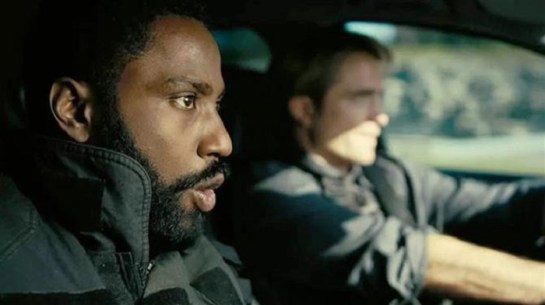
He wakes up to even more shadowy figures who tell him the cyanide capsule was fake, his team is dead, and he has passed their group’s test. He is informed of something called Tenet and learns that the group’s scientists have discovered inverted bullets. Fearing the possible dangers, the group tasks the Protagonist with tracking down who is inverting ammunition and for what reason. The trail leads him to a Russian arms dealer named Sator (a cold and quietly menacing Branagh) who may be communicating with the future. The Protagonist tries to get close to Sator through his estranged wife Kat (Debicki) but that proves tougher than anticipated. So he and his recruit Neil (Pattinson), who always seems to know more than he’s letting on, use more “dramatic” methods to try and get what they need.

That doesn’t sound too confusing, right? Well you ain’t seen nothing yet. Thermodynamics, the Grandfather Paradox, Temporal Pincer Movements – just some of the subjects you’ll encounter along the way. But don’t worry, it’s not like sitting through a science lecture. Nolan takes a very specific approach to telling his story. He begins by bombarding you with information and terminology. Characters are rapidly added, sometimes only for a scene or two, and each have their own unique pieces to add to the puzzle. It can feel a bit overwhelming which seems to be where Nolan wants us. It makes it all the more impressive once those meticulously placed pieces begin to fit together.

TENET2

Photo Courtesy of Warner Brothers

The scale of Nolan’s imagination isn’t restricted to just the storytelling. As you would expect “Tenet” is a technical marvel and a visual feast. Once again working with cinematographer Hoyte van Hoytema, Nolan concocts some truly astonishing action sequences. Fist fights, car chases, a crazy stunt with a Boeing 747 – I hate to repeat myself, but these are moments unlike anything you’ve seen before. And two particular scenes involving what are called inversion “turnstiles” are some of the most creative sequences Nolan has ever conceived.

I can think of only one lone complaint I have about “Tenet”. Swedish composer Ludwig Göransson (filling in for Nolan regular Hans Zimmer) puts together an dazzling score. But the sheer volume during a few scenes made hearing the actors next to impossible. And this wasn’t just an issue isolated to my theater. Other than that Christopher Nolan has once again done what he does best – create an exhilarating cinematic experience aimed at wowing you visually and challenging you intellectually. It’s story is sure to be too dense for some, especially those wanting more easy-going blockbuster fare. But for everyone else buckle up, put your thinking cap on, and enjoy the ride. We don’t get movies like this very often. “Tenet” opens wide this weekend only in theaters.

VERDICT – 5 STARS

5-starss

5star

REVIEW: “The 24th” (2020)

24poster

Named for the all-black Twenty-Fourth United States Infantry Regiment, Kevin Willmott’s “The 24th” tells the story of the Houston riot of 1917. On the night of August 23rd members of the 24th, driven by relentless Jim Crow era racism, police harassment, and a bit of misinformation, took arms and marched into Houston. By the end of the night eleven civilians, five policemen, and four soldiers including a Captain in the National Guard had been killed as a result of their mutiny.

Willmott co-writes the story with the film’s star Trai Byers. Their setting is a compelling one. In the summer of 1917 World War I was brewing in Europe while at home black communities were being violently targeted by angry white mobs in several US cities. It was during this tense and racially-charged time that the 24th Infantry Division were sent to guard the construction of Camp Logan, three miles outside of the city of Houston. The camp was to train white soldiers before they were deployed to France. The 24th went there with similar aspirations of serving their country but ran head-first into hate and persecution.

241

Photo Courtesy of Vertical Entertainment

Much of the movie’s uneven first half plays like a series of racially volatile encounters. Several of them are effective on their own and they do a good job conveying the ugliness of the setting. But there isn’t much connecting one scene to another. The biggest casualty in the earlier scenes is the character building. It takes a while before any of the 24th actually develop individually. When some of the players finally do, the story gets a much-needed boost.

Byars gets the meatiest role playing William Boston, a highly educated and idealistic young soldier hungry to join the war effort. He instantly clashes with his cynical first sergeant (Mykelti Williamson) who is quick to judge Boston’s buoyancy as a sign of weakness. At the same time he and other members of the 24th routinely encounter prejudice from the camp’s white soldiers. So Boston is caught in the middle, forced to prove himself to the bigoted white officers and to his jealous fellow black servicemen. And his friendship with his sympathetic white commanding officer (a fairly wooden Thomas Haden Church) doesn’t win him any fans.

242

Photo Courtesy of Vertical Entertainment

This is the film’s most compelling dynamic and it leads up to the inevitable mutiny and march into Houston. The lid blows off as the men of the 24th are pushed to the point where the line between right and wrong are blurred at best, completely rubbed out at its worst. It’s an ugly and violent final act – a complex melding of righteous indignation and cold-blooded murder. In some scenes Willmott attempts to dull the edge of the killings. But he also makes it uncomfortable to watch and he captures the pure, pained emotions of the soldiers. “Ain’t nobody innocent here soldier,” the sergeant rationalizes. “Not them, not us, nobody.” It’s a really difficult line to walk.

As the movie ended I was left with a feeling of sadness and conflict (although I’m not sure if that was the film’s intent). Willmott and Byers do a nice job boiling up the anger in not only the oppressed 24th but also any fair-minded viewer. And while they effectively show how unconscionable treatment can push people to unconscionable actions, the film’s judgements are pretty muted. Unfortunately the movie’s dependence on archetypes shortchanges several of its characters. And some story angles don’t get the attention they need. Take Boston’s romance with a local girl named Marie (Aja Naomi King). It’s genuinely sweet yet wedged in and underwritten. Those are the kinds of things that strip “The 24th” of certain personal connections it needed to truly stand out. Still, I’m glad I watched it and it’s a story that needs to be told. “The 24th” is now available on VOD.

VERDICT – 3 STARS

3-stars