REVIEW: “To Kill A Mockingbird”

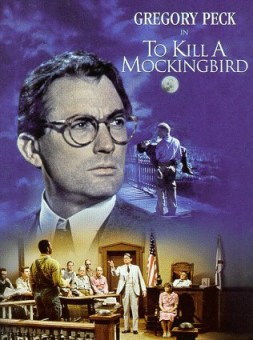
Classic Movie SpotlightMOCKINGConsidered an American movie classic, “To Kill a Mockingbird” is one of the best films to come out of the 1960’s and features what many consider to be Gregory Peck’s finest performance. It was nominated for eight Oscars, a winner of three, and was listed in The National Film Registry in 1995. In many ways “To Kill a Mockingbird” is a time capsule. Each time I watch it I’m transported back to a time that in many ways was kinder and gentler but not without its own open wounds. What’s most impressive is that it manages to do this without ever feeling unimportant or dated. It feels just as powerful and relevent now as it did when I first saw it.

The movie is based on the Pulitzer Prize winning novel by Harper Lee about the small town of Maycomb, Alabama during the 1930’s. Gregory Peck plays Atticus Finch, a town lawyer and a single father of two young children. Atticus is asked to represent Tom Robinson (Brock Peters), a black man who is accused of beating and raping a white woman. Atticus believes in the judicial process and believes Tom to be innocent. But even before the trial, many in the town have already judged Tom to be guilty and tensions soon reach the boiling point.

Peck won the Best Actor Oscar for his performance and many have said it was because of the striking similarity between him and his Atticus character. Atticus is a true man of character and integrity. He stands up for what’s right and tries to instill that same principle in his children. But while the trial and the fallout is a key part of the story, it’s not the main part. The movie’s bigger focus is on Atticus’ children, his son Jem (Phillip Alford) and his daughter Scout (Mary Badham). We first see them in all their innocence, from their imaginative playtime to their light-hearted mischief. Jem and Scout just live their life with a care-free child-like approach that I was really, really drawn into. Perhaps the wonderful portrayal of their innocence helps make what comes later so much more powerful.
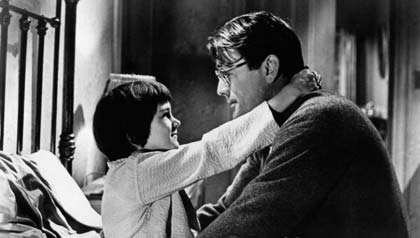
At its core, “To Kill a Mockingbird” is about the loss of innocence. Eventually things unfold through the eyes of the children that reveals to them the darker and more troubling aspects to the world they live in. As the town begins to react to the alleged rape and the tensions leading up to the trial date rise, the kids see things that leave them confused and often times scared. The way director Robert Mulligan switches his camera to the children as they’re watching these harsh and disturbing things unfold is beautifully executed yet so heart-breaking. But yet it’s true and authentic. Unfortunately, as kids we’ve all had those moments. Moments when we realized that the world wasn’t just about tire swings and ice cream. Moments that we see the dark side of society and the people around us. But that’s also when the light shines the brightest and for these kids, their father Atticus was certainly a shining light.

There are several other smaller but equally enthralling side stories and side characters in the movie. Jem and Scout make friends with a young boy named Dill (John Megna) who comes to visit his Aunt Rachel each summer. I loved Dill and the three have some great scenes together including their investigations into Boo Radley, a mysterious crazy man who is believed to only come out of his creepy broken-down house after dark. Robert Duvall plays Boo in what was his big screen debut. I also loved Jack K. Anderson’s performance as Bob Ewell, the slimy and disgraceful father of the rape victim. He’s a despicable man and his vitriol hatred makes him an easy character to dislike. Everyone is well cast and the performances are spot-on.

I also loved the way the film visually captured the 1930’s Depression-era South. By the end of the film you really feel as though you know Jem and Scout’s neighborhood as if it were your own. The subtle things such as porch swings, school attire, and southern accents all give the movie such a homey and believable feel. But the movie doesn’t shy away from the deep racial divide and clear bigotry that was a problem at that time. It shows a warped and broken social structure that put personal hatred above justice and makes no apologies. We see this in not only the story itself but also in the striking visual details as well.
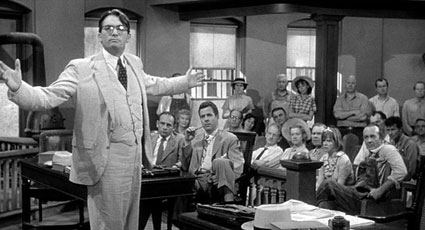
 I think my only real issue with “To Kill a Mockingbird” was with the courtroom scene. Now don’t misunderstand me, it was a great extended scene. But it felt to me like something was missing. With a couple of exceptions, there wasn’t a lot of emotion or intensity. It also seemed as though everything moved and flowed perfectly with nothing to buck the plans of the defense or the prosecution. Now I understand that the courtroom scene itself wasn’t intended to be the centerpiece of the picture. But I really felt it could have had a little more “pop”. That said, Peck was fantastic in the scene and his questioning of Bob Ewell and Tom Robinson were fantastic moments in the film.

“To Kill a Mockingbird” does so many things right that it’s easy to overlook the small faults. Peck certainly deserved his Oscar as he is brilliant playing, as many believe, himself. Atticus Finch really touched me especially as a father trying but failing to shield his kids from the sick side of the world they live in. That father/children relationship really, really worked for me. But the movie also had so many other components that resonated with me and that’s another reason it’s so good. It’s a multifaceted story that’s told with a great visual and technical style and that isn’t ashamed to address the deep-rooted problems of that day. It’s been called “timeless” and I have to agree. It never gets old and it still has the same effect on me today as it always has.

VERDICT – 4.5 STARS

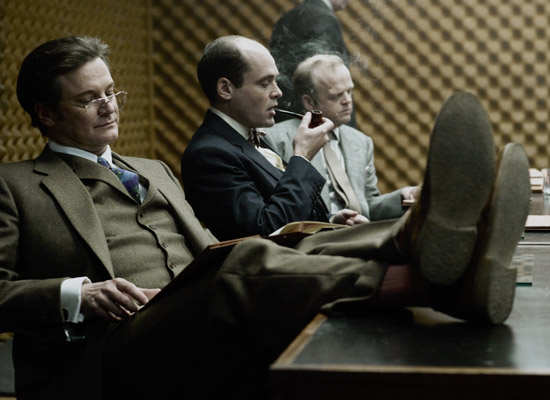
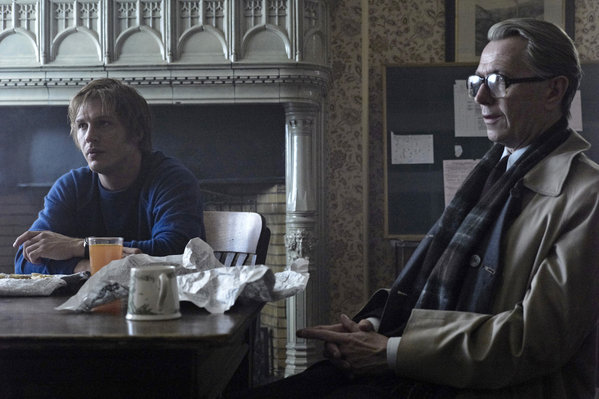
“TINKER, TAILOR, SOLDIER, SPY” (2011) – 4 STARS

Bringing “Tinker, Tailor, Soldier, Spy” to the big screen was a pretty tough challenge. The movie is adapted from John le Carre’s complex 1974 spy novel of the same name. In 1979 it was adapted for television in the form of a seven part mini-series. So trying to condense the story down to two hours while maintaining its tense spy thriller feel was quite an undertaking. But hats off to director Tomas Alfredson and screenwriters Bridget O’Connor and Peter Straughan for not only pulling it off but for delivering a deep and enthralling picture.

I was first attracted to “Tinker, Tailor, Soldier, Spy” thanks to its stellar cast. The film features a veritable who’s who of british actors. Any movie that features the incredible talents of Gary Oldman, Colin Firth, Tom Hardy, Mark Strong, John Hurt, Toby Jones, and Ciaran hinds (who is actually Irish) is automatically off to a good start. Some of my favorite actors are in this bunch and here they really shine. Each perfectly relay the antsy Cold War paranoia that this type of movie calls for. Not one performance is disingenuous or fake. In many ways you can call this an acting clinic.

The film takes place in the early 1970’s. George Smiley (Oldman) is called back to British Intelligence, also known as “The Circus”, to root out a high level “mole” who is believed to be leaking highly classified intelligence to the Russians. One year earlier Smiley along with his boss Control (Hurt) had been forced out after a botched assignment caused the capture of an agent (Strong) in Hungary. Since Control has been removed, the Circus is being run by Percy Alleline (Jones). Working alongside Alleline is Bill Haydon (Firth), Roy Bland (Hinds), and Toby Esterhase (David Dencik). Smiley puts together a team to help find the mole. An important piece of the puzzle is an agent named Ricki Tarr (Hardy). Tarr is the one who made the allegation of a mole and may have even more information that could bring everything to light. Smiley must sift through the misdirections and false leads to find the identity of the mole and the four Circus higher-ups are prime suspects.

“Tinker, Tailor, Soldier, Spy” rewards patience. It’s a story that unfolds through a slow leak of clues and cleverly timed flashbacks. It’s a complex and layered story that requires a lot of attention and that could be what attracts many people to it (myself included). On the flip side I can see where some may be dissuaded after seeing the story as a muddled, convoluted, and almost laborious exercise. I’m not going to lie and say I completely grasped everything I was seeing. It did take a few rewinds and a little research to really put everything together. In some ways that did take away from the experience but on the other hand everything was presented. While it’s deliberate and sometimes dry, O’Connor and Straughan’s script is tight, structured, and clearly intends to make the audience work right alongside of Smiley.

Another thing you will instantly notice is the careful attention to the look and presentation of the movie. Alfredson’s direction is quite good and the mood and tone is just right. The movie is saturated with blues and greys that creates a cold, sullen atmosphere. The steel-faced agents are in a constant state of seriousness to the point that any smile automatically evokes suspicion from the audience. Oldman’s understated performance is pitch-perfect. Smiley is tired and worn but committed and resolved. His weathered poker-face hides his thoughts and intentions from the other characters and from us. Even Tom Hardy’s strange-looking blonde wig seems perfectly in tune with the picture.

This isn’t a spy movie in the same vein as James Bond or Jason Bourne. I’m certainly no expect of being a secret agent but this feels as real and grounded as any spy movie I have seen. It’s slow-moving and sometimes difficult to navigate but it’s also smart and completely engaging. It’s top-tier cast makes things even better and the movie would be worth seeing just for the wealth of acting talent involved. “Tinker, Tailor, Soldier, Spy” isn’t a film for everyone. But I found myself completely invested even if it did take a little work to get the full thrust of the story.

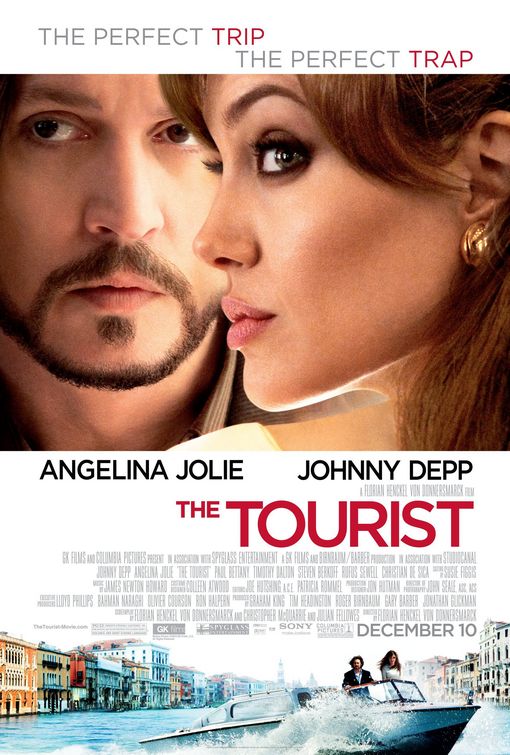
“THE TOURIST” – 2 STARS

You would think a movie starring Johnny Depp and Angelina Jolie, two of the biggest movie stars in Hollywood, would give us fun and charismatic performances even if the material wasn’t the best. Perhaps one of “The Tourist’s” biggest letdown is that it features two of the flattest performances of these two actors careers. Combine that with a rather inconsistent and preposterous story and you have a film that isn’t nearly as good as it should have been.

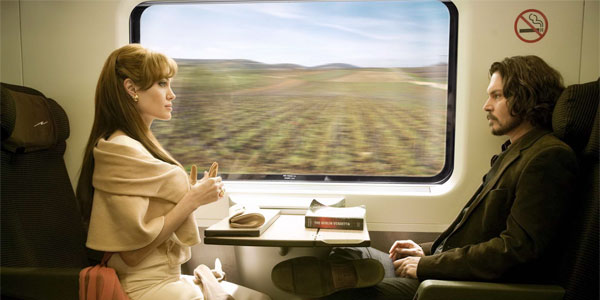
The movie begins with the French police following a woman named Elise (Jolie) who, after receiving a letter from a mysterious man known as Alexander Pearce, hops a train and heads to Venice where the two will rendezvous.  Once onboard she targets and manipulates an American math teacher and tourist named Frank (Depp) who she uses as a decoy to knock her pursuers off track. After arriving in Venice, Frank soon finds himself being pursued by Reginald Shaw (Steven Berkoff), a gangster who has mistaken him for Pearce. Also in the mix is John Acheson (Paul Bettany), an Inspector from Scotland Yard who is after Pearce as well. From there the movie becomes a rather absurd picture that lacks any real pizzaz.

 The story tries to be both a comedy and a thriller but it never fully succeeds at either. It’s attempts at comedy are so underplayed that they are virtually nonexistent. It’s two big twists/revelations do nothing to make it a quality thriller. It’s lack of identity is made worst by the complete lack of chemistry between Jolie and Depp. Both feel like cardboard cutouts and it’s impossible to buy into any real attraction between the two. It’s hard to believe I’m calling a Johnny Depp performance lifeless but here he’s utterly emotionless. Jolie spends most of her time making seductive faces for the camera and seems just as cold as Depp. I don’t want to assume this was just a cash grab especially since these two actors are pretty sought after but it certainly feels like it.

One thing you have to give “The Tourist” is that it’s beautifully filmed by cinematographer John Seale. Whether it be the streets of Paris, the French countryside, or waterways of Venice, Seale captures the sheer beauty of these European locales and I have to admit, it really drew me in. And while the story is full of holes, it’s really quite harmless and there are moments that I found entertaining. But even with its good-looking cast and locations, “The Tourist”  is too shallow, too flat, and ultimately forgettable.

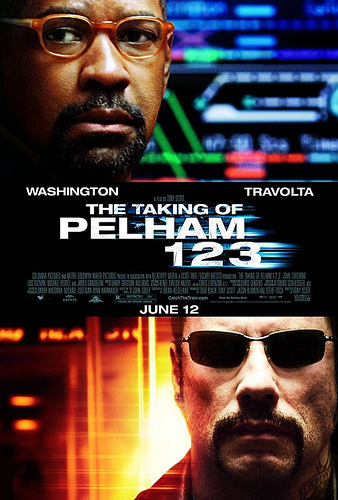
REVIEW: “The Taking of Pelham 123” (2009)

I bet these guys didn’t expect their day to go like this? That seems to be a reoccurring question in Tony Scott’s “The Taking of Pelham 123”, a stylish but sometimes preposterous remake of the 1974 film. At its core this is a pretty formulaic, run-of-the-mill action thriller that takes no chances but also never wastes a moment. It moves at a quick and fluid pace which makes overlooking it’s shortcomings a little easier but not impossible.

“The Taking of Pelham 123” has all the bells and whistles of a Tony Scott production. The quick camera jerks, clever angles, and showy pyrotechnics work well to create an intense environment. In fact often times his camera adds more tension than the screenplay can muster. Scott has a recognizable style and can sometimes be called self-indulgent. He flirts with that label here but as a whole his high-tech machinations work just fine. It often times overcomes the story which is pretty basic material.

The movie starts with four heavily armed men walking into a New York subway station and taking control the Pelham 123 train. The film won’t do anything to enhance your view of post-911 security. There’s no elaborate well executed plan at work. The hijackers simply walk in and take the passenger-filled train. The leader is a man we come to know as “Ryder” played by John Travolta. Sporting a crew cut and fake neck tattoo, Travolta is clearly having fun with the role even though he goes a little over the top sometimes. “Ryder” soon contacts the Subway Control Center and connects with dispatcher Walter Garber (Denzel Washington), a middle-aged husband and father of two who ends up completely out of his element. Washington has played some rough and tough roles but he also has a wonderful knack for playing these “everyday man” characters. Here he’s subtle yet expressive and I loved watching how he handles the role. John Turturro is good as a head hostage negotiator and James Gandolfini is fine as the mayor even though his character is pretty poorly written.

Pelham

While the story is fast paced and it does have its moments of tension, sometimes it’s just plain silly. For example we get a key scene involving an accidental sniper rifle discharge due to a rat bite and there’s a head-scratching sequence involving the cops transporting ransom money through the city. It’s beautifully filmed but utterly ridiculous. The story is also fairly conventionally and predictable. But the movie is also let down by a really flat and lifeless ending. It seems hurried and it packs absolutely no punch whatsoever.

In spite of the movie’s flaws, Tony Scott manages to pack some entertainment into this linear, straightforward action thriller. Washington and Travolta’s CB radio chemistry is compelling even if they aren’t saying much and Scott’s cinematic style gives the story energy and drives the tension in the scenes that do work. But the sub par material is too much to overcome. I especially hate to see such a strong Denzel performance go to waste but in reality there just isn’t enough here to make this anything more than an average movie.

VERDICT 2.5 STARS

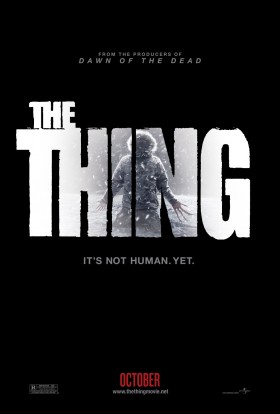
REVIEW: “The Thing” (2011)

While I would hardly call 2011’s “The Thing” necessary, this prequel to John Carpenter’s 1982 horror classic manages to capture enough of the shocks and paranoia of its predecessor to be successful. While it is indeed a prequel, in many ways it’s a remake borrowing more from Carpenter’s version than offering much new. But trying to recreate a tried-and-true formula isn’t a bad thing and “The Thing” almost nails it. It works more often times than not but it does fall victim to its own poor choices.

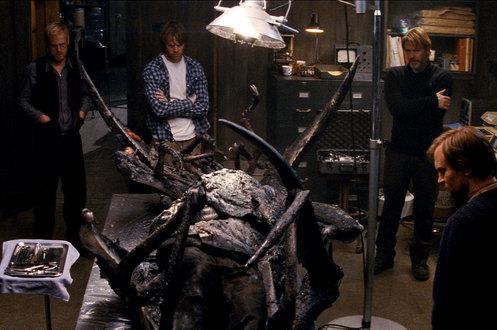
The film sets the table for the 1982 picture by detailing the discovery and unleashing of the deadly shape-shifting extraterrestrial by a Norwegian research team in Antarctica. One of the film’s biggest strengths is its desire for a fluid continuity between the two movies. Everything is connected nicely and any fan of the earlier film will appreciate the effort. Here the Norwegian team has found a UFO and a life form buried under the ice. Against wiser suggestions, the head of the group orders the creature be brought back to their base for research. After the creature reveals it’s still alive and escapes, the team learns that the alien assimilates its victims and then imitates them both physically and verbally. Soon everyone is suspected of being a host which leads to fear and panic throughout the base.

Sound familiar? Like I said, the film borrows a lot from its predecessor. It’s moody and creepy and the isolated Antarctic setting still works really well. But it never lives up to Carpenter’s version. One of the problems is the overloaded cast of characters, most of which we never connect to. Only a few characters really stand out while others feel like token kills for the alien. You could have easily cut out about five meaningless characters. They would have never been missed and the others would have benefited from it. Also while the movie does finally start to capture some of the intense paranoia of the earlier film, it seems to come and go. Carpenter’s film was driven by the paranoia and unnerving suspicions of his characters. I also thought this movie got a little off track close to the end. There’s an out-of-place sequence in the underground UFO that felt completely disconnected from the rest of the film. That was one attempt at originality that really fell flat.

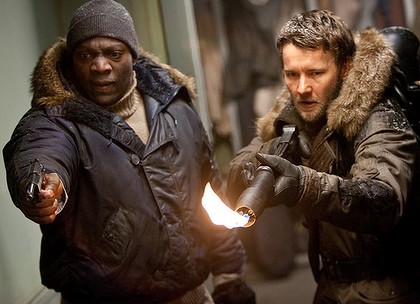
On the flip side, Director Matthijs van Heijningen Jr. does effectively employ several of the techniques used by Carpenter. And while I wouldn’t call the special effects better, the availability of CGI does give this creature much more fluid motions and his assimilations are pretty grotesque. Of course I mean that in a good way. The film is also helped by some really good acting throughout. Mary Elizabeth Winstead as especially impressive as a paleontologist who becomes the lead character. The wonderful Australian actor Joel Edgerton is also quite good as an American helicopter pilot who tends to sit on the outside of the largely scientific group. Both performances are natural and true even when the material let’s them down a bit.

“The Thing” is a film that will largely appeal to a small audience. Fans of the 1982 classic will want to see it and should find a lot to like. While it trips itself up with an overloaded cast and a few scenes which feel like they belong in another film, it does deliver that almost old-school sci-fi monster movie feel. It captures some of the paranoia that I keep harping on and it’s connection to the previous picture is very well done.  Top it off with some nice performances and you have a film that is very watchable. Oh, and did I mention they have flamethrowers???

VERDICT – 3 STARS

REVIEW: “The Tree of Life”

It’s hard to deny that “The Tree of Life”, Terrence Malick’s first film since 2005′s “The New World”, is destined to be a polarizing movie. I’ve seen it called pretentious, self-indulgent, and a muddled exercise in tedium. But I had a much different reaction. I found it to be cinematic poetry. A profound and deeply moving picture that’s cryptic yet bold and thought-provoking. It’s a challenging meditation on life, family, and God. It’s a film that doesn’t revolve around a tight, concentrated narrative. Instead it feels more like an observation of everything from the creation of the world according to Malick to the life struggles of an ordinary family in 1950′s Texas. It moves at a stylish but deliberate pace and this is sure to drive some people crazy. But I feel it rewards the patient viewer and I found myself drawn in by the artistry and emotion of the film.

In the first few minutes of the movie we see Mrs. O’Brien, (Jessica Chastain) as she is receiving a letter stating her 19 year old son is dead. She calls Mr. O’Brien (Brad Pitt) at work to let him know the tragic news. The film then moves to present day as we are introduced to Jack (Sean Penn) the oldest of the O’Brien’s three sons. Jack comes across as an emotional wreck and we find out that he is still devastated by the loss of his younger brother. He notices a tree being planted in a small construction area which triggers an extended flashback to his childhood.

Jack’s childhood revolves around something said at the first of the film. “There are two ways through life, the way of nature and the way of grace. You have to choose which one you will follow”. Jack’s dad is a man of nature. He’s a short-tempered and strict father whose hypocrisies don’t go unnoticed by his children. He has a cynical and hardened view of the world and recognizes success as beating the world at it’s own game. Jack’s mom is a woman of grace. She sees the world as a beautiful place and her faith fuels her loving and trusting nature. She’s quiet and gentle and her love of life is unquestioned even through life’s struggles. The question is which path will young Jack follow?

As we watch Jack and his brothers grow up in 1950′s Waco, Texas, Malick gives us some of the most grounded and natural portrayals of early adolescence that you will find on film. Young Jack, played by the fantastic Hunter McCracken,  has a great relationship with his brothers but always finds himself falling short in his father’s eyes. There are several painfully potent scenes that convey this and over time it leads to some disturbing changes in Jack. It’s heart-wrenching enough to watch this young boy flirt with self-destruction but witnessing his inner struggles with his actions is even more despairing. We hear him in voiceover ask ”What have I done?” He painfully states ”What I want to do I can’t do. I do what I hate.” It’s pretty weighty material and Malick doesn’t treat it halfheartedly.

Malick takes the O’Briens through trials and tragedies but he uses them to explore forgiveness, reconciliation, and peace. He’s not afraid to ask tough questions or address things such as existence, spirituality, and the afterlife. But this gets at another thing that makes this film special. It can speak to different people in so many different ways. Whether it be the spiritual subtext or the strained family dynamic, Malick takes something that is obviously deeply personal and touches the audience in a wide variety of ways.

“The Tree of Life” is a technical masterpiece and it’s impossible to talk about this film without mentioning it. Emmanuel Lubezki’s gorgeous cinematography should garner instant Oscar consideration. In many ways ”The Tree of Life” is more lyrical than dramatic therefore many scenes find their strength in imagery and camera work other than any form of dialogue. Many of Lubezki’s gorgeous shots carry more dramatic and emotional weight than almost any acted sequence I’ve seen all year. Alexandre Desplat’s brilliant score hits at just the right times during the film, weaving itself between Malick’s signature scenes featuring nature’s ambiance.

This is a unique film which calls for a unique approach by the actors. With the absence of a more precise narrative, the performances are structured around Malick’s vision. Pitt is fantastic in a conservative and more restrained performance. Chastain is graceful and has a subtle elegance. But it’s McCracken who steals the show with his authentic and measured performance. He sells every seen he’s in and Malick uses him perfectly.

“The Tree of Life” requires the audience to accept it for what it is. It’s bold and unwavering and while it could be misconstrued as a vanity project, it’s a film that’s clearly close to Malick’s heart. It most certainly isn’t for everyone, but I found myself immediately drawn in and unable to take my eyes off the visual splendor and mesmerizing meditation. It’s easy to be put off by things such as length and the lack of a focused story. But I implore audiences to judge “The Tree of Life” for what’s it’s meant to be. It touched me in many ways and it’s a film that with stick with me for a long time.

VERDICT – 5 STARS

5 STARSs