REVIEW: “Valley of the Dead” (2022)

Zombie movies come in all shapes and sizes. To further prove that glaringly obvious point, just look at the Spanish film “Valley of the Dead” which recently premiered on Netflix. Now while its name may sound like a pretty run-of-the-mill zombie horror title, a first glance of the movie teases something quite different. It starts off resembling like a heavy war movie. Shortly after it starts to play like a comedy. But ultimately things get serious when the dead come alive and begin feasting on the living.

“The Valley of the Dead” is co-directed by Javier Ruiz Caldera and Alberto del Toro. It’s an adaptation of the novel “Noche de difuntos del 38” by Manuel Martín Ferreras. It premiered at 2020 Sitges Film Festival but had its official release delayed until this year due to COVID-19. Now Netflix imports it to their platform, adding to their already large collection of international features.

While this may be a hard film to read initially, it quickly begins to reveal its identity. It’s a zombie flick for certain. But it’s also very much a war movie, a survival thriller, at times a black comedy, and a sharp critique of human division and how we cling so tightly to our differences. When it’s all put together it may not be the most innovative or groundbreaking concoction. But there’s enough action, cool period production design, and good character work to make this a pretty entertaining stew.

The story is set in 1938 and unfolds during the Spanish Civil War. It opens with a Nazi convoy pulling up to a wedding party in a small Italian village and brutally gunning them all down. A Nazi officer puts on a gas mask and then tosses a canister among the dead bodies. A blue gas pours out engulfing the deceased and then the camera cuts. And just like that you have a good example of who is ultimately behind what we are about to experience.
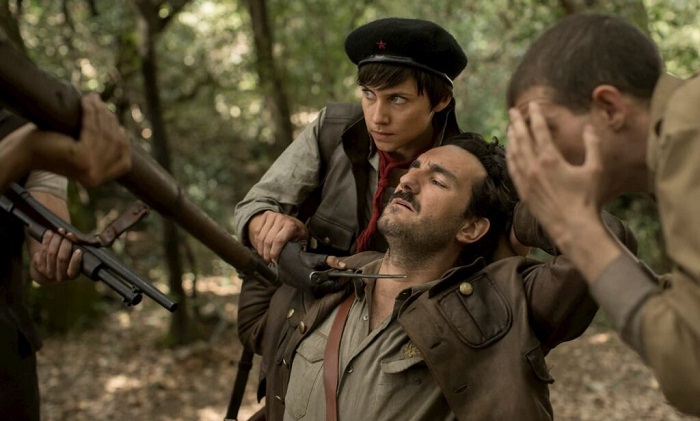
Image Courtesy of Netflix

From there we’re introduced to Captain Jan Lozano (Miki Esparbé), a perpetual troublemaker who finds himself on the brink of being executed for the third time (this time for head-butting a judge who happened to be the cousin of Francisco Franco). Just as the firing squad is about to shoot, Jan’s high-ranking uncle stops the execution. He has convinced his superiors to spare his nephew’s life. But in return, Jan will have to carry out a suicide mission. One that will take him across no man’s land to the other side of the Sierra.

Jan is assigned a 17-year-old driver named Private Decruz (Manel Llunell) and the two head out into the wild. Their first obstacle comes while checking out a downed fighter plane. The pair are surprised and taken captive by a squad of enemy rebels. But before the adversaries can sort out their predicament, they have their first encounter with the undead. Yep, it turns out the battlefield is littered with flesh-eating zombies. And if they want to survive, the Nationalists and the Republicans will have to put aside their politics and work together…if possible.

It’s not hard to see where things go from there. It becomes a story of ‘who makes it till the end’ as the band of survivors fight battles from within and without just to stay alive. There are some fun action sequences as well as some entertaining encounters between characters. There are pinches of black comedy which keep things light early on. But later, the critique of war and politics along with the divisions they cause is addressed in a number of interesting ways. For much of the film, the greatest threat to the group’s survival lies within them, not the undead.

While “Valley of the Dead” takes a few ambitious swings, ultimately it follows a pretty familiar path. You won’t have any problems figuring out how things play out. There’s actually more mystery in guessing who makes it out than how they do. Still, the period wartime setting, the variety of character types, and some genuinely fun zombie action makes for a movie with a little more to offer than you might think. “Valley of the Dead” is streaming now on Netflix.

VERDICT – 3 STARS

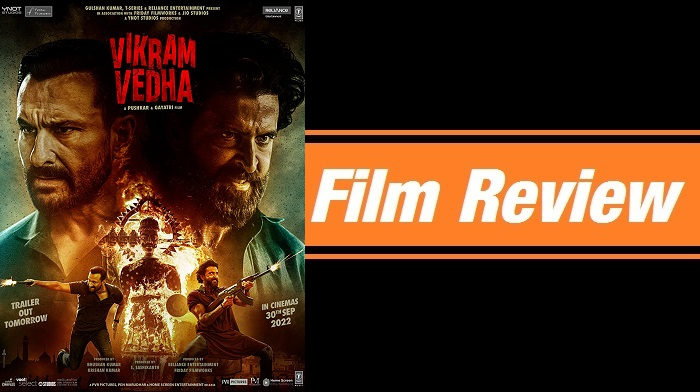
REVIEW: “Vikram Vedha” (2022)

It goes without saying that a quality screenplay is vital to any good movie. And it’s especially true in the crowded sphere of crime thrillers. Just look at some of the genre’s very best films. They’re all marked by truly great screenplays. I wouldn’t dare put “Vikram Vedha” up there with the likes of “Chinatown”, “Mean Streets”, or “No Country for Old Men”. But it’s a prime example of a movie elevated and driven by an exceptional screenplay.

“Vikram Vedha” is written and directed by the husband and wife filmmaking duo Pushkar–Gayathri. The movie is a Hindi-language remake of the couple’s own 2017 Tamil feature of the same name. Fans of the genre will have no trouble recognizing the many marks of a classic crime thriller: shady cops, mob bosses, dirty-dealings, and double-crosses. It’s part mystery, part action flick, part neo-noir, even a bit of a police procedural.

Clearly those are a lot of different ingredients. But Pushkar–Gayathri’s screenplay wrangles and weaves them together in a twisty, intelligent, and thoroughly compelling feature. I haven’t seen the 2017 original so there was no temptation to compare. Instead, it was a treat to go in blind and have a fresh experience with the story. Sure I was excited by the handful of exhilarating action scenes, the pulsating Sam C.S. score, and cinematographer P. S. Vinod’s dynamic camera. But it always came back to the screenplay, and its clever story structure, crisp pacing, and rich dialogue. It all makes the nearly 160-minute running time fly by.

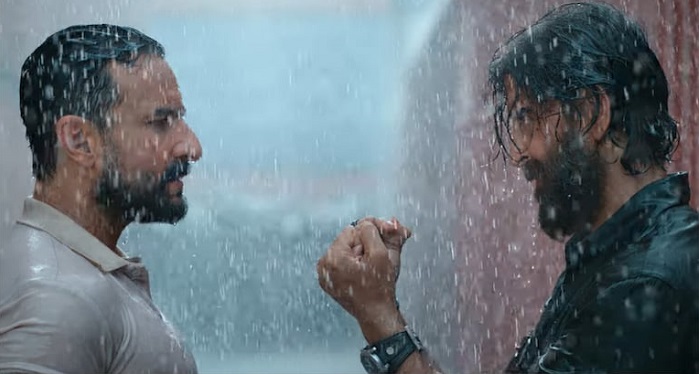
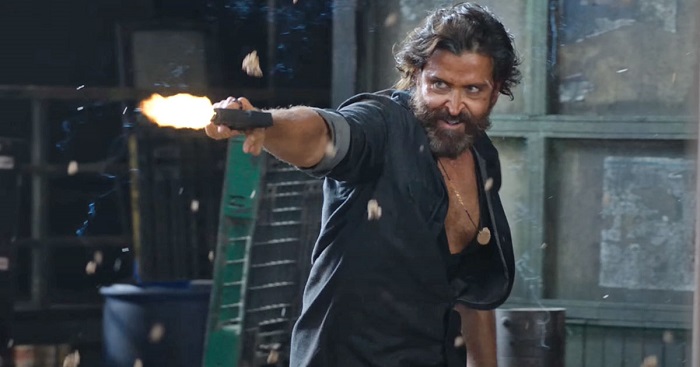
On screen, the story is led by two remarkably strong performances. Saif Ali Khan brings a steely grit to Vikram, a dedicated cop and member of a special task force aimed at taking down organized crime. Hrithik Roshan, oozing charisma, plays Vedha, a notorious gangster who Vikram’s team has made their priority. The problem is Vedha has vanished, forced underground and completely off their radar.

We learn early on that Vikram’s hands aren’t entirely clean. During a raid on one of Vedha’s hideouts, he guns down an unarmed henchman. But rather than reporting it, Vikram plants a gun and makes up a story to avoid an inquiry. “To clean filth, someone has to get their hands dirty,” he reasons to his boss and best friend Abbas (Satyadeep Mishra).

Then things take a turn. When intelligence reports a siting of Vedha, Vikram and his team begin setting up a plan to apprehend him. But they’re stunned when their most wanted target nonchalantly strolls into the police station and surrenders. Why would he come out of hiding? Why would he turn himself in? He won’t say a word until Vikram comes to interrogate him. Suddenly Vedha is ready to talk. “Shall I tell you a story sir?” he asks with a devious grin.

This begins a brilliantly written and well-acted chess match between Vikram and Vedha that plays out for the rest of film. Chunks of the story are told through flashbacks which Pushkar–Gayathri nicely utilize to fill in key details. We learn that Vedha has had a hand in sixteen murders and worked for a powerful heroin smuggler named Parshuram Pandey (Govind Pandey). But we also see another side of Vedha – one that shows his love for his little brother, Shatak (Rohit Saraf) and his efforts to keep Shatak out of the criminal lifestyle. This interesting complexity makes Vedha as much of a mystery to us as he is the Vikram.

Of course a showdown is all but inevitable, yet Pushkar–Gayathri’s keen plotting ensure the journey there is full of unexpected twists and turns. Several good supporting characters add layers to the narrative, including Vikram’s lawyer wife Priya (a really good Radhika Apte), Vedha’s arch-rival Babloo (Sharib Hashmi), and Shatak’s childhood friend Chanda (Yogita Bihani). And of course there are the bursts of action, full of stylish flourishes and driven by two Bollywood stars with wattage to spare. Put it all together and it’s hard not to be swept away by this rousing combination of savvy storytelling and popcorn spectacle. “Vikram Vedha” is now showing in select theaters.

VERDICT – 4 STARS

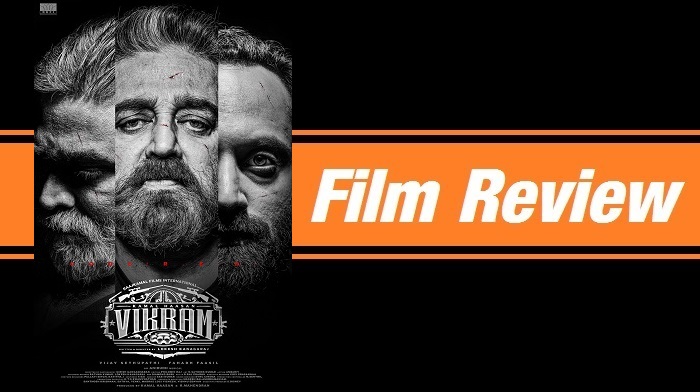
REVIEW: “Vikram” (2022)

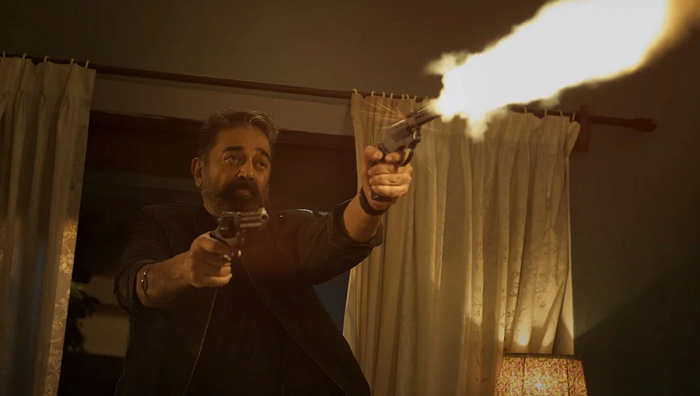
The Tamil action blockbuster “Vikram” has made its way to US streaming (Hulu) giving American audiences the chance to see their highest grossing film of the year. Written and directed by Lokesh Kanagaraj, this is the second film in his shared universe of action thrillers. It’s a movie loaded with ambition, and the craft is undeniable. But it takes some time getting into it. That’s because there are layers upon layers of plot mixed with a seemingly never-ending buildup. But once it gets its footing and all of the story threads start coming together, there’s a reasonably good crime thriller to be found.

Tops among the film’s many characters is Amar (Fahadh Faasil), the leader of an off-the-grid special unit called Black Squad. They’re an elite group who are brought in to solve crimes through methods not readily available to the more law-abiding police. Whenever they’re given a mission, Black Squad stealthily enters and melds into a city or community, connects with the locals for information, tracks down their targets, and brings them to justice by any means necessary.

In this specific case, Black Squad is called in to hunt down a masked killer who has been targeting and brutally slaying cops. Among his victims was a police inspector named Prabhanjan (Kalidas Jayaram). But what made his murder stand out from the others was that the masked man also killed Prabhanjan’s adopted father, Karnan (Kamal Haasan) who has no connection to the police department. Amar and his team latch onto this inconsistency in the killer’s pattern and make it the centerpiece of their investigation.

Through a heavy dose of flashbacks we begin learning more about Prabhanjan and especially Karnan, who becomes a raging alcoholic after his son was killed. As the mystery unfolds, Karnan’s story takes some unexpected turns. Meanwhile separate links to police corruption emerge. And a notorious drug lord Sandhanam (Vijay Sethupathi), the leader of the violent Vetti Vagaiyara gang, becomes a key player and one the main antagonists for the rest of the movie.

Layers continue to be peeled back like onions, and even more characters are introduced as the mystery at the heart of story gets less and less murkier. While the first half will test your endurance, the second half finally gets to a decent enough payoff – one that both (kinda) finishes this story while teases an inevitable sequel. And of course we get the style-heavy action scenes that offer a healthy dose of fight sequences and shootouts. They range from tense yet wildly fun to utterly preposterous.

Yet despite its more attractive pieces, “Vikram” never quite comes together as a whole. That’s because too much of its hefty 174-minute running time is spent weaving together a story that’s more complicated than it needs to be. We spend too much time waiting for the movie to kick into gear and deliver the big action beats we know are coming. These are nagging issues that the film’s star power and impressive style can’t quite make up for. “Vikram” is now streaming on Hulu.

VERDICT – 2.5 STARS

REVIEW: “Vengeance” (2022)

(CHECK OUT my full review in today’s Arkansas Democrat-Gazette)

Culture clash comedies can be hit-or-miss, but writer, director and star B.J. Novak gives us a good one with his new film “Vengeance”. What makes this surprisingly rich and textured movie stand out is its blend of influences. It’s a black comedy. It’s a murder mystery. Parts of it has a Western flavor while other parts feel like a neo-noir. It has a can’t-miss satirical bite and offers some timely commentary on the Red State/Blue State divide that’s not-so-silently ripping our country apart. The movie isn’t overtly political. Instead, it’s interested in how we as Americans burrow into our own groups and are quick to judge anyone who doesn’t fit within them.

Novak (“The Office”) plays Ben Manalowitz, a newly hired writer for The New Yorker and an aspiring podcaster. We first meet him at a Brooklyn rooftop party where he and his equally flakey buddy (John Mayer) tout their skewed views on monogamy while questioning what constitutes a “meaningful relationship”. To these guys, hook-up culture allows them to satisfy their self-absorbed needs without putting in the effort of viewing people as more than fixtures. They’re a rather insufferable pair who seem to revel in their big city smugness yet are oblivious when it comes to the shallowness and real-world detachment in their worldview.

You would think that writing for The New Yorker would make a guy like Ben happy. But his complacency is only outdone by his ambition. He’s enamored with the idea of having something profound to say and a podcast would give him that platform. He has the support of his friend and producer Eloise (Issa Rae) who runs a podcast company. But he needs a theme and a story that people want to follow. He finds one in the most unexpected of places.

Image Courtesy of Focus Features

Ben gets a phone call in the middle of the night from a stranger named Ty Shaw (Boyd Holbrook). He’s the older brother of a young woman named Abilene (played briefly in recordings by Lio Tipton). Turns out Ben and Abby hooked up a couple of times when she visited New York. While he didn’t bother to get her last name, she went back home to West Texas telling her family they were a couple. A heartbroken Ty informs Ben that Abby is dead from an alleged opioid overdose. In one of the more far-fetched bits, Ben is guilted into flying to Texas for Abby’s funeral despite not knowing her nearly as well as the family believes.

When Ben arrives he’s picked Ty, a well-meaning yokel who firmly believes his sister was murdered. “She never touched so much as an Advil,” he attests. Of course he doesn’t have any evidence nor has he taken his suspicions to the local authorities. But he’s determined that Ben join him after the funeral to help “avenge” her death. Now to Ben, Abilene is just a name in his phone; nothing more than a wannabe singer who overdosed in a Texas oilfield. But she’s also a potential story and she could be Ben’s much desired ticket to fame.

So with as much faux compassion and sincerity as he can muster, Ben convinces Ty and the rest of grieving family that he’ll get to the bottom of what happened to Abilene. What he’s really doing is shaping his podcast by recording conversations with family members and other locals and sending them to Eloise in New York. But (of course) the more he gets to know Abilene’s family and gets acquainted with dusty rural living, the more he begins questioning his own motivations.

Image Courtesy of Focus Features

“Vengeance” is full of laugh-out-loud exchanges as Ben makes his best efforts to fit in. Whether Novak is poking fun at small-town Southern quirks or picking away at his own character’s big city sensibilities, the movie finds a lot to laugh at from both cultural camps. That said, it’s clearly country-fried Texas that takes most of the ribbing. It doesn’t reach the point of full mockery, but the movie does have its share of broad Southern characterizations. But many of them are genuinely funny, and the movie never lets Ben and his city-boy condescension off the hook.

While comedy runs throughout “Vengeance”, the second half sees Novak veering away from formula and carving out a few trails of his own. He takes many of the stereotypes he leans on early and shatters them, using the pieces to pose some compelling questions. But it’s the character twists that surprise the most. Holbrook’s Ty is a fascinating character – a striking balance of hayseed caricature and clear-eyed revelation. But the most intriguing character comes from a scene-stealing Ashton Kutcher. He plays record producer/small town philosopher Quinten Sellers. He has the look of a snake-oil selling goof. But once he begins speaking, you can’t turn away.

While I’m still not sure if I fully buy the final ten minutes, I do buy B.J. Novak as a feature filmmaker. “Vengeance” is a movie made with confidence and even the few bits that don’t entirely work show a willingness to bend the rules and take some big swings. Overall, “Vengeance” is a film that entertains us, engages us, and indicts us all at the same time. It’s hard not to be impressed with Novak who turns his nerd-out-of-water comedy into something weightier and with more punch. “Vengeance” opens in theaters today (July 29th).

VERDICT – 4 STARS

REVIEW: “V/H/S/94” (2021)

I admit to being a little hesitant about jumping into the horror anthology feature “V/H/S/94”. This new Shudder Original Film is actually the fourth movie in the “V/H/S” series. I had heard of the modestly budgeted horror franchise but have never actually sat down and watched one of the films. But good reviews can do wonders and Shudder’s announcement that “V/H/S/94” is the biggest movie premiere in the streaming platform’s six year history was enough for me to give it a go.

Called a reboot by those who know, “V/H/S/94” basically follows the same structure of its predecessors. It takes four distinct found-footage shorts films, each written and directed by different creatives, and sets them within a wraparound story that holds them all together. It’s a framing device that seemingly has worked in the past. But here the frame story (titled “Holy Hell” from Jennifer Reeder) turns out to be the film’s biggest weakness. It has an interesting enough premise, but it’s far too messy and confusing in its execution.

Image Courtesy of Shudder

The film opens with an Ohio SWAT team storming a gated warehouse. But instead of drug runners they find a labyrinthine network of hallways leading to an assortment of rooms decorated in the macabre and grotesque. In each room they find dead bodies with their eyes gouged out and a different VHS tape playing on a screen. And on those tapes are the four video nasties that make up the bulk of the anthology. They’re also what end up saving the movie. Of course some are better than others, but all four have their own twisted flavor.

The first short “Storm Drain” is by Chloe Okuno and follows an ambitious local TV news reporter (Anna Hopkins) and her cameraman (Christian Potenza) as they investigate rumors of a “Rat Man” living in the sewers. It’s the weakest of the four but it ends with a gruesome splash. The second is “The Empty Wake” by Simon Barrett, part haunted house and part zombie horror. It follows a young woman (Kyal Legend) sitting up during an evening wake at a small funeral home. Needless to say, it isn’t a quiet night.

From there the shorts get a little longer and crazier. The third is easily the most batty and unabashedly gory of the bunch. It’s titled “The Subject” and it comes from Indonesian director Timo Tjahjanto. It’s a mad scientist story about a brilliant yet unquestionably unhinged doctor (Budi Ross) who kidnaps unwilling subjects for his gruesome experiments. Things get even bloodier when a military squad invades the lab and makes some grisly discoveries.

Image Courtesy of Shudder

The fourth and final short “Terror” comes from Ryan Prows. It’s a rough-around-the-edges yet entertaining swirl of creature horror and dark comedy that follows a radical militia group called the First Patriots Movement Militia. Set mostly within their remote compound on the outskirts of Detroit, the story sees the group planning to “redeem the soul of the USA” by bombing a federal building. Their weapon? – the blood of a vampire-like creature they keep caged in a barn. Things really get nuts in the final ten minutes as the dimwitted hicks blow their plan to oblivion.

On their own merits, each of the four shorts have things worth applauding. But unfortunately after each, we’re forced to come back to the framing story. And aside from some gnarly imagery, nothing in it comes close to the quality of the shorts. It’s use of the found-footage style seems mostly contrived, the actors are abrasive and over-the-top, and the ending packs no punch whatsoever. So we’re left thinking back on the four individual tales and wishing there was something better to connect them all together. “V/H/S/94” is now streaming on Shudder.

VERDICT – 3 STARS

REVIEW: “Violet” (2021)

Us 1980s kids will always remember teen star Justine Bateman as Mallory Keaton on NBC’s hit sitcom “Family Ties”. Since then she’s done a lot of television and has starred in a handful of big screen movies. But her role as the snarky yet kind-hearted younger sister to Michael J. Fox’s Alex P. Keaton is the one she’ll forever be affectionately attached to.

Now Bateman is making her feature film debut behind the camera with “Violet”, an audacious indie drama that she directs, writes, and produces. The film stars Olivia Munn, a talented and underrated actress who has been needing a role like this to sink her teeth into in order to open more eyes. Here she plays Violet, a film executive emotionally tormented by a cruel internal voice filling her with anxiety, insecurity and self-doubt. Bateman’s vision is a tricky one to pull off, but she manages it thanks to her uniquely clever approach.

Image Courtesy of Relativity Media

On the surface, Violet seems to have everything a thirty-something professional woman could want. She’s smart, talented and attractive. She’s a successful movie producer with a good reputation who makes a comfortable living working in an industry she loves. But any chance of happiness and self-fulfillment is stymied by the bullying voice in her head. It keeps her constantly second guessing herself. It keeps her from going through with a long-time passion project despite the encouragement of colleagues. It dissuades her from pursuing a deeper relationship with her childhood friend Red (Luke Bracey).

To convey the struggle in Violet’s head Bateman uses a handful of stylish flourishes. The Voice (who she refers to as “the committee”) is…well…voiced by Justin Theroux. He’s mercilessly demeaning, calling her an idiot, a pig, and a baby. He tells her she’s inferior, unworthy, and a disappointment. Even worse, he suppresses any ambition or sense of accomplishment and urges her to accept the abuse both from her jealous boss Tom (Dennis Boutsikaris) and with her estranged family. The Voice tells her that she’ll never be a success if she follows her dreams and passions.

As a counter to the voice, Bateman also shows us Violet’s true feelings through handwritten thoughts that appear across the screen as she’s thinking them. Sometimes they’re questions like “Why can’t I just be happy?” Other times it’s a painful longing – “I want to be free.” There are several other visual touches Bateman uses to capture Violet’s mindset. They don’t always work and they sometimes inadvertently draw too much attention away from Violet. But once you get in sync with what Bateman is going for, it makes the occasional overreaches easier to look past.

Back to Munn, she truly is the most essential piece of the film. She brings the perfect measure of restraint to her character and relays so much through her sensitive expressions and body language. It’s a well-calibrated performance that deftly captures the various sides of Violet in a way that makes her feel genuine and relatable. And when Violet begins to question the Voice in her head, Munn gives us a good sense of the tension and conflict that comes with it.

Image Courtesy of Relativity Media

One of my favorite scenes involves a poignant moment where Violet is reflecting back on her childhood. Her younger self is riding her bike on a idyllic afternoon. The wind is blowing through her hair, the warm sun beaming down on her face. “You’ll never find your way back to that kind of freedom,” the crippling Voice chides. It’s a picture of the bitter back-and-forths Bateman creates and Munn realizes.

To go along with those moments Bateman sprinkles in scenes that touch on the producing process – meeting with directors, sorting out casting, scheduling film festivals, etc. (I’m a sucker for that stuff). It all makes for an assured feature film debut that tackles its subject matter from a unique and fresh perspective. It doesn’t always come together as intended, but I love that Bateman took chances and “Violet” should open some exciting doors for both her and Olivia Munn. “Violet” gets a limited theater release October 29th before coming out on VOD November 9th.

VERDICT – 3.5 STARS