REVIEW: “Warfare” (2025)

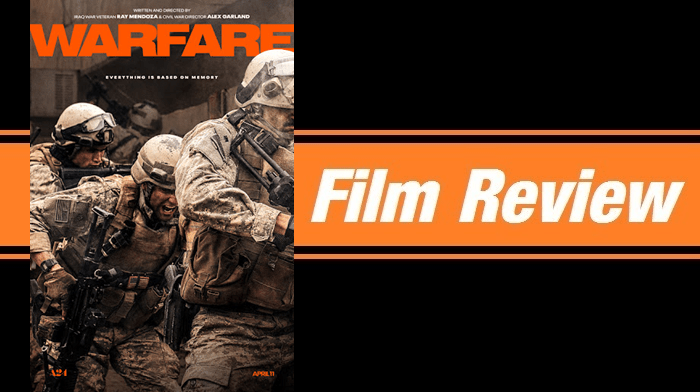
For decades war movies have come in all shapes and sizes. But only a handful of modern war movies have hit as hard as “Warfare” from Iraq War veteran Ray Mendoza. A former U.S. Navy SEAL, Mendoza writes and directs alongside Alex Garland (“Ex Machina”, “Civil War”) to deliver a raw and no frills feature based on his own personal memories. The results are harrowing, sobering, and eye-opening. And it makes for one of the most gripping experiences of the year.

Already heralded for its stunning realism, “Warfare” thrusts us into the grip of combat where bravery and brotherhood are the only means of survival. Before filming began, the cast underwent an intensive three week bootcamp that included weapons training, communications etiquette, and tactical maneuvers. It pays off in some really big ways, adding a striking layer of authenticity that help Mendoza and Garland immerse us deeper into the true-to-life world they’re recreating.
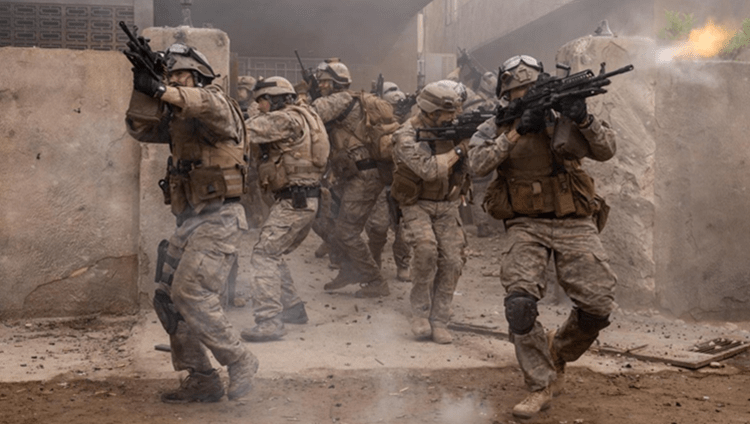
Image Courtesy of A24

The story of “Warfare” is as straightforward as its title. There are no sweeping character arcs, no dense plot, no artificial drama. Set in 2006 during the Iraq War, the movie follows Navy SEAL team Alpha One also known as the Bushmasters. The team are ordered to take up a sniper position on the top floor of a home they commandeer in Ramadi. From there they are to monitor a market place just down the street that’s believed to be a gathering place for insurgents.

One the many effective elements in “Warfare” is in how it presents the moment by moment realities these soldiers face. We’re immediately shown that not every second of a mission is guns blazing. In fact, Mendoza and Garland use their early scenes to emphasize the lull of surveillance and intelligence gathering. Yet they ramp up the tension with subtle references to the danger these young men are in. And when a hand grenade is tossed into their building, the intensity quickly goes from a simmer to a boil.

Things only ratchet up from there as “Warfare” grounds us in the efforts of the platoon to evacuate amid a hail of small arms fire from the converging insurgents. With unflinching effort, Mendoza and Garland put us side by side with the soldiers, making us feel the ferocity of combat without sacrificing verisimilitude for sensationalism. They avoid the usual war movie tropes – no chest-pounding bravado, no “tell my wife I love her” moments, no big inspirational speeches. Every heart-stopping second feels rooted in reality.

Capturing the real-time events is aided by the film’s impressively stacked cast that includes Will Poulter, D’Pharaoh Woon-A-Tai, Joseph Quinn, Charles Melton, Cosmo Jarvis, Michael Gandolfini, and Kit Connor among others. Each young actor clearly understands their assignment and fully commits to bringing their real-life characters to the screen as authentically as possible. They really shine in the second half as the mission falls apart and the “war is hell” adage takes full form.
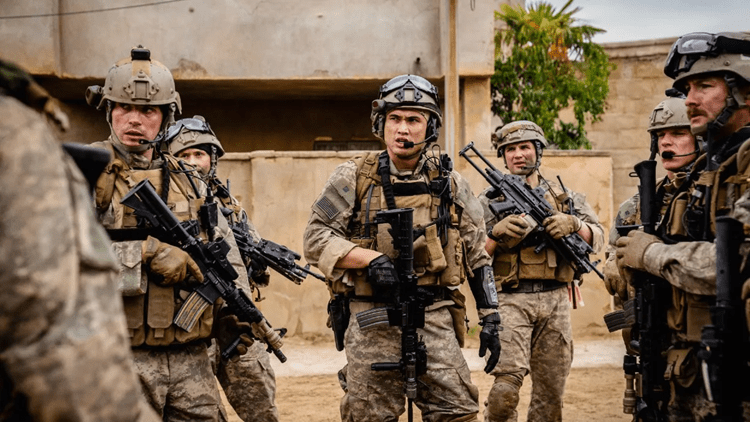
Image Courtesy of A24

Equally impressive and just as vital is the technical craft, from the stunning cinematography to the concussive sound design. Both contribute to the overall visceral reaction the movie evokes, at times hitting like a sensory assault but in the most fitting way. Take the scene where an IED is suddenly detonated. The sound of the blast rattled my theater and the disorientation of the aftereffects underscores the chaos. Both leave such an impact.

Those who tend to view war movies through the prism of politics may be discouraged to find that “Warfare” isn’t interested in sermonizing or editorialization. That’s not to say there isn’t plenty that we can conclude from the moral murkiness that unfolds onscreen. But the movie’s focus remains on the men in uniform, and for 93 minutes we follow them through the trenches of warfare where we’re inspired by acts of heroism yet grieved at the human cost. It’s the latter that makes “Warfare” such a gut punch.

VERDICT – 4.5 STARS

REVIEW: “Annihilation”

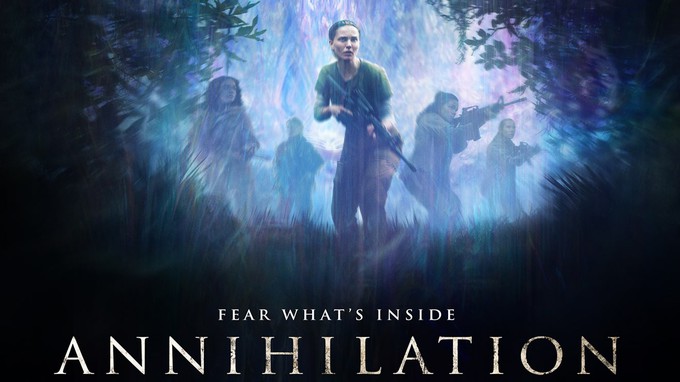
Annihilationposter

Around the midway point of “Annihilation” one character says to another “We’re all damaged goods here.” This seemingly inconsequential line of dialogue is one of several keys to unlocking the secrets of Alex Garland’s trippy science-fiction mindbender. It’s one of several statements or conversations that offer meaning to what we see, yet unraveling the mystery is a bit tougher than it sounds.

Garland’s previous film 2015’s “Ex Machina” was his directorial debut and showed an affection for toying with sci-fi genre norms and conventions. Garland considers himself a writer first and his genre roots actually go back a bit to his time as a novelist and screenwriter. As with “Ex Machina”, “Annihilation” sees him handling both the writing and directing duties.

The film is loosely adapted from the first volume of Jeff VanderMeer’s 2014 Southern Reach Trilogy. Garland has called it an “adaptation of atmosphere” with a “memory of the book”. He takes concepts from the novel and gives each a good twist making his film very much its own thing. I also couldn’t help but see shades of Tarkovsky’s “Stalker”, Kubrick’s “2001: A Space Odyssey” and more recently Villeneuve’s “Arrival” just to name a few.

Annihilation1

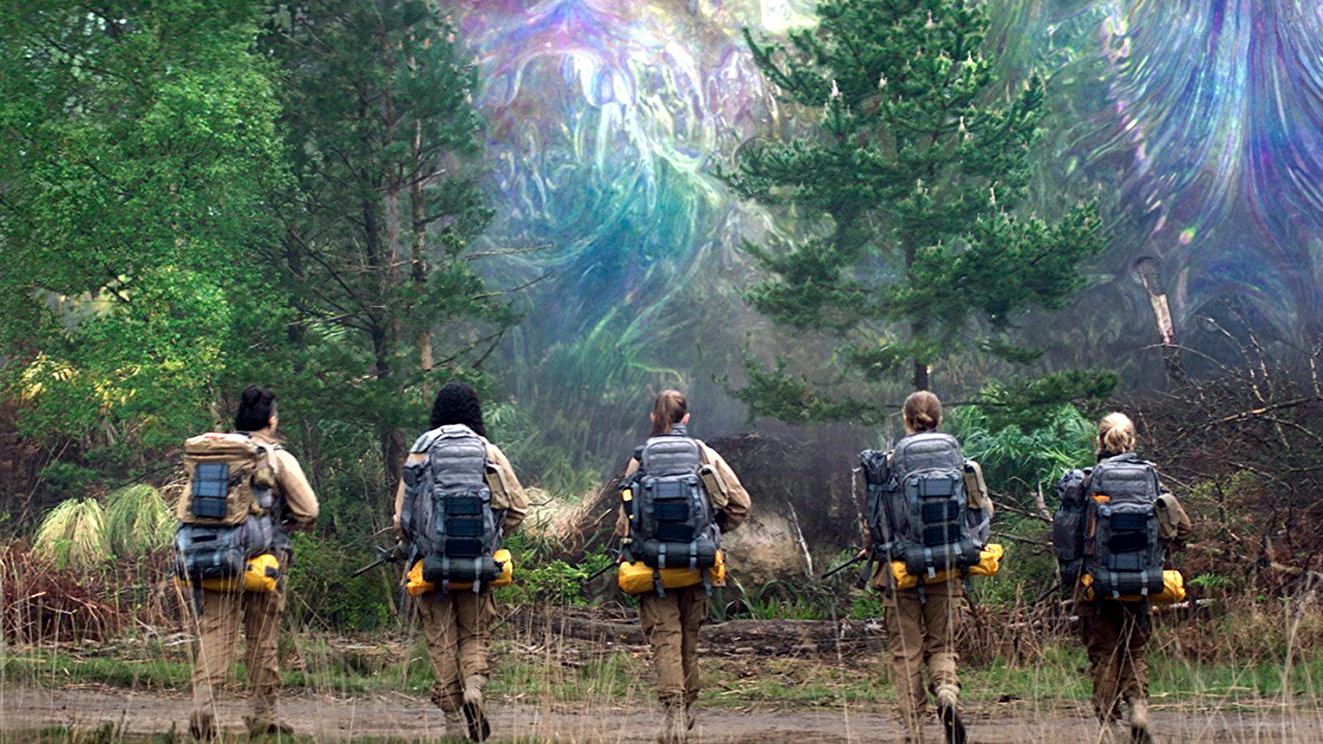
Giving an introduction to the story seems almost pointless since the meat of it is found in the mystery and metaphors. But here goes: Shortly after a mysterious object from space crashes along the United States coastline, an amorphous anomaly forms. For three years the U.S. government have watched it expand and every military expedition into the anomaly has failed. The soldiers who enter immediately lose communication with the outside and have no sense of time or place. Even worse, none of the teams have returned.

Enter Lena played by Natalie Portman, a biology professor emotionally detached following the disappearance and presumed death of her military husband Kane (Oscar Isaac). After a year away Lena is stunned when Kane suddenly shows up. But something is about him is off. He has no recollection of where he has been or how he got home. He quickly becomes violently ill. On the way to the hospital in sweeps the U.S. government to take Lena and Kane to a top-secret facility near the anomaly.

Lena is briefed by a psychologist named Dr. Ventress (Jennifer Jason Leigh). She learns the anomaly is called ‘The Shimmer’ and is slowly engulfing unpopulated swamplands. But concerns are that its growing blob-like borders will eventually swallow cities, states, and so on. Therefore a new team prepares to enter with the mission of reaching ground zero, acquiring data, and making it out alive. Learning of a connection between the Shimmer and her husband, Lena joins the expedition in hopes of finding some answers.

This time the team is made up mostly of scientists instead of soldiers and women instead of men. It’s an interesting assortment of characters. In addition to Lena and Ventress we get Gina Rodriguez as a Chicago paramedic, Tessa Thompson as a timid physicist, and Tuva Novotny as a protective geologist. Each woman fits the above description of “damaged goods” and each come into the Shimmer with their own unique perspective and purpose.

The film’s non-linear structure adds to the overall puzzle. Flashbacks and flash-forwards rich with meaning not only fill in story gaps but reveal some of the key themes. And it toys with time, not to make it needlessly complex, but to feed us narrative and thematic clues. I’m not sure how mainstream audiences will respond to the demand for attention and contemplation. It’s unashamedly cerebral and Garland isn’t interested in playing by genre rules. Sometimes he even breaks his own. For me that was a real strength.

Annihilation2

I found discovery to be a fundamental component both for us and the characters. Take the Shimmer itself – Garland and his crew visualize a truly fascinating off-kilter creation. The exterior emanates both beauty and menace. Think of light being bent through a detergent bubble. The soapy glow offers a stunning effect yet at the same time it’s both ominous and foreboding. The same contrast is seen inside – beautiful albeit unnatural flora mixed with terrifying animal mutations.

I really don’t want to say more because (as cliché as it sounds) this is a movie best experienced. The atmosphere alone was enough to suck me in from the gorgeously discomforting visuals and effects to Ben Salisbury and Geoff Barrow’s unsettling score filled with moody tones and occasional strums of a folksy guitar. It’s all quite effective. Garland has said his intent was to make the Shimmer “truly alien”. Mission accomplished.

But it all gets back to the movie’s meaning, something Garland (thankfully) is unwilling to spoon-feed us. Some have pointed out its dealings with depression, grief, guilt, and the meaning of being human. I believe it speaks to all of those things. More than anything else I heard it speaking the loudest about mankind’s penchant for self-destruction. But one of the truly great things about “Annihilation” is the ambiguity, not for the sake of being ambiguous, but to allow us to mediate and consider what it is saying to us. That’s a special trait the movie has in common some of the very best science fiction.

VERDICT – 4.5 STARS

4-5-stars