
I’ve long been fascinated with the history of the Mafia in the United States. Over the years I’ve read countless works of nonfiction and biographies. And I’ve soaked up numerous documentaries covering the Mafia’s violent rise and inglorious fall, both of which left an indelible mark on 20th century America. Of course by extension that makes me a sucker for Hollywood’s storied gangland treatments – “The Godfather”, “Once Upon a Time in America”, “The Departed”, “The Irishman”, just to name a few.
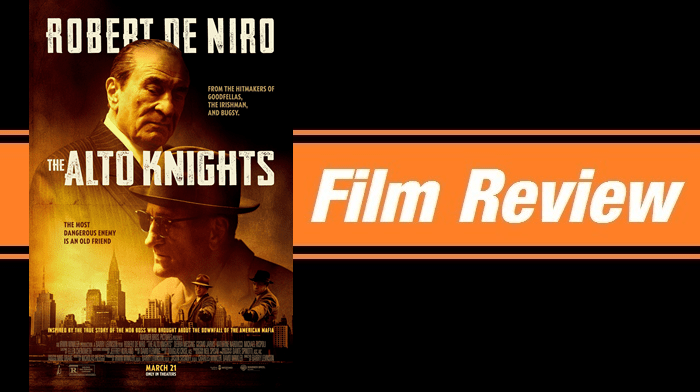
The latest mob movie to join the ranks is “The Alto Knights”, a gangland drama that certainly comes with impressive credentials. It is Oscar-winning director Barry Levinson’s first big screen feature since his 2015 clunker “Rock the Kasbah”. It’s penned by 92-year-old Nicholas Pileggi whose screenwriting credits also include “Goodfellas” and “Casino”. And it stars Robert De Niro, an Academy Award winner himself who’s no stranger to gangster fare.
To be truthful, “The Alto Knights” doesn’t belong in the same company with the superior mob movies mentioned above. That’s because of some nagging shortcomings that hold it back (more on those in a moment). But the film hones in on a fascinating relationship set during an equally fascinating time in the history of the American Mafia. Pileggi’s script shows he has done his homework, and Levinson makes it a point to ensure the film stick close to the facts.

“The Alto Knights” tells the true story of childhood friends turned mobsters Frank Costello and Vito Genovese (each played by De Niro). Both grew up together on the New York City streets and both rose in the mob ranks under boss Charles “Lucky” Luciano. While they would often work together, Costello and Genovese had dramatically different tactics when it came to mob business. Costello preferred power through influence, often controlling politicians, judges, cops, and city officials. Genovese was more prone to use violence and even murder as a means to an end.
But tensions would form and fester between the two powerful men. Some came from Vito’s involvement in the bustling drug trade which was drawing unnecessary heat from the feds. But most was due to Vito’s desire to become the “boss of all bosses“. The ambitious Vito had long felt he deserved the top seat, but he had one significant obstacle – Frank Costello. After Vito was forced to flee the country to avoid a murder charge, an imprisoned Luciano named Costello acting boss. When Vito returned he begin plotting to gain the title from his old friend.
The movie opens with De Niro’s Frank Costello walking into his apartment building. As he waits for the elevator, a gunman, Vincent Gigante (Cosmo Jarvis) shoots him in the head by orders of Vito Genovese (also De Niro). Miraculously the murder attempt only amounted to a flesh wound, but it convinced Frank to relinquish his power. Yet the ever paranoid and growingly volatile Vito doesn’t buy it and isn’t sold on Frank’s sudden urge to retire.

From there Levinson takes us back in time to show key moments that led these one-time friends to become high-ranking rivals. He eventually works his way back to the murder attempt and then shifts to the events that follow. Along the way the film highlights the power, the politics, the insecurities, and the inevitable violence that is inherent to the true account. It’s all helped along with solid supporting work that includes Debra Messing as Frank’s wife Bobbie, Kathrine Narducci as Vito’s wife Anne, and Michael Rispoli as Albert Anastasia, the notorious mob enforcer with close ties to Frank.
While the story itself is quite interesting, the storytelling device Levinson uses is wobbly as best. For some reason the story is told through what resembles a video diary shared by an older Frank. Sometimes it’s Frank narrating while sitting in a dark room watching old slides. Other times he’s breaking the fourth wall while sitting outside in some park or garden. There’s no real rhythm or cohesion to any of it, making it more distracting than clever.
“The Alto Knights” recycles a few things from other mob movies and can almost be too straightforward and workmanlike in how it relays parts of its story. But it remains compelling throughout, especially for those familiar with the history and its key players. De Niro’s double duty turns out to be more than a gimmick as he breathes life and personality into these two complex figures. Overall, Levinson and Pileggi add another worthwhile entry into the mobster movie catalog.
VERDICT – 3.5 STARS

 Keith & the Movies