“TUCKER AND DALE VS. EVIL” – 3.5 STARS

It’s automatically hard to take a movie titled “Tucker and Dale vs. Evil” seriously. But to be perfectly honest, that’s a good thing. With a budget of under $5 million dollars and almost no studio support, “Tucker and Dale vs. Evil” made a strong impression at the 2010 Sundance Film Festival. It finally got a very limited theatrical release in September of 2011 and now it’s available on DVD. It’s an unfortunate example of a good film that was shunned by the studios but that deserves an audience.

This is a movie that’s all about parody. It pokes fun at every splatter movie cliché and gimmick you can imagine while also packaging in a load of genuinely funny dialogue and hilarious gags. As I was watching the film, it offered me funny takes on so many movies including “Deliverance”, “Evil Dead”, “Texas Chainsaw Massacre” and several others. But while there is certainly a horror element to the movie, this is essentially a comedy and a very funny one. In fact, I would say that it offers more clever and well delivered humor than most of the stuff that comes from Hollywood’s comedy favorites.
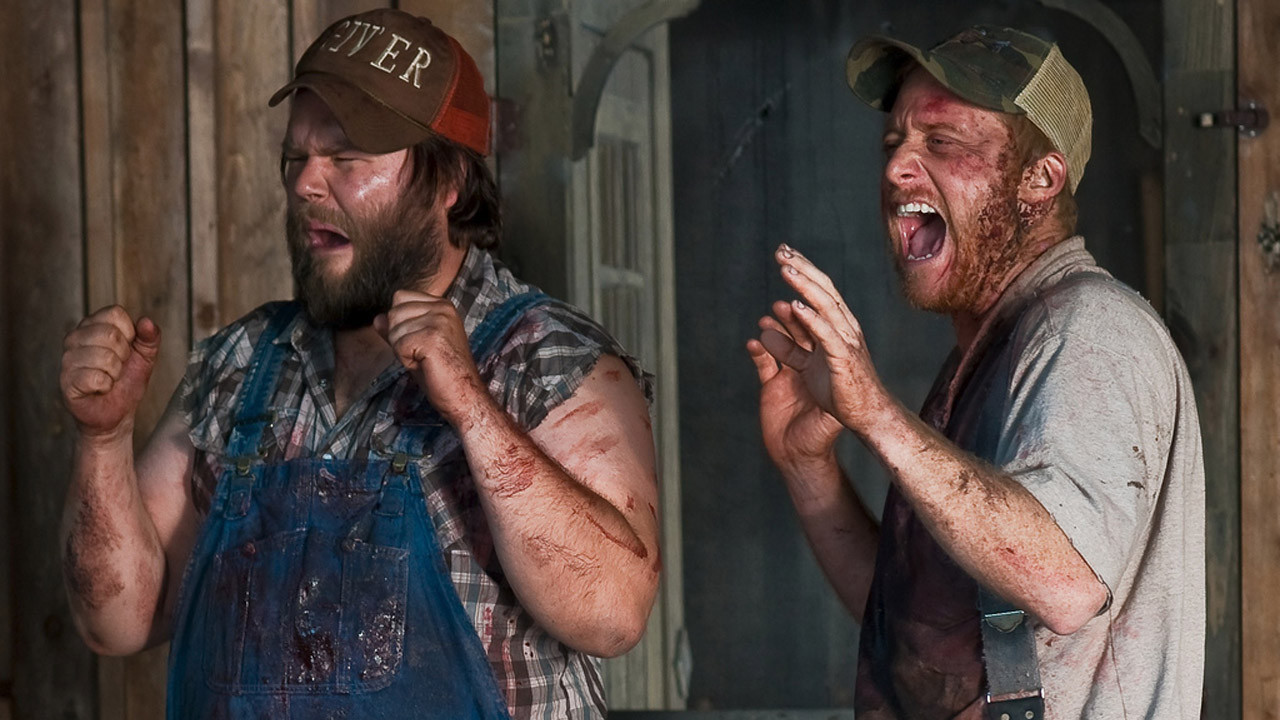
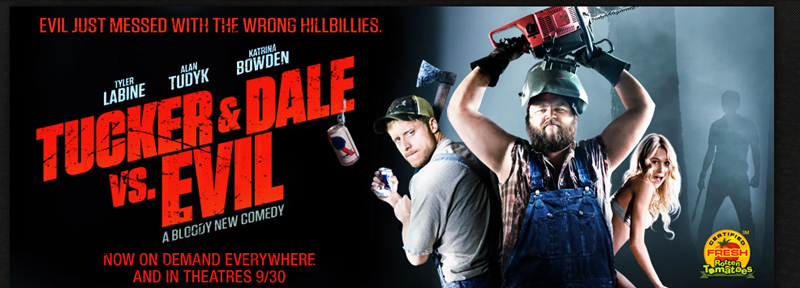
The movie’s lead characters (as you probably can guess) are Tucker (Alan Tudyk) and Dale (Tyler Labine), two simple-minded hillbillies heading up in the West Virginia hills to fix up an old rickety cabin (or as they call it, their new summer home). Also in the hills is a group of stereotypical slasher movie college kids who are on a camping trip. You’ve seen them all before. You have the beautiful shapely blonde, the full-of-himself preppie, the nerdy guy, the pot smoker, and your token kids who are mainly there to add to the body count. They act stupid, do ill-advised things, and leave you wondering how they could ever pass a college course. But co-writer and director Eli Craig has a lot of fun with them. He’s clearly spoofing them but he doesn’t overexaggerate. Instead he injects some really funny lines and gags into these basic, cookie cutter characters.

Tucker and Dale first meet the kids at a gas station and through a hilarious misunderstanding they don’t leave a good first impression. The misunderstandings mount up after they cross paths in the mountains and the kids conclude that Tucker and Dale are psychotic hillbilly killers. This results in a bloody and often times rollicking chain of events that’s so cleverly put together. The good-natured back and forth between Tucker and Dale, even in light of the horrific things happening around them, will leave you laughing and Tudyk and Labine are believable from the first moment you see them. They may not be big household names but they are very good here.

This certainly isn’t a movie for everyone. The blood and gore is gratuitous but intentionally so and it sometimes plays a big part in the parody. This may turn some people off but it’s easy to forgive considering how it’s used. The movie does stumble a bit at the end. There’s a big showdown at an old lumber mill that also gives us our big revelatory moment. It was pretty anti-climatic and didn’t work for me. Again, it was soaked in parody but it still felt a little too conventional, something that can’t be said about most of this film. “Tucker and Dale vs. Evil” isn’t a movie you can pigeonhole and that’s a real strong point. It’s bloody and hilarious and you may find yourself grimacing and laughing at the same scene. It’s truly that funny.
REVIEW: “The Red Balloon”

Classic Movie SpotlightRED BALLOON“The Red Balloon” is a 1956 short film written, produced, and directed by French filmmaker Albert Lamorisse. It was filmed in and takes place in the Belleville neighborhood in Paris and follows a little boy who discovers a bright red, helium filled balloon. The film is simple but it’s one of the most tender and enchanting pictures you’ll have the pleasure of watching. At only 34 minutes long, it manages to pack more heart and authenticity into it’s running time than most feature-length movies of today.

Young Pascal (played by Lamorisse’s son Pascal) discovers a beautiful red balloon on his way to school one morning. He proudly walks along the streets of Paris with his new balloon while encountering a wide assortment of people, some friendly and some not so friendly. But over time we begin to believe the balloon has a mind of its own and a wonderful relationship develops between it and Pascal. It’s hard to believe but Lamorisse manages to make the balloon a true character in the film and we have no problems investing in this little boy’s attraction to and love for his red balloon.

We the audience basically just sit back and watch this young boy. There is almost no dialogue throughout the film, only a beautiful and appropriate score used at just the right times. But dialogue isn’t needed. The visual narrative is perfectly structured and paced and there’s not one thing that more dialogue could add that would improve on what we’re given. Young Pascal’s expressions, the beauty of Paris – even in this working class area, the amazing handling of the balloon, and the incredible camera work all contribute to grabbing us and wrapping us up in the wonderfully visual story.

“The Red Balloon” has received a lot of praise and rightly so. In fact, it’s one of the few short films to ever win a major Academy Award category (Best Original Screenplay). I was completely engaged throughout this short picture. And even during the couple of times where I felt I was missing what Lamorisse was saying, I was still wrapped up. “The Red Balloon” is a magical meditation on the innocence of a child’s imagination meeting the harshness of reality. But there’s more to it than just that and for my money, it’s one of those rare movies that is impossible to dislike. If you haven’t seen it, take 34 minutes and experience it. It’s worth the time.

VERDICT – 4.5 STARS

“LAWLESS” – 4 STARS

Just seeing the list of great names attached to “Lawless” easily made it one of my most anticipated films of 2012. I’m a huge fan of Tom Hardy, Guy Pearce, Jessica Chastain, and Gary Oldman. The thoughts of them in a Prohibition-era action flick had me giddy with excitement. But I also had one serious concern about the movie and that was Shia LaBeouf in the lead role. I’ve never been impressed with his acting and I couldn’t help but wonder if he could hold his own in the company of such great talent. While LaBeouf was certainly better than I expected, he was swallowed up by some really strong performances around him. But thankfully that wasn’t enough to keep “Lawless” from being a highly entertaining piece of American pulp.

Australian John Hillcoat, also known for “The Road” and “The Proposition”, directs the film with fellow Aussie Nick Cave handling the screenplay. Their story is set in the hills of Franklin County, Virginia and follows the Bondurant boys – three brothers who make their living bootlegging moonshine during the Prohibition years. Forrest (Hardy) is the tough, hard-nosed leader of the bunch. Howard (Jason Clarke) works alongside Forrest. Then there’s Jack (LaBeouf) who at one time is described as “the runt of the litter”. The brothers get by alright with their own system of running moonshine, at least until a vicious Special Agent Rakes (Pearce) is sent in to clean up the hills. Rakes immediately clashes with Forrest and before long the hills erupt into violence.

Of the brothers’ stories, its Forrest’s that’s considerably more entertaining even though Jack’s takes up more of the movie. Forrest is a tough-as-nails brute but he also knows how to handle their business. Hardy chews up every scene he’s in with his grunts and mutterings as well as his intimidating stares and low-key dialogue. He’s also not afraid to use brutality with his brass knuckles or razors. But even he is tamed a bit by Maggie (Chastain), a former dancer who moves to the community to escape the troubles of the big city. Boy did she pick the wrong place. I enjoyed the romance that developed between the two. Chastain gives a great performance and she matches Hardy scene for scene and line for line.

The same can’t be said for LaBeouf and his Jack character. As I alluded to, LaBeouf is better than I expected and, to be fair, he’s at times quite good. But he just can’t hold his own especially when alongside Hardy. He is helped by the story which doesn’t build his toughness beyond the bounds of believability. It fact it’s his weakness and desire to prove himself to his brothers that turns out to be the most compelling part of his character. He’s attracted to a local minister’s daughter (Mia Wasikowska) and the two eventually fall for each other. But overall their romance feels inconsequential and adds little to the story. On the other hand, I did enjoy his scenes with his friend Cricket (wonderfully played by Dane DeHaan of “Chronicle” from earlier this year). And he also encounters a powerful mobster named Floyd Banner played by Gary Oldman. Oldman is really good even though he’s given almost nothing to do.

But the biggest delight is Guy Pearce. He’s sensational as the creepy and psychotic special agent who abuses his power and who will stop at nothing to take out those who cross him. Pearce’s high hairline with its accentuated part down the middle, shaved eye brows, and prim and proper wardrobe gives him a distinct eccentric look. But it’s also Pearce’s mannerisms, unhinged chuckles, and the way he carries himself the gives the character a sinister presence. He has some of the film’s best scenes, none better than the tension-filled first meeting between Rakes and Forrest. Pearce is simply fantastic and this is an Oscar worthy supporting performance.

Another huge plus for “Lawless” is the incredible production design. The movie features such a realistic and atmospheric recreation of the hilly, poverty-stricken, 1930’s moonshine territory. Every scene is soaked with period details and the lush, vibrant locations make everything feel authentic. Hillcoat’s unfiltered Franklin County is rusty, dirty, and dangerous. From the opening credits I found myself completely drawn in by the period look. The wardrobes, the automobiles, the rundown shacks – everything contributes to the pitch-perfect aesthetic.

“Lawless” is a tough, bloody, and violent action picture that’s very honest in what it’s trying to be. The story is simple and nothing will catch you by surprise. But it’s also compelling and the characters are easy to invest in. The movie does hit a little lull in the middle and we actually get a skip ahead montage to set up the simply ok ending. But the film still packs plenty of pop and there are some tremendous performances that will stick with you, particularly from Tom Hardy and Guy Pearce who may have given us the best villain in the movies this year. “Lawless” is both poetic and visceral and even though it just misses being a real classic, it’s still a true Southern Gothic treat.

“THE 3 STOOGES” – 2 STARS

I have to admit, I avoided the Farrelly brothers new movie “The 3 Stooges” for a while. It was a prime example of a film that seemed utterly unnecessary and I had no confidence, knowing the state of modern comedy, that any director would be able to capture what made the original Stooges so beloved. After finally catching up with the film, I have to admit that I was pretty surprised at just how well the Farrelly brothers channelled the Stooges unique brand of humor. This is actually a comedy with some pretty good laughs. But it also feels like an imitation and a little of these Stooges goes a long, long way.

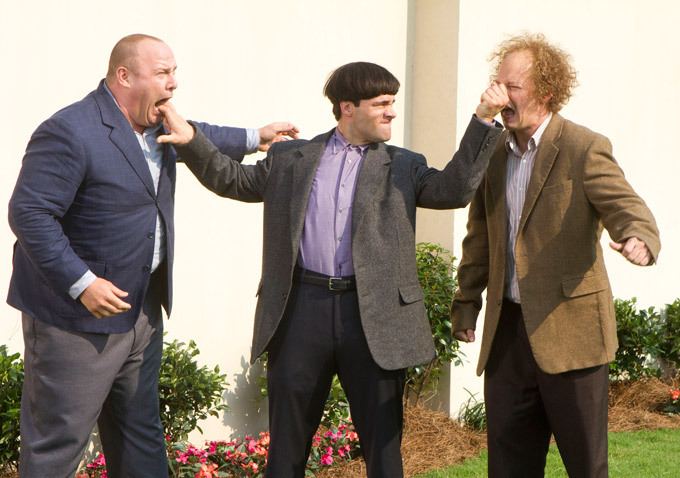
“The 3 Stooges” is unabashed slapstick silliness that covers everything from the Stooges’ trademark belly punches, eye pokes, and face slaps to their knuckleheaded way with words. It’s relentlessly rambunctious and completely juvenile, yet this lighthearted story has some success and it’s mainly due to some incredibly committed performances from its three leads. The transformation of Chris Diamantopoulos (Moe), Sean Hayes (Larry), and Will Sasso (Curly) into these three classic comedy characters is nothing short of amazing. And it’s not just their impeccable physical resemblances. Their voices, mannerisms, and of course their slapstick antics are unmistakably Stooge-like. But perhaps what’s best about their performances is that they never stop and wink at the audience. They each play their roles straight and it really helps the film.

The movie is broken into three clever “episodes”. The story itself is about as simple as it gets. The orphanage the Stooges were raised in has fallen on tough economic times and is being forced to shut their doors. That is unless they can get $830,000. Our lovable buffoons, who still live at the orphanage and have been completely sheltered from social interaction and any modernities, take it on themselves to head out into the world and get the money to save their home. Of course their sheltered lives and natural idiocy lead to a series of wacky ‘fish out of water’ scenes and several off-the-wall encounters. Some of the moments work really well and generate some genuine laughs. But as the movie progresses it seems to lose more and more of its energy and interest.

I mentioned above that a little of these Stooges goes a long way and that’s one of the real problems with the movie. Yes, the three leads do an amazing job of portraying the 3 Stooges. But over time their shtick runs headfirst into a wall of repetition. The gags become increasingly generic and less and less funny. And even worse, there were times when it seemed either the movie was running short on material or the Farrelly’s just felt the need to include it, but it resorts to your standard modern-day urine and fart jokes. I just couldn’t help but feel that the movie was running out of gas and that did make it harder to overlook the other more obvious faults with the story.

Even with its faults, “The 3 Stooges” did surprise me. It has some really weak spots in the writing and it may have a hard time holding the attention of anyone over 12 years old. But it certainly has it’s funny moments particularly in the first half of the film. And there’s no way you can discount the really good performances from Diamantopoulos, Hayes, and Sasso. But even with their tremendous efforts this still felt like a really good Elvis impersonator. They look like Elvis. They sound like Elvis. They shake like Elvis. But they aren’t Elvis. But you know, a lot of people like Elvis impersonators and enough is done right in “The 3 Stooges” to earn it an audience. Personally, I just needed a little bit more.

REVIEW: “THE EAGLE” (2011)

There have been several movies about Rome’s powerful Ninth Legion and their annihilation in the British territories in the 2nd century. The newest addition is “The Eagle”, adapted from the novel “The Eagle of the Ninth” by Rosemary Sutcliff. Channing Tatum plays Marcus Aquila, a young Roman centurion taking his first command in a dangerous and isolated part of Britain. Aquila seeks to restore the honor of his father who was leader of the powerful Ninth Legion when they mysteriously disappeared along with the sacred golden Eagle of Rome. After their fort is attacked, Aquila gains the trust and admiration of his legion by leading them to victory but is injured in the battle resulting in his honorable discharge. But with his father’s name still held in contempt and the Eagle still missing, he sets out on a quest past the Northern Wall, accompanied only by his newly acquired slave Esca (Jaime Bell), to find the Eagle and redeem his father’s reputation .

While “The Eagle” does start off promising, it’s an inconsistent and uneven film that falls into mediocrity. The first act is encouraging. The attack on the fort features the film’s best action sequences. They are furiously shot and edited and bring reminders of films like “Gladiator”. Later, as we’re introduced to Esca, the relationship between wounded Roman hero and Rome-hating slave offers up potential even though it’s built upon pretty familiar grounds. But it never goes very far. Nonetheless the movie still has some pretty decent moments early on.

But then the picture bogs down in numerous scenes of tedious exposition and a quest that lacks any real sense of urgency or peril. These problems can be traced back to a very lackluster script. Other than a few bits of text in the opening, there’s no real effort to develop the film’s historical setting. There is no real explanation of the importance of the Eagle other than “The Eagle is Rome”. The relationship between Aquila and Esca is underdeveloped and hard to buy into. The ending is flat and lacks any real punch or emotion. These are all issues that could be resolved with better writing.

Channing Tatum does a better acting job than in many of his previous films but the verdict is still out for me. He gives a good effort but he just can’t carry a picture like this. His scenes involving interaction with his soldiers early on are his best but he struggles elsewhere. Then you have Donald Sutherland who is laughably bad and terribly miscast as Marcus’ uncle. He appears to be just going through the motions and he’s impossible to take seriously. Jamie Bell gives the better performance of any but even he is handcuffed by the weak screenplay.

“The Eagle” is a very “ok” movie. It’s best parts are experienced early then the movie falls off considerably. It starts off as a poor man’s “Gladiator” which isn’t necessarily a bad thing. But then it loses it’s identity and heads off into a different direction becoming a very mediocre action picture. The characters and the story are underdeveloped and in a movie like this you have to buy into the quest and the stakes must be high. The stakes weren’t that high and I was never sold enough on the story to really invest in it.

VERDICT – 2 STARS

REVISITING A CLASSIC: “Citizen Kane” (1941)

You may have heard by now that Sight & Sound Magazine recently announced the results of their The Greatest Films of All Time poll. If you’re unfamiliar with the poll, it’s a worldwide survey of critics that has been conducted every 10 years dating back to 1952. Since 1962 “Citizen Kane” has been at the top of this pretty prestigious list, at least until this year. Alfred Hitchcock’s “Vertigo” has dethroned “Citizen Kane” which has launched a ton of great discussions on both of these films. Personally, “Vertigo” isn’t the greatest film of all time. In fact, for me it isn’t even the best Hitchcock film. And for my money, even though I like “Vertigo” a great deal, it can’t beat “Citizen Kane”, a movie that is a lesson in quality filmmaking starring, directed, and co-written by Orson Welles.

Last night I had the opportunity to revisit this cinema classic and it’s amazing how it truly seems to get better with each viewing. “Citizen Kane” is a film that has aged like the finest wines and there are so many reasons for it. The more I watch the movie the more I can appreciate the skilled filmmaking and risks taken to bring the movie to life. The film certainly had its share of struggles particularly when trying to find an initial audience. William Randolph Hearst, the American newspaper giant who is the clear inspiration for the movie’s main character, was infuriated by the movie and took huge measures to keep “Citizen Kane” from reaching an audience. Fear of his power kept the film out of many newspapers and out of many theaters. But after all these years, it’s the movie that has come out with the better reputation.

While there has been some controversy over who was the driving force behind the movie’s screenplay, Orson Welles and Herman Mankiewicz are credited with its authorship. It tells the story Charles Foster Kane, an immensely wealthy newspaper mogul, who lies on his deathbed, alone within the closed isolation of his mammoth Florida estate known as Xanadu. We watch as Kane utters his final word “Rosebud” and then dies. This opening event catapults the entire story forward. In fact, the entire narrative is driven by one incredibly clever device – “Rosebud”. Kane’s final word becomes a huge topic of interest especially for investigative reporter Jerry Thompson (William Alland). Thompson is convinced that there is a deeper secret meaning to Kane’s final word and he sets out to uncover it by looking into Kane’s past and interviewing those closest to him.

This points to one of the things that makes this movie so special. There’s no straight-line, uninterrupted narrative. Instead the story is told through well placed flashbacks from the points of view of several different people. Through their eyes we learn about Kane’s impoverished childhood. We learn about his leap of faith into the newspaper business at a young age. We see his political ambitions. But we also see the story of a man whose motivations fester into those of power and self-promotion. We watch as his ego and self-indulgence destroys every nonmaterial thing in his life. He’s the epitome of gaining the whole world but losing all that’s important. It’s a fascinating study of a man who, regardless of his wealth, power, and influence, is unable to overcome the greatest obstacle to true happiness – himself. This all unfolds through the words of Kane’s guardian, ex-wife, business partner, butler, and best friend. Now as someone who isn’t always attracted to the use of flashbacks, I’m really impressed at just how well they work here. Welles is truly laying out a man’s life before us and I was enthralled not only in his story but also with the small question behind it all – just who or what is “Rosebud”?

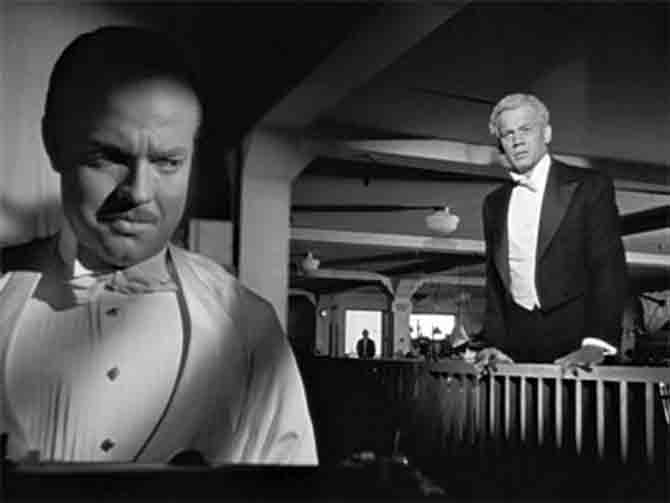
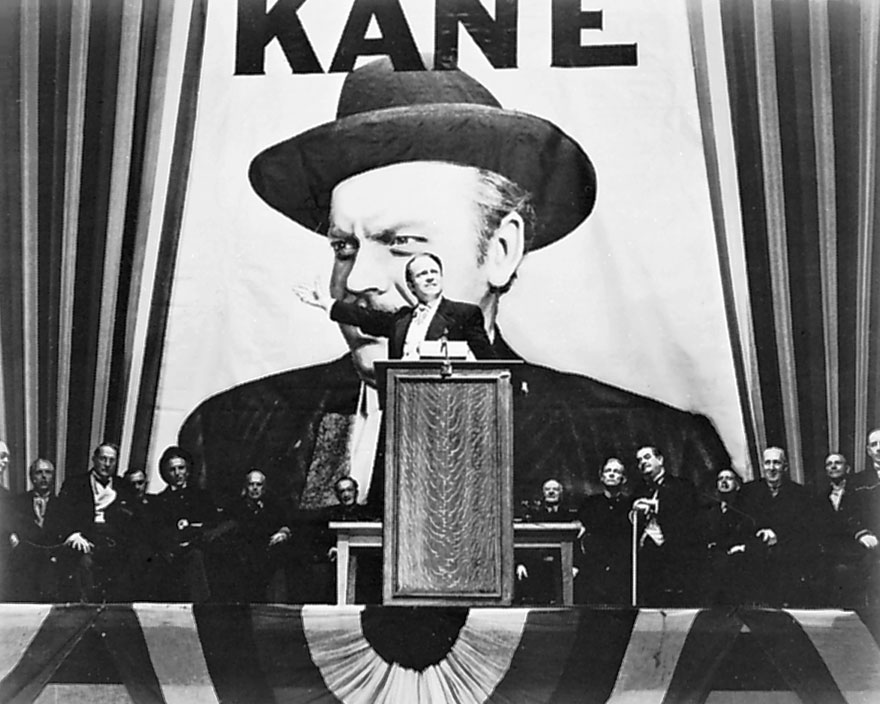
While many love the story and the storytelling behind “Citizen Kane”, it is equally or maybe even better known for its ambitious visual presentation and stylistic techniques. Welles was given tons of liberties from RKO Pictures when it came to making the film and that’s all the more surprising considering that this was his first feature film. He took his creative control and mixed it with a young man’s enthusiasm that resulted in a visual style significantly different from anything else in Hollywood. I can still name numerous carefully framed shots and brilliantly conceived camera tricks. There’s also Welles’ penchant for placing his camera at ground level and shooting up at his characters. This is ever so effective particularly in one extended take featuring a crucial conversation between Kane and his long-time friend Jedediah Leland (played wonderfully by Joseph Cotton). There are several other cool camera techniques and special effects along with some impressive makeup work that still influences a host of modern filmmakers.

I worry that newcomers or even those who haven’t seen “Citizen Kane” in years will approach the film from the “So this is the greatest film of all time?” perspective. That’s a bad way to approach any film especially considering how subjective these lists are anyway. Instead, this movie should be approached as its own creation – enjoyed and measured within those bounds. Welles’ accomplishment with the film cannot be overstated. The direction is brilliant, the screenplay is fantastic, and he gives a thundering performance and all within what was his first feature film. “Citizen Kane” was a critical success at its time but struggled to gain a huge following. But as years have passed, the movie has risen to be appreciated as a monumental film in cinema history. I tend to agree. And while “Citizen Kane” wouldn’t be my personal “greatest movie of all time”, there’s no denying it’s inventiveness, it’s influence, and its overall excellence.

VERDICT – 5 STARS

5 STARSs

5STAR K&M