REVIEW: “FLAGS OF OUR FATHERS” (2006)

If you looked at a list of movies made about World War 2 it would probably stun you. Hundreds of films have been made worldwide that have examined and portrayed the global conflict from a variety of different perspectives. Many have focused on the combat, particular battles, or even well-known officers. Others have looked at different aspects of the war including the horrors of the Holocaust and the resistance movements that rose against the Nazi aggression. In 2006 director Clint Eastwood released “Flags of our Fathers” and it’s sequel/companion piece “Letters from Iwo Jima”. It was an ambitious undertaking as both films attempted to look at the brutal and bloody battle of Iwo Jima, one through the eyes of the Americans and the other through the eyes of the Japanese.

“Flags of Our Fathers” was adapted from the James Bradley and Ron Powers book of the same name. It’s story centers around the six soldiers who raised the American flag on top of Mount Suribachi. The flag raising was captured on camera on February 23, 1945 by Pulitzer Prize winner Joe Rosenthal and is considered by many to be one of recognized photographs from the war. The story is told through a series of flashbacks that are at first tough to navigate though. Eastwood sets up the battle of Iwo Jima and introduces us to the main characters early on. We see the landing, scenes involving the intense and rugged fighting, and the eventual flag raising.

But it’s all being told through the flashbacks of three of the soldiers who raised the flag, Navy Corpsman John “Doc” Bradley (Ryan Phillipe), Private Rene Gagnon (Jesse Bradford), and Private Ira Hayes (Adam Beach).  After the photograph is released in the states, the three are called back to participate in a war bond tour to raise much-needed money for the war effort. But what’s being promoted isn’t exactly how things happened and the soldiers have a hard time reconciling the importance of the war bond campaign with their painful memories of the bloody battle they took part in.

Staying with Eastwood’s film can be a bit challenging and I found it at times be a little clunky in its transitions from the stateside scenes to the battlefield flashbacks. But that’s not saying the story is bad. It packs a lot of emotion and sincerity and Eastwood clearly wants to tell the stories of not just the soldiers at war but the people back home as well. He nicely portrays the battlefield camaraderie that goes well beyond the trenches and he also puts great effort and detail into presenting the United States and it’s mood during that pressing time. Everything looks and feels just right. The problem is that the attempt at clever storytelling does more to hurt the flow of the movie than to help it.

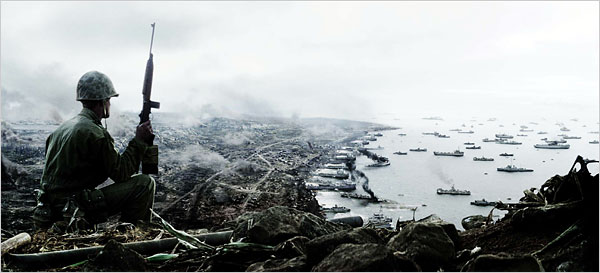
I was also a little mixed on Eastwood’s battle scenes. The visuals are at their best during the wide shots of the battlefield or the Naval fleet around the island. There are also a few really cool scenes involving airplanes attacking Japanese hillside fortifications. But the ground combat seemed to be missing something. There certainly are moments of intensity but as a whole things looked plain and with the exception of a few standout scenes, the combat feels a bit repetitive. I’ve thought that maybe I’ve seen too many war films and maybe the combat in movies doesn’t pack the same punch that it used to. But I don’t think that’s the case here. Eastwood is trying to create the same atmosphere that those soldiers faced back in 1945 but it’s the actors that relay that more than the visuals.
The performances are strong and the big cast of quality actors add a lot to the film. Phillippe is really good both on the battlefield and during that stateside scenes. I also enjoyed Beach’s performance as the Native American soldier who fighting more than just one war. There are several other good performances from the likes of John Slattery, Barry Pepper, and Neal McDonough.

“Flags of Our Fathers” ends with a poignant reminder of just how much this war effected our country and our people. In many ways it’s the final 15 or 20 minutes that helped bring everything together for me. I was really mixed during several parts of the film but after seeing it through, I get a better idea of what Eastwood is conveying. It’s a story of patriotism, sacrifice, and brotherhood. But it’s also a film about desperation, vulnerability, and exploitation. It does become a little melodramatic but never to the point of drowning us. Instead the bigger problems centered around the movie’s structure and it’s so-so combat scenes. But I still find “Flags of Our Fathers” as an easy movie to recommend and it certainly looks at the war with sincerity and care.
VERDICT – 3.5 STARS

REVIEW: “Defiance”

Edward Zwick’s 2008 World War 2 movie “Defiance” is an intriguing look at the Nazi’s invasion and ultimate occupation of Belarus. As with every other German occupation, the brutality was rampant and the death tolls were high. The Nazi’s stormed through the countryside, destroying villages, killing hundreds of thousands of civilians, and shipping hundreds of thousands more to forced labor camps. As expected the Jewish population was hit particularly hard. This is the harsh and troubled setting for Zwick’s film.

“Defiance” is based on the true story of the four Bielski brothers. After their parents are murdered by Nazi sympathizers, the brothers flee to the forest to avoid the German atrocities which are spreading from village to village. While there, they come across fellow Jews who are also seeking refuge. While hesitant at first, the brothers agree to help protect them. In order to survive, they begin making trips into occupied villages where they swipe food and supplies and are assisted by a few sympathetic farmers. The Bielskis also see their numbers grow as more and more Jews came to be under their protection. In a span of over two difficult years, it’s said that over 1,200 Jews were saved by the Bielski’s efforts.

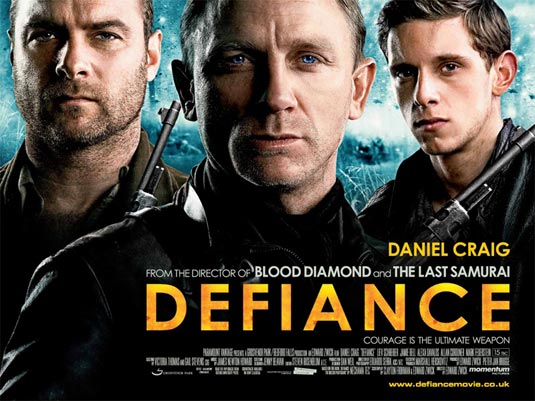
Daniel Craig plays Tuvia, the oldest brother who finds himself the leader of their forest community. At first his perspective is controlled by his desire for revenge. But over time as he connects more with the people under his care, he begins to see things differently. His tough, burly brother Zus (Liev Schreiber) has a different approach which at times causes friction between the two. Craig is an excellent actor and he is very good here. I’ve always liked Liev Schreiber and have felt that due to some of his past roles he is often time underappreciated. He’s also really good here and shares some fantastic scenes with Craig. I also enjoyed Jaime Bell as their younger brother Asael and Mia Wasikowska as young Jewish girl he becomes involved with. The movie also features strong supporting work from Alexa Davalos, Mark Feuerstein, and Allan Corduner.

“Defiance” is a pretty by-the-books production that plays it pretty safe. But that’s not to say its a bad film. In fact, I really liked the movie despite it’s formulaic approach. At it’s core it’s a truly extraordinary and inspiring story with roots in reality that gives it even more punch. Zwick makes it easy to care about his characters and their plight but he also shows some of the Bielski’s more questionable actions. The complexity of their situation goes beyond mere survival in the forest. For example we see the impact of the Soviet Partisans on everything from the Bielski’s forest camp to the relationship between Tuvia and Zus. As the camp population grows, internal fighting and power struggles pop up as supplies begin to run short. There are several other interesting dynamics that Zwick explores well.

Some have argued that the movie’s desire for a broader audience resulted in the inclusion of content that just didn’t belong. In some countries, people took issue with the film’s portrayal of the brothers. They felt they were made to look more heroic than they were and their shady dealings were underplayed. Some accused it of rewriting history while others griped about its use of other languages instead of Belarusian. It’s hard for me take issue with the movie for any of these issues. As with many historical movies, things were added for dramatic effect. Also, I never felt that it was dealing with the material in an irresponsible or half-hearted way. There may be some issues with the overall narrative, but as a whole the movie really worked for me.

“Defiance” is an underappreciated and often times overlooked World War 2 picture. It doesn’t take many risks and it never strays too far from the more conventional survival movie path. But it’s a very well made film that captures the look and tone of the period. It tells a story that many may be unfamiliar with and even with the historical objections of some, I found it to be a testament to the will to live possessed by this group of Jewish refugees. Daniel Craig and Liev Schreiber are fantastic and their performances drive the film.

VERDICT – 4 STARS

REVIEW: “Dark Shadows”

Director Tim Burton and actor Johnny Depp’s history of collaborations could graciously be called a roller-coaster. The two have worked together on a total of eight movies, each to some degree sharing the same Tim Burton gothic quirkiness. Burton’s style is unique and specific and it’s easy to see how someone could be turned off by it. He’s also known to dabble in the same general themes and his movies often have the same look and tone. “Dark Shadows” is no different and you almost instantly know you are watching a Tim Burton picture. But to be honest, I’m not the biggest Burton fan and I’m rarely attracted to his films. But there was something about “Dark Shadows” that caught my attention.

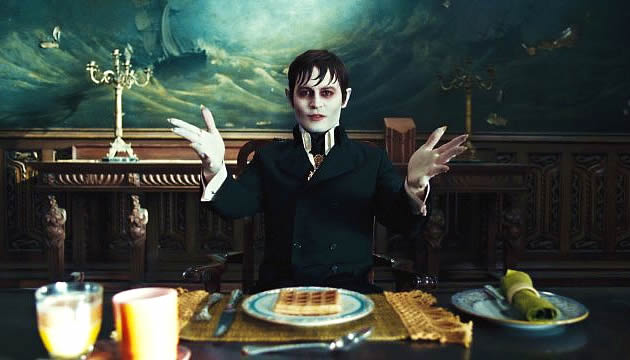
The trailer and TV spots showed what could potentially be a hilarious dark comedy based on the “Dark Shadows” vampire soap opera from the late 60’s and early 70’s. Depp plays Barnabas Collins who finds his life turned upside down after breaking the heart of a witch named Angelique (Eva Green). The Collins family had moved from Liverpool, England to Maine and started a fishing village. They called it Collinsport and built the huge Collinwood Manor on top of a hill overlooking the town. Angelique was part of the Collins’ work staff and immediately fell for young Barnabas. But he never notices her especially after finding the love of his life Josette (Bella Heathcote). Taking the ‘woman scorned’ idea to new levels, she uses her black magic to cause the deaths of Barnabas’ parents and Josette. To take things even further, she turns Barnabas into a vampire then buries him in the forest in a chained up casket where he stays for almost 200 years.

But his casket is accidentally unearthed and Collins is eventually freed. The problem is that the year is 1972 and things certainly aren’t how they were when Barbabas was buried. At this point the movie seems set up to be another absurd fish-out-of-water story. In fact, that’s exactly what it was advertised as. And while there are some genuinely funny moments when Barnabas clashes with his new 1972 environment, it’s far from the meat and potatoes of the story. “Dark Shadows” actually plays things straight for much of the film and I often found the comedy to be back-burnered. To me Burton squandered a lot of potential by not spending more time on laughs. One minute he and Depp are winking their eye and having fun with the old show. The next minute they’re taking the story in a more serious direction. I found the absurdity of the comedy to clearly be the most fun.

After being freed, Barnanbas connects with the dysfunctional Collins descendants now living in the rundown Collinwood manor including Elizabeth (Michelle Pfeiffer) and Roger (Jonny Lee Miller). He also meets Carolyn (Chloe Moretz), a rebellious teenager and David (Gulliver McGrath), a young boy who believes in ghosts. Helena Bonham Carter plays a boozing psychiatrist living in the house supposedly to help David. He also meets Victoria Winters (also played by Heathcote) David’s governess who has a striking resemblance to Josette. Barnabas finds that his descendants have allowed their family fishing business to fall apart. He takes it upon himself to rebuild the business back to prominence especially after seeing that the rival fishing company is run by an incarnation of none other than Angelique.

One thing you instantly notice is that the film looks fantastic. Even when the story sputters, the visuals never do and the movie features some gorgeous camera work and fantastic makeup and costume design. Burton also does a nice job a recreating a believable 1972, an unusual time in American history that strangely fits a Tim Burton project. I loved the selection of 70’s pop and rock songs chosen for the film and there are several funny jokes involving things such as lava lamps, hippies, and The Carpenters. And while we’ve seen comedies that focus on misplaced people before, here it works pretty well. But unfortunately we only get snippets of it scattered throughout the picture. It’s mixed in with the more serious and straight-laced narrative which often times causes a frequent and almost distracting change of tone throughout the film. This isn’t so much due to Burton’s direction, but to the structure of the story.

Depp plays weird really well and here he gives his usual solid performance. His comfort level with pasty-faced Burton roles is evident and his own quirky sense of humor shines through. His goofy facial expressions and sometimes exaggerated line delivery really sells the Barnabas Collins character even during the times where the main story feels lifeless. Depp can get a laugh from the audience just by lifting an eye brow at the right moment and his performance was one of my favorite things about the film. Most of the other cast members are good particularly Jackie Earle Haley in a fun role as the Collinwood caretaker. There are no glaringly bad performances and to be honest, it’s Depp’s show.

“Dark Shadows” is a genre-jumper that moves between comedy, horror, drama, romance, and action yet never feels grounded in any of them. An argument could be made that this is a typical Tim Burton picture and if you’re a fan, you’re probably going to like it. And I certainly won’t deny that Burton’s fingerprints are all over the movie. But I just didn’t find myself as interested in the main story as I hoped to be. The comedy works and there are some truly clever and funny gags that you have to appreciate. Depp carries many scenes and makes them work just by his stiff and unusual character presentation. Things like this really work in the film. In other words, “Dark Shadows” isn’t a terrible movie. In fact, it’s far from it. But it is an inconsistent movie and one that I have a hard time embracing. I may like the film more after a second viewing, but right now it feels like a movie that had great comedic potential but only gave us a sampling of it.

VERDICT – 2 STARS

REVIEW: “Battle: Los Angeles” (2011)

When reviewing a film I always try to consider what kind of movie the filmmakers intend to make. It’s especially important to employ this philosophy when reviewing a movie like “Battle: Los Angeles”. I enjoy all kinds of movies including those that are intellectually challenging, emotionally stimulating, or even the proverbial mindless popcorn picture. “Battle: Los Angeles” is very honest about it’s intent and never pretends to be something it isn’t. It could best be described as “Black Hawk Down” meets “Independence Day”. It takes realistic, gritty military combat and mixes it with the alien invasion angle. It’s a loud, simple, explosion filled action film that does succeed to a degree.

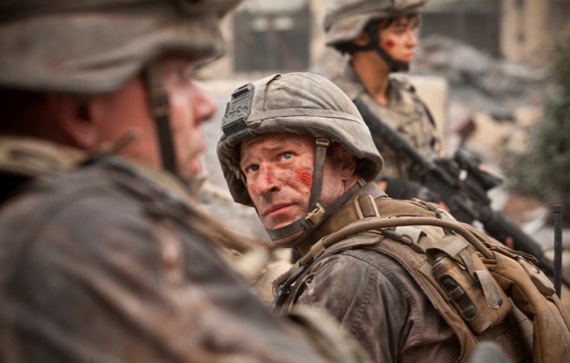
In some ways it resembles a video game, not only by it’s title but also by it’s look and feel. What’s funny is that many modern video games have more plot than “Battle: LA”. It’s a very basic story. A staff sergeant (Aaron Eckhart) and his new platoon are sent into the alien infested Los Angeles battle zone to help escort out a small group of stranded civilians. That’s really it. It starts with a very brief introduction to the platoon but almost immediately the first attack occurs and the action takes off, only occasionally slowing down for small doses of character developing dialogue. While they try to add some degree of depth to the characters, other than Eckhart’s, none are all that interesting.

The movie also uses every military cliché you can think of. Whether it’s the personalities in the platoon or the contrived dialogue, you name the cliché, it’s used here. We’re also offered very little in regards to explanation. We hardly know anything about the alien invasion even though we do gather tidbits of information through brief glimpses of CNN newscasts (which I actually liked). The movie vaguely informs us that the alien’s objective is to steal our water and we get a little information about how they function. But to be honest, in this type of film is it really that important? Obviously the filmmakers think not.

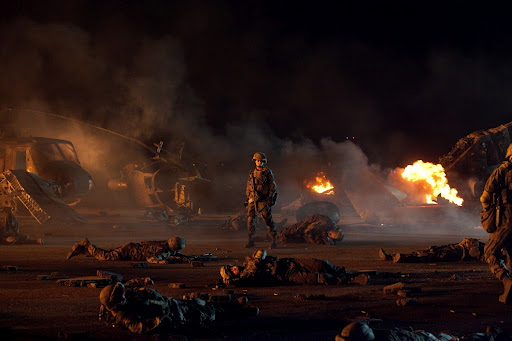
“Battle: LA’s” action is it’s bread and butter and it’s largely impressive. Director Jonathan Liebesman used handheld cameras to give his film the familiar documentary feel while recreating the chaos and intensity of war. It’s nothing we haven’t seen before but it works more often than not. While a few scenes are a little disorienting it’s very effective most of the time. The CGI is generally good and especially shines in the large-scaled shots of the city and in images showing the massive destruction from the battles. The look of the aliens is serviceable but I was never blown away by them or their technology. There are some fierce action sequences particularly a frantic battle on a freeway and the final battle which I won’t give away. For my money, these scenes worked pretty well.

Aaron Eckhart is well cast as the combat-seasoned staff sergeant and the only remotely interesting character. Michelle Rodriguez plays the exact same type of role she always plays. The other performances range from fairly good to pretty bad. But then again this isn’t a performance driven picture, right? The bigger problem is the actors aren’t given much to work with. They also aren’t asked to do much more than shout and shoot so judging acting performances in this type of picture is pretty pointless.

“Battle: Los Angeles” isn’t a perfect film but it’s an honest one. It’s aim was to be a pre-summer popcorn action movie and it hits it’s mark. The trouble is the plot is paper-thin, the aliens aren’t that menacing, and it’s loaded with pointless, forced, and clichéd dialogue.. But the action is intense and it’s shot and edited in a way that pulls you into the combat. Even with it’s shortcomings, it manages to be a fairly entertaining getaway, but it’s not one that will stay with you very long.

VERDICT – 2.5 STARS

“WE BOUGHT A ZOO” – 2 STARS

“We Bought a Zoo” is a comedy/drama from director Cameron Crowe that’s based on the memoir of Benjamin Mee. It’s packaged as a family movie that tells the interesting true story of Mee and his purchase of a run-down zoo. “We Bought a Zoo” does sometimes tug at the proverbial heartstrings and there are occasional moments where the film is mildly amusing. But it’s also a movie that’s full of forced sentiment and familiar themes that play out exactly as they have in countless other films.

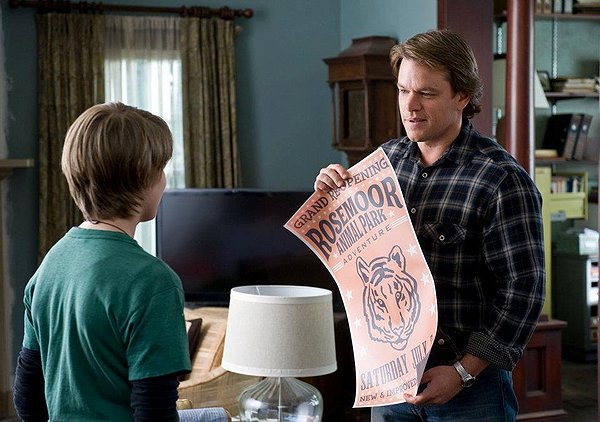
Matt Damon plays Benjamin Mee, a recent widower still struggling with the recent death of his wife. He has two kids, both fitting the molds of so many others we’ve seen. There’s his adorable 7-year old daughter Rosie (Maggie Elizabeth Jones) who is filled with cute smiles and cuter sayings. Then there is 14-year old Dylan (Colin Ford), the misunderstood older child with a bad attitude who is really just hurting inside due to his mom’s death. C’mon, you know you’ve seen versions of these same kids in several other movies. They both closely follow the blueprint here and everything from their actions to their relationships with their father seems really familiar.

After Dylan is expelled from school and after seeing too many reminders of his wife around town, Benjamin buys and moves to a dilapidated old zoo just outside of the city. His hopes are to start a new adventure that will help both him and his children overcome the grief that they’re all still battling in their own ways. The zoo comes with it’s own assortment of exotic animals as well as a small staff that we hardly get to know with the exception of the head zookeeper Kelly (Scarlett Johannson). Young Rosie loves their new home while the rebellious Dylan wants to move back to the city. Against the advise of his older brother Duncan (Thomas Haden Church), Benjamin sets out to fix up the zoo in hopes of opening it up for the public. But as costs mount up and money runs out, he soon finds that his entire adventure may never get off the ground.

As I alluded to earlier, Cameron Crowe  milks emotion out of almost every plot point. There are occasions where it does work especially when the film deals with the more personal feelings of loss that each member of the family is dealing with. But Crowe drags these things out just a little to far. I’ll use the strained relationship between Benjamin and his son as an example. We know that a huge blow-up is coming before the relationship will ever be fixed but it feels like it’s never going to come. At over two hours long, Crowe could have trimmed a lot of fat off of the story and the movie would have been better for it. There are also underwritten relationships between Benjamin and Kelly as well as Dylan and a 13-year old home-schooled zoo restaurant employee that go nowhere. But there is a touching side story about a sick bengal tiger that Benjamin grows close to. In a sense it mirrors what he faced with his wife and it plays a big part in his personal healing process.

It sounds like I’m being really hard on the movie and with good reason. But there is also some things to like. As I mentioned there are moments where the emotion feels genuine and I was stirred by them. And even though the family dynamic is something we’ve seen numerous times before, there were instances where they were a believable family struggling with an intense loss. The performances are generally good even though the material sometimes lets the actors down. And I also found that the true story vibe made the movie more interesting. It’s really a neat story. I just wish it had been constructed a little better.

“We Bought a Zoo” isn’t a horrible movie but it’s one that could have been a lot better. It’s sloppy screenplay doesn’t help and the movie runs about 20 minutes too long. It advertises itself as a family picture but it deals with some fairly heavy subject matter and the inclusion of a few pointless vulgarities, especially from a young child, had me shaking my head. At it’s core, the movie has a really good story and we see glimpses of it in some of the scenes. Even with it’s faults, I stayed with the film to the end just to get the feel-good payoff it delivers. It’s just a shame that it couldn’t have maintained a more consistent story from start to finish.

“CORIOLANUS” – 4 1/2 STARS

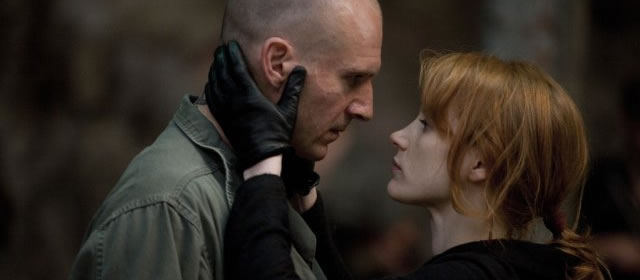
The wonderful actor Ralph Fiennes makes his directorial debut with “Coriolanus”, a modern-day version of Shakespeare’s 400 year old  play. It’s such an interesting and faithful take on the Shakespeare tragedy. While the film takes place in an entirely different time period than the one the play was written in, it’s still a wonderful examination of war and politics as well as an enthralling look at a truly mesmerizing character. It’s an incredibly unique movie and a challenging undertaking by Fiennes especially since he not only directed the picture but also starred in it.

Fiennes plays Caius Martius, an accomplished Roman general who finds himself at odds with the people of Rome after overseeing the government’s effort to hoard up all of the grain during a food shortage. Martius has no love for the people. He finds them contemptible  and he doesn’t trust them nor does he respect them. After Martius squelches a riot led by an anti-government protest group, two politicians Sicinius (James Nesbitt) and Brutus (Paul Jesson) seize the opportunity to gather support from the people by speaking out against him. It’s here that Fiennes the director gives us our first look at the political maneuvering and manipulation that plays such a big part of the story.

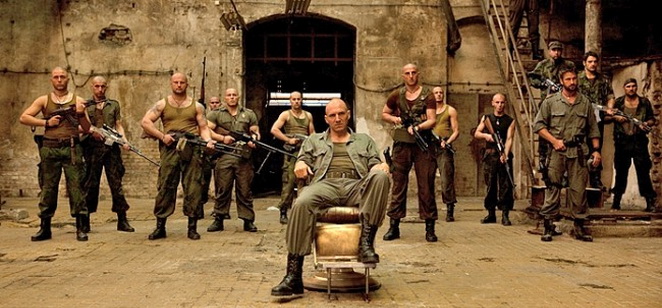
But after Rome’s bitter enemy the Volscians begin moving closer to the city, Martius and the army head out to meet them. The Volscians are led by Tullus Aufidius (Gerard Butler). Aufidius and Martius have met in battle several times and have developed a deep-rooted hatred for each other. The two bring their armies and engage in a bloody urban gun battle that results in the Volscians falling back. Martius is welcomed back to Rome as a wounded war hero. He’s awarded the name Coriolanus in honor of his service and is encouraged to run for Consul by his mother Volumnia (Vanessa Redgrave) and Menenius (Brian Cox), a Roman Senator sympathetic to Coriolanus and his family. But in the midst of his popularity, his pride and stubbornness combined with the ambitions of the self-seeking politicians put him at odds once more with the people of Rome. This time Sicinius and Brutus get what they want and Coriolanus is banished from Rome. Burning with anger and blood-thirsty for vengeance, Coriolanus forms the most unlikely of alliances to pay Rome back for what they’ve done to him.

Fiennes delivers a bold and vigorous performance. He shapes and develops Coriolanus through every scene and we quickly understand that he’s a very complex individual. He’s hampered by his unbriddled arrogance and refusal to compromise the smallest thing that he feels may question his authenticity. He’s also a soldier who loves Rome and a man who loves his family. But even when in the comfort of those people and things he loves, he finds it hard to function as he should. Fiennes perfectly sells all of this to us and I was completely enthralled in the character.

Fiennes is also helped by a phenomenal supporting cast. Gerard Butler gets back on track after a few subpar performances in some really subpar movies. Here he’s really good and I was immedietaly reminded that he can be a solid actor. Vanessa Redgrave was simply fabulous as Coriolanus’ mother. She shares several brilliant scenes with Fiennes that you just can’t take your eyes off of. I also loved Jessica Chastain who gives another understated and measured performance as Coriolanus’ wife. I couldn’t help but find similarities between this and her role in “Take Shelter” even though they are two very different films. Even Brian Cox, an actor that I haven’t always appreciated, is really good here.

One of the first things that you’ll notice when watching “Coriolanus” is that it uses the classic Shakespeare lines and language. At first I wasn’t 100% sure if I liked it or not. It was a little jarring at first seeing it used in such a modern setting. But before long I was perfectly sold on it and I was amazed at how fluid and seamless Fiennes made it feel. Now I admit, there were a few moments where I simply didn’t follow what was being said and a few that just didn’t fit with the current day setting. But these moments were rare and overall it was pretty remarkable what the movie was able to accomplish.

I also have to mention that “Coriolanus” is a really good looking picture. Fiennes doesn’t try to do too much with the camera but he clearly has a good eye for framing shots. The film also has a unique look to it and a lot of that has to do with the decision to shoot in Serbia. The locations have a gloomy almost war-torn look to them and not I’m not just talking about the action sequences. Speaking of that, the movie does feature some pretty gritty action that are made even more believable in large part due to the setting that resembles what Serbia may have been like just a few years earlier. Fiennes doesn’t exclude the blood but he doesn’t load these scenes down with them either. Instead he focuses on Coriolanus and his combat intensity as he leads his men through the streets. It works really well. He also tells a lot of the story through some clever usage of the Roman media, particularly a news channel called Fidelis TV. There’s some interesting commentary on the power and influence of the media and we see it through a host of really effective news clips and talk shows.

I was excited about “Coriolanus” but I was caught a little off guard. The Shakespearian dialogue took some adjusting to at first but as I mentioned, soon I was completely wrapped up in it. This was an extremely ambitious project for Ralph Fiennes especially for his first attempt at directing. But this is an impressive and auspicious debut from this already seasoned actor. On that note, his performance is simply fantastic and he brilliantly portrays one of the most intriguing characters I’ve seen on screen in a while. But he’s not alone. The film is also helped by a tremendous supporting cast. I really enjoyed “Coriolanus”. It’s not just a unique and daring movie. It’s also one of the best movies of the year so far.