REVIEW: “Black Phone 2” (2025)

Scott Derrickson’s 2021 horror gem “The Black Phone” left a mark with its sinister tone and edge-of-your-seat suspense. But its ace in the hole was Ethan Hawke who took on a role unlike any other in his brilliant forty-year career. Hawke played The Grabber, a serial killer and child abductor who terrorized the residents of a Denver suburb. Hawke lost himself in the character and delivered a horror movie antagonist that was both chilling and fascinating.

Derrickson returns to direct and rejoins C. Robert Cargill in writing the script for “Black Phone 2”, a sequel set four years after the events of the first film. Even more exciting, Ethan Hawke returns as The Grabber who (and this may be a spoiler for series newcomers) was killed at the end of the first film. But Derrickson and Cargill have created a surprisingly compelling angle to bring their villain back, and they manage to extend the original story in a unique and effective way.

“The Black Phone” drew its inspiration from a 2005 short story by Joe Hill. It laid the groundwork for the unexpected narrative twists of “Black Phone 2”. Set in 1982, the sequel continues the stories of brother and sister Finney and Gwen Blake (played by the returning Mason Thames and Madeleine McGraw). Now 17-years-old, Finney has tried burying his trauma since grabbing headlines as the lone survivor of The Grabber’s murder spree.

Image Courtesy of Universal Pictures

But the movie is most interested in Finney’s kid sister Gwen, whose mysterious power (or curse) played a big part in the first movie. Gwen’s clairvoyance is manifested in dreams that she doesn’t fully understand. Lately they’ve been horrifying nightmares where she witnesses the brutal murders of three young boys. There is also the piercing rings of a black rotary phone – a potential connection to The Grabber. Each new nightmare gets more vivid and more disturbing. And each points to Alpine Lake Youth Camp high up in the Rocky Mountains.

Desperate for answers, Finney, Gwen, and her wannabe boyfriend Ernie (Miguel Mora) head to Alpine Lake to investigate. Posing as counselors in training, the trio arrive in the middle of a blizzard and are greeted by a limited staff including the owner, Armando Reyes (Demián Bichir). While there, Gwen’s terrifying dreams intensify. They begin with horrific encounters with the three mutilated little boys. But soon it’s The Grabber himself, now a raging vengeful spirit with an ax to grind with Finney and Gwen.

Derrickson really leans into the added supernatural spin, taking an already dark and unnerving story and making it even more unsettling. Along the way, we’re treated to several intriguing connections and unexpected reveals, some of which change our perspective on the first film in some surprisingly clever ways. They tell us more about The Grabber’s violent history as well as Finney and Gwen’s family struggles.

The performances from the young stars are generally good although the script trips them up on occasion. This is especially true with McGraw who is routinely forced to blurt out 80s-inspired insults which sound more hokey than authentic. Otherwise both she and Thames meet the many demands of their roles. We also get good supporting turns from Bichir and Jeremy Davies as Finney and Gwen’s father, Terrence.

Image Courtesy of Universal Pictures

As for Hawke, aside from a few glimpses in a handful of early flashbacks, it’s nearly an hour before we see him as The Grabber. And once he appears he is every bit as chilling as before, lurking in the shadows of Gwen’s dreams while grimly uttering his lines with an ethereal menace. He’s a haunting presence with powers inspired by Freddy Krueger, but whose vengeful rage and sadism is far more serious and focused.

The movie makes a number of impressive choices, but some of the most effective involve its bold visuals. Derrickson shoots Gwen’s dream sequences using Super 8mm and 16mm, giving them a grainy old home video quality. Together with the crackle of static in the audio, it creates an eerie and dread-soaked atmosphere. It’s a very specific and potent visual choice that’s more than just a gimmick. And it stands out even more once Derrickson begins integrating it with the digital photography of the ‘real world’.

“Black Phone 2” is a terrific sequel that many of us didn’t know we needed. From its well-developed character arcs to its sinister set pieces, the movie uses every facet of filmmaking to make us squirm in our seats but also empathize with its characters as they navigate such common yet weighty themes as processing trauma, facing fears, family bonds, and the testing of faith. Admittedly the rules of ‘dreams versus reality’ aren’t always clear, especially in the final act. But it’s easy to look past such small gripes after considering the keen vision and first-rate execution of this worthwhile sequel that’s full of proud callbacks and original twists all its own.

VERDICT – 4 STARS

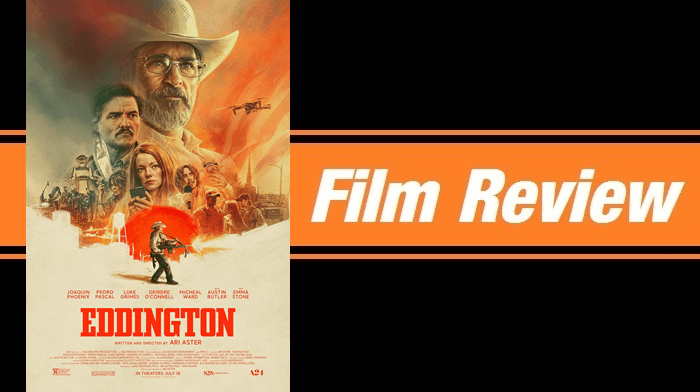
REVIEW: “Eddington” (2025)

Ari Aster’s short but attention-getting feature film career has been a fascinating rollercoaster. It began with a bang with his exceptional 2018 supernatural/psychological horror gem “Hereditary”. He followed it up with 2019’s “Midsommar” – a movie with a first half that is every bit as brilliant as his debut film and an unfortunate second half that goes completely off the rails. Things only got worse with 2023’s disastrous “Beau Is Afraid”.

Now Aster is back with his fourth film and with it we see his career pendulum swinging back mightily the other way. Aster takes a bold and provocative swing with “Eddington”, shrewdly straddling the line between satirical black comedy and a Neo-Western thriller. His story is set in 2020 during the early days of the COVID-19 pandemic. He takes an unvarnished look at the heightened paranoia and anxieties that swept through communities while spotlighting the political opportunism and obstinance that only made things more complicated.

Adding to the already tumultuous landscape were the growing tensions following the killing of George Floyd. Impassioned protests swept across the country. But several were overthrown by aggressive rioters, sometimes prompted by well-funded outside agitators eager to plunge the country into violence. Aster’s willingness to take on such fresh wounds speaks to his audacity. But what’s amazing is how well he pulls this crazy thing off.

Image Courtesy of A24

While some may try hard to put “Eddington” in their political corner, the film openly fillets the political left, right, and most everyone in between. It should be stated that Aster isn’t fence-straddling. He offers frank and truthful observations through a fable that is as thematically chaotic as the times it represents (and fittingly so). Most will remember the events with alarming clarity which may make this a difficult watch. Yet Aster mines so many darkly funny moments out of the pointed, pathetic, and preposterous scenes that unfold before us.

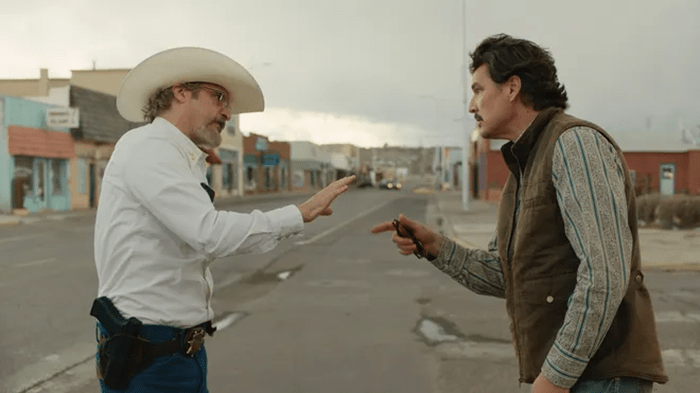
The story plays out in Eddington, a small dried-up New Mexico town with a population of 2,435. It’s where we meet Sheriff Joe Cross (an exceptionally pitiful Joaquin Phoenix), a by-the-books rural conservative who keeps the law in his quiet town with the help of his two deputies, Guy (Luke Grimes) and Michael (Michael Ward). The only thing more frustrating to Joe than mask mandates and government imposed lockdowns is his live-in mother-in-law, Dawn (Deirdre O’Connell) who rarely misses a chance to scrutinize how he handles his dissociative wife Louise (an underused Emma Stone).

Joe doesn’t see the coronavirus or the growing unrest as Eddington problems. This puts him at odds with Ted Garcia (Pedro Pascal), Eddington’s incumbent mayor who is up for reelection. Ted stands for nearly everything Joe is against. He’s a good-looking and good-talking politician who is intent on protecting his political career by staying on his liberal governor’s good side. That means imposing and enforcing mandates and policies that don’t always apply to him. Far shadier is his involvement in a massive AI data center set to be constructed on Native American land outside of Eddington.

Image Courtesy of A24

As the tensions fester between Joe and Ted, a small but growing BLM-inspired protest breaks out on Main Street. They’re spearheaded by the impressionable Sarah (Amélie Hoeferle) whose verbiage and sloganizing sounds plucked from TikTok videos rather than out of organic conviction. She’s supported by Brian (Cameron Mann) who is more smitten with her than their cause. Joe is ill-equipped to either control the crowd or empathize with their cause which only makes things worse.

Aster throws in so many other things, all ripe for critique. Conspiracy theories, misinformation, social media dependency, cult leaders (a shaggy but captivating Austin Butler is a brief delight), white middle-class radicalism, etc. With so much laid out, the budding question became how would Aster wrangle it all together? The answer – with an insanely violent Tarantino flavored exclamation point at the end. It’s a wildly entertaining finish that speaks to where our intensifying divisions could eventually lead us.

“Eddington” feels like a movie some will need to wrestle with, not just for days but perhaps years. It’s a feature that demands a level of honesty and introspection. Those unwilling will likely contort the movie to fit their political dogmas or simply dismiss it altogether. But those willing to look deeper will find a well-conceived and well-crafted satire that is both ruthlessly funny and daringly insightful. Top it off with a terrific cast (none better than Phoenix), and you have Aster’s best film since his stellar debut. “Eddington” is in theaters now.

VERDICT – 4 STARS

REVIEW: “I Know What You Did Last Summer” (2025)

Riding hot on the heels of Wes Craven’s enormous box office hit “Scream”, director Jim Gillespie’s 1997 slasher “I Know What You Did Last Summer” pretty much followed the same path to success. It was made on a small budget, it featured a collection of fresh young faces, and it raked in a lot of money leading to one immediate sequel, one later direct-to-video sequel, a now a legacy sequel that follows the events from the second movie.

Originally based on a 1973 novel by Lois Duncan, “I Know What You Did Last Summer” pulls inspiration from an old urban legend of the Hookman. In the 1997 film, a group of teenage friends from Southport, North Carolina are terrorized by a hook-wielding killer one year after they covered up a car accident where they accidentally killed a man. Murder and mayhem ensued as the friends found themselves the target of a mysterious killer.

Image Courtesy of Columbia Pictures

The 2025 film (which follows that silly trend of using the same name as a previous installment) takes place 28 years after the Southport murders. Director Jennifer Kaytin Robinson, working from a script she co-wrote with Sam Lansky, basically follows the same blueprint as the first film, with a new group of friends and a couple of old familiar faces which fans will enjoy seeing despite them feeling shoehorned in.

Five not so interesting friends, Ava (Chase Sui Wonders), Danica (Madelyn Cline), Milo (Jonah Hauer-King), Teddy (Tyriq Withers), and Stevie (Sarah Pidgeon), drive up in the hills overlooking Southport for the best view of the town’s annual late-night Fourth of July fireworks show. As the group dumbly goofs around in the middle of the winding road, a truck is forced to swerve to miss them, plunging off the gorge to the rocks below.

Rather than help, the frightened group flee the scene. They later find out the driver was killed, but Teddy’s wealthy father (Billy Campbell) uses his influence with the cops to keep the kids from being implicated. The five friends take an oath to never mention what happened to anyone. But if you know anything about the original movie you know their secret comes back to haunt them.

One year later, Danica receives a mysterious note the reads “I know what you did last summer“. It forces the five startled friends back together where they quickly find themselves being stalked by a hook-wielding killer in a rain slicker. While the police aren’t much help, they find unexpected allies in Julie James (Jennifer Love Hewitt) and Ray Bronson (Freddie Prinze Jr.) – two original survivors of the 1997 murder spree.

Image Courtesy of Columbia Pictures

Robinson and Lansky try but have a tough time giving us anyone to root for. It’s no fault of the cast as everyone puts what they can into their mostly hollow characters. Even Hewitt and Prinze Jr. struggle to bring anything beyond nostalgia to their characters. The story does them no favors, predictably moving from point to point, relying on jump scares rather than real tension, and eventually falling apart with a desperate twist that is more eye-rolling than shocking.

That leaves us with the kills – something all good slashers lean on to some degree. Here they barely leave an impression and even the most die-hard slasher fan will have a tough time being impressed. It’s just another blemish on what is a mostly lifeless and painfully by-the-numbers snooze that has a difficult time justifying its own existence. We get glimpses of what the movie could have been, but sadly it’s only glimpses. “I Know What You Did Last Summer” opens in theaters today.

VERDICT – 2 STARS

RETRO REVIEW: “Star Wars: Episode III – Revenge of the Sith” (2005)

SITHposter

It’s hard to believe, but it has been twenty years since the release of “Star Wars: Episode III – Revenge of the Sith”. To celebrate Lucasfilm and Disney are re-releasing the movie in theaters across the country and the projected turnout has been amazing. It’s well deserved as “Episode III” is not only the best film from the prequel trilogy, but it’s one of the very best Star Wars movies made.

When it comes to the prequels, Star Wars mastermind George Lucas certainly saved his best for last. “Episode III: Revenge of the Sith” is a fabulous final chapter in the prequel trilogy and a movie that stands firm on its own individual merits. Rewatching it again, I was again reminded of how much I’ve loved it, not only during its initial release, but during every subsequent viewing.

SITH11

“Episode III” begins three years into the Clone Wars with an eye-popping opening rescue attempt sequence in the atmosphere above Coruscant. Chancellor Palpatine (Ian McDiarmid) has been captured by General Grievous, the commander of the Separatist droid army. Jedi Knights Obi-Wan Kenobi (Ewan McGregor) and Anakin Skywalker (Hayden Christensen) eventually succeed in rescuing the Chancellor but fail to capture Grievous. It’s an exhilarating start to the film, full of action, stunning visuals, and some meaningful story nuggets. It also adds some welcomed levity before the inevitable darker turn.

Lucas moves things along at a faster pace than in the previous two films mainly because he has a lot of ground to cover. Obi-Wan sets out to track down Grievous with hopes that his capture would end the war. Palpatine continues his quest for power through the manipulation of politics and the war. But the Chancellor’s biggest target is Anakin who he secretly works to sway to the dark side. Meanwhile Anakin and Padme (Natalie Portman) continue to hide their marriage which proves tougher after Padme reveals she is pregnant.

SITH2

The sheer number of dangling story threads is pretty daunting, but Lucas ties them up nicely and his management of both narrative and tone is superb. He keeps a sharp focus and doesn’t wander off into needless side-stories. The movie stays centered on Anakin and those closest to him – Padme and Obi-Wan on one side; Palpatine on the other. Of course we know Anakin becomes Darth Vader and Lucas chronicles His turn in a powerful and often heart-breaking way.

That doesn’t mean other key characters and plot points are overlooked. Yoda (again perfectly voiced by the great Frank Oz) gets some big moments as does Samuel L. Jackson’s Mace Windu. Lucas answers questions concerning the Jedi Order, the Trade Federation, and of course a few bigger ones that directly connect to “Episode IV”. As a long time fan of the original three Star Wars pictures, it’s pretty amazing to watch these two trilogies connect in such a satisfying way.

Several things take a step up from the previous film, most importantly the performances from Christensen and Portman. Christensen makes the bigger leap which is impressive considering he’s given much trickier material to work with. The range of emotions and the level of character transformation was challenging but he does a nice job. Sure, you’ll wince at a couple of line deliveries, but as a whole its a solid performance. Same with Portman who just feels more comfortable with her character. McGregor is outstanding as is the conniving McDiarmid.

SITH22

Even visually “Episode III” seems more focused. We get none of those shallow sequences that are little more than CGI showcases. Here everything serves the story, the characters, the environments, and the atmosphere. And of course you have the musical genius of John Williams who has over 50 Academy Award nominations to his credit. Over the decades his music has played crucial roles in Star Wars storytelling and “Episode III” features some of his best work, especially during the film’s darker second half.

As you can probably tell I still love “Revenge of the Sith” and that enthusiasm was only strengthened with this 20th Anniversary rewatch. It remains a fantastic conclusion to the prequels and a satisfying segue to the classic original films. It all wipes away most concerns for the previous episodes, especially when watching them in succession and as one 415-minute whole. Best yet, they maintain a firm place in Star Wars canon and opened the door to a host of exciting content that’s still playing out today.

VERDICT – 4.5 STARS
4-5-stars

REVIEW: “Warfare” (2025)

For decades war movies have come in all shapes and sizes. But only a handful of modern war movies have hit as hard as “Warfare” from Iraq War veteran Ray Mendoza. A former U.S. Navy SEAL, Mendoza writes and directs alongside Alex Garland (“Ex Machina”, “Civil War”) to deliver a raw and no frills feature based on his own personal memories. The results are harrowing, sobering, and eye-opening. And it makes for one of the most gripping experiences of the year.

Already heralded for its stunning realism, “Warfare” thrusts us into the grip of combat where bravery and brotherhood are the only means of survival. Before filming began, the cast underwent an intensive three week bootcamp that included weapons training, communications etiquette, and tactical maneuvers. It pays off in some really big ways, adding a striking layer of authenticity that help Mendoza and Garland immerse us deeper into the true-to-life world they’re recreating.

Image Courtesy of A24

The story of “Warfare” is as straightforward as its title. There are no sweeping character arcs, no dense plot, no artificial drama. Set in 2006 during the Iraq War, the movie follows Navy SEAL team Alpha One also known as the Bushmasters. The team are ordered to take up a sniper position on the top floor of a home they commandeer in Ramadi. From there they are to monitor a market place just down the street that’s believed to be a gathering place for insurgents.

One the many effective elements in “Warfare” is in how it presents the moment by moment realities these soldiers face. We’re immediately shown that not every second of a mission is guns blazing. In fact, Mendoza and Garland use their early scenes to emphasize the lull of surveillance and intelligence gathering. Yet they ramp up the tension with subtle references to the danger these young men are in. And when a hand grenade is tossed into their building, the intensity quickly goes from a simmer to a boil.

Things only ratchet up from there as “Warfare” grounds us in the efforts of the platoon to evacuate amid a hail of small arms fire from the converging insurgents. With unflinching effort, Mendoza and Garland put us side by side with the soldiers, making us feel the ferocity of combat without sacrificing verisimilitude for sensationalism. They avoid the usual war movie tropes – no chest-pounding bravado, no “tell my wife I love her” moments, no big inspirational speeches. Every heart-stopping second feels rooted in reality.

Capturing the real-time events is aided by the film’s impressively stacked cast that includes Will Poulter, D’Pharaoh Woon-A-Tai, Joseph Quinn, Charles Melton, Cosmo Jarvis, Michael Gandolfini, and Kit Connor among others. Each young actor clearly understands their assignment and fully commits to bringing their real-life characters to the screen as authentically as possible. They really shine in the second half as the mission falls apart and the “war is hell” adage takes full form.

Image Courtesy of A24

Equally impressive and just as vital is the technical craft, from the stunning cinematography to the concussive sound design. Both contribute to the overall visceral reaction the movie evokes, at times hitting like a sensory assault but in the most fitting way. Take the scene where an IED is suddenly detonated. The sound of the blast rattled my theater and the disorientation of the aftereffects underscores the chaos. Both leave such an impact.

Those who tend to view war movies through the prism of politics may be discouraged to find that “Warfare” isn’t interested in sermonizing or editorialization. That’s not to say there isn’t plenty that we can conclude from the moral murkiness that unfolds onscreen. But the movie’s focus remains on the men in uniform, and for 93 minutes we follow them through the trenches of warfare where we’re inspired by acts of heroism yet grieved at the human cost. It’s the latter that makes “Warfare” such a gut punch.

VERDICT – 4.5 STARS
REVIEW: “The Alto Knights” (2025)

I’ve long been fascinated with the history of the Mafia in the United States. Over the years I’ve read countless works of nonfiction and biographies. And I’ve soaked up numerous documentaries covering the Mafia’s violent rise and inglorious fall, both of which left an indelible mark on 20th century America. Of course by extension that makes me a sucker for Hollywood’s storied gangland treatments – “The Godfather”, “Once Upon a Time in America”, “The Departed”, “The Irishman”, just to name a few.

The latest mob movie to join the ranks is “The Alto Knights”, a gangland drama that certainly comes with impressive credentials. It is Oscar-winning director Barry Levinson’s first big screen feature since his 2015 clunker “Rock the Kasbah”. It’s penned by 92-year-old Nicholas Pileggi whose screenwriting credits also include “Goodfellas” and “Casino”. And it stars Robert De Niro, an Academy Award winner himself who’s no stranger to gangster fare.

To be truthful, “The Alto Knights” doesn’t belong in the same company with the superior mob movies mentioned above. That’s because of some nagging shortcomings that hold it back (more on those in a moment). But the film hones in on a fascinating relationship set during an equally fascinating time in the history of the American Mafia. Pileggi’s script shows he has done his homework, and Levinson makes it a point to ensure the film stick close to the facts.

Image Courtesy of Warner Bros.

“The Alto Knights” tells the true story of childhood friends turned mobsters Frank Costello and Vito Genovese (each played by De Niro). Both grew up together on the New York City streets and both rose in the mob ranks under boss Charles “Lucky” Luciano. While they would often work together, Costello and Genovese had dramatically different tactics when it came to mob business. Costello preferred power through influence, often controlling politicians, judges, cops, and city officials. Genovese was more prone to use violence and even murder as a means to an end.

But tensions would form and fester between the two powerful men. Some came from Vito’s involvement in the bustling drug trade which was drawing unnecessary heat from the feds. But most was due to Vito’s desire to become the “boss of all bosses“. The ambitious Vito had long felt he deserved the top seat, but he had one significant obstacle – Frank Costello. After Vito was forced to flee the country to avoid a murder charge, an imprisoned Luciano named Costello acting boss. When Vito returned he begin plotting to gain the title from his old friend.

The movie opens with De Niro’s Frank Costello walking into his apartment building. As he waits for the elevator, a gunman, Vincent Gigante (Cosmo Jarvis) shoots him in the head by orders of Vito Genovese (also De Niro). Miraculously the murder attempt only amounted to a flesh wound, but it convinced Frank to relinquish his power. Yet the ever paranoid and growingly volatile Vito doesn’t buy it and isn’t sold on Frank’s sudden urge to retire.

Image Courtesy of Warner Bros.

From there Levinson takes us back in time to show key moments that led these one-time friends to become high-ranking rivals. He eventually works his way back to the murder attempt and then shifts to the events that follow. Along the way the film highlights the power, the politics, the insecurities, and the inevitable violence that is inherent to the true account. It’s all helped along with solid supporting work that includes Debra Messing as Frank’s wife Bobbie, Kathrine Narducci as Vito’s wife Anne, and Michael Rispoli as Albert Anastasia, the notorious mob enforcer with close ties to Frank.

While the story itself is quite interesting, the storytelling device Levinson uses is wobbly as best. For some reason the story is told through what resembles a video diary shared by an older Frank. Sometimes it’s Frank narrating while sitting in a dark room watching old slides. Other times he’s breaking the fourth wall while sitting outside in some park or garden. There’s no real rhythm or cohesion to any of it, making it more distracting than clever.

“The Alto Knights” recycles a few things from other mob movies and can almost be too straightforward and workmanlike in how it relays parts of its story. But it remains compelling throughout, especially for those familiar with the history and its key players. De Niro’s double duty turns out to be more than a gimmick as he breathes life and personality into these two complex figures. Overall, Levinson and Pileggi add another worthwhile entry into the mobster movie catalog.

VERDICT – 3.5 STARS