
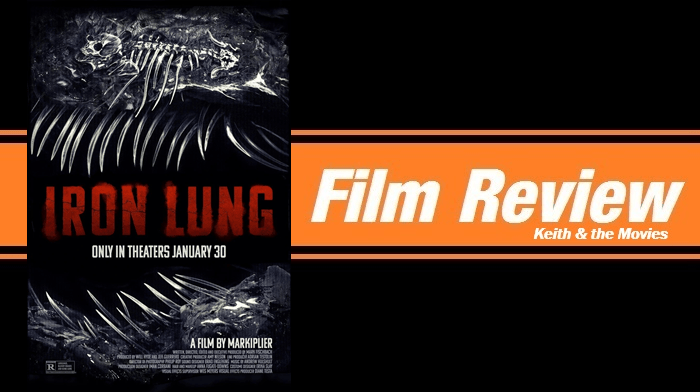
The potential game-changing success of “Iron Lung” has become a compelling story on its own. The science-fiction horror film is written, directed, edited, and produced by Mark Fischbach, a popular YouTuber who goes by the online name Markiplier. He sits as one of the most popular streamers on the platform with over 38 million channel subscribers to date.
Fischbach self-financed “Iron Lung” for $3 million. Even more impressive, he self-distributed his film, initially only negotiating a small release in 60 independent theaters across the United States. He then reached out to his fans who spearheaded a massive grassroots campaign which caught the attention of several major theater chains. As of now, the film is showing in over 4,100 screens worldwide and made over $21 million in its opening weekend.
“Iron Lung” is based on a 2022 indie game developed and published by David Szymanski. It was a first-person simulation horror experience set entirely within a cramped midget submarine. The movie follows suit, keeping us confined inside a small iron shell for the duration of its two hours. The confinement itself is never an issue. But the two-hour runtime is, with Fischbach too often dragging things out considerably longer than he needs to.
The story is set in a distant future where mankind has colonized space. But a catastrophic event called the Quiet Rapture caused all star systems to vanish. Planets, stars, moons – all gone. And nearly all of humanity disappeared with them. The only survivors are the small numbers of people who were onboard space stations and starships. Those remaining desperately do what they can to stave off their extinction.
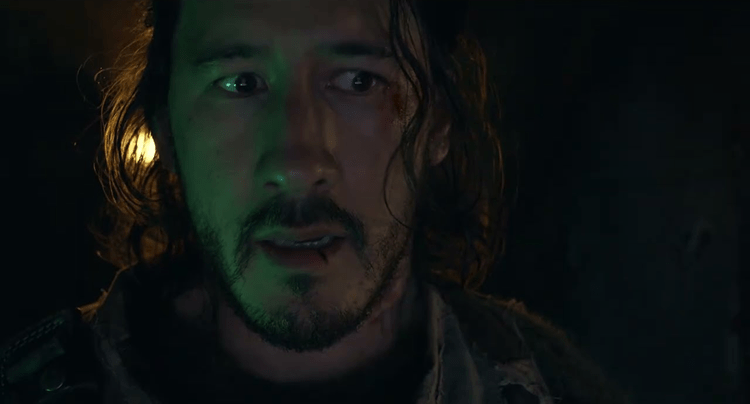
Enter Simon (strongly played by Fischbach), an antsy convict about to go on a dangerous mission as penance for a crime that we learn more about as the movie progresses. His mission is to descend deep into an uncharted ocean of blood on a desolate moon believed to hold information and resources crucial to human survival. His handlers have nothing but surface scans. So Simon is tasked with exploring the deep and photographing his findings in exchange for his freedom.
Simon’s small single-chambered submarine is welded shut and the lone porthole is sealed to prevent leaks due to the ocean’s intense pressure. That leaves him completely blind when submerged. His only means of navigation are his instruments and the crude images of an x-ray camera. His chief handler on the surface is the stern and cryptic Ava (Caroline Rose Kaplan) who barks Simon’s orders through a small speaker while trying to keep him focused.
There’s not a lot in terms of plot, but the first half-hour is riveting both narratively and technically. The early storytelling is equal parts harrowing and mysterious as new revelations raise the stakes while introducing an array of physical and psychological dangers. Tensions simmer, trust erodes, and deeper questions emerge. At the same time, Fischbach impressively acquaints us with the “Iron Lung” vessel, skillfully capturing the claustrophobia and peril through his camera and rich sound design.
But things take a frustrating turn as the film goes beyond slow-burning to meandering. Fischbach stretches his already limited story beyond its bounds, overextending sequences and repeating himself in scenes to the point of tedium. The gaps between new information get wider as Simon slowly navigates an assortment of drawn-out side quests that end up opening more questions than the movie ever answers.
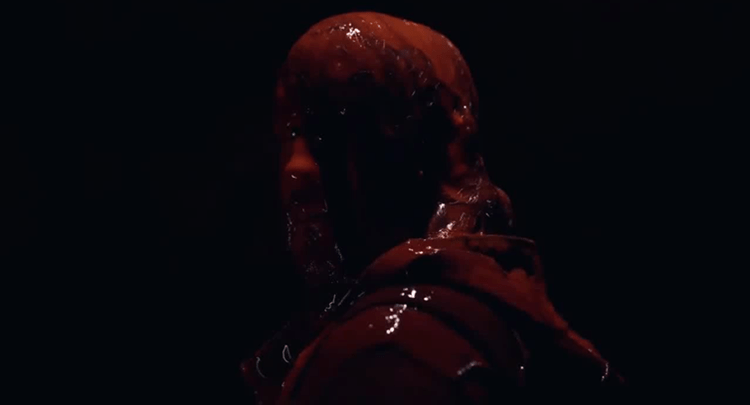
Things do pick up in the final half-hour as Fischbach lets the blood gush (and I say that in its most literal sense). He and his team serve up a gory, blood-drenched ending that’s realized through a series of gnarly practical effects. And though it’s sometimes hard to discern what’s happening amid the dim lighting and shaky camera, the film’s ending goes for the jugular, more so visually than narratively.
In the end there is so much to admire about “Iron Lung” – the concept, the craftsmanship, the ambition, the determination. Markiplier shows some real creative chops, both in front of and behind the camera. Unfortunately the middle-hour’s languid pacing really stymies the movie’s momentum and zaps it of its tension, making the experience more grueling than thrilling. It’s a bummer because somewhere in “Iron Lung” is a tighter and more focused 90-minute movie that I would have loved.
VERDICT – 2.5 STARS






 Keith & the Movies