

The last time we saw acclaimed director Paul Thomas Anderson was in 2007 with his sensational drama “There Will Be Blood”. With it he solidified his position as a film critic favorite. Now he’s back with his next movie, “The Master”. As with every other feature film Anderson has made, he both wrote and directed this audacious drama that bounces between captivating and utterly frustrating. There are some award-worthy performances and loads of ambition, just as you would expect from a PTA feature. But while there were moments where I couldn’t take my eyes off the screen, there are others where the story bogs down in the deliberate pacing and slight self-indulgence. Nonetheless Anderson presses all the right critic’s buttons so this will has a good chance to be an awards season contender.
No one can deny Anderson’s filmmaking skills. “The Master” looks every bit of an epic, landmark film. There are a number of scenes that stand out due to their framing and camera work alone. Anderson uses several amazing tracking shots, sometimes shifting focus three or four times while still maintaining a single fluid shot. He also uses several fantastic locations which he captures through his stylish and precise lensing. I also have to mention the way he recreates America in 1950 both narratively and visually. The wardrobes, hairstyles, furnishings, etc. all fit perfectly, right down to the smallest details. Anderson takes no shortcuts on selling the audience on the period and that’s one of the reasons it’s so easy to connect with the story.

It’s in this 1950 America that we are introduced to Freddie Quell. He’s played by Joaquin Phoenix who gives the performance of his career. While not as breathtaking as Daniel Day-Lewis in “There Will Be Blood”, Phoenix is magnetic portraying a man emotionally scarred from his time in World War 2, or at least that’s what I presume. Freddie’s life is in shambles. He’s a raging alcoholic who resorts to drinking his own concoctions made from paint thinner and any other chemical he can get his hands own. He also has a twisted sex disorder that pops up here and there. His alcoholism is destroying his life and ends up playing an important part in the film. On the other hand, his sex addiction felt terribly underwritten and is only explored by adding a handful of uncomfortable scenes that quite frankly I could have done without. But as I said, Phoenix is brilliant and should be in prime position for an Oscar nomination.
Freddie ends up crossing paths with the charismatic leader of a group called “The Cause” named Lancaster Dodd (wonderfully played by Philip Seymour-Hoffman). Dodd is a self-proclaimed philosopher and intellectual with a steady and devoted group of followers. He also has a way with words which draws Freddie to him and his movement. Dodd takes a special liking to Freddie, at one point calling him his guinea pig but clearly growing more fond of him. Dodd is able to suppress Freddie’s mental issues to the point where Freddie begins to buy into his teachings. But his inner turmoil resurfaces on several occasions making him more and more conflicted.
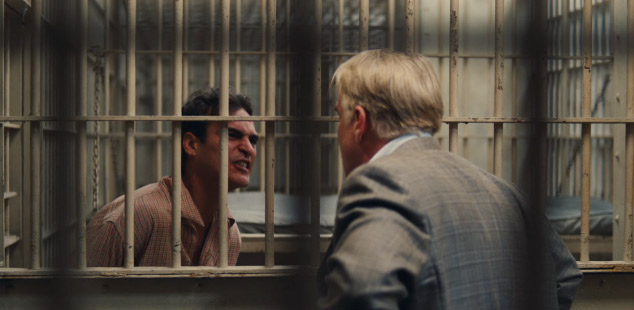
The story often moves with an amazing rhythm and Phoenix and Hoffman share some mesmerizing scenes together. But for such a hyped picture, I was surprised to see the overall lack of plot. “The Master” features some of the best scenes you’ll see in the theaters this year, but honestly, there’s not a lot that happens within the film’s long running time. But a bigger problem with “The Master” is that for the entire film Anderson keeps the audience at arm’s length from what we are seeing. We’re never allowed to fully get to know the characters who truly are the driving forces behind the entire story. Anderson wants us to do a lot of guesswork and come to our own conclusions. But for me, a little less ambiguity and more intimacy with the characters would have been a big plus.
Overall there is a lot to like about “The Master”. Anderson’s style of filmmaking is about as good as you will find and it really stands out here. The movie looks and feels right at home in post-World War 2 1950 and the cinematography will blow you away. The film is also helped by tremendous performances from Phoenix and Hoffman and I didn’t even talk about Amy Adams’ strong work. Expect to hear all of their names when the Oscar nominations are announced. But while Anderson’s story is good, it doesn’t pack the punch that it’s going for. While it’s fascinating to watch these characters, I couldn’t help but want more. That, combined with a few pacing issues and a couple of scenes it could have done without, keep this from being the Best Picture frontrunner many are touting it as.
VERDICT – 3 STARS

 Keith & the Movies