
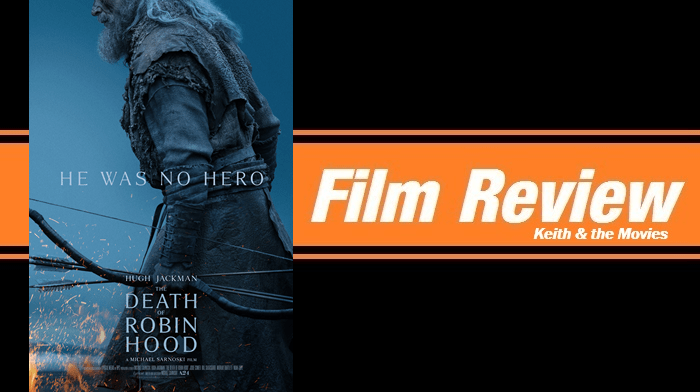
The legend of Robin Hood has been told on screen in a wild variety of ways. Their range has included Errol Flynn’s 1938 swashbuckling classic, Disney’s 1973 animated reimagining, Kevin Costner’s 1991 popcorn blockbuster, the hysterical 1993 spoof from Mel Brooks, and the more serious-minded 2010 Ridley Scott telling. The latest is the aptly titled “The Death of Robin Hood” and it is dramatically different from any other iteration that came before it.
“The Death of Robin Hood” doesn’t fit into any of the more popular molds that we have seen before. There’s nothing light, merry, or charming about it. Instead, it’s a bleak and gritty adaptation of the 17th-century ballad “Robin Hood’s Death”. Writer-director Michael Sarnoski (“Pig”, “A Quiet Place: Day One”) offers up a fresh and compelling reimagining of Robin Hood. He builds a fascinating character arc that’s rooted in savage violence but evolves into a deeper and almost meditative study of guilt, self-forgiveness, and mortality.
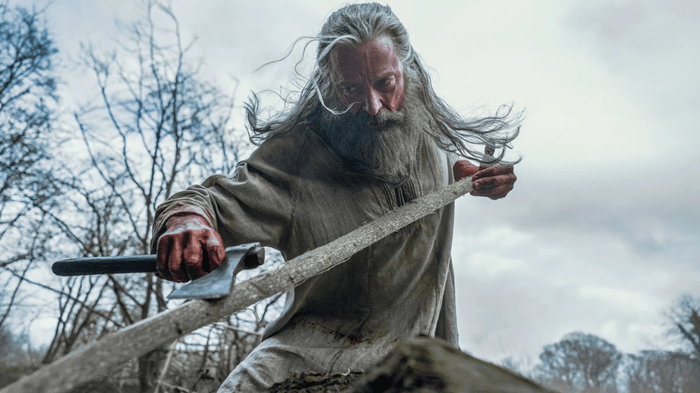
Sarnoski’s vision is impressive on its own. But it would never be fully realized without the gravitas brought by the film’s star, Hugh Jackman. With his long stringy gray hair, matching beard, weathered skin, and world-weary eyes, Jackman deftly conveys the numerous layers to this Robin. He’s legitimately terrifying as a murderous outlaw whose true self defies the local legend describing him as a hero who “protects the meek”. Yet he’s grown to despise the man he has become. He is haunted by the generations of his victims and he sees no moral reckoning outside of the worthy death he longs for.

The first 30 minutes gives us a good taste of the man Robin has been. Set in 1247, these early scenes are grisly and violent, with Sarnoski destroying the Robin Hood myth that we and the locals have clinged to. It’s most viscerally realized when Robin is visited by his longest and most loyal friend, Little John (Bill Skarsgård). Now living under the name Edward, John has made a new life for himself with his beloved wife and their young daughter.
But John has come to his old friend in desperate need of help. He recruits Robin to help him rescue his family and retake his farm from the clutches of some old enemies. The gruesome chain of events that follow shock by the sheer intensity of the violence. Brutes soaked in blood and caked in mud fight with a primal ferocity, crushing bones with maces, puncturing organs with jagged blades, searing flesh with burning torches. It’s pure savagery which Sarnoski visualizes with unflinching clarity.
Robin is seriously injured and later wakes up at a remote island priory under the care of an abbess named Sister Brigid (Jodie Comer) who begins nursing him back to health. It’s here that the film takes a dramatic turn, shifting its focus from Robin as a man of violence to Robin as a shattered soul who is crumbling under the weight of his own guilt. He keeps his identity hidden and begins blending in with the others being cared for by Sister Brigid, from orphan children to a wise but nameless leper (Murray Bartlett).
But Robin’s old life threatens to resurface after the unexpected reappearance of Little John’s traumatized daughter, Margaret (movingly played by newcomer Faith Delaney). She brings with her a looming sense of danger from the mainland that lasts for the remainder of the film. Yet Sarnoski remains committed to methodically maneuvering us through Robin’s internal reckoning. It’s more than simply deromanticizing of a myth. He takes his time exploring his more personal interests, right through to the payoff which is itself counter to what we expect.
A key reason for the film’s effectiveness can be found in Jackman’s deeply committed performance. It’s stripped-down and solemn yet full of conviction as the 57-year-old star balances bearing and releasing the emotional weight of past sins. Comer too is a key strength, portraying Sister Brigid as sturdy and stoic yet tender in moments that finally allow her to let down her guard. And all are canvassed by the richly textured 35mm cinematography of DP Pat Scola. There’s never a moment where the film doesn’t impress through his lens.
“The Death of Robin Hood” is the kind of revisionist counter-programming that won’t be for everyone. Purists hoping for another playful spin on the noble bandit who steals from the rich and gives to the poor won’t find that here. Instead, this film is for those interested in looking beyond the myth. And anyone hoping for something bigger and more blockbustery will be confounded by the more intimate scale. It’s more aimed at those wanting a breather from summer popcorn productions. In those regards, Michael Sarnoski hits exactly what he aims for. And I was enthralled the entire way.
VERDICT – 4.5 STARS


Yeppity yep, I’m in for this!
I know some haven’t liked it as much as I did. But it really impressed me.
Ive literally zero interest in this deconstruction of a hero of myth and legend. The world has enough ugliness lately ,I think we need more movies that have real heroes and that actually are noble,herioc.Kinda of tired of this happening more and more . So hard pass from me.
I have no deep affection for the Robin Hood legend so that wasn’t a big deal for me. And we’ve had so many of those takes on Robin Hood that I enjoyed the deeper, darker, and more human spin.
Fair enough. Growing up I loved reading those stories , legends of Robin Hood , King Arthur etc… so they hold a special place for me. Just simply no my cup of tea , and perhaps also my headspace lately , the world’s ugly enough , Id like to see more movies with real heroes.
I can certainly understand that.
Sounds well worth watching. Gives Jackman a peachy role. Comer is good in anything she does. Always nice to see a Skarsgard!
Comer is an underrated actress and I’m really excited for what she has ahead of her. She’s really good here. And Jackman is fantastic.
Does the dog die or does she save it?
It does look like a good movie. From time to time, a decent movie pops up; I hope this is one of them.
This story reminds me of the epic 1986 Frank Miller’s, The Dark Knight Returns.
Hmm, that’s an interesting comparison. Perhaps in some ways, but it’s very different in others.