

Hanna Bergholm follows up her delightfully demented directorial debut “Hatching” with the less wacky and considerably more obvious “Nightborn”. Her latest is a Shudder Original that dips its toes into both Finnish folk horror and gruesome body horror. At the same time, her movie is a glaring allegory for young motherhood, hampered by a lack of subtlety that can be hard to look past.
Saga (Seidi Haarla) and her husband Jon (Rupert Grint) make the decision to leave the comforts of London and move to the Finnish countryside, into an old home that once belonged to her late grandmother. They arrive to find the house in serious disrepair. But with a little work, it should be the perfect place for them to raise the three children they plan to have. But the seemingly sentient forest that surrounds them appears to have other ideas for this family-to-be.
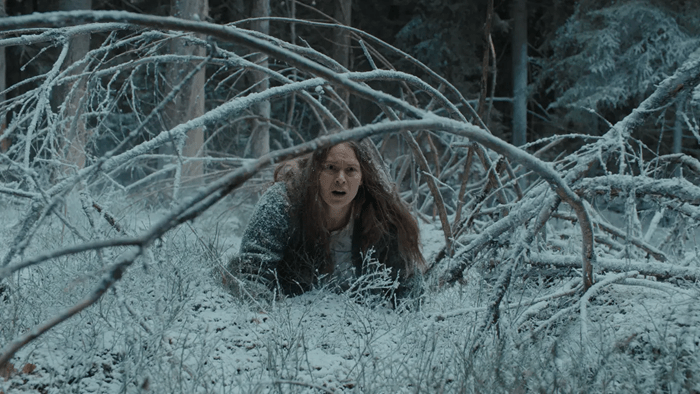
Soon Saga is pregnant with their first child, and following a hard labor, she gives birth to a baby boy they name Kuura. But the child has some noticeable abnormalities, starting with him being unusually hairy. Later it’s his sharp, fast-growing fingernails and sensitivity to sunlight. And perhaps most disturbing is his insatiable appetite for his mother’s blood rather than her breast milk. The borderline feral Kuura pushes Saga to her maternal limits, and feelings of dread, frustration, guilt, and isolation quickly set in.
Meanwhile Jon is written to be oblivious to the obvious signs. He insists Kuura is fine and believes Saga is the real concern. Jon isn’t portrayed as intentionally cruel. Instead he comes off as clueless, which may be a big part of Bergholm’s critique. Either way it takes Jon from being a supportive partner to unaware at best and doltish at worse. It’s hardly an unfair approach. But when taken with the film’s allegorical heavy-handedness, it somewhat undermines what Bergholm is going for.

Things only get worse when Saga’s domineering mother (Pirkko Saisio) and her cryptic sister (Pamela Tola) pay a visit. Both have their own concerns with Saga’s parenting and they express them in dramatically different ways. They end up fueling Saga’s feelings of alienation and self-doubt. Meanwhile the forest becomes more of an ominous and overpowering force, which itself is a metaphor for the inner battle going on within Saga. Animosity gives way to hostility as the new mother’s idealistic world crumbles all around her.
Bergholm conveys Saga’s disintegrating psyche in some creatively twisted and grotesque ways. It may be through the beautiful yet creepy forest routinely making its presence known, or some squirm-worthy body horror that can sometimes come when you’re least expecting it. But the story’s themes are blaring from the start. And there is a lack of subtlety and nuance that keeps us from connecting with the message in the way that Bergholm intends. It doesn’t fully derail “Nightborn”, but it’s a nagging issue that never goes away.
VERDICT – 2.5 STARS


Obviously you lost me at body horror. 😁
I know. But fear not – there are some non-horror movies on the horizon! 🤣
Thing is… I just know I’m still gonna watch it
It’s not a bad watch. There’s some enjoyment there.