
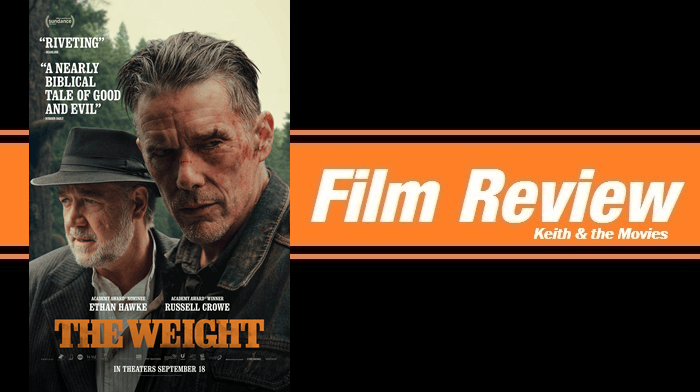
One of my most anticipated films of the year has been director Padraic McKinley’s “The Weight”. Everything about the movie excited me – the rich period setting, the rugged throwback story, and especially the impressive cast. I missed seeing the movie during its world premiere at Sundance, but early word of mouth only raised my excitement. Now here’s the best part – “The Weight” doesn’t disappoint. In fact, it stands out as one of the year’s best films.
“The Weight” is an astonishing feature debut for McKinley. He’s made a film that calls back to a kind of against-the-odds action-adventure movie that was once a staple of Hollywood. Sadly we rarely get them anymore which is one of many reasons that this one stands out so strongly. But there’s more than just nostalgia. It’s the riveting storytelling, the compelling characters, the immersive world-building, and the savvy craftsmanship. It also doesn’t hurt having Ethan Hawke doing some of his very best work.
The story takes place in 1933 Oregon, some four years into the Great Depression. Hawke plays Samuel Murphy, a street-smart mechanic and single father who’s struggling to make enough money to provide for his beloved young daughter Penny (Avy Berry). After being evicted from his small apartment in Eugene, Murphy sells what little they have in order to afford another place for them to stay. But while looking, a misunderstanding leads to a tussle with an unforgiving cop. Murphy is arrested and sent to prison while Penny is placed in a shelter.
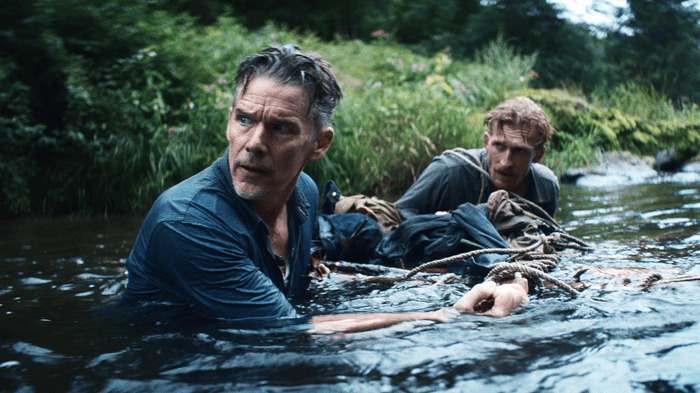
Murphy finds himself caught in the gears of a broken system. He’s sent to a labor camp ran by Warden Clancy (Russell Crowe) where he has to serve at least six months. But Penny only has one month until she’s handed over to the state to be put up for adoption. After hearing of Murphy’s predicament, Clancy makes him a high-stakes proposition – complete an illegal and potentially dangerous job and he’ll have his sentence commuted in time to be reunited with his daughter.
So what’s the job? Murphy is to select three inmates he trusts and report to an area mining camp to receive their orders. Once there, they meet a man named Taggert (Alec Newman) who informs them that President Roosevelt has ordered the seizure of all hoarded gold from mining operations. But rather than letting the government take it, Taggert tasks Murphy and his fellow inmates Rankin (Austin Amelio), Singh (Avi Nash) and Olson (Lucas Lynggaad Tonnesen) with smuggling four backpacks full of stolen gold bars through the unforgiving Oregon wilderness to a secret rendezvous point.
To ensure the inmates follow their orders, they’re escorted by two of Taggert’s armed henchmen, Amis (Sam Hazeldine) and Letender (George Burgess). They’re also accompanied by Anna (Julia Jonesy), an Indigenous runaway who shrewdly maneuvers her way into their group. Together they form an intriguing cadre of characters who are firmly rooted in the world McKinley creates. And at the center is Hawke’s Murphy, grizzled and world-weary, but also a man of honor and integrity. And the only thing that drives him is reuniting with his daughter.

With the party set and on their way, “The Weight” turns into a good old-fashioned survival thriller that brings to mind such rugged classics as William Friedkin’s “Sorcerer” and Henri-Georges Clouzot’s “The Wages of Fear”. Their first battle is with the land itself, with its steep rocky terrain, vast gorges, and perilous rivers. Then there are the people living off the land who may not take kindly to strangers. Lastly and most deadly, is the battle within their ranks. “People get funny around gold” are words that ominously linger throughout their journey. And soon trust is the hardest thing to come buy.
Matthew Booi and Shelby Gaines co-write the film’s muscular script, infusing their story with a slow-boiling tension and a potent allegorical undercurrent. McKinley douses it all in rich atmosphere and a gritty authenticity. Visually, he and DP Matteo Cocco use a combination of sweeping landscape shots, realistic natural lighting, and deep nighttime shadows to capture nature in all its beauty and menace. Their use of extreme closeups have a similar effect, but on intensely emotional and psychological levels.
“The Weight” has all the ingredients you look for in an old-school period thriller. Hawke offers up a sturdily classic film protagonist while Crowe’s quiet, calculated menace can be felt in every second of his limited screentime. Even the throwback end credits conjure feelings of nostalgia. But surprisingly, the engine that runs it all is a gripping father-daughter story with emotional stakes that can felt throughout. McKinley’s ability to balance it all is what makes “The Weight” such a profoundly satisfying experience.
VERDICT – 4.5 STARS


Only read up to the warden’s proposition. Will read rest after seeing it. I have to thank both Hawke and Crowe for not caving it to plastic surgery and keeping their well-earned “facial seasoning.” I’m all in for this one. If the director’s debut is this excellent, we can hope for more of the same from them ❤
It’s a must-see IMO. Terrific throwback movie that I can’t wait to see again.
Yep!
I loved it!