
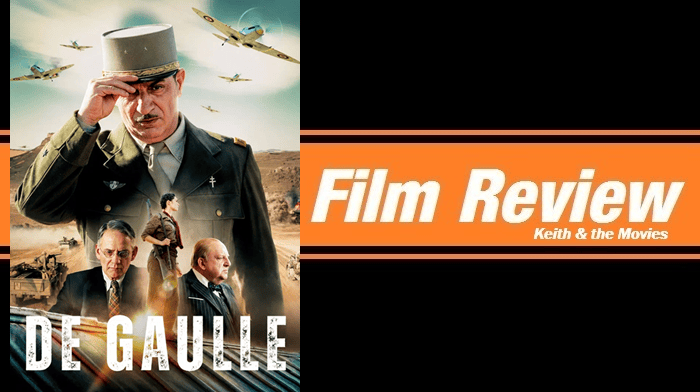
Director and co-writer Antonin Baudry’s vast, ambitious, and utterly enthralling new diptych “De Gaulle” chronicles the efforts of General Charles de Gaulle to inspire, build, and lead the Free French movement after France fell to the Germans during World War II. It’s a captivating historical epic that’s told over two feature-length films that collectively clock in at over five hours. And regardless of whether you consider it one movie or two, it firmly sits as one of the year’s very best releases.
“De Gaulle” is based on British historian Julian Jackson’s 2018 nonfiction book “A Certain Idea of France: The Life of Charles De Gaulle”. The story by Baudry and his co-writer Bérénice Vila spans four years and is told across the two films, part one titled “Résistance” and part two “Liberté”. Their film offers a uniquely French perspective on the war that is proud but not partisan and that honors without being hagiographic.
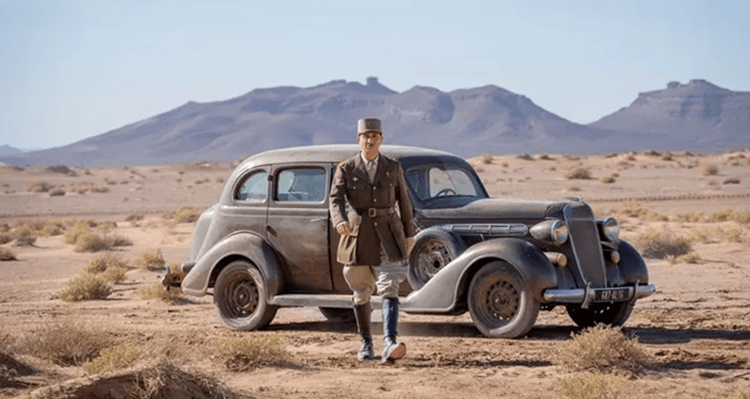
In June of 1940, Paris fell to the invading Germans and the French government collapsed. Appointed Prime Minister Marshal Philippe Pétain agreed to an armistice that formally ended active hostilities between France and Nazi Germany while securing Hitler’s control of the country. Many rejected the armistice including General Charles de Gaulle (Simon Abkarian), who insisted that the French would continue their fight for freedom.
While Pétain gathers his loyal parliamentarians in Vichy to set up his pro-German collaborationist French government, de Gaulle flees to London where he transmits messages to the French people urging the rise of a resistance. His actions lead Pétain to strip de Gaulle of his nationality and sentence him to death. But ever the maverick, de Gaulle refused to conform, and his defiance led to the establishment of Free France, a resistance-driven alternative to the Pétainist regime.
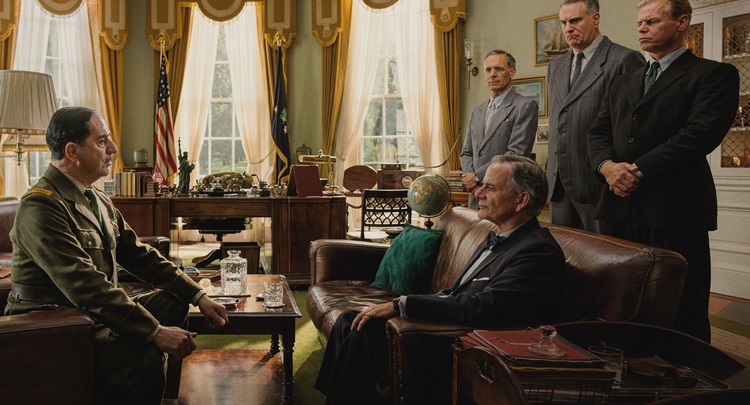
Meanwhile Winston Churchill (Simon Russell Beale) battles it out with his cabinet over how to approach de Gaulle. Many see the proud Frenchman as a troublemaker who unnecessarily complicates things, especially Britain’s relationship with the United States. But Churchill goes against his advisors and recognizes de Gaulle as the leader of the Free French – a move that would rattle the world stage from England to Africa to Washington DC to France herself.
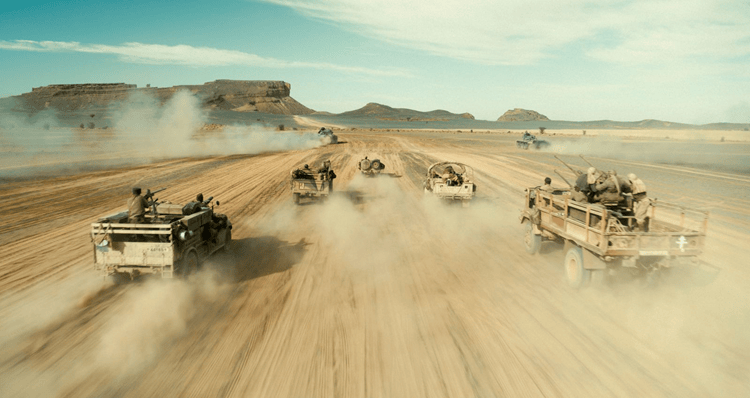
“De Gaulle” never restricts itself to one single lens. Instead, it looks at war from a variety of angles. We get the stellar battlefield sequences which Baudry uses to tell stories of immense courage in the face of overwhelming odds. We watch as de Gaulle loyalists General Pierre Kœnig (Benoît Magimel) and General Philippe Leclerc (Niels Schneider) carry out daring missions against the Nazis across North Africa. While they’re visually stunning, it’s the infusion of humanity that makes them powerful.
But the two films put even more of its focus on the boiling geopolitical tensions. De Gaulle finds himself at odds with his supposed allies more than with the Vichy German sympathizers. We witness fascinating back-and-forths between a determined de Gaulle and Churchill who has the impatient US President Franklin Roosevelt (Campbell Scott) breathing down his neck. And it only gets more intense after de Gaulle learns to play their game against them.
But even more, the movie also shows how de Gaulle’s actions inspire resistance from those on the ground in Paris. Among those swayed to keep fighting are 17-year-old Fernand Bonnier de La Chapelle (Florian Lesieur) and a young woman named Livia (Anamaria Vartolomei). Their paths intersect before going in different directions. But both of their stories capture the fearlessness, resilience, and conviction that defined so many within the French Resistance.
Part one (“Résistance”) follows de Gaulle from his exile to London to his establishment of Free France. We watch as he struggles to put together a cabinet and build a military. We follow along as he seeks strategic alliances with French colonies in Africa, specifically Chad, Cameroon, and Dakar. And again, we see the roots of resistance from those inspired by de Gaulle’s patriotism, confidence and resolve.
Part two (“Liberté”) takes the geopolitical wrangling to more strained heights as de Gaulle navigates the demands of a frustrated FDR and an uncertain Churchill. As he does, the Gestapo tighten their search for the underground resistance networks while the makeshift army of the Free French make a name for themselves across North Africa and on their way to Paris.
Top-to-bottom superb performances bring this true story to life starting with Abkarian. His nuanced portrayal captures the steely and self-assured manner de Gaulle was known for. There are also quiet moments where he allows us to sense the emotion behind the stoic stature. The supporting cast are equally impressive, none better than Beale and Vartolomei. The rest is Baudry who crafts a historical biography that keeps us completely involved, whether we’re in the back rooms or on the battlefield. It’s a truly extraordinary wartime epic.
VERDICT – 4.5 STARS