I’m a little late getting to this, but last week Marvel Studios dropped the first trailer for the upcoming third installment in their “The Guardians of the Galaxy” branch of the MCU. I’ve enjoyed the “Guardians” films, but I’ve never considered them top-tier MCU. The films are full of fun characters, but the hit-and-miss goofiness along with some pretty bland villains have held them back. Still, director James Gunn finds ways to make things entertaining.
His third chapter sees the Guardians at a pretty low point. It’s especially true for Peter (Chris Pratt) who’s still struggling with the loss of his Gamora. But this is a James Gunn movie so you know things aren’t going to stay somber for very long. In fact we get several good laughs in the trailer that fit nicely with the goofy tone of the previous films. But we also get glimpses that make us wonder if we’re in for some heartbreak. Time will tell. I’m pretty interested in seeing where this third (and possibly final) “Guardians” movie goes.
“The Guardians of the Galaxy Vol. 3” opens May 5, 2023. Check out the trailer below and let me know if you’ll be seeing it or taking a pass.
Anytime I see Hirokazu Kore-eda’s name attached to a project you can bet I’ll be watching. The 60-year-old Japanese auteur’s last film was 2019’s “The Truth”, a terrific drama not near enough people talked about. It was Kore-eda’s first movie set outside of his native Japan and not in his native tongue. His latest, “Broker”, sees him once again venturing outside his home country, this time to South Korea. Yet it remains a Hirokazu Kore-eda film through and through.
In “Broker” (written and directed by Kore-eda), the story revolves around a band of outcasts brought together through an unusual series of circumstances and who have all kinds of odds stacked against them. As you would expect from a Kore-eda film, we once again see him plowing that fertile ground of family, both the conventional and (more so in this case) the unconventional kinds. And, as he so often does, Kore-eda tells his story with a heartfelt humanistic touch, ushering his characters (and us) across some morally thorny ground, yet always finding ways to earn our empathy.
Image Courtesy of NEON
Another way you know you are watching a Kore-eda film is by the richness of his visuals. “Broker” is no exception. You can always sense the trust Kore-eda has in his actors by the way he shoots them. So often the camera will sit still, strategically framing a shot in a way that both captures our eye and let’s the performances carry a good portion of the load. And usually when there is movement, it will be slow and steady pans that stay intently focused on the characters. Then you have the incredible detail squeezed into nearly every frame, whether he’s shooting a wider area like a neighborhood street or a small intimate space like a single room. There’s always something compelling to take in.
As for the story, Kore-eda begins with some important table-setting. On a dark and rainy night, a young mother leaves her infant child on the cold concrete in front of Busan Family Church and then scurries off. Watching from a nearby car are two police detectives, Soo-jin (Bae Doona) and Lee (Lee Joo-young). Lee follows the young mother while Soo-jin picks up the well-wrapped child and places it in the church’s “baby box” (it’s like a drop box for infants). Soo-jin then hurries back to her car to avoid being noticed.
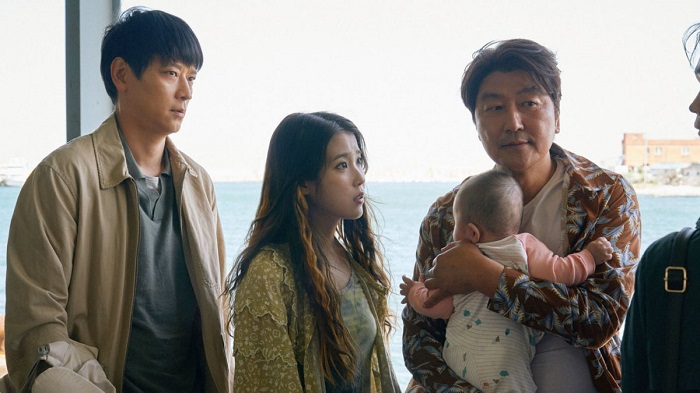
Inside, Dong-soo (Gang Dong-won), a part-time employee at the church, retrieves the baby boy from the box and gives him to Ha Sang-hyeon (Song Kang-ho). They erase the security camera footage and any evidence that the child was dropped off. Sang-hyeon then takes the child to his ragtag laundromat which is really just a front for their equally ragtag two-man child trafficking operation. They defend their practice by claiming they’re saving children from the inevitability of growing up in an orphanage. Instead, they find the babies a home, allowing potential parents to bypass the country’s broken adoption process. Of course they do expect a “modest payment” for their services. So as the title intimates, they are brokers, but of a more sordid kind.
But what they didn’t expect was for the mother, Moon Sun-ah (Lee Ji-eun) to show up the next day looking for her son. Before long, she has joined Sang-hyeon and Dong-soo on a long road-trip to meet a couple who are interested in buying her child. Meanwhile the two detectives follow the oddball trio plus one baby, watching from a distance with hopes of arresting them in the act.
Image Courtesy of NEON
It certainly makes for an offbeat scenario – one that could easily veer off into into several directions, either super-serious or farcical. But in the hands of Kore-eda, the film never loses its plausibility despite how crazy the circumstances get. And while fairly serious, the story makes time for more light-hearted moments and even dashes of black comedy. Meanwhile the characters, as morally suspect as they may be, earn and maintain our empathy. Kore-eda guides us past their flaws and urges us to see them in a different light.
There are times when Kore-eda drives close to melodrama, but he never lets his film cross over the line. He keeps things grounded and character-focused, making it easy for us to relate despite the on-screen actions we’re witnessing. At the same time, Kore-eda also poses some thoughtful questions through his characters as they’re forced to face difficult choices, no-win scenarios, and unavoidable consequences. Just more pieces that enhance this technically, narratively, and emotionally savvy journey. Altogether “Broker” is a beautifully composed and constructed character study wrapped in Kore-eda’s signature warmth and grace. “Broker” hits select theaters on December 26th.
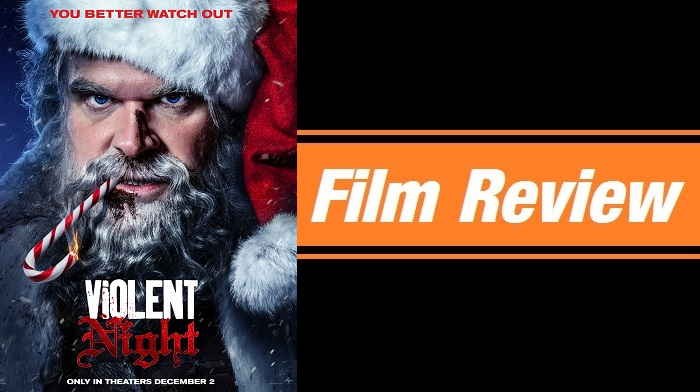
“Violent Night” is dumb beyond measure, deliriously hyper-violent, and a glaring clone of countless other movies (just with a Christmas time setting). But here’s the thing, this holiday action-comedy is proud to be all of those things. In fact, it’s exactly what director Tommy Wirkola and the screenwriting duo of Pat Casey and Josh Miller are going for. Their firm devotion to their vision is certainly commendable. It’s also what makes the film wear out its welcome well before its numbingly goofy (and proudly blood-soaked) final act.
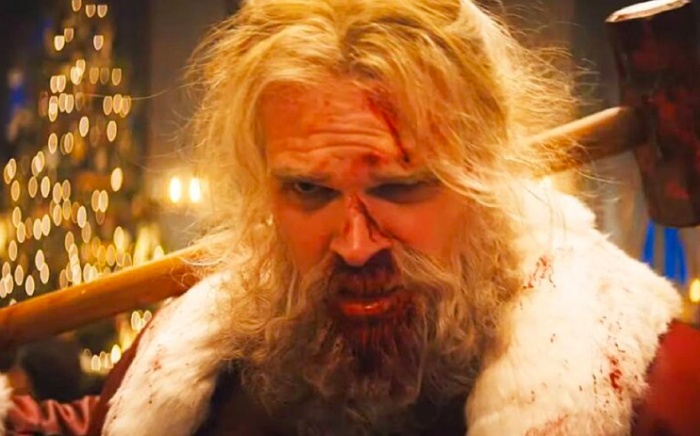
David Harbour plays Santa Claus, donning the classic red suit and white beard but with a far from festive snarl. We first meet him on Christmas Eve chugging beer at a pub in Bristol, England. Disenchanted with the greed and overall lack of Christmas spirit in the world, the not-so-jolly elf lets out his frustrations to his makeshift drinking buddies before hopping on his sleigh, upchucking all over the bartender (a drunk barfing – there’s a new one), and flying off to continue his deliveries.
Meanwhile in Greenwich, Connecticut, an estranged couple, Jason Lightstone (Alex Hassell) and his wife Linda (Alexis Louder), are taking their daughter Trudy (Leah Brady) to the excessively lavish Lightstone estate, the home of Jason’s crude and obscenely wealthy mother, Gertrude (Beverly D’Angelo) who’s hosting a Christmas Eve party for her family. Between the staff, the security detail, and the team of caterers, it’s far from a cozy affair. But that’s hardly a concern for the garish and self-consumed Gertrude.
Image Courtesy of Universal Pictures
Already at the party is Alva (Edi Patterson), Gertrude’s shallow, boozy daughter; Morgan (Cam Gigandet), Alva’s husband and a low-rent action movie star; and Bert, Alva’s obnoxious son from her first marriage and a wannabe social media influencer. They all come together for a night of upper-crust indulgence, fake affection, and family posturing.
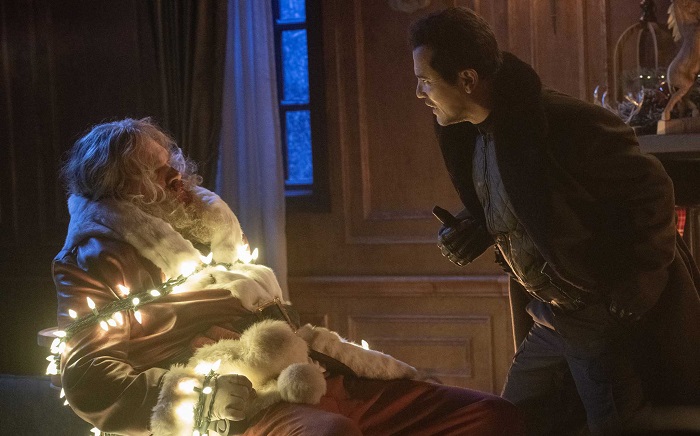
But just as the money-grubbing Lightstones are set to begin their festivities, the caterers pull out automatic weapons and start mowing down Gertrude’s staff and security detail. Leading the assault is “Scrooge” (John Leguizamo), a holiday-hating mercenary who fires more dopey Christmas one-liners than bullets (a gag the movie never seems to grow tired of). Scrooge and his team aren’t just their to crash the party. No, he’s there for the $3 million in cash that Gertrude has locked up in a state-of-the-art vault.
What the goons didn’t count on was Santa Claus who stops at the Lightstone compound to leave a present for Trudy (she’s on his nice list). But after he encounters one of the mercs, Saint Nick finds himself forced into action. From there this “Die Hard” knock-off pretty much plays just as you would expect, with Santa as the John McClane character, Scrooge playing a poor-man’s Hans Gruber, and several heavily armed henchmen – some trying to open the vault while others try to track down the poison pill that threatens to derail their heist.
Image Courtesy of Universal Pictures
The film shamelessly rips off several other movies, but in the case of “Die Hard”, it’s too much to even be considered an homage. But thanks to its Christmas setting, “Violent Night” is able to have some fun all its own. And that’s fairly entertaining for a while. Unfortunately for me, the film reached a point where I needed more than a hard-R spin on a Christmas movie. But Wirkola and company are relentless, milking their gimmick dry and then still pressing on for another 30 minutes or so.
One bit I did enjoy was its tip of the hat the “Home Alone”. We get about a ten-minute sequence that I won’t spoil, but it sees Trudy going full-blown Kevin McAllister but with much more gruesome results. And despite the lazily conceived potty-mouthed Santa bit, Harbour is (to no surprise) really good in his role. There’s not much depth or nuance in the character (despite the writers trying to manufacture some), but Harbour’s natural personality makes his Santa semi-interesting.
“Violent Night” desperately wants to be a new holiday cult classic, but it’s hardly something that’ll leave a lasting impression. Ultimately it is aggressively what it is. It tries to add some emotional layers by throwing in a couple of sudsy scenes along the way. But in reality, the movie mostly seems interested in pushing its R rating, and it loses itself in that relentless pursuit. It’ll be a blast for some. But for those who burn out on its gimmick, I can see it being an endurance test. “Violent Night” is out now in theaters.
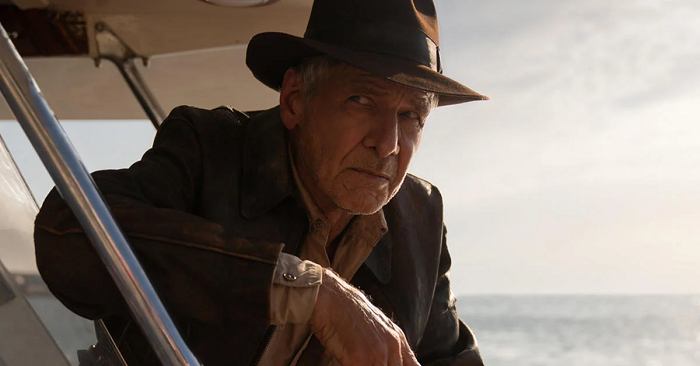
Very little in the realm of movies could excite me more than this – “Indiana Jones and the Dial of Destiny”. 2023 was already stacking up to be a stellar year for movie lovers. One of the biggest treats was a new Indiana Jones movie. Most of us had written off any chance of a new installment, especially after the woefully bad “Kingdom of the Crystal Skull”. Yet here we are with a fifth Indy film on the way. And it’s once again led by the wonderful 80-year-old Harrison Ford.
As a die-hard fan of the first three films, of course I had concerns. But then I saw the just-released first trailer. Now I’m as giddy as 10-year-old me was back in 1981 as we left the Flick Twin Cinema after seeing “Raiders of the Lost Ark”. Everything about this trailer excited me – fabulous familiar faces, some interesting new ones, glorious callbacks, plenty of Indy-styled swashbuckling. It hit every mark it needed to. I love the look of it. And with director James Mangold at the helm, I think the property is in very good hands!
“Indiana Jones and the Dial of Destiny” hits theaters June 30, 2023. Check out the trailer below and let me know if you’ll be seeing it or taking a pass.
“Shutter Island” is a film that usually gets tossed aside when discussing the greater movies of filmmaker Martin Scorsese. But since first seeing it in the theater during its original 2010 release (three times actually), I’ve stood firmly by my assertion that it’s absolutely top-tier Scorsese. I loved everything about it then, and I’ve found that it still holds up to repeat viewings. The cast, the script, the costumes, the production design, and (of course) the direction are all top-notch.
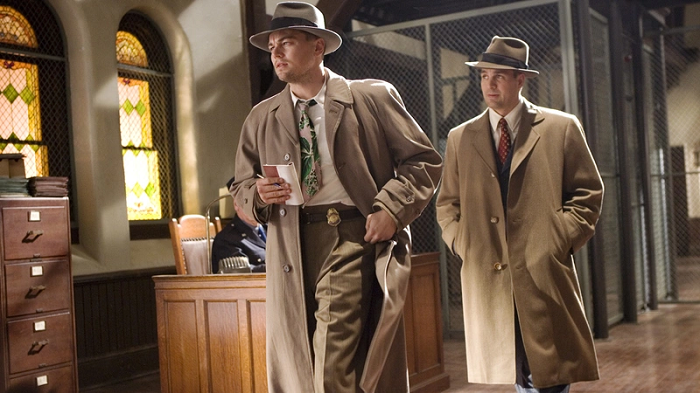
Adapted from the novel by Dennis Lehane, “Shutter Island” (at the time) marked the fourth collaboration between director Martin Scorsese and Oscar-winner Leonardo DiCaprio (they would re-team in 2013’s “The Wolf of Wall Street” and their latest, “Killers of the Flower Moon” is due out next year). Here Scorsese delves into the psychological thriller genre while also brilliantly injecting elements of horror and even classic noir. It all fits great with the cool period setting and the overall captivating premise.
Image Courtesy of Paramount Pictures
DiCaprio plays Federal Marshal Teddy Daniels, who is summoned to Ashecliffe Hospital on Shutter Island in Boston Harbor. It’s a mental hospital for the criminally insane where a patient has recently gone missing. Teddy is accompanied by his new partner Chuck (Mark Ruffalo) to investigate the disappearance, but they’re immediately met with a lack of cooperation. Teddy grows increasingly impatient, particularly with the facility’s head psychiatrist, Dr. Cawley (Ben Kingsley). To complicate matters, Teddy is being haunted by recurring dreams of his wife (Michelle Williams) who we learn died two years earlier.
Scorsese is meticulous and deliberate in unfolding the many layers of the story (written by Laeta Kalogridis), often focusing on misdirection more than a straightforward narrative. He sends us in several different directions but never gives us any firm footing until the end. And as usual for Scorsese, he never does anything without a purpose or reason. Whether it’s metaphorical, revelatory, or a simple homage, his scenes are filmed with specificity and intent. If you fail to soak in the details there’s a good chance you may miss much of what he’s going for.
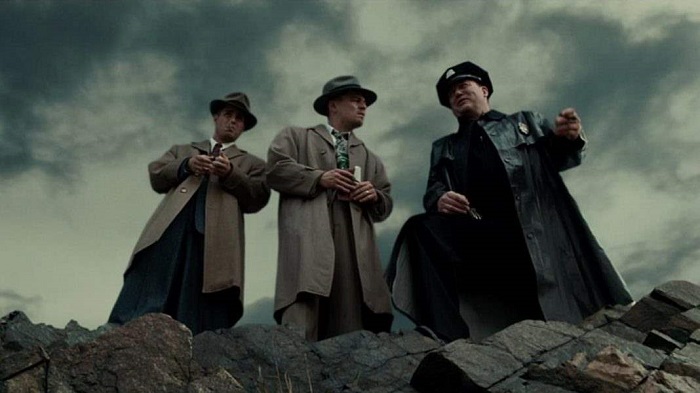
In a movie like this, the less you say about the story the better. But as the mystery uncoils, Scorsese reveals as much through his camera as through the script. The riveting cinematography (from Quentin Tarantino regular Robert Richardson) helps make the island one of the most effective supporting characters. Peddocks Island in Boston Harbor was used for the haunting, panoramic shots of Shutter Island and was particularly effective in setting the tone in the chilling opening sequence. From there, the camera steadily works to immerse us deeper and deeper into the story’s dark and unsettling setting.
Image Courtesy of Paramount Pictures
As for the performances, DiCaprio delivers what is one of my favorite performances of his to date. He’s handed some challenging and emotionally heavy material, and he nails it. Ruffalo, Williams, and Kingsley along with Emily Mortimer, Patricia Clarkson, Jackie Earl Haley, and John Carroll Lynch make for a stellar supporting cast. We even get the late great Max von Sydow is small yet terrific role playing a creepy German doctor with a mysterious presence. Scorsese is known for surrounded himself with quality performers, and it’s certainly no different here.
“Shutter Island” was one of the best films of 2010, and it remains among my favorites from Martin Scorsese. It’s impossible to restrict it to any one genre, it maintains a wonderfully eerie tone, and the direction and visual energy is sublime. Scorsese takes us on an emotional ride that can be hard to watch especially as truths are slowly unearthed. The movie does require patience, but the payoff, both narratively and cinematically, makes every second of this extraordinary film worthwhile.
Cate Blanchett cements her next Oscar nomination (and quite possible a win) with “Tár”, the latest film from writer-director Todd Field. It’s Field’s first time behind the camera since 2006’s “Little Children”, and he has once again put together a movie that’s getting a lot of awards season buzz. His story follows a fictional conductor and composer named Lydia Tár who’s at the height of her career. But when accusations of misconduct arise, she watches as her life of success and renown begins to unravel.
Blanchett plays Lydia Tár with a fierce confidence that bleeds over into the character. It can be quiet and subtle, or it can be unbridled and consuming. It’s that very confidence that makes Lydia such a fascinating, complicated, and at times loathsome character. It’s a trait that has made her one of the greatest living composers. It has led her to become the Berlin Philharmonic’s first female chief conductor. It’s put her in place to lead the upcoming live performance of Mahler’s Fifth Symphony. It has even enabled her to publish her own biography.
Image Courtesy of Focus Features
But we watch as that same confidence that has afforded Lydia so many opportunities crushes the people who dare to get close to her. It’s seen through a collection of relationships she has, mostly business but occasionally personal. They include people such as her diligent assistant Francesca (Noémie Merlant), her concertmaster and significant other Sharon (Nina Hoss), her assistant conductor, Sebastian (Allan Corduner), the manager of her fellowship program Eliot (Mark Strong), and a young Russian cellist named Olga (Sophie Kauer).
Field uses these relationships for much of the film’s near 160 minute runtime to try and give us a full picture of Lydia Tár. As a character study it mostly works although it does leave some of the supporting players doing little more than servicing Lydia and her story. It’s a shame because the film sports a compelling cast. But rather than building on them, we get several showy, pretension-soaked scenes that can be a lot of fun, but would be even better if Field would have pushed his story a little more off the rails.
But the film’s self-seriousness eventually gets Field into trouble, especially as he breezes by the heavier subject matter (allegations of inappropriate conduct, sexual harassment, suicide, etc.). None of them gets the attention they need. He also skirts around what seems like important details – the accusations themselves, the backlash, the legal hearings, the consequences.
All of that is exacerbated by some frustrating pacing decisions. The first two hours (plus some) of the film moves at such a patient (and at times borderline lethargic) pace. It can be slow yet it’s often observant. But then in the final 30 minutes it’s as if Field checked his watch and said “We need to wrap this up.” He frantically jumps from place to place as he shows Lydia’s house crumbling down on her. It’s an intentional choice that simply doesn’t have the desired effect. Ultimately it leaves the ending feeling terribly rushed and woefully unsatisfying.
Image Courtesy of Focus Features
Whether Lydia is conducting in Berlin or teaching at Julliard, Blanchett munches her scenes with a conviction that’s hard to turn away from. At the same time, in many of these very same scenes you can see the movie working hard to earn its prestige status. Take the film’s opening, Lydia’s ego-stroking interview with The New Yorker‘s Adam Gopnik. It’s an compelling scene, but I found myself more interested in watching what Blanchett was doing than getting an introduction to Lydia Tár. It’s not her fault. It’s just that the scene (like several others) exudes a vanity that almost rivals that of the main character.
“Tár” has a lot to admire even if it doesn’t all coalesce into something truly satisfying. And while it attempts to tackle some pretty hefty issues, its story blurs too many details which does more to obscure any truth than actually reckon with it. So much so that I found it hard to get a grasp the movie’s convictions. For some, Blanchett’s domineering performance will be enough to cover any flaws or at least divert attention away from them. Me, I’m stuck on the fence, appreciating the things that fit with what I hoped the movie would be, and a little frustrated with how things ultimately turned out.









 Keith & the Movies