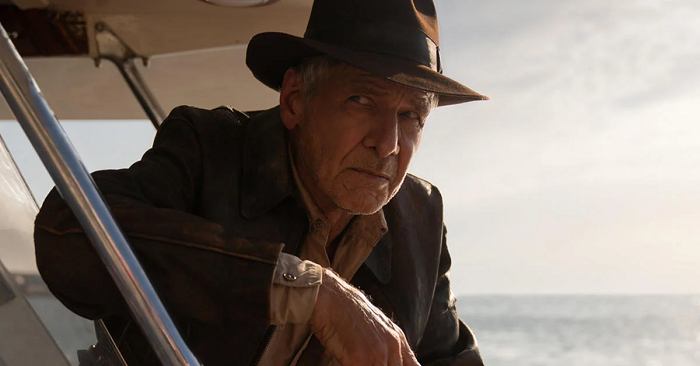
Very little in the realm of movies could excite me more than this – “Indiana Jones and the Dial of Destiny”. 2023 was already stacking up to be a stellar year for movie lovers. One of the biggest treats was a new Indiana Jones movie. Most of us had written off any chance of a new installment, especially after the woefully bad “Kingdom of the Crystal Skull”. Yet here we are with a fifth Indy film on the way. And it’s once again led by the wonderful 80-year-old Harrison Ford.
As a die-hard fan of the first three films, of course I had concerns. But then I saw the just-released first trailer. Now I’m as giddy as 10-year-old me was back in 1981 as we left the Flick Twin Cinema after seeing “Raiders of the Lost Ark”. Everything about this trailer excited me – fabulous familiar faces, some interesting new ones, glorious callbacks, plenty of Indy-styled swashbuckling. It hit every mark it needed to. I love the look of it. And with director James Mangold at the helm, I think the property is in very good hands!
“Indiana Jones and the Dial of Destiny” hits theaters June 30, 2023. Check out the trailer below and let me know if you’ll be seeing it or taking a pass.
“Shutter Island” is a film that usually gets tossed aside when discussing the greater movies of filmmaker Martin Scorsese. But since first seeing it in the theater during its original 2010 release (three times actually), I’ve stood firmly by my assertion that it’s absolutely top-tier Scorsese. I loved everything about it then, and I’ve found that it still holds up to repeat viewings. The cast, the script, the costumes, the production design, and (of course) the direction are all top-notch.
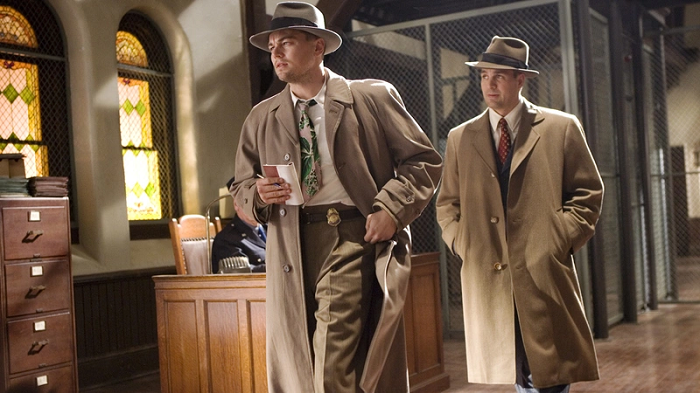
Adapted from the novel by Dennis Lehane, “Shutter Island” (at the time) marked the fourth collaboration between director Martin Scorsese and Oscar-winner Leonardo DiCaprio (they would re-team in 2013’s “The Wolf of Wall Street” and their latest, “Killers of the Flower Moon” is due out next year). Here Scorsese delves into the psychological thriller genre while also brilliantly injecting elements of horror and even classic noir. It all fits great with the cool period setting and the overall captivating premise.
Image Courtesy of Paramount Pictures
DiCaprio plays Federal Marshal Teddy Daniels, who is summoned to Ashecliffe Hospital on Shutter Island in Boston Harbor. It’s a mental hospital for the criminally insane where a patient has recently gone missing. Teddy is accompanied by his new partner Chuck (Mark Ruffalo) to investigate the disappearance, but they’re immediately met with a lack of cooperation. Teddy grows increasingly impatient, particularly with the facility’s head psychiatrist, Dr. Cawley (Ben Kingsley). To complicate matters, Teddy is being haunted by recurring dreams of his wife (Michelle Williams) who we learn died two years earlier.
Scorsese is meticulous and deliberate in unfolding the many layers of the story (written by Laeta Kalogridis), often focusing on misdirection more than a straightforward narrative. He sends us in several different directions but never gives us any firm footing until the end. And as usual for Scorsese, he never does anything without a purpose or reason. Whether it’s metaphorical, revelatory, or a simple homage, his scenes are filmed with specificity and intent. If you fail to soak in the details there’s a good chance you may miss much of what he’s going for.
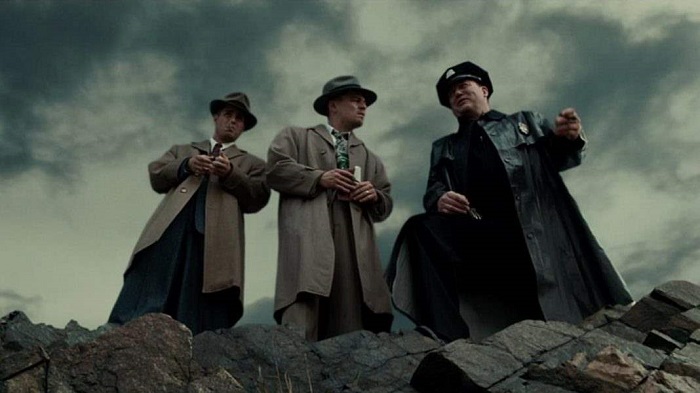
In a movie like this, the less you say about the story the better. But as the mystery uncoils, Scorsese reveals as much through his camera as through the script. The riveting cinematography (from Quentin Tarantino regular Robert Richardson) helps make the island one of the most effective supporting characters. Peddocks Island in Boston Harbor was used for the haunting, panoramic shots of Shutter Island and was particularly effective in setting the tone in the chilling opening sequence. From there, the camera steadily works to immerse us deeper and deeper into the story’s dark and unsettling setting.
Image Courtesy of Paramount Pictures
As for the performances, DiCaprio delivers what is one of my favorite performances of his to date. He’s handed some challenging and emotionally heavy material, and he nails it. Ruffalo, Williams, and Kingsley along with Emily Mortimer, Patricia Clarkson, Jackie Earl Haley, and John Carroll Lynch make for a stellar supporting cast. We even get the late great Max von Sydow is small yet terrific role playing a creepy German doctor with a mysterious presence. Scorsese is known for surrounded himself with quality performers, and it’s certainly no different here.
“Shutter Island” was one of the best films of 2010, and it remains among my favorites from Martin Scorsese. It’s impossible to restrict it to any one genre, it maintains a wonderfully eerie tone, and the direction and visual energy is sublime. Scorsese takes us on an emotional ride that can be hard to watch especially as truths are slowly unearthed. The movie does require patience, but the payoff, both narratively and cinematically, makes every second of this extraordinary film worthwhile.
Cate Blanchett cements her next Oscar nomination (and quite possible a win) with “Tár”, the latest film from writer-director Todd Field. It’s Field’s first time behind the camera since 2006’s “Little Children”, and he has once again put together a movie that’s getting a lot of awards season buzz. His story follows a fictional conductor and composer named Lydia Tár who’s at the height of her career. But when accusations of misconduct arise, she watches as her life of success and renown begins to unravel.
Blanchett plays Lydia Tár with a fierce confidence that bleeds over into the character. It can be quiet and subtle, or it can be unbridled and consuming. It’s that very confidence that makes Lydia such a fascinating, complicated, and at times loathsome character. It’s a trait that has made her one of the greatest living composers. It has led her to become the Berlin Philharmonic’s first female chief conductor. It’s put her in place to lead the upcoming live performance of Mahler’s Fifth Symphony. It has even enabled her to publish her own biography.
Image Courtesy of Focus Features
But we watch as that same confidence that has afforded Lydia so many opportunities crushes the people who dare to get close to her. It’s seen through a collection of relationships she has, mostly business but occasionally personal. They include people such as her diligent assistant Francesca (Noémie Merlant), her concertmaster and significant other Sharon (Nina Hoss), her assistant conductor, Sebastian (Allan Corduner), the manager of her fellowship program Eliot (Mark Strong), and a young Russian cellist named Olga (Sophie Kauer).
Field uses these relationships for much of the film’s near 160 minute runtime to try and give us a full picture of Lydia Tár. As a character study it mostly works although it does leave some of the supporting players doing little more than servicing Lydia and her story. It’s a shame because the film sports a compelling cast. But rather than building on them, we get several showy, pretension-soaked scenes that can be a lot of fun, but would be even better if Field would have pushed his story a little more off the rails.
But the film’s self-seriousness eventually gets Field into trouble, especially as he breezes by the heavier subject matter (allegations of inappropriate conduct, sexual harassment, suicide, etc.). None of them gets the attention they need. He also skirts around what seems like important details – the accusations themselves, the backlash, the legal hearings, the consequences.
All of that is exacerbated by some frustrating pacing decisions. The first two hours (plus some) of the film moves at such a patient (and at times borderline lethargic) pace. It can be slow yet it’s often observant. But then in the final 30 minutes it’s as if Field checked his watch and said “We need to wrap this up.” He frantically jumps from place to place as he shows Lydia’s house crumbling down on her. It’s an intentional choice that simply doesn’t have the desired effect. Ultimately it leaves the ending feeling terribly rushed and woefully unsatisfying.
Image Courtesy of Focus Features
Whether Lydia is conducting in Berlin or teaching at Julliard, Blanchett munches her scenes with a conviction that’s hard to turn away from. At the same time, in many of these very same scenes you can see the movie working hard to earn its prestige status. Take the film’s opening, Lydia’s ego-stroking interview with The New Yorker‘s Adam Gopnik. It’s an compelling scene, but I found myself more interested in watching what Blanchett was doing than getting an introduction to Lydia Tár. It’s not her fault. It’s just that the scene (like several others) exudes a vanity that almost rivals that of the main character.
“Tár” has a lot to admire even if it doesn’t all coalesce into something truly satisfying. And while it attempts to tackle some pretty hefty issues, its story blurs too many details which does more to obscure any truth than actually reckon with it. So much so that I found it hard to get a grasp the movie’s convictions. For some, Blanchett’s domineering performance will be enough to cover any flaws or at least divert attention away from them. Me, I’m stuck on the fence, appreciating the things that fit with what I hoped the movie would be, and a little frustrated with how things ultimately turned out.
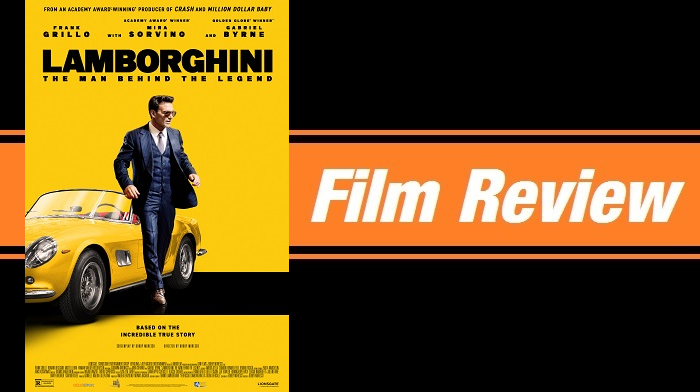
I’ve always been a fan of Frank Grillo and have often found him to be underrated as an actor. A lot of it may have to do with his choices of roles, some of which aren’t especially good at showing off his talent. That’s why it’s nice to see him get a meaty lead spot in a movie like “Lamborghini: The Man Behind the Legend” – one that doesn’t rely so heavily on Grillo’s bankable tough-guy persona. And to no surprise, Grillo is quite good playing luxury car maker and namesake Ferruccio Lamborghini. If only the film itself wasn’t so disappointingly flavorless.
Sadly, “Lamborghini” turns out to be a frustratingly bare-bones biopic that never gets out of neutral. What we end up getting is more of sketch than a full-fledged portrait of the man behind the world famous automobiles. The film hits on the most basic points in Ferruccio Lamborghini’s life, many of which are easy to predict mainly because they stick so close to the tried-and-true biopic formula. As a result, the film does nothing that makes Lamborghini’s story stand out against the countless other celebrity biographies that have came down the movie pipeline.
Image Courtesy of Lionsgate
The film opens in 1982 at the Lamborghini vineyard in Umbria, Italy, where an aged Ferruccio Lamborghini (Grillo) sits alone, looking down at a model of a blue Lamborghini Countach. He begins to recall his past life, including a seemingly friendly street race he had with rival Enzo Ferrari (a woefully underused Gabriel Byrne) that never amounts to much. I’m still not sure whether the older Ferruccio’s reflection is meant to be a framing device. It’s too vaguely presented to know for sure. Either way, writer-director Robert Moresco quickly ushers us back in time to kick off his story.
In Cento, Italy shortly after World War II had ended, a younger Ferruccio Lamborghini (played by Romano Reggiani) returns home from the war. His first order of business is to surprise his girl Clelia (Hannah van der Westhuysen). Then he heads home to see his father and brothers. We learn Ferruccio was a mechanic during the war and learned all about engines. Now he wants to take that knowledge to make and sell tractors, much to the chagrin of his farming father. But Ferruccio’s ambition and thirst for success can’t be quenched.
From there the movie chronicles Ferruccio’s push to turn his dream into a reality. He and his best friend Matteo (Matteo Leoni) go to work building building their first engine and designing their first tractor. Soon they’re starting up their own company. But as Ferruccio’s ambition turns to obsession, he finds himself alienating those closest to him.
Image Courtesy of Lionsgate
Later, Moresco hops ahead to 1963 when Ferruccio (now played by Grillo) runs his own successful tractor company. But he wants more. After being turned down and insulted by Ferrari, Ferruccio decides to get into the luxury car game. He puts together a crack team of engineers and designers who tell him his vision in impossible. But Ferruccio’s zeal is infectious and soon he’s showing the Lamborghini 350 GT at the prestigious Geneva Auto Show. But his desire for greatness keeps driving him, resulting in him becoming one of the most renowned car makers in the world. It also sees him once again alienating those who have loved and stood by him.
I’m sure it all sounds familiar to anyone who has seen a high-profile biopic and for good reason. There is a dramatic turn or two that feels meaningfully personal, and we get a few stretches of car talk that gearheads will probably appreciate. Also, Moresco is more than capable with the camera, capturing some beautiful imagery with a vibrant palette. But the movie is missing what it needs most – personality. It has an interesting subject with an equally interesting life to explore. Sadly, we only get glances of what made Ferruccio Lamborghini a compelling figure.
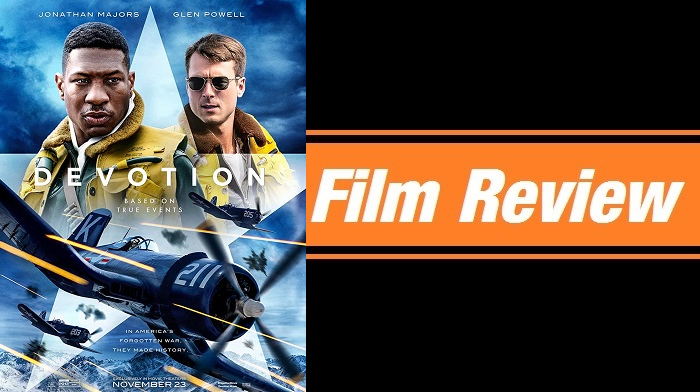
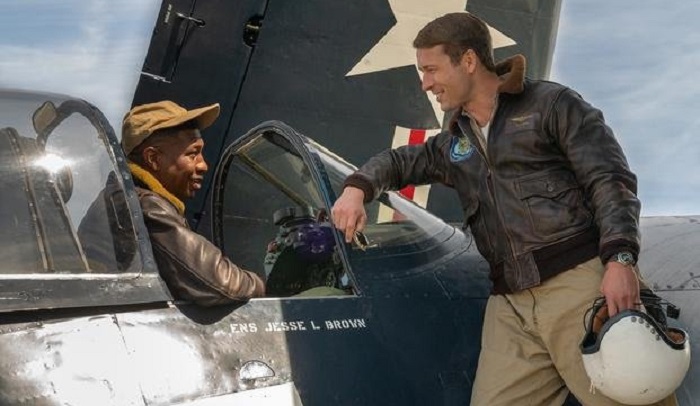
Two rising stars, Jonathan Majors and Glen Powell shine in “Devotion”, a war-drama based on the inspiring friendship between fighter pilots Jesse Brown and Tom Hudner. Jesse LeRoy Brown was the first African-American pilot to complete the U.S. Navy’s flight training program. Along with his wingman and devoted friend Tom Hudner, the pair would become two of the Navy’s best pilots during the Korean War, with Brown earning the Distinguished Flying Cross.
Directed by J.D. Dillard and written for the screen by Jake Crane and Jonathan A. Stewart, the film is based on the novel “Devotion: An Epic Story of Heroism, Friendship, and Sacrifice” by Adam Makos. Dillard hones in on a segment of Jesse Brown’s life, starting from the time he met Tom Hudner at Quonset Point Naval Air Station in Rhode Island. He shows their eventual friendship, but even more time is put on Jesse’s struggle as a black man in the desegregated military of 1950.
Image Courtesy of Columbia Pictures
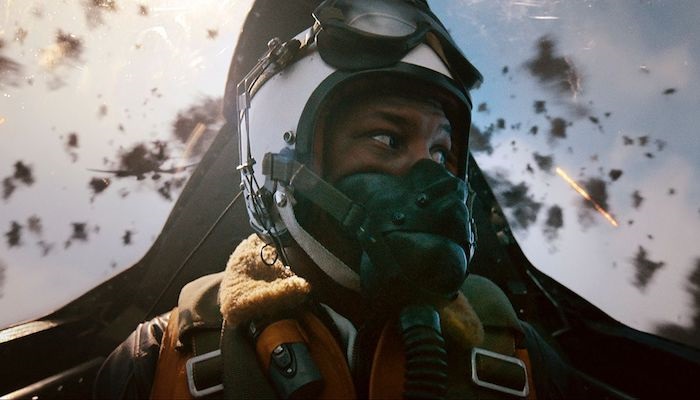
If you’ve seen the trailer you know “Devotion” has some war-time action and air combat scenes (they’re exhilarating and worth seeing on the biggest screen possible). But the meat of the movie is Jesse’s experience and the unexpected friendship forged with his wingman. For that reason, more time is spent building the characters (especially Jesse) and some of the story’s key relationships. And while it may take a little while to get off the ground, this development is crucial and ends up significantly helping things down the line.
When we meet Jesse (played with dignity and quiet resolve by Majors), he’s already an accomplished pilot who is generally respected for his skills yet still looked down on by many due to the color of his skin. New to his squad is Tom Hudner (an utterly convincing Powell) who is immediately assigned to be Jesse’s wingman. On top of earning Jesse’s trust in the air, the naive but genuine Tom also seeks to earn his trust as a man. But it takes some time, especially as we get a better understanding of the adversity Jesse has fought to overcome for his entire life.
While showing Jesse’s military service is a big part of the story, we also get a few touching moments with him at home with his wife Daisy (a really good Christina Jackson) and their young daughter. In many ways she’s his anchor, and the film uses her inclusion to reveal another side of Jesse – one as equally important to the story as his piloting scenes. Then there is the racial tension which comes in all sizes. Sometimes it comes from snide remarks that may seem harmless, especially when Jesse appears unfazed. But the film makes it clears that there’s no such thing as harmless racism, and over time it has taken a toll on Jesse despite his best efforts to hide it.
Image Courtesy of Columbia Pictures
The movie is also helped by the strong chemistry between Majors and Powell which makes what unfolds between their characters feel genuine and true. While the movie could have put a little more time into fleshing out Hudner, his eventual friendship with Jesse doesn’t come across as a made-for-screen concoction. There are actual barriers they must break down and hurdles they’re forced to navigate. It’s an honest and thoughtfully conceived relationship that’s cemented in the final 20 minutes when they’re called into combat as the Korean War intensifies.
The big fighter plane scenes leading up to the finale are a thrilling mix of practical and digital effects that look amazing and thrusts us into the heart of air combat. I’d be lying if I didn’t admit to wanting more of it. But the heart of “Devotion” is with the characters, namely Jesse Brown. Dillard, Crane, and Stewart never lose sight of that which makes this more than your standard-issue war movie. Instead it shares the story of someone we all should know about while highlighting a friendship that we all could learn from. “Devotion” is now showing in theaters.
Noah Baumbach’s new film “White Noise” hits Netflix late next month. I recently had the chance to see it at an awards season press screening (I’ll have a full review coming soon). It’s an odd and fascinating film adaptation of Don DeLillo’s odd and fascinating 1985 novel. So it’s kind of fitting that it also has three odd and fascinating character posters. I absolutely love them, and crack up every time I see them. There’s no need to say much more. I’ll let you check them out yourselves. Let me know what you think.
DIRECTOR – Noah Baumbach
WRITER – Noah Baumbach
STARRING – Adam Driver, Greta Gerwig, Don Cheadle, Raffey Cassidy, Sam Nivola, May Nivola, Jodie Turner-Smith, Lars Eidinger, André Benjamin