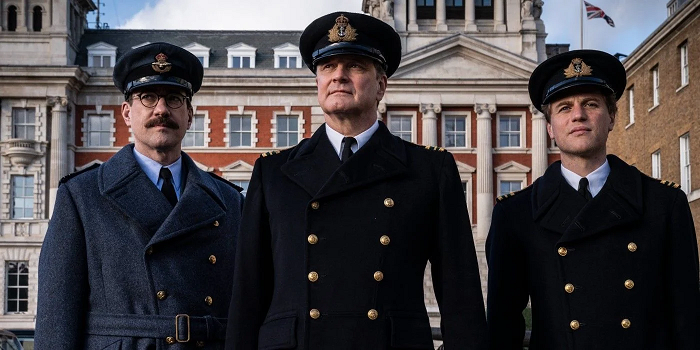
Don’t let its funky sounding title fool you. “Operation Mincemeat”, the new British war drama on its way to Netflix, is based on a story that would be impossible to believe if it weren’t true. Directed by John Madden (“Shakespeare in Love”, “The Best Exotic Marigold Hotel”) and written by Michelle Ashford, “Operation Mincemeat” puts together a sparkling cast for what could be a nice grab for Netflix.
Set in 1943, the movie depicts Britain’s attempt to disguise the upcoming Allied invasion of Sicily during World War II. To fool the Germans, the Brits took the corpse of a tramp who had died from ingesting rat poison, dressed him up as a military Captain, gave him fake and misleading documents, and covertly placed the body where the Germans would find it. Colin Firth, Matthew Macfadyen, Kelly Macdonald, Jason Isaacs, Penelope Wilton, Johnny Flynn, and Simon Russell Beale star in the crazy yet true war story that seems ripe and ready for the big screen treatment.
“Operation Mincemeat” releases in select theaters May 6th and streams on Netflix May 11th. Check out the trailer below and let me know if you’ll be seeing it or taking a pass.
Chris Pine gets to flex his action-thriller muscles in “The Contractor”, the new film from Swedish director Tarik Saleh. The movie is Saleh’s English language big screen debut and it sees Pine as an ex-military special forces soldier (aren’t they all in these things) who joins a private contracting outfit with his best buddy played by Ben Foster. But as you can probably guess, the two end up in over the heads in what unfortunately turns out a fairly conventional and predictable story.
Written by J.P. Davis, “The Contractor“ seems to struggle with an identity crisis. The story kicks off with promise and positions itself as a stinging examination of the United States government’s treatment of military veterans. But the further it goes down the genre route the more it loses its relevance. And as an action movie, Saleh never fully gets the film off the ground. So it isn’t as pertinent as it tries to be or as kinetic as it wants to be.
Image Courtesy of Paramount
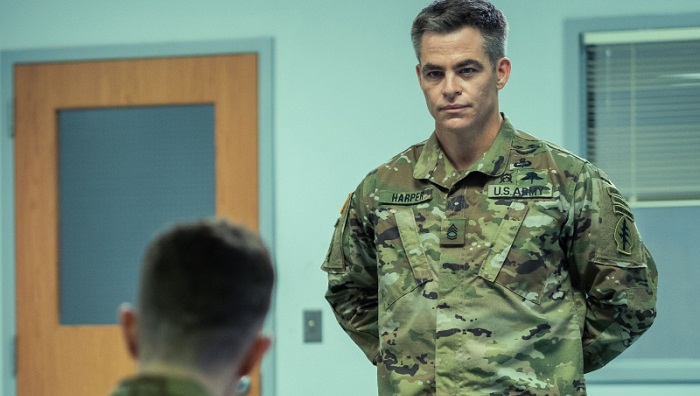
Pine plays James Harper, a soldier out of Fort Bragg who we first meet as he rehabs from a knee injury. But when steroids used to speed up his recovery show up in his blood work, his unit’s new commanding officer kicks him out, granting James an honorable discharge but stripping him of his pension and healthcare. “They’re cleaning house,” a more sympathetic officer tells James. “You made it easy for them.“
As unpaid bills mount back home, James begins to reconsider his pledge not to take contract work. Desperate for cash and despite the concerns of his wife Brianne (Gillian Jacobs), James lets his buddy and fellow vet Mike (Ben Foster) set up a meeting with Rusty Jennings (Kiefer Sutherland), a private contractor who does jobs globally for the United States government. You know, the covert, ‘no one can know about them’ kind. “We import and export coffee,“ Jennings says in the most unconvincing fashion.
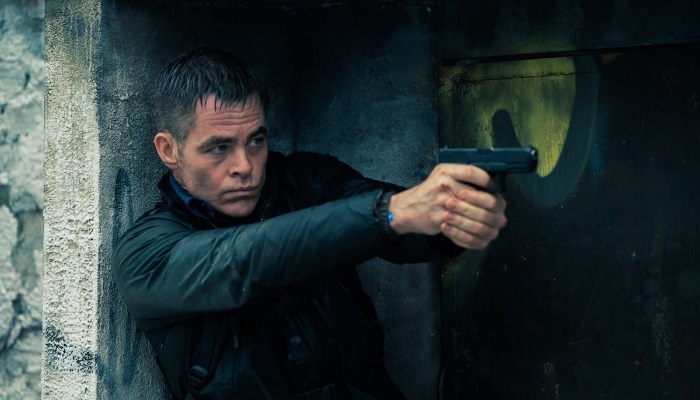
James and Mike are sent to Berlin where they’re tasked with doing a lot more than moving coffee. What starts as surveillance of a big-shot bio-engineer and virologist (Fares Fares) leads to James running for his life. This is where the predictability kicks in. And while the movie tries to throw a couple of twists into the mix, nothing catches us by surprise and the tension never gets above room temperature.
Image Courtesy of Paramount
The movie teases more layers to James such as his desire to escape from the shadow of his hardened military father and (as mentioned above) the failings of the government towards our military vets. Sadly, the film never does much with those angles. And the idea of a husband and father trying to get back to his wife and son should carry a certain emotional connection for the audience. But even that is tepid at best.
“The Contractor” ends up being a movie that can’t quite build the momentum or the emotional stakes that it needs to sell us on its story. The capable cast deliver solid performances, but there’s only so much they can do. Outside of a few early table-setting scenes and one particularly well-shot action sequence, the story mostly sits in neutral. And that’s a shame because there’s a lot of potential here that’s never met. “The Contractor” is out now in select theaters and on VOD.
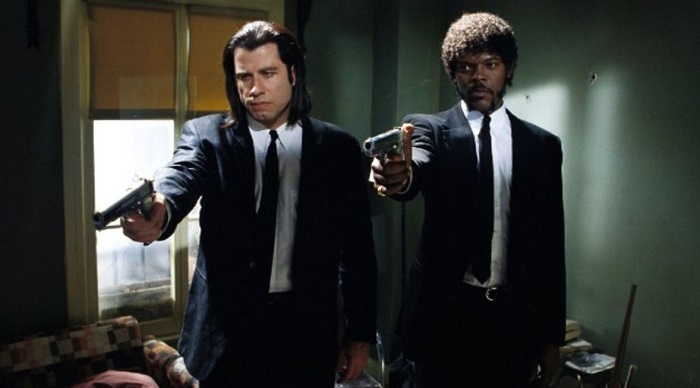
Considered by many to be Quentin Tarantino’s seminal classic, “Pulp Fiction” took the world by storm when it released in the early fall of 1994. And while it isn’t my favorite QT movie, it’s influence is hard to overstate. It also had one of the coolest and most recognized posters perhaps of all-time. It’s one many of you can probably picture in your mind without it needing to be described. But just as a reminder, take a look at this gem.
DIRECTOR – Quentin Tarantino
WRITER – Quentin Tarantino
STARRING – John Travolta, Samuel L. Jackson, Uma Thurman, Bruce Willis, Harvey Keitel, Tim Roth, Amanda Plummer, Rosanna Arquette, Ving Rhames, Eric Stoltz, Christopher Walken, Maria de Medeiros
“Master” was one of a handful of movies I regretfully missed during this year’s Sundance Film Festival. The tense and at times perplexing thriller was quickly snatched up prior to Sundance by Amazon and is now available on their Prime streaming platform. The film is written and directed by first-time filmmaker Mariama Diallo who pulls from reflections on her own feelings and experiences to craft a movie with a strong premise but that can’t quite get out of its own way.
“Master” can best be described as a social horror thriller with a lot to say about race, class, gender and academia. But while its themes are potent, its messy execution ends up undercutting its effectiveness. We’re left with a movie that has a captivating vision but that never seems sure of how to bring that vision to life. Its social commentary is hampered by the film’s borderline hokey characterizations and its sledgehammer-like subtlety. Meanwhile the tacked-on horror elements are underserved and get in the way of the movie’s deeper aims.
Image Courtesy of Amazon Studios
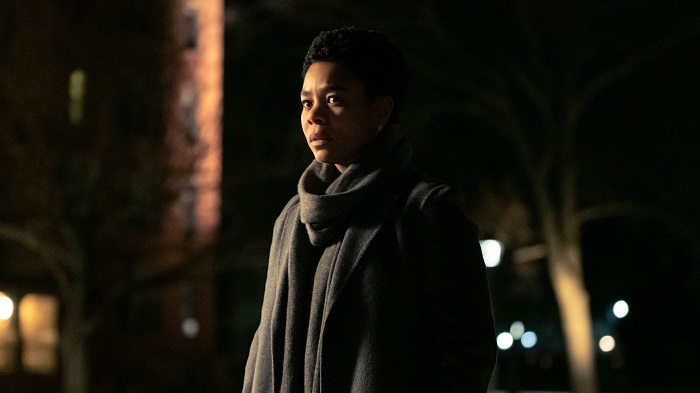
The movie (written and directed by Diallo) follows the experiences of three black women at the esteemed (and predominantly white) Ancaster University. The always wonderful Regina Hall plays faculty member Gail Bishop, Ancaster’s new and first black house master. At first Gail is proud of her hard-earned new status and takes pride in creating a welcoming environment for the students under her care.
Yet despite her best efforts, Gail struggles to fully gel with her all-white colleagues who proudly flaunt their self-defined wokeness amid an array of far-from-subtle microaggressions which range from disturbing to downright corny. These scenes are a weird mix – opening up some of the movie’s most essential topics then undercutting them with over-the-top portrayals that almost feel satirical but clearly aren’t meant that way.
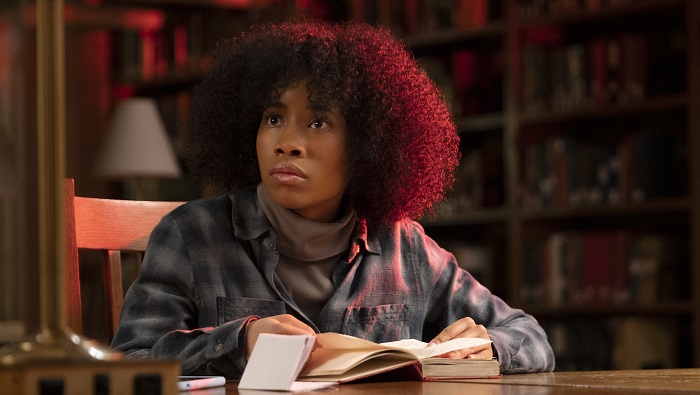
Then there’s Jasmine Moore (played by the delightful Zoe Renee), a wide-eyed freshman who arrives at Ancaster in a denim jacket, khaki pants, blue converse, and a big infectious smile. Smart and outgoing, Jasmine has big dreams and works hard to fit in. But she is often met with condescension by her white dorm-mates and even gets mean looks from the black cafeteria workers. In one of the stranger turns, Jasmine is inexplicably assigned the exact dorm room where the college’s first black undergraduate died back in the 1950s.
The third woman is Liv Beckman (Amber Gray), an English professor applying for tenure at the University. Though friends with Gail, Liv is the far more spirited of the two both in style and personality. It’s one reason the university is hesitant to grant her tenure. Another reason is a recently filed dispute accusing Liv of targeting Jasmine by giving her a bad grade. Liv’s story plays more prominently in the second half but sadly goes from mysterious to absurd.
Image Courtesy of Amazon Studios
As the movie weaves the three women and their stories together, the themes really come to the surface. Sometimes they’re effectively chilling and uncomfortable. Other times they can be needlessly heavy-handed. And then there’s the entire horror element that tosses in everything but the kitchen sink to try to make things creepy – a maggot infestation, a creepy Mennonite community, a maggot infestation, some silliness about a witch who picks out one freshman each year to possess (or something like that).
In the end, none of the horror stuff is the slightest bit unsettling and it feels tacked on in a vain attempt to fit genre expectations. The moments of true horror comes in the discomfort of watching these three women be swallowed up by an oppressive social structure. But it’s too often curtailed by the glaring on-the-nose dialogue and characterizations. For that reason “Master” never quite reaches the potential it teases, despite the best efforts of a fine cast. “Master” is now streaming on Amazon Prime.
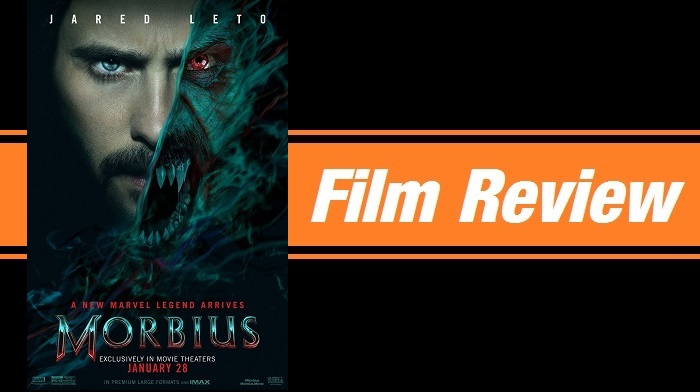
I still haven’t fully figured out how Sony’s Spider-Man Universe connects with the broader Marvel Cinematic Universe. Some parts seem more connected than others while other parts don’t seem connected at all. Oh well. To be honest, I’ve lost interest in trying to figure it all out. In a nutshell both universes are (somehow) related and “Morbius” and the most recent installment.
Unfortunately, it’s not a particularly good installment. It’s not terrible either. Certainly not as bad as Sony’s last effort (“Venom: Let There Be Carnage”). But it’s hardly a movie you’ll be rushing out to see again.
“Morbius” always seemed like an unusual and risky choice. And from the very start, it never felt like the studio was all that certain on how to approach the movie and on when to release it. Granted, COVID-19 played a big part in some of its delays. Still, there was a hesitancy from Sony that was hard to miss especially in their promotion of the film. And even the earliest trailers seem desperate, name-dropping Venom and revealing Michael Keaton’s Vulture just to grab the attention of the lucrative superhero genre’s fan base.
Image Courtesy of Sony Pictures
It feels like “Morbius” has been about to come out for years. One of the great blessings about its release is that I’ll no longer have to sit through its trailers which found their way in front of every single movie I would see at the theater (I could almost recite them word for word). And while my interest in the movie had waned, I still held out hope regardless of the lashing it took during early screenings (much of it from the Marvel Studios faithful).
“Morbius” is directed by Daniel Espinosa and despite the mixed reactions, I enjoyed his last three movies (“Safe House”, “Child 44”, and “Life”). This is a much different venture for Espinosa and it shows. At times his movie plays great and sports its own unique style which really comes out in some of the action scenes. But there are just as many moments that feel disjointed, rushed, or uninspired. The result is a mixed bag.
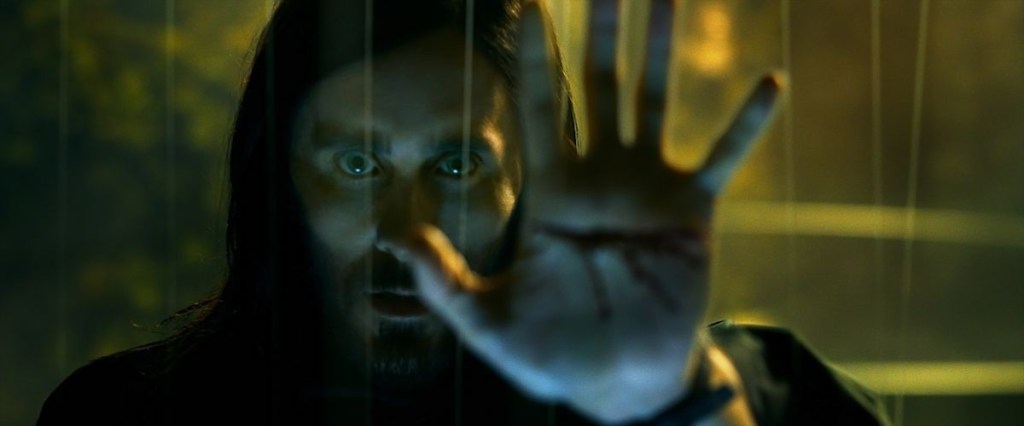
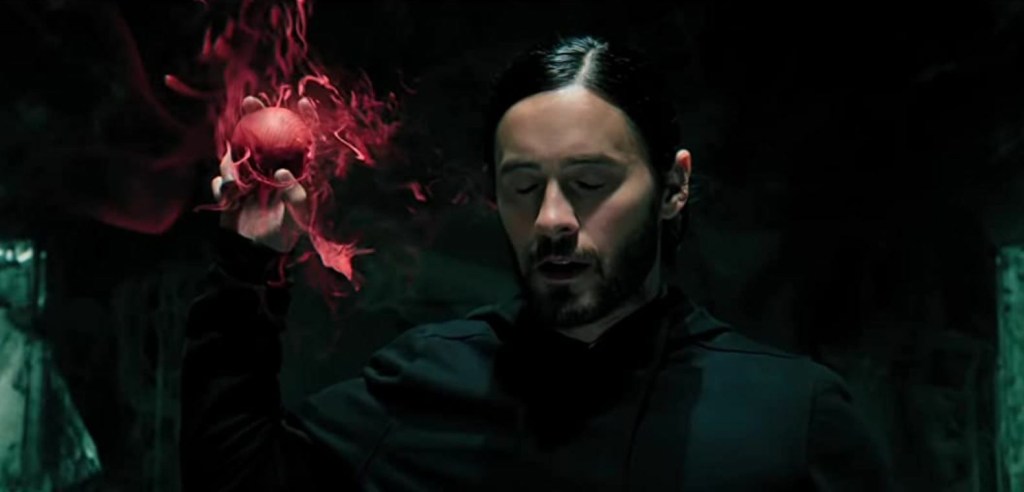
Jared Leto is a nice fit playing Dr. Michael Morbius who suffers from a rare debilitating blood disease he has had since birth. Gifted since childhood, Michael gained notoriety in the medical science world for developing a life-saving synthetic blood. Since then he has used his talents to try and find a cure for his disease. Helping him is his scientist partner and (potential) love interest Dr. Martine Bancroft (Adria Arjona). And funding his work is his wealthy friend and surrogate brother Milo (Matt Smith) who happens to share the same illness.
Strangely, Michael’s serum seemingly comes out of the blue. All we really know is that it involves vampire bats from Costa Rica and the mixing of bat DNA with human DNA. As Michael explains to Milo, it’s “highly experimental, morally questionable and very expensive”. When a sickly and desperate Michael injects himself with the serum, he does indeed cure his disease. But he also gains superhero strength, sonar-like sensitivity, and a rather disturbing appetite for human blood.
In one sense it’s tempting to praise the movie for cutting through the scientific mumbo-jumbo associated with Michael’s work. There are a couple of scenes where he’s recording medical logs explaining his symptoms. But for the most part Espinosa and screenwriters Matt Sazama and Burk Sharpless mercifully skip past that stuff. On the other hand, it’s such a weird and wild approach to medicine yet we get nothing to form the basis of his experiments. A guy turns himself into a living vampire and we’re just supposed to go with it.
Image Courtesy of Sony Pictures
Of course every superhero story needs a villain and here it comes in the form of Milo. Frightened by what he has become, Michael tries to protect Milo by refusing to give him the serum. But Milo gets his hand on a vial and injects himself. While Michael sees his vampire condition as a curse, Milo fully embraces it which pits the close friends against each other. Like most of the characters, Milo lacks some needed depth. Matt Smith’s performance is solid even though the script pulls him in some weird directions. Sadly, the bond between Milo and Michael (which should have added emotional weight to their conflict) barely gets beyond surface level, leaving Smith and Leto with little to explore.
Visually there are some cool stylish touches that I liked quite a bit. They’re unlike anything we’ve seen before in the crowded superhero movie space. But the drab and murky color palette doesn’t always help. And there are times where the CGI heavy action can be hard to decipher. Take the final 15 minutes which can be really hard to make out, right up to the film’s jarringly abrupt ending. Meanwhile Arjona offers a good supporting presence even if she isn’t given much to do. And there’s Tyrese Gibson in the thankless role of a generic FBI Agent trying to track Michael down after bodies drained of blood begin showing up across the Big Apple. Gibson is more of a plot device than an authentic character.
Of course there are also two obligatory post credits scenes that confused me more than excited me. Sure, they tease interesting things to come. But they also reminded me of how convoluted this Sony/MCU collaboration has been. “Morbius” does little to change that. Leto is certainly up for the role, and I can see where he could have done something special with a better script and more focused direction. As it is, “Morbius” is a ‘middle of the road’ Marvel movie. One that ultimately teases more than it’s able to deliver. “Morbius” opens in theaters tomorrow.
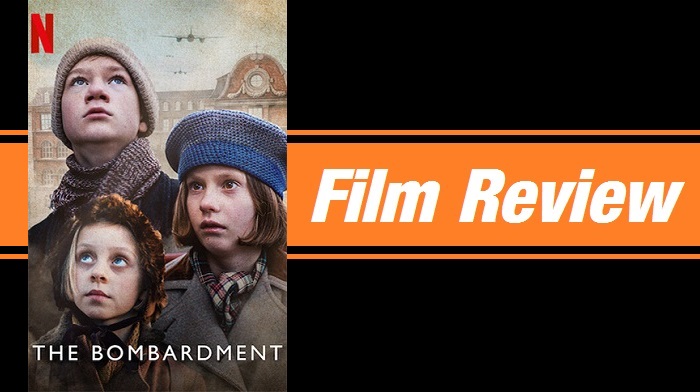
The new Netflix film “The Bombardment” isn’t for the faint of heart. Danish filmmaker Ole Borndahl’s World War II historical drama tells the heart-wrenching true story of Operation Carthage, the 1945 British air raid on Nazi-occupied Copenhagen that went horribly wrong. Borndahl is very well aware of the weight of the material he’s covering, and he doesn’t hold back in telling this crushing true story. It makes “The Bombardment” tough to watch, but it treats the actual account honestly and the many lives it impacted with reverence.
In 1945 the Nazis had occupied Denmark. With their numbers dwindling, the Danish Resistance repeatedly sent requests to Britain’s Royal Air Force to carry out an air raid on the Gestapo headquarters located in the heart of Copenhagen. The Brits initially turned down the request but later accepted. On March 21st British aircraft left RAF Fersfield to carry out their surprise attack. But during the raid the unthinkable happened. While the Gestapo HQ was hit, several bombers mistook the Institut Jeanne d’Arc school for girls as their target. By the end, 19 adults and 86 children were killed when the school was mistakenly hit.
Image Courtesy of Netflix
“The Bombardment” opens with a young boy named Henry (Bertram Bisgaard) witnessing a horrible tragedy. In a possible bit of foreshadowing, a taxi carrying three young women to a wedding party is shot to pieces by a fighter plane on a country road. Henry is the first to see the carnage and is left traumatized – unable to speak and constantly looking at the sky in sheer terror.
Henry is sent to spend the month with his aunt in Copenhagen with the thought that the less wide-opened sky may help him overcome his fear. He’s quickly taken under the wing of his compassionate and outgoing younger cousin Rigmor (Ester Birch Beck) and her best friend Eva (played by the effortlessly expressive Ella Josephine Lund Nilsson). The two precocious girls show him around town, treat him to the local children’s legends, and get him comfortable in their school.
Meanwhile Borndahl (who writes and directs) introduces us to a number of other characters, all of whom will have roles to play as his story unfolds. There’s the troubled Sister Teresa (Fanny Leander Bornedal) who helps at the local Catholic school. There’s a conflicted member of the Gestapo-sanctioned auxiliary police named Frederik (Alex Høgh Anderson). There’s a British pilot burdened by conscience. And a Danish resistance fighter who is our eyes inside the Gestapo HQ.
Image Courtesy of Netflix
Early on the movie may seem a bit scattered is it hops back-and-forth between these seemingly unconnected people. But their connection becomes crystal clear as the movie moves towards the violent and deadly tragedy marked by the film’s title. It becomes a case where you know where things are heading, and no matter how you brace yourself for the impact, the wrenching horror of the event as it unfolds on screen still shakes you to your core.
Thankfully Borndahl is smart about it. He doesn’t exploit or manipulate the story for a dramatic effect. He lets it speak for itself both through his script and his camera. It’s never gratuitous, yet it is honest. It makes for a story that’s as eye-opening as it is heartbreaking. And for those of us unfamiliar with the disaster that was Operation Carthage, the film follows the tracks of other insightful international features. Those that shed lights on lesser known or untold stories which give us a deeper and fuller picture of World War II. “The Bombardment” is now streaming on Netflix.








 Keith & the Movies