REVIEW: “Carter” (2022)

We critics often throw out the phrase “non-stop action” when describing a movie. It’s almost always an exaggeration because of course there are pauses here and there for storytelling and some degree of drama. But the new South Korean action-thriller “Carter” may be the closest thing you’ll find to actual non-stop action. Yes, we get brief interludes stuffed with exposition and information drops. But for the most part this thing is fists-swinging, guns-blazing, bones-cracking, and blood-splattering all the way through.

“Carter” is both ridiculous and extraordinary. It’s a fast-paced, ultra-violent action spectacle unlike anything I’ve ever scene. The goal was to frame the entire film as one single long take. There are numerous cleverly concealed cuts and they aren’t too hard to find. But ultimately the film sets out to give audiences an adrenaline-jacked experience where their eyes are never taken off the action. It’s undeniably impressive, and I’m still not sure how director Jung Byung-gil managed to pull some of his scenes off.

Image Courtesy of Netflix

But while it’s unquestionably bold, there is a downside to this style of relentless full-throttle filmmaking. It can be exhausting and even suffocating at times. And I say that as someone who truly loves big action. It’s a lot for one sitting, and there were times when I just wanted to catch my breath. It’s made even tougher by its hefty 132-minute runtime. By the time “Carter” reaches its big finale, I was a bit worn down and felt like I had already seen the best action it had to offer.

To no surprise, the story is the biggest casualty in such an action-focused movie. Joo Won plays a mystery man who wakes up in a blood-soaked hotel bed with no memory of who he is or how he got there. From there it’s a frantic race to regain his identity and figure out who he can trust. Throughout the small pockets of plot we learn about a fatal DMZ virus that after thirteen days turns people into feral zombie-like killers. We learn our protagonist has a daughter who’s infected and that his mission is to retrieve a young girl and take her to a lab North Korea where her father is using an antibody in her blood to create a vaccine. Without the vaccine, our hero can’t save his own little girl.

All of that sounds like at interesting enough premise. But the problem is most of it is simply conveyed through brief info dumps. We don’t get to watch it play out or have any real dramatic moments of consequence. We get these short bits of story and then it’s off to the next action scene. This lack of attention also leaves the plot murky. For example, there’s this whole friction between North Korea, South Korea, and the CIA that is introduced early but that gets harder to follow as the movie goes on. To be honest, I quite trying.

But let’s be realistic, the huge extravagant action sequences are the movie’s bread and butter. “Carter” is an action junkie’s fantasy, and I found myself rewinding and watching some of the scenes again out of sheer amazement. The constant motion of Jung Byung-gil’s camera can be disorienting at times. But the way he captures and combines the hand-to-hand combat, the John Wick styled gunfights, and the sprawling vehicle chases is truly incredible.

Image Courtesy of Netflix

And then there’s Joo Won whose physicality is mind-blowing. He may not be given a lot to do dramatically, but the steely intimidating hero more than delivers with the action. There is both a fluidity and an unbridled ferocity to his fighting which the movie utilizes to near perfection.

“Carter” is an audacious concoction that is sure to land differently for a lot of viewers. I can see some being exhilarated by the action and all-in on the movie’s grand ambition. I can see others checking out after being worn down by the unrelenting pace and incalculable body count. Me? I see both ways. I was let down by the storytelling and tired by the end. But I can’t deny the kinetic sensation brought on by action sequences and the sheer craftsmanship behind them. They are something to behold, and I would be up for more. But maybe in 90-minute form next time. “Carter” is now streaming on Netflix.

VERDICT – 3 STARS

First Glance: “Weird: The Al Yankovic Story”

Whether you’re a fan of long-time parody musician Weird Al Yankovic or not, the new film “Weird: The Al Yankovic Story” looks to be worth a gander especially after seeing the recent trailer. Co-written and produced by Weird Al himself, the film is the not-so-true story of his rise from young accordion enthusiast to parody pop star. The movie openly exaggerates Weird Al’s rise to stardom and happily makes up some details along the way. Even better, the movie is a straight-up parody of the popular music biopic which makes this even more attractive.

Daniel Radcliffe plays the titular character complete with the funky mustache and big crop of curls. In the new trailer we get clips of him hamming up and down Al Yankovic’s timeline. From Al’s homelife to his discovery by Dr. Demento (Rainn Wilson) to his relationship with Madonna (Evan Rachel Wood). The movie looks to cover (and fictionalize) a lot of ground. I’m not sure if it will all come together, but it looks to be a lot of fun nonetheless. I’m in.

“Weird: The Al Yankovic Story” releases November 4th on The Roku Channel. Check out the trailer below and let me know if you’ll be seeing it or taking a pass.

REVIEW: “Persuasion” (2022)

Yet another Jane Austen big screen adaptation arrives with “Persuasion”, a recent Netflix drama based on the 1817 Austen novel of the same name. The film is directed by Carrie Cracknell and stars Dakota Johnson who seems to be everywhere these days. Add to it a compelling supporting cast that features Henry Golding, Cosmo Jarvis, Nikki Amuka-Bird, and Richard Grant among others. Those are a lot of good pieces. It’s too bad they can’t bring life to this mostly tepid affair.

Johnson does her best playing Anne Elliot, the middle daughter in a family of vain and incredibly shallow aristocrats. For eight years Anne has remained heartbroken over losing her true love, Frederick Wentworth (Jarvis). Anne was crazy about him, but was persuaded to turn down his proposal by her disapproving family who saw him as “a sailor without rank or fortune”. So Anne spends her time quietly moping while secretly keeping up with Frederick’s Naval exploits.

Image Courtesy of Netflix

Anne is a baffling character. Co-screenwriters Alice Victoria Winslow and Ron Bass turn their protagonist into an impossible to read contradiction. In one sense she’s smarter and more grounded than anyone else we meet. She often clashes with her family’s unbridled vainglory, frequently breaking the fourth wall to point out their conceit or to give us a “can you believe that?” look. At times she seems incisive and self-assured – the kind of clear-eyed woman who sees through the societal nonsense of the era.

Yet all of that is undone by countless instances where she’s rendered weak and subservient. The sly and spirited Anne we see when she looks into the camera clashes with the one who doesn’t stand up for herself and lets her obnoxious family treat her like dirt. It’s even worse once Frederick inevitably comes back into the picture. It becomes one of those annoying movie situations where the central tension hinges on two people’s refusal to have one simple conversation. In this case, it’s Anne and Frederick’s unwillingness to express their feelings for each other.

So the film’s ice-cold romance basically waits in the wings as Anne and Frederick mope around in various states of unhappiness. Henry Golding is supposed to add some complexity to the relationship, but he’s essentially little more than eye-candy. He plays Anne’s dashing distant relative who has one eye on his inheritance and one eye on his cousin. He brings very little to the story.

The same can be said for pretty much all of the supporting cast. Easily the most annoying of the bunch is Anne’s spoiled drama-queen sister, Mary (Mia McKenna-Bruce). She’s a one-note irritation who wears out her welcome. As with most of the film, it’s not due to the performance. It’s just a case of McKenna-Bruce being handed a poorly written character who you quickly grow tired of seeing.

Image Courtesy of Netflix

The one character who’s actually fun is Anne’s haughty father, Sir Walter Eliot, a man infatuated with status and his “exquisite jawline”. Richard Grant’s deliciously over-the-top performance brings several good laughs. Unfortunately, after some early scenes he pretty much vanishes until the final act.

I’m not a seasoned Jane Austen reader so it’s hard for me to compare her novel with the film. But from what I’ve read, this isn’t the most faithful Austen adaptation. Either way, “Persuasion” isn’t a very good movie. It’s flat and lacks the spark that it needs to make us care. As it is, nothing about the supposed romance keeps our interest, and the characters just putter along as we wait for something interesting to happen. Sadly, it never really does. “Persuasion” is streaming now on Netflix.

VERSION – 2 STARS

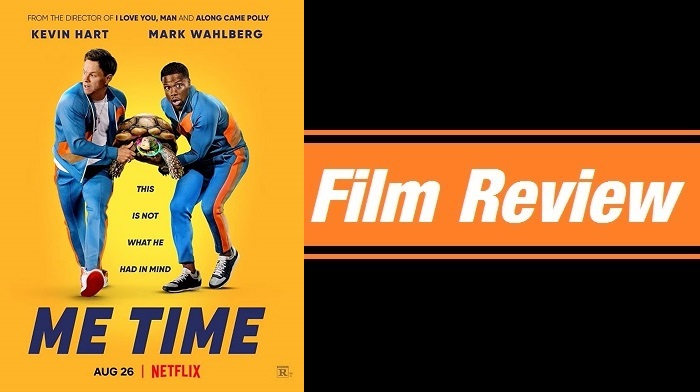
REVIEW: “Me Time” (2022)

(CHECK OUT MY FULL REVIEW in this week’s Arkansas Democrat-Gazette)

Written and directed by John Hamburg, “Me Time” is the latest film spawned from Kevin Hart’s megadeal with streaming giant Netflix. The try-hard comedy sees Hart teaming up with Mark Wahlberg and Regina Hall for what could have been a decent weekend diversion. Instead, “Me Time” loses itself in a haze of flat jokes, predictable story beats, and one particularly cringe-worthy music number.

The bummer of it is “Me Time” starts with promise. Minus a woefully bad (and mercifully short) prologue, the first 15 minutes or so is spent introducing a really good family dynamic. But once the buddy comedy stuff takes over, the movie takes a noticeable dip. Hamburg tries to compensate in the final act, but the ending is so schmaltzy and artificial that it only compounds the film’s numerous problems rather than alleviate them.

Image Courtesy of Netflix

Hart plays Sonny Fisher, a proficient stay-at-home dad who takes care of the house and the kids while his wife, Maya (the always good Hall) builds her career as an architect. Sonny is absorbed in his duties, especially when it comes to his aspiring comedian son Dash (Che Tafari) and his precocious daughter Ava (Amentii Sledge). He’s always present at their school, volunteering for various functions. He’s the president of the PTA, and he even has his own kindergarten blog.

While Sonny never has any time away from their kids, the hardworking Maya desperately needs some quality time with them. So they agree to let Maya take the kiddos to her parents house for spring break while Sonny enjoys some much-needed me-time. And what better way to spend some time away than with his childhood friend, Huck (Wahlberg), an annoyingly spontaneous manchild who always lives in the moment. And Huck has been dogging Sonny to come to his 44th birthday bash.

The movie sours once Sonny joins Huck and his faceless band of partiers for an elaborate five-day outdoor shindig in Death Valley. What we get is a conveyor of ludicrous scenarios, often laced with embarrassingly bad slapstick, a wide range of lazy toilet humor, and on the rarest occasion an instance of ever so slight amusement. There’s also a wedged-in angle with Maya’s flirty New Age boss Armando (Luis Gerardo Méndez) and an even lesser developed one involving a lone shark named Stan (Jimmy O. Yang).

Image Courtesy of Netflix

The performances range from good, to routine, to pretty bad. Hart starts well, but as the story devolves into mush, he falls right into his normal schtick. Wahlberg’s performance is pretty bad although it’s hard to put it all on him. He actually captures the character the filmmakers want him to be. Unfortunately for him, Huck is a shallow insufferable goof and there’s not much Wahlberg can do to make the character (or the material) appealing. Hall is the one who gives the movie glimmers of credibility. She’s such a good actress, and she does the best she can with what she’s given.

I admit, the prospect of “Me Time” being good wasn’t high. But a guy can hope, can’t he? To be honest I have a growing frustration towards movies like this – comedies that are so beholden to formula that nearly everything they do feels old hat. They’re all so canned and processed, but I guess they make money. Why else would we continue to get so many of them? “Me Time” is streaming now on Netflix.

VERDICT – 1.5 STARS

REVIEW: “The Invitation” (2022)

I happen to be a big fan of movie trailers. When done right there are a few better ways to get moviegoers excited about an upcoming film. Of course there are several ways a movie trailer can go wrong. One of the biggest (and sadly most prevalent) ways is by revealing too much. It’s something that can be incredibly frustrating and has driven many to simply skip trailers altogether. I mean who can blame them when the studios are spoiling key chunks of their movie in what amounts to a two-minute advertisement?

I felt that frustration after seeing the trailer for “The Invitation”. Not only did it more or less give away the entire story, but it revealed what looked to be the movie’s big twist. I was hoping that wouldn’t be the case when I sat down to watch this gothic supernatural horror film. But it kinda is. From start to finish the story plays out just as we see in the trailer with practically no shocks or surprises. Yet “The Invitation” is a surprisingly easy watch in large part thanks to a nice lead performance from Nathalie Emmanuel.

Evie Jackson (Emmanuel) works for a New York City caterer where she serves hors d’oeuvres to their snooty upscale clientele. Evie is bright and talented but has been stuck at her go-nowhere job, unable to get a leg up in her career. Personally things have been even worse. Her father died several years back and she’s still mourning the recent loss of her mother to cancer. With no siblings, aunts, uncles, or cousins, Evie can’t help but feel all alone.

But that changes after she’s tries a mail-in ancestry kit called ‘Find Yourself’. It’s one of those deals where you send in a DNA sample, the company traces your family history, and contacts you with the results. Evie is surprised to learn that she has a second-cousin in London named Oliver Alexander (Hugh Skinner) and it just so happens that he’s going to be in New York City in the upcoming days. So the two connect and arrange a meet-up for coffee. The enthusiastic Oliver tells her all about her wealthy family in England and invites her to another cousin’s upcoming wedding where she can meet her newfound kin.

With practically no hesitation (gulp), Evie accepts the all-expenses-paid offer and jets off to England. Oliver picks her up at the airport and whisks her away to New Carfax, a posh abbey remotely nestled in the British countryside. The manor itself is custom-made for a horror movie. It has an extravagant yet alluring storybook exterior. But inside is cold Gothic architecture with dimly lit hallways, drafty bedrooms, and jagged bars on the windows to keep out those pesky carnivorous birds (or so Evie is told). Think of it as a beige-colored Highclere Castle on the outside and a home fitting of Barnabas Collins inside.

Image Courtesy of Sony Pictures

Despite the numerous red flags that would send most people rushing back to the States, Evie sticks around, eventually falling for the charms of Walter Deville (Thomas Doherty), the suave and dapper lord of the manor. A romance blooms and everything seems to be falling into place for our protagonist. But we know better (even if our clueless heroine doesn’t). Even if you haven’t watch the trailer, it’s glaringly obvious that something is not quite right at New Carfax. It takes a while to get there, but once the reveal comes things get batty and we’re treated to bloody finish that ranges from fairly entertaining to utterly ridiculous.

Directed by Jessica M. Thompson and written by Blair Butler, “The Invitation” does a good job creating an atmosphere fitting for what’s to come. It also builds its own compelling mythology that centers around four filthy-rich families and a centuries-old pact. And though frustratingly oblivious to the clear signs in front of her, Emmanuel manages to make Evie a character we actually root for, especially when put up against the smug aristocracy.

But there are too many areas where the movie flounders. Many of them are in the handling of its themes. There are constant on-the-nose references to how “white” Evie’s new family looks and acts – a dull-edged attempt at racial commentary that never quite goes anywhere. Slightly more effective yet still lacking the needed bite are the film’s messages on class and patriarchy. They’re more natural to the story, but even they fail to resonate in the way the movie wants them to.

I can see where some may take issue with the movie’s slow pace. Others will be disappointed in its lack of scares. I wouldn’t be surprised to hear audiences vocally chiding the protagonist as she repeatedly breaks some of the basic cardinal rules of horror movies. It’s such a shame because there are some good ingredients here. But every time when I would get onboard with what the movie was doing, it would go off and do something that would leave me shaking my head. Take the final 15 minutes of so. It was just bonkers enough to get me smiling but then ends with a hokey final scene that left my face firmly planted in my palm. Like I said, such a shame. “The Invitation” is now playing in theaters.

VERDICT – 2.5 STARS

REVIEW: “Three Thousand Years of Longing” (2022)

If you’ve had the chance to see the trailer for the new film “Three Thousand Years of Longing” you’ll probably go into it expecting a trippy, gonzo bonanza of big effects and crazy imagery that could only come “from the mad genius of George Miller”. After all, he’s the visual virtuoso whose last movie was none other than the 2015 action masterpiece “Mad Max: Fury Road”. So George Miller comes packaged with some expectation of eye-popping bombast.

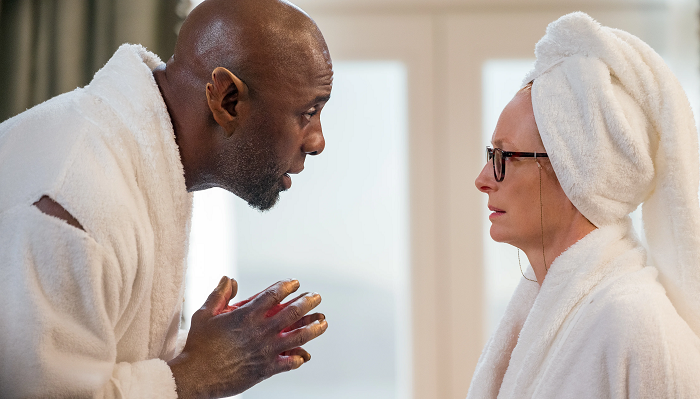
Surprisingly, “Three Thousand Years of Longing” is tamer than you might think. I mean there’s still plenty of stylistic flourishes and excesses. But not as much as the trailer might have you believing. Even more surprising, with the exception of a scene or two, it’s when the movie ventures off into the fantastical that some of its weaknesses really show. I mean who would’ve guessed that the best parts of a George Miller movie would be Tilda Swinton and Idris Elba in white terrycloth bathrobes sitting in a hotel room talking?

Image Courtesy of Roadshow Entertainment

“Three Thousand” is full of big ideas that never quite gel and ambition that it never quite fulfills. Based on the short story “The Djinn in the Nightingale’s Eye” by A. S. Byatt, the script (penned by Miller and Augusta Gore) gets off on the right foot. We get a really nice setup, and once Elba is introduced, he and Swinton immediately grab our interest. The movie is at its best when sticking to its intimate two-hander framework. But then we get these sequences from the past, each coated in Elba’s aching but rather drab narration. While interesting at first, these detours quickly start to wear thin.

Swinton is very good as Dr. Alithea Binnie, a narratologist who we meet as she’s arriving in Istanbul for a literary conference. Alithea was once happily married. But a heartbreaking miscarriage followed by an unfaithful husband led to the end of her marriage. Since then, she has walled off a part of herself, traveling abroad and focusing on her work. “I’m a solitary creature by nature,” she says proudly describing her new approach to life which sees her happy and content on her own. Or is she?

While walking through Istanbul’s grand bizarre, Alithea stops in a small shop and purchases a memento – a small blue and white stained glass bottle. She takes her knickknack back to her hotel room to give it a good cleaning. While doing so, the bottle pops open and out filters a pointy-eared djinn (Elba) the size of a cement truck. Now that would be quite a jolt for anyone, even more so for someone like Alithea who doesn’t believe in fate and spends many of her lectures teaching that gods have outlived their purposes. So what to make of the djinn in her hotel suite?

After the djinn sizes down to more human proportions the two begin their rather fascinating introductions. He explains to her that he has the ability to grant her heart’s desire. All she has to do is wish it. Alithea is both cynical and dispassionate to the point that she’s not interested in the djinn’s offer. It sets up an interesting dynamic between the two. The djinn needs Alithea to make a wish because it would finally free him from his centuries of servitude. She has no interest in wishes, but she is an admirer of stories. And that’s something the djinn has plenty of.

So the djinn begins telling Alithea the stories of his previous masters. As he does, Miller makes several pseudo historical trips back in time, including to the days of King Solomon (Nicolas Mouawad) and the Queen of Sheba (Aamito Lagum) as well as the Ottoman Empire during the reign of Suleiman the Magnificent (Lachy Hulme). Considering this is a Miller film, you’d think these peculiar mixes of history and fantasy would be the movie’s high points. It’s quite the opposite.

Image Courtesy of Roadshow Entertainment

When Miller leaves the hotel room for centuries past, the movie hits a wall and bogs down. And frankly, it’s because the djinn’s stories simply aren’t that interesting. There’s not enough weirdness. There’s not enough excitement. There’s practically no suspense whatsoever. The drama is very low-key. And some of Miller’s choices range from bland to lurid and tasteless. There are a few layers of excess that are more off-putting than audacious. Even the visuals are lacking, often highlighted by cheap-looking digital backdrops or glaringly artificial sets.

The movie always gets better whenever it shifts back to Alithea and the djinn in the hotel room. Their conversations are emotionally rich and revealing. Both characters are portraits of longing. His is more open and pronounced. Hers has been suppressed. Both the dialogue in these scenes and the chemistry between Swinton and Elba make them sparkle. Sadly, they can’t make up for the unremarkable flashbacks and the assortment of issues that come with them. And so we end up with a movie exploring why we tell stories that is ultimately undone by a character telling stories? Ironic.

VERDICT – 2.5 STARS