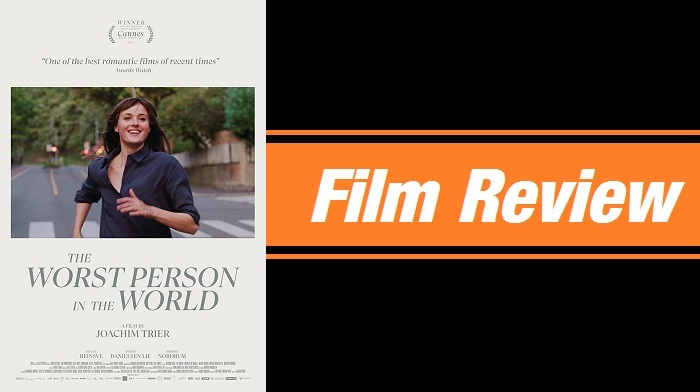
REVIEW: “The Worst Person in the World” (2021)

(CLICK HERE for my full review in the Arkansas Democrat-Gazette)

“The Worst Person in the World” has earned a lot of praise for Norwegian director Joachim Trier. This slyly romantic drama, laced with some wily dark comedy, is considered the third film in Trier’s unintentional “Oslo Trilogy” (following 2006’s “Reprise” and 2011’s “Oslo, August 31st”). The film has earned accolades galore during its festival run including a Best Actress win at Cannes for its electric star Renate Reinsve. And now it sits with Oscar nominations for Best International Feature and Best Original Screenplay.

Trier and his frequent screenwriting partner Eskil Vogt use a novelistic structure consisting of twelve short chapters, book-ended by a prologue and an epilogue. The centerpiece of their story is a free-spirited young woman named Julie (Reinsve) who Trier follows from chapter to chapter with an almost obsessive fascination. He chronicles Julie’s transition from her twenties to her thirties with an episodic rhythm meant to mirror the fickle ebb and flow of her life.

Our first shot of Julie sees her in a sleek black dress, standing on a balcony gazing over Oslo’s Akerselva River. She finishes off a cigarette and checks her phone as the piano chords from the dinner party she’s attending fades away. We’re left with a painterly image of a young woman lost in her thoughts. It may seem like a rather frivolous moment, but there’s a lot baked into it. It’s a portrait of a burdened woman begging the question “What’s next?” but terrified at the thought of one day asking “What if?”.

Image Courtesy of NEON

That lingering conflict is woven throughout the film’s 128-minute running time as Julie constantly wrestles with what she really wants in life. Along the way she experiences periods of potential happiness. But she’s quick to run away – partially out of fear, partially out of her commitment to some vision of fulfillment that the movie never really clarifies. Perhaps it’s due to Julie’s own ambivalence. Or maybe its a lack of interest from the filmmakers. Sometimes its hard to tell.

Julie’s early years are little more than a sketch. A seemingly all-knowing narrator hurries us through her time as a medical student where, despite being near the top of her class, she drops out and begins studying psychology. But that’s short lived as she abandons it for photography. New hair colors and boyfriends come and go as frequently as her career choices. And she ends up working in an Oslo bookstore just to make ends meet.

But the film slows down a bit when Julie meets Aksel (Anders Danielsen Lie), a 44-year-old underground cartoonist (I didn’t know that was a thing) who immediately takes a liking to her. Trier skips the formalities and soon Julie is moving into Aksel’s apartment. There’s a genuine chemistry between the two even if their individual pieces don’t quite click into place. But the 15-year age difference looms overhead like a dark cloud and is seen most in their conversations over children. Aksel wants kids. So does Julie…eventually…maybe…just not now.
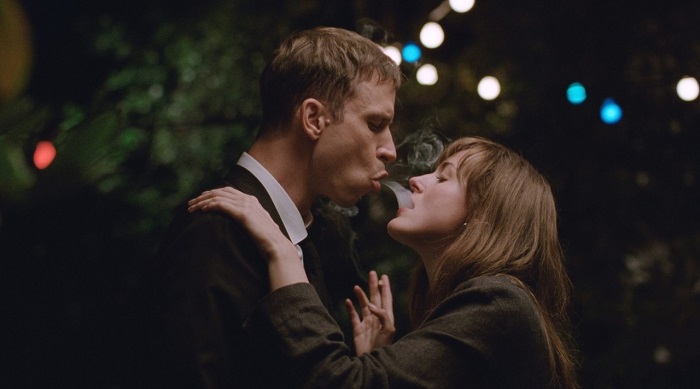
Image Courtesy of NEON

As inevitable cracks start to form in their relationship, Julie is reacquainted with those nagging feelings of restlessness and doubt. Soon her mind and heart are once again wandering which leads to her locking eyes with a similarly adrift barista named Eivind (Herbert Nordrum). What follows is a night-long meet-cute where the two dance around the bounds of “cheating” on their significant others without ever committing the act (or so they convince themselves). Needless to say, for Julie this adds more complexity, more uncertainty, and more messiness.

As Trier maneuvers us through several years in the life of Julie, the experience can be both exhilarating and occasionally frustrating. There are moments when the organic and rich conversations bring to mind Ingmar Bergman’s masterful “Scenes from a Marriage”. Other times it plays like a shrewd deconstruction of “Annie Hall”. Yet the strict chapter-to-chapter structure leaves so much off screen. And many facets of Julie’s character feel underdeveloped making it even more of a challenge to fully understand her.

Thankfully there’s the beguiling Renate Reinsve who shines as the movie’s heart and soul, making it easier to look past the shortcomings. Even if the movie never fully fleshes Julie out, Reinsve lures us in with her energy, charm, and sincerity. And despite how we feel about Julie’s choices, Reinsve earns our empathy and keeps us invested in her character who, blemishes and all, is a far cry from the person the film’s irony-rich title suggests. “The Worst Person in the World” in now showing in select theaters.

VERDICT 3.5 STARS

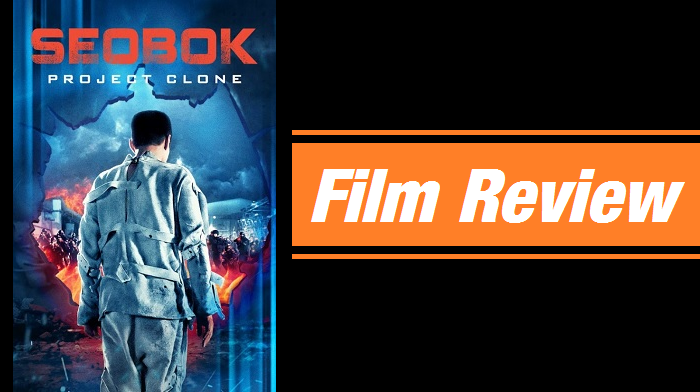
REVIEW: “Seobok: Project Clone” (2022)

Based on its American title alone, “Seobok: Project Clone” sounds like some low-budget, straight-to-video, B-movie with Bruce Willis as its lead. In reality, South Korean director and screenwriter Lee Yong-ju offers up something considerably different – a movie that will have you anticipating one thing while delivering a dramatically different experience.

“Seobok: Project Clone” frames itself as a science-fiction action flick and there is certainly some of both in Yong-ju’s movie. But it doesn’t take long to notice that there is more going on underneath its showy surface. We quickly see that the film’s real interests are cerebral and philosophical rather than meeting any specific genre expectations. Yong-ju wants his his audience to think about and wrestle with the themes he presents. In this case, it’s mortality and the many layers of thoughts surrounding it.

Image Courtesy of Well Go USA Entertainment

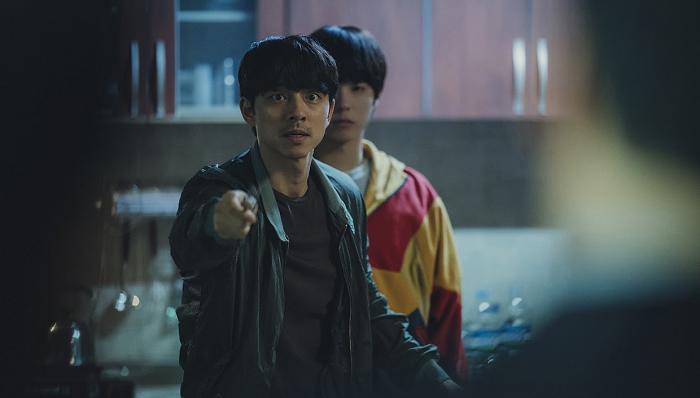
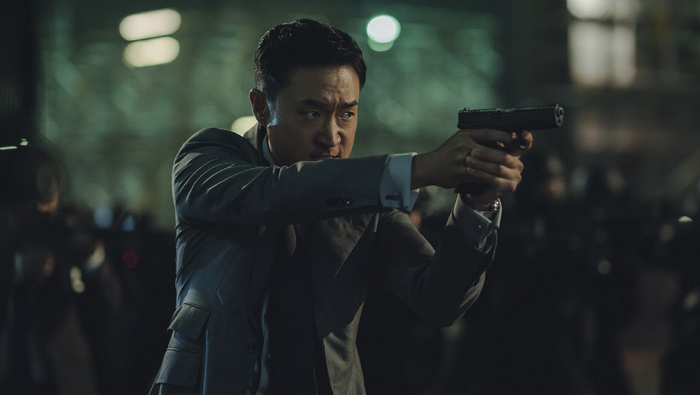
Gong Yoo (“Train to Busan”, “Squid Game”) plays Ki-hun, a former intelligence officer who is commissioned by a shadow organization called “The Company”. They need him to escort a valuable asset to a safe house following the assassination of one of the group’s top scientists. Ki-hun is leery at first but agrees after being told by the cryptic Director Ahn (Jo Woo-jin) that the asset can save his life. We learn Ki-hun has been struggling with severe headaches and fainting spells, the results of a brain tumor that has left him with six months or so to live.

Ki-hun goes to a research laboratory hidden in the belly of a giant docked freighter where he is to retrieve the asset. Inside he learns that the asset is actually a clone named Seobok (Park Bo Gum). “He’s more of a new species that a direct human clone,” informs the new head scientist who goes on to explain the science and value of their creation. Turns out Seobok is believed to hold “the secret to conquering death.” Due to genetic manipulation, Seobok’s body produces special proteins that can cure any and all human diseases including Ki-hun’s cancer.

There is one rather notable side effect. Seobok is able control matter with his mind. It’s no small thing, and as you can probably guess, it’s something that definitely comes back into play as the movie moves forward.

With Seobok’s creator assassinated, it’s clear that some rather nefarious people want their hands on this genetic “technology“. And as the only successful source of their work, the Company needs Seobok protected at all costs. So Ki-hun and Seobok set out on a most unconventional road trip to a secret safe house where clinical trials can begin. Easier said than done. Soon the terrorists are hot on their heels and it quickly becomes evident that not everyone can be trusted.

Image Courtesy of Well Go USA Entertainment

While the movie features a couple of inevitable action scenes, the real surprise is found in the almost meditative nature of second-half. As he spends more time with Seobok, Ki-hun slowly moves from antagonistic to compassionate. And as he begins to see Seobok as more than a piece of technology, it opens up considerations that Ki-hun (and frankly the audience) never see coming. A rich and textured relationship forms which Lee Yong-ju uses to ask a series of thought-provoking questions.

As “Seobok: Project Clone” navigates through the moral dilemmas and murky ethics of its story, you can’t help but be impressed by how much it has on its mind. And it’s always nice to see a filmmaker using genre for more than just thrills and chills. In this case, Lee Yong-ju tries to cover a tad too much philosophical ground. This not only bogs his film down in spots, but it also leaves it feeling unfocused. Still the film still manages to deliver something fresh and surprising. And who doesn’t love being surprised. “Seobok: Project Clone” is now available on VOD.

VERDICT – 3.5 STARS

REVIEW: “The Batman” (2022)

While the lucrative Marvel Cinematic Universe gets most of the attention when it comes to the popular superhero genre, it’s hard to find a more anticipated movie than “The Batman”. The Caped Crusader certainly isn’t new to the big screen. First there was the Burton/Schumacher films that began in 1989. Then there was Christopher Nolan’s brilliant bar-setting trilogy starting in 2005. And most recently we had Zack Snyder’s Batman in his “Justice League” series of movies.

Now director Matt Reeves brings a new flavor to the character with “The Batman”, a film originally set for release in June 2021 but pushed back twice during the COVID-19 pandemic. Some may roll their eyes at yet another Batman big screen iteration. But I’ve always found the character, his world, and his rouge gallery to be among the most rich and interesting of its genre. And I love how the Bat-related movies are often willing to step outside the confines of the superhero genre. Such is the case here.

Without question, “The Batman” (co-written by Reeves and Peter Craig) is much more of a detective story than a superhero movie. And rather than following the stock comic book blueprints of movies like “Spider-Man” and “Eternals”, “The Batman” falls more in line with edgy crime thrillers like Fincher’s “Se7en” and “Zodiac”. In some ways it’s a love letter to classic noir. Other times it plays like a hard-boiled procedural with as many bold cerebral choices as eye-popping visual ones.

Image Courtesy of Warner Brothers

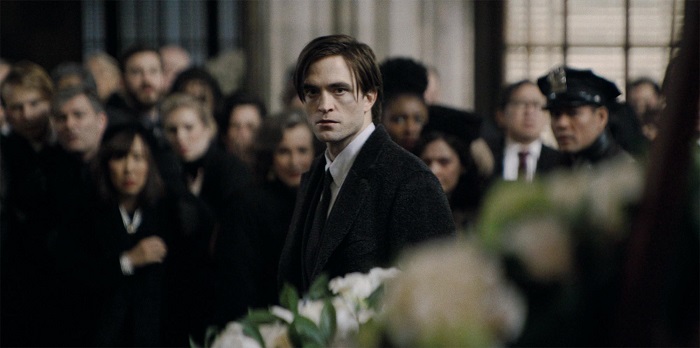
Robert Pattinson is the latest actor to don the cape and the cowl in what is the first solo non-animated Batman movie since Nolan’s 2012 “The Dark Knight Rises”. Pattinson was an interesting choice, and he slides right into the dueling roles of brooding billionaire Bruce Wayne and the vigilante Dark Knight. What’s fascinating is how Reeves braids the two personas together in ways we haven’t seen before. And while the Batman film’s are notorious for being dark, here the grim and grimy dystopian tone surrounds you in what feels like a three-hour visceral nightmare.

As with most Batman stories, Gotham plays an essential role. Mixing old gothic architecture with a dull glow of LED and neon, the dour rain-soaked design is a perfect reflection of the city’s deterioration. This is a diseased Gotham with striking similarities to our modern day society – the bitter division, the rise in crime, the corrupt leadership willing to let the city burn if it means holding onto power. It’s as if Reeves is holding up a mirror and asking, “Do you see this America? This is where you’re heading. Is this what you want?”

Reeves wisely bypasses the whole Batman origin story which most people (die-hards and casual fans alike) know by heart. Instead he cuts right to the chase. In his film there’s already a bat-suit, a batmobile, a bat-signal, and the bat-cave. And Batman and Gotham PD detective Jim Gordon (a terrific Jeffrey Wright) are already two years into their off-the-record crime-busting partnership. Of course there are references to Thomas and Martha Wayne and how their death has shaped Bruce and given birth to the Batman. It’s an essential piece to any Batman story. But Reeves is crafty in how he uses it and adds some fresh and interesting twists of his own.

Image Courtesy of Warner Brothers

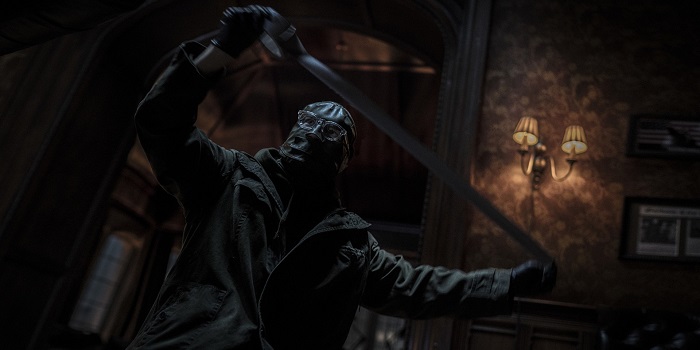
Fitting for a movie this bleak, the story begins with the brutal murder of Gotham City’s mayor at the hands of a masked serial killer who goes by Riddler (Paul Dano). Aside from his affection for handmade greeting cards and duct tape, Riddler has a special interest in the Batman. With each new high profile victim, the killer leaves a new riddle specifically for him. This twisted game of cat-and-mouse eats up much of the film’s first half as Gordon works with Batman (much to the chagrin of many of his fellow officers) to piece together the clues before Riddler kills again. Not only is this where the film really ratchets down on the detective angle, but it’s also where Batman and Gordon’s relationship takes form.

But there are several other players with key roles to play. There’s Zoë Kravitz’s seductive and mysterious Selina Kyle, a fresh spin on the Catwoman character with personal stakes in the game. She works at a nightclub ran by Carmine Falcone (John Turturro), a powerful mob boss and drug trafficker who has most of the city’s leaders on his payroll. Falcone’s right-hand man is Oswald Cobblepot, aka Penguin. He’s played by an unrecognizable Colin Farrell in heavy makeup and prosthetics. It’s an astonishing transformation and Farrell is an absolute scene-stealer.

Also in the mix is Andy Serkis playing Bruce Wayne’s butler and mentor Alfred. It’s a small role, but Serkis is a nice fit. The always good Peter Sarsgaard pops up as a crooked district attorney while Jayme Lawson plays a young idealistic mayoral candidate thrust into the center of Gotham’s growing chaos.

Image Courtesy of Warner Brothers

And of course there’s Dano who gives an effectively creepy take on Riddler. There are no green spandex with question marks or shrill persistent cackling. Dano’s Riddler is a meticulous and calculated killer; a sociopath with brains and a very clear agenda in mind. His murders are detailed and with purpose, and his cold calloused pathology makes him a terrifying threat. I was concerned about Dano’s boyish appearance, but it works to make Riddler even more unsettling. And much like Nolan’s treatment of the Joker, Reeves doesn’t overuse his chief villain. He’s in there just the right amount of time.

The more you watch “The Batman” the more you recognize and appreciate the differences in Reeves’ vision. For example, there isn’t a glimpse of ‘billionaire playboy’ Bruce Wayne. There’s a fleeting reference to that expectation, but in this Gotham it’s hard to visualize big lavish galas and hobnobbing with the elite. Much like Bruce, the people of Gotham seem beaten down by a city that’s eating itself alive. Also, while this is a superhero movie per se, Reeves’ Batman is far more grounded in reality. Much of it is inherent to the story, but just as much of its identity comes through Greig Fraser’s moody cinematography and Michael Giacchino’s epic score – both Oscar-worthy.

“The Batman” gives you a lot to process, but when fully considered this is a truly great addition to the character’s big screen legacy. What I like best is that Matt Reeves has delivered something strikingly unique – not only as a Batman movie, but within the superhero genre as a whole. And while I wasn’t initially sold on its length, the movie earns its three hour running time. Sure, you could pick apart some of Reeves’ choices and find things to trim down. But doing so would cut out what makes his movie unique. And with so much potential on the horizon, I want Reeves to use his creative freedom to the fullest. “The Batman” is out now in theaters.

VERDICT – 5 STARS

First Glance: “Umma”

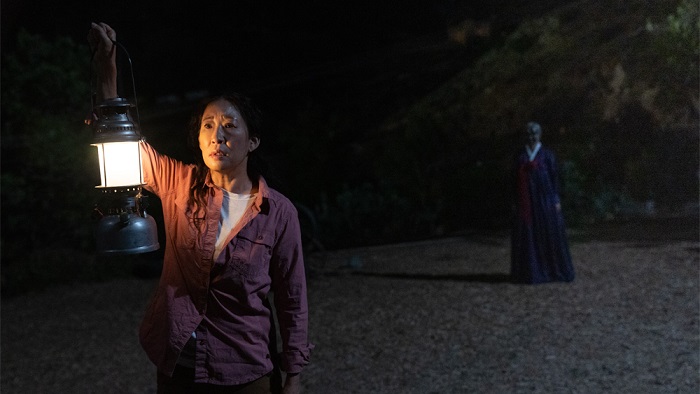
“Umma” is creepy supernatural chiller written and directed by Iris K. Shim. The name that’ll catch many people’s eye is Sam Raimi who produces. Yesterday distributor Sony Pictures dropped the first trailer, and I can honestly say it wasn’t what I expected. Now “Umma” is high on my ‘to watch’ list thanks in large part to it’s eerie vibe and the intriguing casting of Sandra Oh as its lead.

Oh plays a hermit named Amanda. She’s a Korean immigrant who has made a home for herself and her daughter on a remote rural farm. There she raises bees and holds to a strict policy of no modern technology – no televisions, no radios, not even automobiles are allowed. But her secluded life is interrupted when a mysterious man arrives unannounced carrying the ashes of her recently deceased mother. It opens the door to something wicked and utterly terrifying. The trailer rightly keeps a lot under wraps, and I’m anxious to see where this thing goes.

“Umma” lands in theaters March 18th. Check out the trailer below and let me know if you’ll be seeing it or taking a pass.

First Glance: “Bullet Train”

I’ve been waiting for this one. “Bullet Train” is a star-studded action-comedy directed by David Leitch, the man behind movies like “John Wick”, “Hobbs and Shaw”, and “Deadpool 2” (ugh). Here he teams with a stacked cast of noteworthy names that includes Brad Pitt, Sandra Bullock, Brian Tyree Henry, Joey King, Michael Shannon, Andrew Koji, Aaron Taylor-Johnson, Hiroyuki Sanada, Zazie Beetz, Logan Lerman, Bad Bunny, Masi Oka, and more.

This is the kind of crazy action movie where characters sport goofy names like Ladybug, Prince, Tangerine, Kimura, and Lemon. Set aboard a non-stop train speeding through the Japanese countryside, the story follows five assassins who each find themselves after the same silver briefcase. It looks like we’re in for loads of crazy action and lots of humor. Punch my ticket!

“Bullet Train” hits theaters July 15th. Check out the trailer below and let me know if you’ll be seeing it or taking a pass.

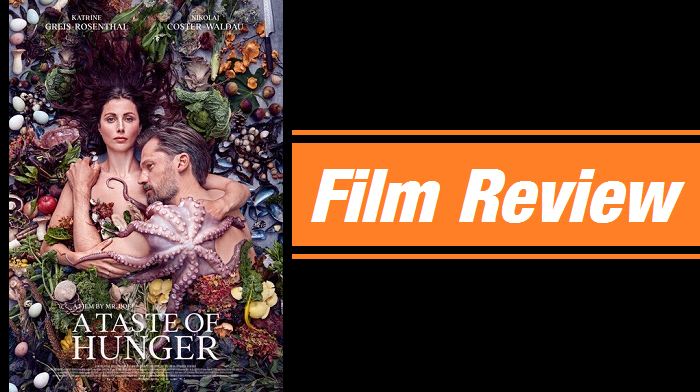
REVIEW: “A Taste of Hunger” (2022)

The new Danish film “A Taste of Hunger” opens with a quote from the late novelist Kathy Acker, “If you ask me what I want, I’ll tell you. I want everything.” It’s a fitting intro to this stirring relationship drama masquerading as a foodie flick. Don’t misunderstand, we get several visual helpings of exquisitely shot cuisine. But the cooking is mostly dressing. The main dish is the souring dynamic between a husband and wife whose lofty goals begin to tear an otherwise loving couple apart.

The film is directed by Christoffer Boe who co-writes the script alongside Tobias Lindholm. If that name sounds familiar, it’s because Lindholm also penned the exceptional dramas “Another Round” and “The Hunt” alongside Thomas Vinterberg. Here the Danish duo use the setting of Denmark’s cooking scene to explore the consequences of unbridled ambition.

Image Courtesy of Magnolia Pictures

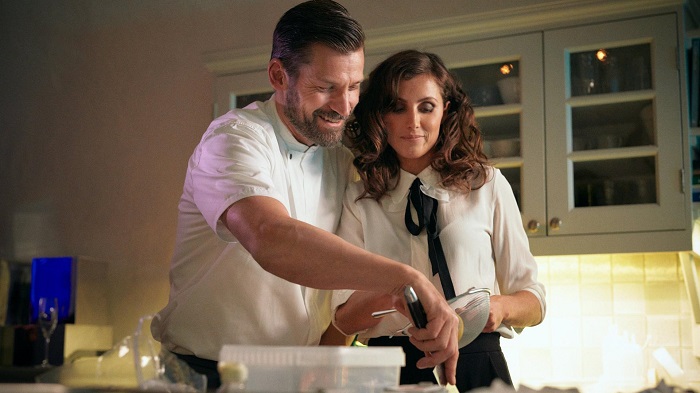
Carsten (Nikolaj Costner-Waldau) and Maggie (an absolutely phenomenal Katrine Greis-Rosenthal) are a culinary power couple who own Malus, a trendy high-end restaurant in the heart of Copenhagen. Carsten is a master-chef with a ferocious drive. He trained in Japan before opening his own eatery back home. Maggie is a sharp-witted anthropologist with a sharp eye for what people like.

Yet despite their successful privileged lives; despite having two beautiful children; despite owning one of their city’s premiere restaurants, there’s one thing that has kept them from being truly satisfied and content – the coveted Michelin star and the prestige and recognition that accompanies it. They crave it, particularly Carsten who has let it drive him to the point of obsession.

Chopped into chapters and moving back-and-forth through time, “A Taste of Hunger” reveals what brought Carsten and Maggie together as well as what tore them apart. In the current day, we see the couple desperate to repair the damage done by a bad oyster starter. They think it may have been served to a visiting undercover Michelin rep rumored to have visited their restaurant that evening. If they can track down the representative, perhaps they can convince him/her to give them another shot.

But it’s the flashbacks that give us the bigger picture and ultimately fill out this complicated relationship. Through them Boe shows us how the Carsten and Maggie met, the near instant attraction, and the intense passion marking the beginning stages of their marriage. In these early scenes, Boe and his cinematographer Manuel Alberto Claro shoot the couple with the same sensuous gaze as they do the cuisine. But it’s the performances that really bring these characters to life. Costner-Waldau and Greis-Rosenthal have a fierce chemistry that comes through with every scene they share.

Image Courtesy of Magnolia Pictures

While Carsten and Maggie seem to have a magnetic connection, the later flashbacks show what happens once their dogged pursuit of culinary fame takes precedent over their homelife. Soon both their marriage and their children are suffering, which sends the story down some ugly paths. Some of these scenes teeter close to the melodramatic, but Boe keeps everything grounded and honest. And (once again) the performances are crucial, especially Greis-Rosenthal who’s asked to navigate a thornier range of emotions. She’s sublime.

“A Taste of Hunger” takes an unflinching look at a crumbling marriage and it does so without casting judgement or taking sides. In fact, each time our sympathies shift from one spouse to the next, something happens to yank us back to the center. The real heartache comes with the children. Boe and Lindholm do a great job relaying the impact of the parents’ neglect, mostly through the eyes of their young daughter Chloe (an astonishingly good Flora Augusta). It adds kick that’s as painful as it is palpable. “A Taste of Hunger” is now streaming on VOD.

VERDICT – 4 STARS